Presentation
Hollow Knight welcomes the player with very little explanation.
Dirtmouth contains only a handful of buildings and inhabitants. A well leads into the depths. Hallownest begins below.
That restraint is essential. The game does not introduce its kingdom through a long opening sequence: it allows the player to learn its geography by moving through it. The first corridors of the Forgotten Crossroads lead toward other passages, then into regions whose architecture, colors, creatures and music each possess their own identity.
Hallownest functions as one vast interconnected whole.
An inaccessible door, a platform that is too high or a gap that cannot yet be crossed may be encountered several hours before the ability needed to pass it is obtained. Returning to an earlier region is therefore not simply backtracking: a new power can completely change the way it is traversed.
The Knight gradually acquires movement abilities that open new possibilities. Some allow greater height to be reached, others make it possible to quickly cross a distance or enter areas that were previously impossible to explore.
This progression gives the world a particular shape. Rather than distributing regions in a perfectly linear order, Hollow Knight gradually opens several directions and accepts that two players may not necessarily discover Hallownest along the same route.
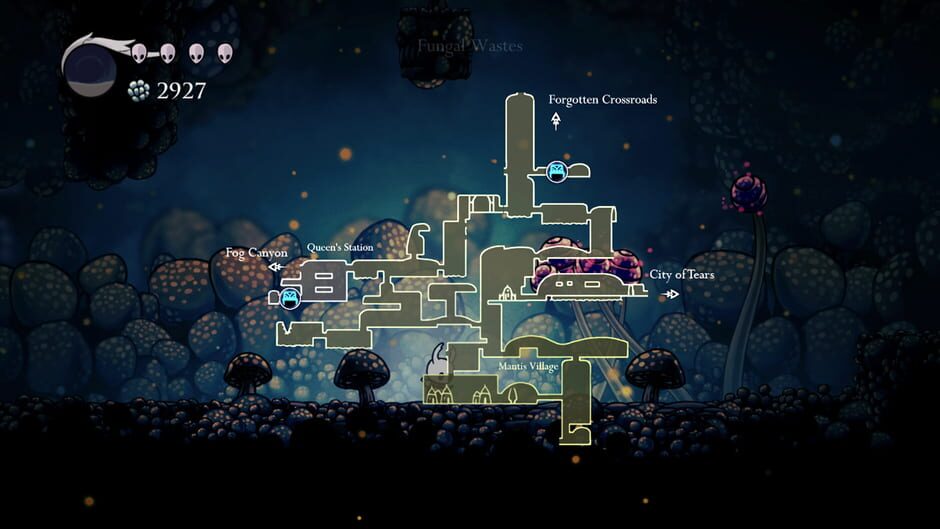
The map supports this exploration without making it completely automatic.
When Cornifer is found in a new area, the player can purchase an initial map of the region. It remains incomplete, however, and must be expanded as the journey continues. This means the player sometimes has to move forward without knowing exactly how the corridors ahead are arranged.
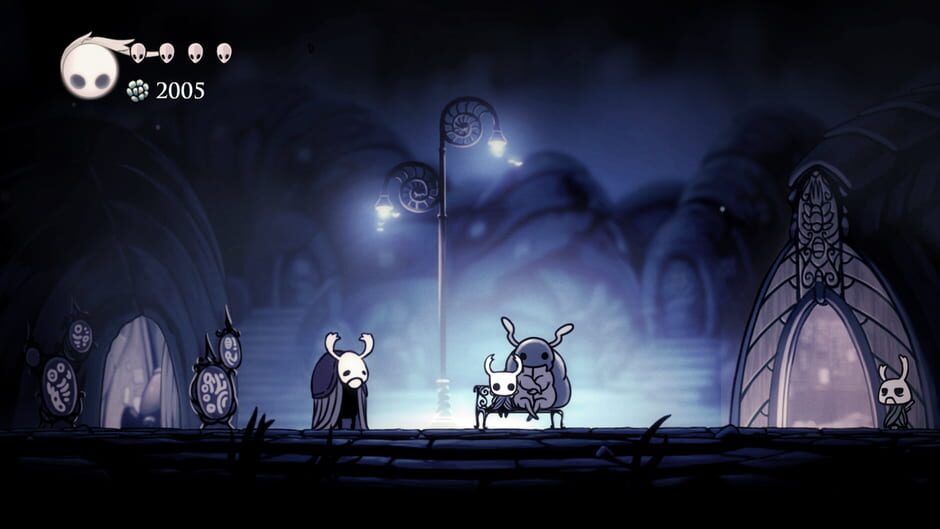
Benches therefore become essential landmarks.
They allow the Knight to rest, save progress, change equipped Charms and update certain map information. In a kingdom where a detour can lead very far away, finding a bench often creates a genuine sense of safety.
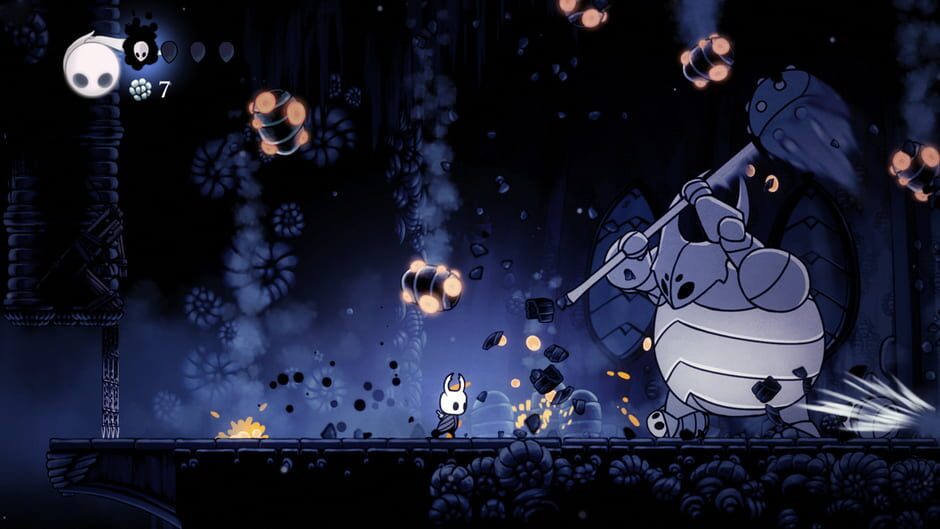
Combat is built on a deliberately simple foundation.
The Knight mainly uses the Nail, a small blade that can strike horizontally, upward or downward. The downward attack has a particular role: striking certain creatures or surfaces beneath the Knight allows them to bounce, sometimes turning an attack into a movement tool.
This simplicity makes precision especially important. Positioning, Nail range and enemy rhythm matter more than a long list of combinations.
By striking enemies, the Knight gathers Soul. This resource can be used to cast certain spells, but also to heal through Focus.
Choosing when to recover health therefore becomes a combat decision. Healing takes a few moments during which the Knight remains vulnerable. Against a boss, recognizing a genuine opening can be just as important as knowing how to avoid the previous attack.
Major encounters develop this logic further.
Many bosses have clearly identifiable movements, but their speed and combinations require the player to gradually understand their rhythm. A first attempt may feel chaotic; after several encounters, the same attacks begin to become readable.
Death adds another consequence.
When the Knight falls, they leave behind a Shade containing, among other things, the Geo they were carrying. Returning to the place of death and defeating that Shade restores what was lost. Dying a second time before doing so can cause that reserve to disappear permanently.
This mechanic adds particular tension to long periods of exploration. Continuing while carrying a large amount of Geo means accepting the risk of going deeper before finding another bench or somewhere to spend those resources.
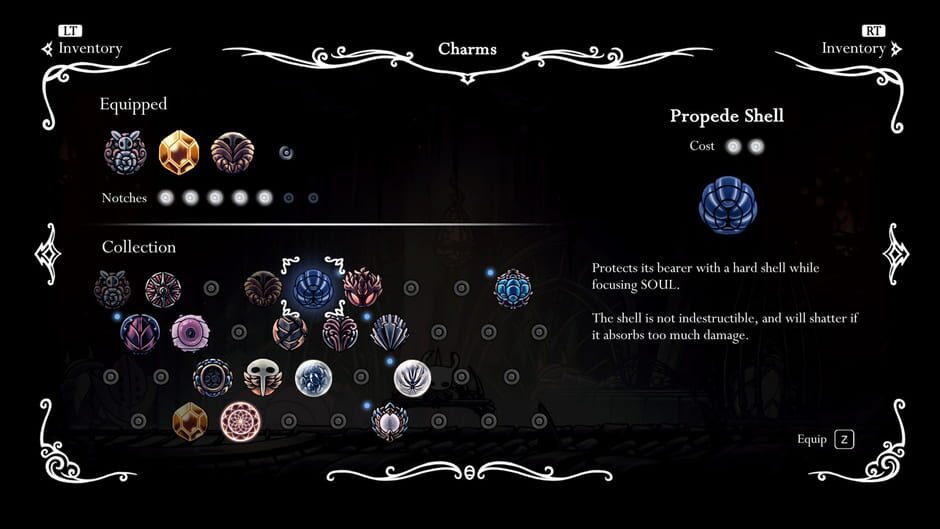
Charms, meanwhile, allow the Knight to be customized.
Each Charm modifies a specific aspect: Nail range, the way Focus works, Soul generation, defensive abilities or other properties. Because the number of available Notches is limited, the player must choose combinations that best suit the situation or their preferred way of playing.
This customization remains light enough that Hollow Knight never becomes a statistics-driven RPG. Instead, it allows certain habits to be emphasized: favoring close combat, strengthening spells, making exploration easier or preparing for a particular confrontation.
Discovering Hallownest, however, does not rely only on mechanics.
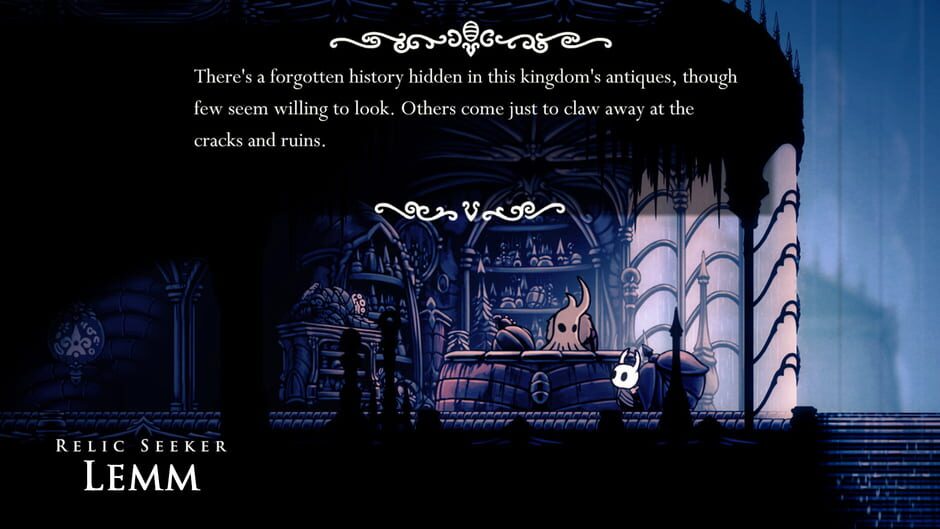
The kingdom is filled with characters who give personality to its different regions. Some provide services, others travel with goals of their own, and a few can be encountered several times as their journeys unfold.
The main story itself remains deliberately fragmented. The game provides pieces, but leaves the player responsible for connecting much of what they discover.
The environments directly participate in that storytelling. A silent former capital, gardens overtaken by vegetation or a region transformed by the infection can explain something about Hallownest before a character says a single word.
Christopher Larkin’s music accompanies this melancholy without constantly trying to fill the silence. Some regions have highly distinctive themes; elsewhere, footsteps, creatures and the echo of underground spaces are enough to create the atmosphere.
This restraint allows Hollow Knight to make Hallownest feel immense without relying on a gigantic map in the traditional sense. Its depth comes from the way places connect, passages discovered much later and the feeling that a seemingly secondary path may still conceal an entire region.
What to remember
- A 2D action-adventure game centered on exploring the fallen underground kingdom of Hallownest.
- Progression built around acquiring new abilities that gradually open passages that were previously inaccessible.
- Precise combat based mainly on the Nail, dodging, Soul, spells and Focus for recovering health.
- A Charm system allowing different properties of the Knight to be adapted with a limited number of available slots.
- A map that develops gradually and encourages players to understand the connections between regions themselves.
- Numerous bosses whose encounters rely on observation, positioning and learning their movement patterns.
- Fragmented storytelling where the history of Hallownest is discovered through characters, ruins and exploration as much as through directly narrated events.
Conclusion
Hollow Knight does something rare with a ruined world: it makes getting lost in it appealing.
Hallownest is not welcoming. Its roads are labyrinthine, some inhabitants have disappeared and others have been distorted by the infection. Dying far from a bench can force a tense return toward the Shade, and a simple passage can sometimes lead to an enemy far more dangerous than expected.
Yet the unknown is almost always more tempting than returning to safety.
An unreachable platform becomes a promise for later. A locked door stays somewhere in the player’s memory. A new power does not simply mean that the character has become stronger: it immediately recalls several places where something might now be different.
That memory of the world is what makes exploration so satisfying.
Combat follows a similar logic. The Knight possesses few fundamental moves, but their precision creates a very noticeable sense of improvement in the player. A boss that once seemed uncontrollable eventually reveals openings, not because its attacks have changed, but because the player has learned to read them.
The difficulty can sometimes be demanding, particularly when repeated attempts require crossing part of the world again. The game also asks the player to accept a story that does not immediately provide all of its answers.
That restraint, however, is part of its identity.
Hallownest does not tell the story of its fall as though it had already been neatly arranged in a book. Pieces of it remain everywhere, and the Knight encounters them in an order largely determined by their own path.
Hollow Knight therefore does not merely give the player a map to complete.
It gradually gives them a kingdom to understand.
Good to know
- Hollow Knight was developed and published by Australian independent studio Team Cherry.
- The game was originally released on PC on February 24, 2017, before being adapted to several consoles.
- The adventure takes place primarily in Hallownest, a former underground kingdom inhabited by insects and other creatures.
- The protagonist is generally known as the Knight and explores the kingdom mainly using the Nail.
- Charms modify different character abilities and can be rearranged when the Knight rests on a bench.
- Soul obtained notably by striking enemies is used both to cast certain spells and to recover health through Focus.
- The soundtrack was composed by Christopher Larkin.