Overview

Team Asobi is a Japanese development studio belonging to PlayStation Studios and based in Tokyo. Its history begins in 2012, when a small team then integrated into Japan Studio worked on technology demonstrations designed to explore the possibilities of the future PlayStation 4. Today, the studio presents itself as a team devoted to creating games accessible to players of all ages, built around immediate enjoyment, expressive characters, and playful uses of PlayStation technology.

That origin explains almost everything about its identity.

Team Asobi was not born around a storyline, a gigantic universe, or the ambition to immediately create a major franchise. Its starting point was much more fundamental: take a technology and discover how it could become fun.

This method appears as early as The Playroom, a collection of augmented-reality experiences preinstalled on PlayStation 4 in 2013. The team experiments with the camera, the DualShock 4 controller, and small virtual robots known as the AR Bots. These secondary characters gradually become more important until they eventually lead to Astro and the universe surrounding him. PlayStation directly traces the character’s roots back to Team Asobi’s work at the beginning of the PS4 generation.

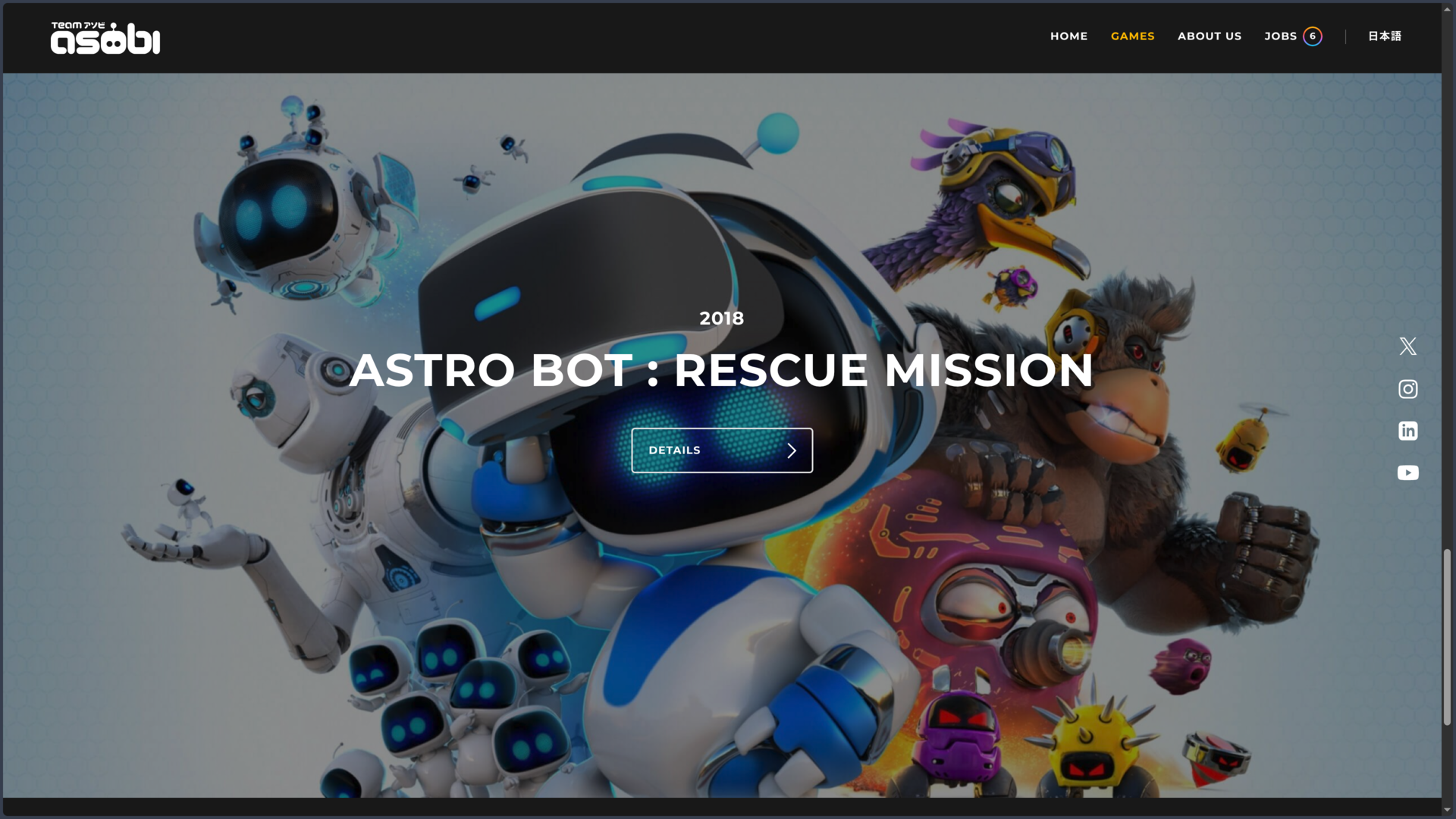
A few years later, the studio transposes this philosophy into virtual reality with The Playroom VR, and especially with Astro Bot: Rescue Mission in 2018. The small robot is no longer simply one element in a collection of demonstrations: he becomes the hero of a full platform game designed around PlayStation VR.

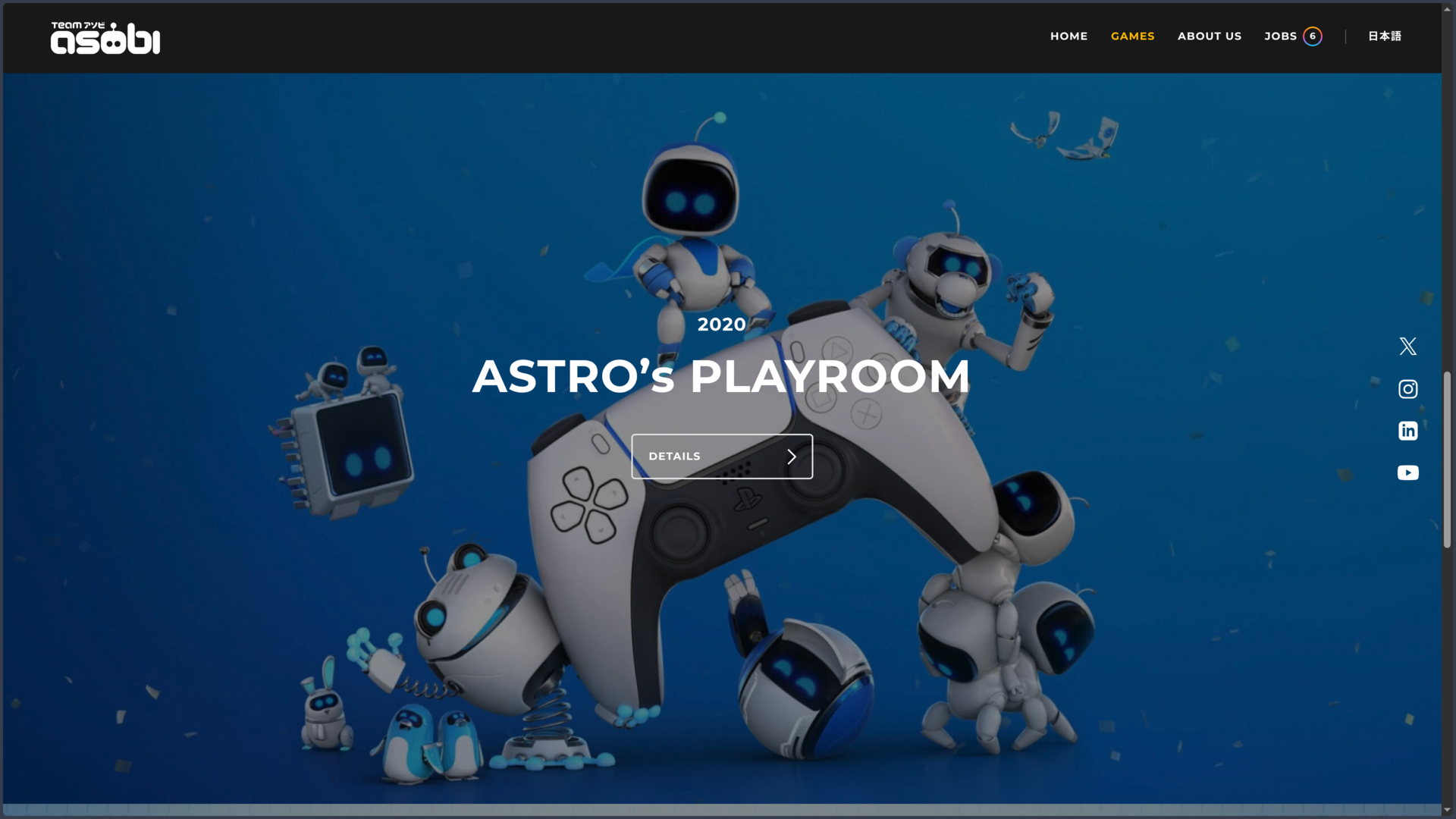
In 2020, Astro’s Playroom accompanies every PlayStation 5. The game is preinstalled on the console at no additional cost and turns the features of the new DualSense controller into game mechanics while also travelling through several decades of PlayStation history. Team Asobi then finds a particularly clear expression of its identity: a technology can be explained without an endless tutorial if it becomes a direct sensation of play.

The year 2021 marks an organizational transformation. Team Asobi leaves its status as a team integrated into the former Japan Studio to become a standalone internal studio within PlayStation Studios, still led by Nicolas Doucet. Sony Interactive Entertainment officially identifies Nicolas Doucet as Team Asobi’s studio director within PlayStation Studios as early as April 2021, while the studio publicly presents its new identity in June.

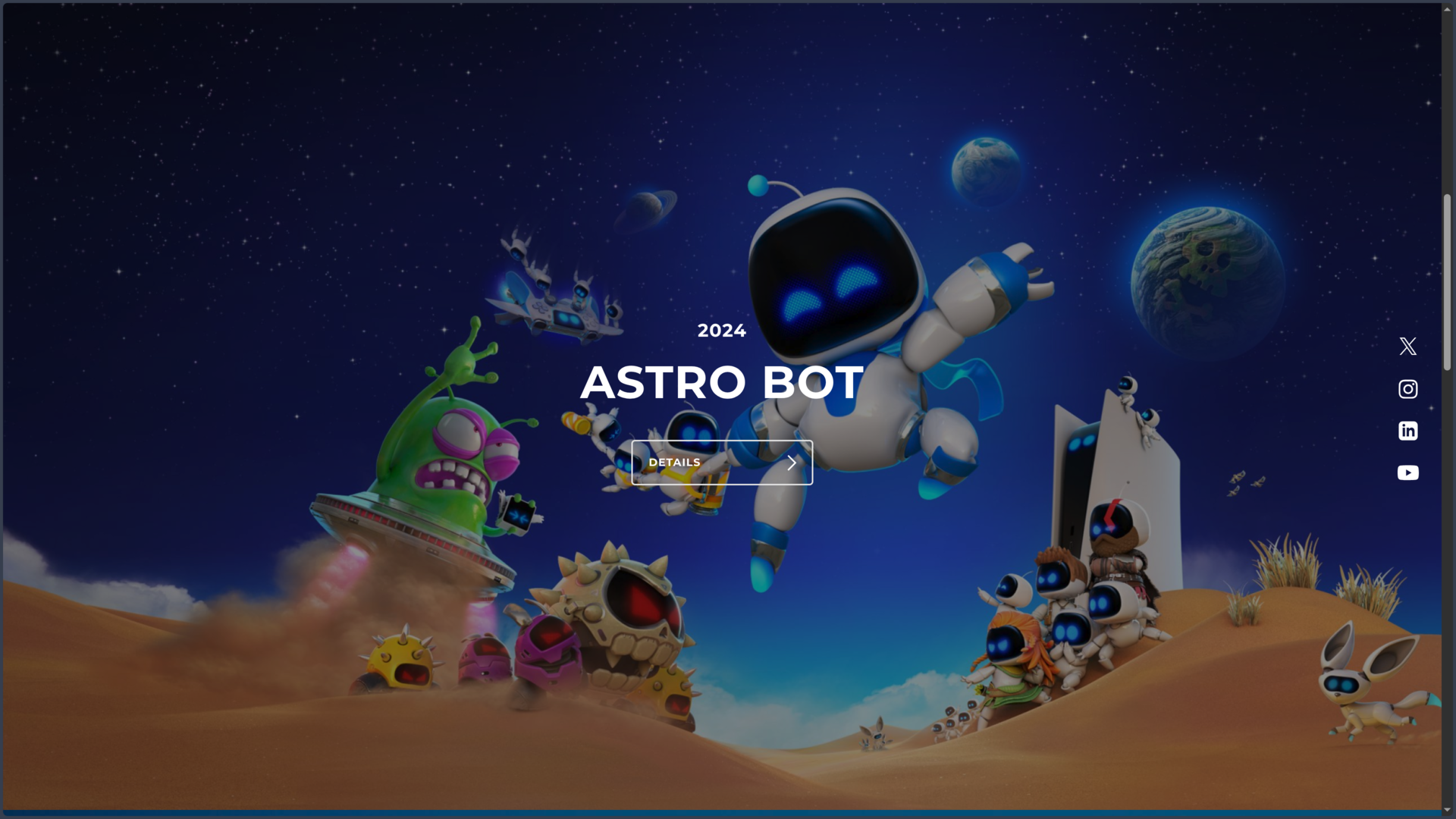
That autonomy leads to a much more ambitious project: ASTRO BOT, launched on PlayStation 5 in September 2024. The game takes the principles developed over more than a decade — precise platforming, rapid prototyping, use of PlayStation hardware, visual humor, and accessibility — and applies them to a complete, large-scale adventure.

The result changes the studio’s stature. At The Game Awards 2024, ASTRO BOT wins Game of the Year, Best Game Direction, Best Action/Adventure, and Best Family. The game moves Team Asobi from a team long associated with PlayStation technology experiments to one of the brand’s most visible studios.

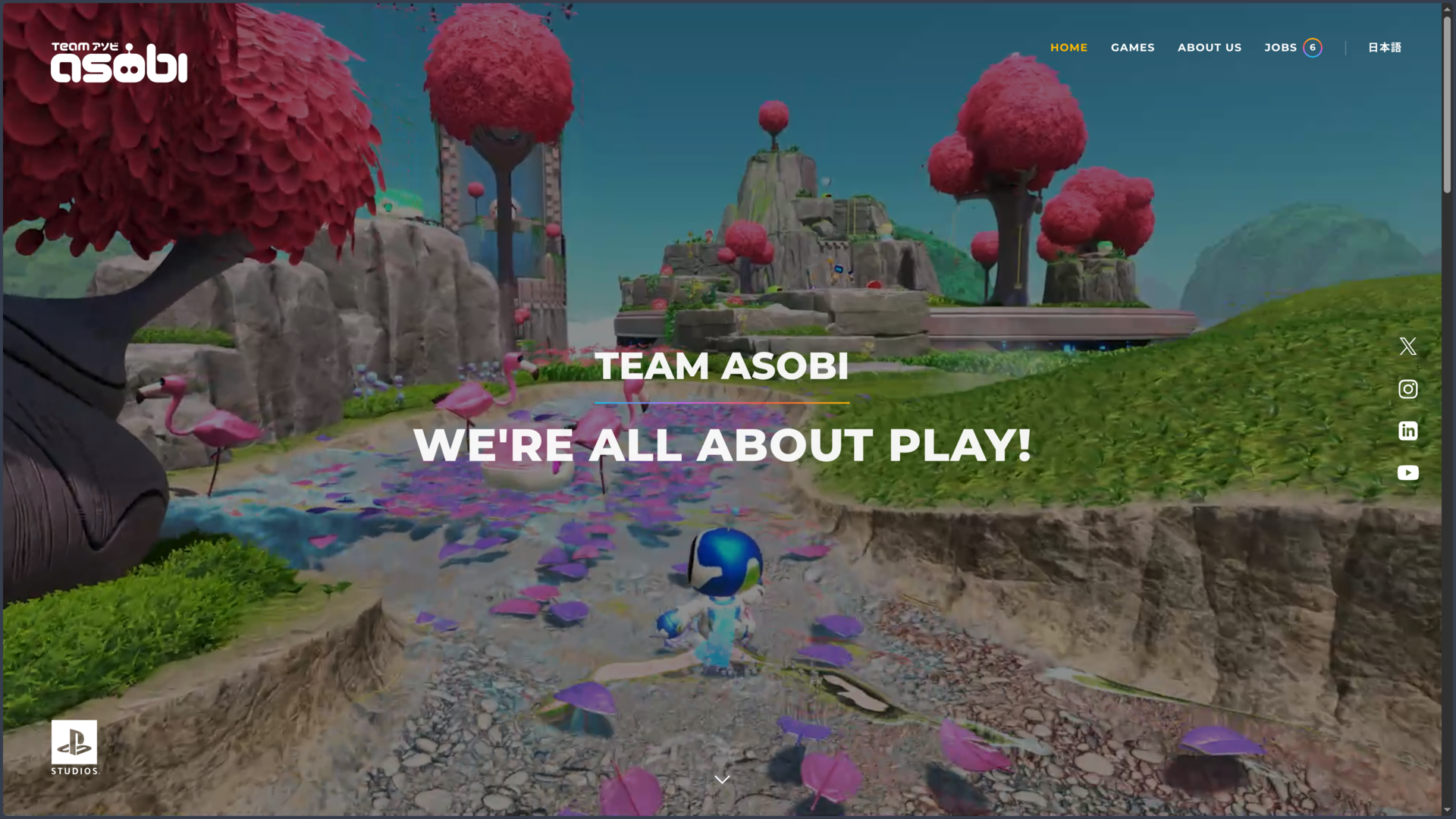
Yet the philosophy presented by Team Asobi remains remarkably close to where it began. Its website now summarizes the team with a simple phrase: “We’re all about play.” Behind that apparent simplicity lies a fairly precise method: first build something enjoyable to control and experiment with, then develop the world, animation, and technology around that pleasure.

History

2012: a small team playing with the future PS4

Team Asobi was formed in 2012, a little more than a year before the launch of PlayStation 4. Several of its members were then working on demonstrations intended to showcase the console’s new possibilities. The team decided to give itself a name that summarized what it considered essential in a game: the quality of the gameplay and the pleasure experienced by the player.

They chose Asobi, derived from the Japanese verb asobu, meaning “to play.”

The name works particularly well because it describes neither a genre, nor a technology, nor even a character. It describes an intention.

That gives the team considerable freedom. Its role is not to defend a precise formula, but to look for situations in which manipulating something becomes immediately enjoyable.

This experimental approach would shape much of its work over the following decade.

The Playroom: turning a technology demonstration into a small playground

When PlayStation 4 launched in 2013, The Playroom came preinstalled on the console and worked notably with the PlayStation Camera and DualShock 4.

At first glance, the project looks like a technology showcase. Yet Team Asobi is already trying to avoid the cold demonstration of a feature. The technology has to become a situation that the user understands by playing.

It is in this context that the AR Bots appear: small robots that symbolically live inside the controller before emerging from it to interact with the player and their surroundings. Team Asobi would later explain that these characters were the direct origin of the family of robots used in its later games.

That lineage matters.

Astro was not invented several years later as a mascot decided in a marketing meeting.

He gradually emerged from experiments connected to PlayStation hardware.

The character and the technology grew together.

The Playroom VR: changing technology without changing method

With the arrival of PlayStation VR, Team Asobi continued its experiments around a new peripheral.

The Playroom VR takes the idea of small experiences that are immediately understandable and transposes them into virtual reality. The technology changes profoundly: the player now wears a headset, spatial perception becomes part of the gameplay, and the relationship between the person using the headset and other people in the room creates new possibilities.

But the method remains comparable to The Playroom.

The goal is not to demonstrate in abstract terms what virtual reality can do.

The goal is to discover what kinds of games this new way of seeing and moving makes possible.

That logic gradually leads the team toward something more ambitious than a collection of experiments.

2018: Astro Bot: Rescue Mission turns the experiment into a full game

Astro Bot: Rescue Mission launches in October 2018 on PlayStation 4 and PlayStation VR. Team Asobi presents it as an action-platform game entirely designed around virtual reality.

This time, Astro truly becomes the central character.

The classic platform-game principle — moving a small hero through levels filled with obstacles — is profoundly altered by the player’s position in space. It becomes possible to look behind parts of the scenery, physically lean to discover a passage, or perceive levels as small three-dimensional stages surrounding the player directly.

The project’s interest therefore does not simply come from seeing a platform game inside a VR headset.

Team Asobi tries to understand what virtual reality can change in the very way a level is designed.

That research neatly summarizes the studio’s philosophy: technology only has value when it changes what the player can feel or do.

The game also receives significant recognition, including the Best VR/AR Game award at The Game Awards 2018.

Astro gradually becomes more important than the technology demonstration

Rescue Mission creates an interesting shift.

Until then, the robots had mainly existed because they allowed the team to play with different PlayStation technologies.

After 2018, the relationship begins to reverse.

Players become attached to the character.

Astro now has a recognizable silhouette, body language, a world, and a way of interacting with the player. What began as a family of small graphical elements created to illustrate an interface can gradually become an intellectual property capable of existing on its own.

Team Asobi then has to solve a new problem: preserve its obsession with technological experimentation without reducing Astro to the role of an educational mascot whose job is simply to present Sony’s next peripheral.

The PS5 generation provides the ideal opportunity to test that balance.

2020: Astro’s Playroom accompanies every PlayStation 5

Astro’s Playroom launches alongside PlayStation 5 in November 2020 and comes preinstalled on the console. Team Asobi designs it in particular to introduce the features of the new DualSense controller.

Haptic feedback, adaptive triggers, and different forms of interaction with the controller are directly integrated into the gameplay.

But the game gradually goes beyond its demonstration function.

Its different worlds are inspired by components of the PlayStation 5, while the levels are filled with references to older consoles, accessories, characters, and games associated with PlayStation history.

The hardware almost becomes cultural heritage.

An old Memory Card, a forgotten controller, or an earlier handheld console are no longer simply electronic products replaced by their successors. They become objects capable of triggering recognition and nostalgia.

Team Asobi begins to play simultaneously with current technology and PlayStation memory.

Astro and the DualSense: explaining technology through sensation

Team Asobi’s work with the DualSense reveals an important difference between demonstration and design.

A specification sheet can explain that a controller has haptic feedback or adaptive triggers.

A game has to make that difference perceptible without asking the player to think about how the device works.

In Astro’s Playroom, walking across different surfaces, using certain objects, or manipulating various mechanisms directly changes the sensations transmitted through the controller.

The explanation disappears behind the action.

This is probably one of the purest expressions of Team Asobi’s philosophy: when a technology is properly integrated into the game, it stops feeling like an added feature and simply becomes a new way to play.

2021: Team Asobi becomes a standalone PlayStation Studios studio

In 2021, Sony reorganizes its Japanese development activities. Team Asobi, until then integrated into Japan Studio, is repositioned as a standalone internal studio within PlayStation Studios.

Sony Interactive Entertainment identifies Nicolas Doucet as Studio Director of Team ASOBI within PlayStation Studios as early as April 2021. In June, the studio publicly presents this new stage of its history, reveals a new logo, and explains that it wants to grow while preserving the philosophy developed since 2012.

The transformation is significant enough for Team Asobi to speak at the time of a “new PlayStation studio,” but it does not reset its history.

The team remains part of the same creative lineage.

Its previous games continue to be presented as stages in its journey.

Its current website notably lists Astro Bot: Rescue Mission, Astro’s Playroom, and ASTRO BOT as its main productions.

The year 2012 therefore corresponds to the birth of Team Asobi as a creative team, while 2021 marks its transformation into a standalone studio.

Growing without losing the small scale of the prototype

Becoming a more autonomous studio could naturally have pushed Team Asobi toward larger projects and heavier methods.

Yet the studio retains a strong prototyping culture.

In 2024, its developers explained that gameplay ideas emerge before much of the final artistic work. Very simple models can be built quickly by programmers to test a mechanic; once the team considers the idea genuinely fun, artists and animators develop the world around it.

Nicolas Doucet summarizes two strengths of the studio as ideas and speed.

That speed does not mean rushing to finish the final game.

It mainly concerns the ability to test many ideas quickly, abandon those that do not work, and deepen the best ones.

In an industry where productions can become extremely heavy, Team Asobi therefore retains something of the technology laboratory from which it emerged.

2024: Astro Bot becomes a complete adventure

On September 6, 2024, Team Asobi launches ASTRO BOT on PlayStation 5. The studio presents it as its biggest adventure yet, designed around dozens of planets, new powers, and numerous references to PlayStation history.

The difference from Astro’s Playroom is significant.

PlayStation technology remains deeply integrated into the project, but the game no longer exists primarily to present a console.

Astro now has enough identity to carry a complete adventure.

The studio can therefore use everything it has learned about the DualSense, animation, platforming, and interactive surprises without having to justify every idea as a demonstration of new hardware.

This evolution may represent Team Asobi’s true creative emancipation.

The technology remains present.

It no longer needs to be the main subject.

A game built around fun before scenery

The team’s accounts of ASTRO BOT describe a particularly coherent design method.

Programmers and designers first test mechanics with simple shapes. Artists then step in to transform those prototypes into coherent, expressive worlds. A gameplay idea involving ice can, for example, lead the team to imagine a marine environment or a specific setting suited to that mechanic.

The process reverses a common habit: imagining a spectacular world first, then trying to decide what the player should do inside it.

At Team Asobi, the environment often has to justify a sensation or interaction already identified as fun.

This gives the levels a particular density.

Every object can become an opportunity for movement, animation, or reaction.

The scenery is not simply something to look at.

It constantly tries to respond to the player.

Playing with thirty years of PlayStation without building a museum

ASTRO BOT also uses numerous characters and references drawn from PlayStation history.

Team Asobi explains that it worked with other PlayStation studios and third-party publishers in order to integrate many characters into the game. Nicolas Doucet says he initially expected to have to severely limit the number of references, before partners proved far more open to allowing these appearances.

What matters is the way those references are used.

The game does not simply display familiar characters in a gallery.

It sometimes transforms their objects, abilities, or worlds into mechanics.

Nostalgia therefore becomes interactive.

An experienced player recognizes PlayStation history.

A child who has never encountered those characters before can simply enjoy the level.

This double reading fits perfectly with Team Asobi’s stated desire to create for experienced players as well as those who may be discovering video games for the first time.

2024: recognition changes the studio’s symbolic scale

ASTRO BOT receives considerable critical and institutional recognition.

At The Game Awards 2024, the game wins four categories: Game of the Year, Best Game Direction, Best Action/Adventure, and Best Family.

That same year, PlayStation Blog readers also choose Team Asobi as Studio of the Year in the annual awards.

These awards do not only change the status of a game.

They also change how the studio is perceived.

For a long time, Team Asobi could be viewed as the small team responsible for exploring new PlayStation accessories and technologies.

After ASTRO BOT, that description becomes insufficient.

The studio proved that the same culture of experimentation could support a complete game capable of standing at the forefront of the PlayStation catalog.

Today: remaining a studio devoted to play itself

Team Asobi now describes itself as a Tokyo-based PlayStation studio devoted to polished, joyful experiences accessible to players of all ages. Its official website directly highlights ASTRO BOT as its major recent work.

That description sounds almost modest after the game’s success.

But it fits the studio’s trajectory well.

Team Asobi has never built its identity around the size of its worlds, the seriousness of its stories, or the apparent sophistication of its systems.

Its obsession remains much more fundamental: does controlling this character, this object, or this technology make you want to keep playing?

After more than a decade of evolution, the question remains almost the same as it was in 2012.

What sets it apart

Gameplay comes before presentation

Team Asobi places gameplay very explicitly at the beginning of its creative process.

Developers interviewed by PlayStation in 2024 explain that ideas are first judged according to their ability to make the game more fun. Artists do not independently choose a world that mechanics will later have to fit into: the team imagines gameplay situations, builds prototypes, plays with them, and gradually develops the corresponding universe.

This method reduces some of the distance between an idea and its real-world test.

A mechanic can look brilliant on paper.

Once controlled with a gamepad, it may prove slow, confusing, or simply boring.

Team Asobi prefers to get that answer quickly.

The prototype therefore becomes less a primitive version of the final game than a tool for deciding whether an idea truly deserves to exist.

Technology should disappear behind the fun

The studio has a particularly close relationship with PlayStation hardware.

PS Camera.

PlayStation VR.

DualShock 4.

DualSense.

Haptic feedback.

Adaptive triggers.

Yet its objective is not to turn its games into catalogs of features.

Team Asobi itself explains that technological innovation is only a starting point: to matter, it has to become something magical and enjoyable for the player.

That idea separates a technology demonstration from a real game.

An impressive technology can create a few minutes of curiosity.

A well-integrated mechanic can become something the player simply wants to do again.

Astro was born from function before becoming a character

Astro’s trajectory is fairly unusual among video game mascots.

The character does not first appear with an elaborate mythology.

His ancestors are small robots designed to accompany technology experiments in The Playroom. Their simple design responds in part to the project’s constraints and aims to remain immediately readable.

The character then gradually gains personality through animation, movement, and interaction.

That origin remains visible in the studio’s identity.

Astro works particularly well because he is designed to be controlled.

His personality comes through his reactions, movements, and relationship with objects more than through long dialogue scenes.

The character exists first and foremost inside the game.

Animation makes every action enjoyable

Team Asobi places particular importance on the expressiveness of its characters.

Its animators explain that they observe, among other things, the way children spontaneously express joy or excitement in order to give the characters reactions that are immediately understandable.

This animation is not merely decorative.

In a platform game, the character is constantly at the center of the screen.

Running, stopping, jumping, or interacting with an object are actions repeated hundreds of times.

If each of those actions contains a little personality, the game becomes livelier without requiring more story.

Team Asobi therefore builds much of its humor through details.

The player may smile simply because a robot falls, dances, panics, or reacts disproportionately to what has just happened.

Designing for a child without boring the adult

The studio explicitly describes its games as being for all ages.

That does not simply mean lowering the difficulty.

Team Asobi instead tries to make the fundamentals immediately understandable while still allowing experienced players to enjoy the precision of the movement, optional challenges, or more discreet historical references.

Nicolas Doucet has notably explained that he thinks both about players with several decades of experience and very young players who may be discovering their first video game with ASTRO BOT.

That ambition requires a particular discipline.

A mechanic must be readable without becoming meaningless.

A level must be welcoming without becoming empty.

A PlayStation reference must be able to amuse someone who recognizes it without excluding someone who does not understand it.

Turning PlayStation itself into creative material

Team Asobi is probably one of the PlayStation studios that most directly uses PlayStation itself as creative material.

The brand’s consoles, controllers, accessories, and characters can become environments, vehicles, objects, or jokes.

This proximity could easily turn its games into interactive advertising.

The studio generally avoids that trap by giving these references a gameplay function.

A historical object is interesting because it can be manipulated.

A familiar character is interesting because it can create a new situation.

The heritage therefore becomes another material with which to build the game.

The small idea can sometimes matter more than the big feature

Team Asobi works on technically sophisticated productions, but its philosophy often gives considerable value to very small interactions.

An object that can be hit for no reason.

A creature reacting as Astro passes by.

A particular vibration in the controller.

An animation hidden in a corner of a level.

Taken individually, none of these elements would justify producing a game.

Yet accumulating these kinds of reactions gradually transforms the player’s relationship with the world.

The game gives the impression that it anticipated their curiosity.

This density of small responses forms an important part of the charm of the studio’s productions.

Being Japanese without creating only for a Japanese audience

Team Asobi is based in Tokyo and remains strongly connected to Japanese creative culture, but the team also emphasizes its international character. As early as 2021, Nicolas Doucet explained that the studio consisted primarily of Japanese developers alongside members from several other countries, and considered that diversity important for creating games with universal appeal.

This dimension fits Astro particularly well.

The character speaks very little.

The mechanics rely heavily on movement and imagery.

The humor is primarily visual.

The studio can therefore build an identity deeply rooted in Tokyo and PlayStation while creating experiences that require relatively little cultural translation.

A studio born to showcase hardware becomes the creator of a mascot

Team Asobi’s evolution can almost be read as a complete reversal.

At first, the characters exist to present technology.

Today, the technology also serves to enrich the character’s adventures.

That reversal shows how much autonomy Astro has gained.

With ASTRO BOT, the small robot no longer needs the arrival of a new console or headset to justify his existence.

He can carry his own game.

Team Asobi has therefore evolved from a laboratory tasked with exploring PlayStation into a studio capable of creating one of the properties most directly associated with the platform’s modern identity.

Good to know

  • Team Asobi is a video game development studio based in Tokyo, Japan, and a member of PlayStation Studios.
  • The Team Asobi team was formed in 2012, before the launch of PlayStation 4.
  • The name “Asobi” comes from the Japanese word asobu, meaning “to play.”
  • Team Asobi began as a team within Japan Studio, working notably on technology demonstrations intended for PlayStation 4.
  • The Playroom was one of its first productions and introduced the AR Bots, ancestors of the robots that eventually led to the character of Astro.
  • Astro Bot: Rescue Mission launched in 2018 on PlayStation VR and was published by Sony Interactive Entertainment.
  • Astro Bot: Rescue Mission won Best VR/AR Game at The Game Awards 2018.
  • Astro’s Playroom launched in 2020 and came preinstalled at no additional cost on PlayStation 5. The game was notably designed around the features of the DualSense controller.
  • Nicolas Doucet leads Team Asobi. Sony Interactive Entertainment officially identified him as Studio Director within PlayStation Studios in 2021, and he continues to hold that role in later studio communications.
  • In 2021, Team Asobi became a standalone studio within PlayStation Studios, after previously operating as a team within Japan Studio.
  • This entry retains 2012 as the creation year, because that is the date Team Asobi states it was formed; 2021 corresponds to its new organizational status.
  • Team Asobi’s current official website presents three main productions: Astro Bot: Rescue Mission, Astro’s Playroom, and ASTRO BOT.
  • ASTRO BOT launched on PlayStation 5 on September 6, 2024 and was developed by Team Asobi and published by Sony Interactive Entertainment.
  • ASTRO BOT won four awards at The Game Awards 2024, including Game of the Year and Best Game Direction.
  • Team Asobi was named Studio of the Year in the 2024 PlayStation Blog awards.
  • The studio describes its current philosophy around play, creativity, expressive characters, and experiences intended for all ages.
  • Its production method relies heavily on prototyping: gameplay ideas are tested before the final artistic environment is built around them.
  • Team Asobi works closely with PlayStation technology, notably PlayStation VR and the DualSense, but treats technological innovation as a means of creating new experiences rather than an end in itself.