






Overview
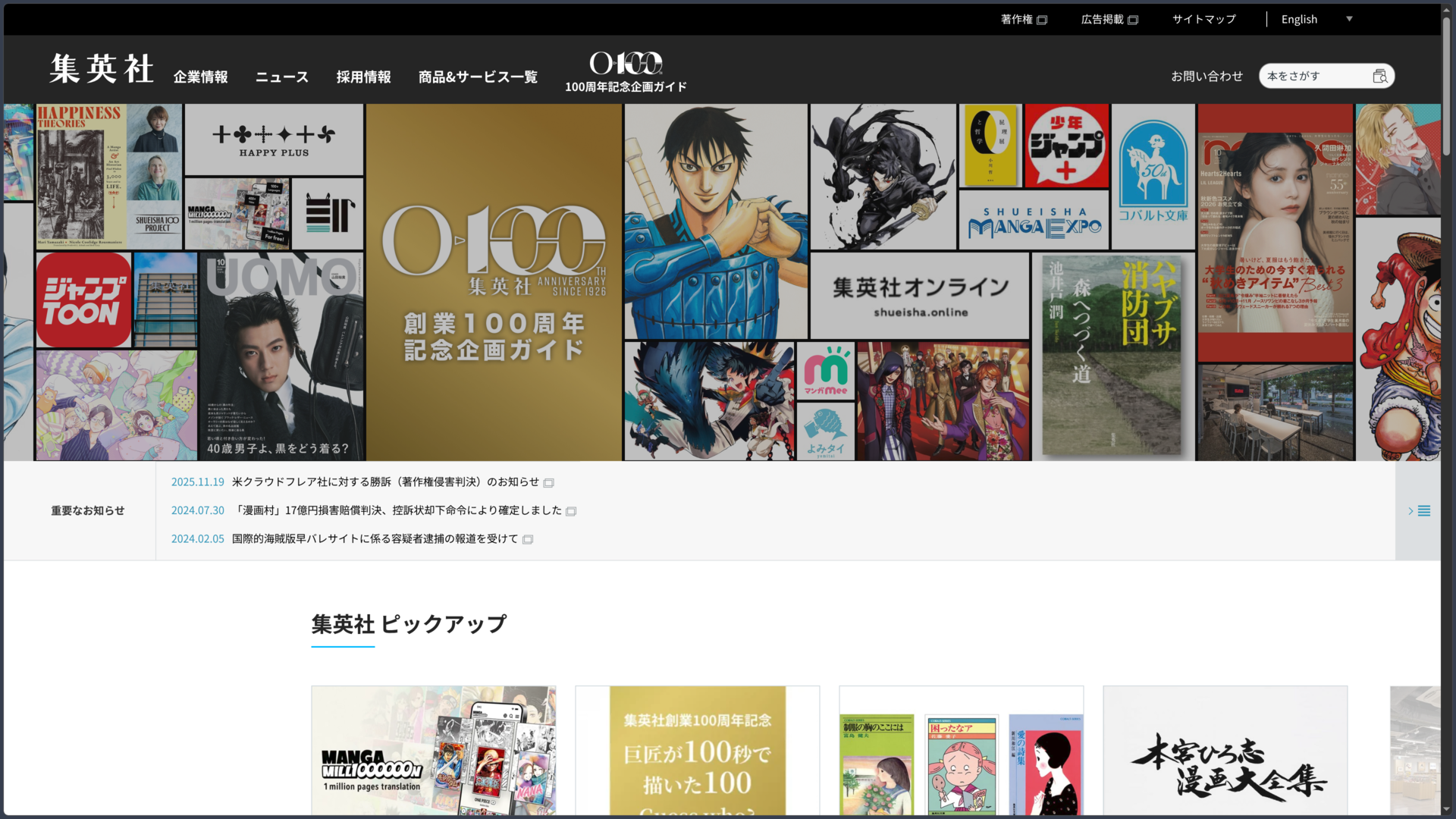
Shueisha is a Japanese publishing house founded in 1926 in Tokyo, which has become one of the major players in manga publishing worldwide.
Its Japanese name, 集英社, can be associated with the idea of gathering or bringing together knowledge and talent.
Shueisha’s international image is now deeply connected to manga and especially to the Jump editorial family.
Dragon Ball, JoJo’s Bizarre Adventure, Slam Dunk, One Piece, Naruto, Bleach, Hunter × Hunter, Death Note, Demon Slayer: Kimetsu no Yaiba, Jujutsu Kaisen, My Hero Academia, Chainsaw Man, SPY×FAMILY, Kaiju No. 8 and Kingdom belong to different generations and different magazines within its catalogue.
But reducing Shueisha to Weekly Shonen Jump would give a very incomplete picture of the publishing house.
Its editorial history also covers shōjo manga, seinen, literature, essays, dictionaries, children’s publishing, practical books, photography, sport, popular culture and several generations of fashion magazines.
Ribon, launched in 1955, and Margaret, created in 1963, are two historical pillars of its publishing activity aimed at young female readers.
Their environment has hosted works as varied as Chibi Maruko-chan, The Rose of Versailles, Hana Yori Dango, Kimi ni Todoke and many other series that have contributed to the history of shōjo manga.
Young Jump, created in 1979 and later turned into a weekly, simultaneously developed an editorial line aimed at an older readership.
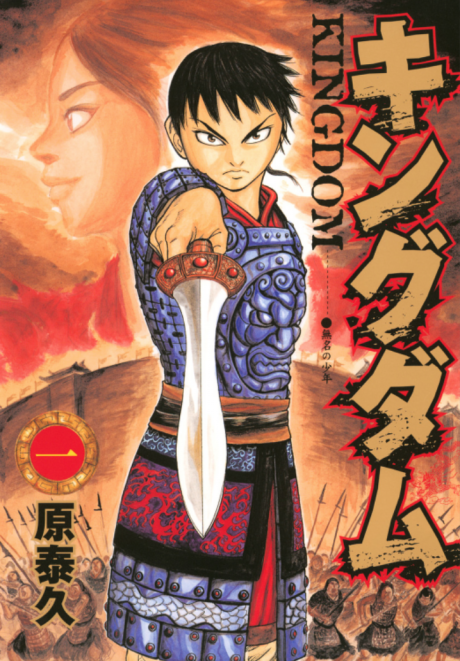
Throughout its history, it has hosted works such as Kingdom, Gantz, Golden Kamuy and Oshi no Ko.
Shueisha therefore operates less like a publisher associated with a single audience than as a group of specialized editorial departments, each with its own magazines, platforms, collections and relationships with creators.
This system historically relies on serialization.
A series generally begins in a magazine or, today, on a digital platform.
Its chapters can then be collected into volumes.
Within the Jump environment, the Jump Comics collection, created in 1969 when Shonen Jump became weekly, is one of the main brands under which these volumes are published.
This model allows the publishing house to simultaneously support the discovery of new series, their regular publication, their release in collected volumes and, when they find an audience, their development across other media.
Shueisha also places historical importance on the discovery of new creators.
The Tezuka Award, created by Weekly Shonen Jump in 1971, followed by the Akatsuka Award in 1974, contribute to the discovery and development of new generations of mangaka.
The publishing house itself describes this policy as a model in which the magazine must form a genuine ecosystem where new creators can grow and new successes can regularly emerge.
This logic does not concern Jump alone.
Bessatsu Margaret established its own system for discovering young creators as early as the 1960s.
It is also found in the publishing house’s literary prizes.
The objective is therefore not simply to acquire works that already exist, but to maintain editorial teams capable of supporting creation over time.
This relationship between creator and editor is essential for understanding Shueisha.
A work such as One Piece is created by Eiichiro Oda.
Shueisha is its Japanese publisher and works with the creator through its editorial team, manages publication in Weekly Shonen Jump, produces the collected volumes, handles editorial management and plays an important role in the exploitation of its rights.
This does not mean that Shueisha itself produces every anime, film, video game or derivative product associated with its manga.
These adaptations involve studios, producers, broadcasters, manufacturers and outside partners.
Shueisha’s role remains first and foremost that of a publisher and manager of content and rights.
This distinction becomes even more important as its works have acquired a considerable international dimension.
In 1994, Dragon Ball surpassed 100 million copies published in Japan and Weekly Shonen Jump reached a record circulation of 6.53 million copies with a double issue released at the end of that year.
In 1997, One Piece began publication in the magazine.
In 2022, Shueisha announced that the series had surpassed 510 million copies in circulation worldwide.
Other works such as Naruto, Demon Slayer, Jujutsu Kaisen, My Hero Academia and Kingdom have also crossed major circulation milestones.
Shueisha’s publishing power does not, however, depend only on these franchises.
The house also has a long-established literary activity.
The magazine Subaru was created in 1970.
Shueisha Bunko, its paperback collection, appeared in 1977.
The publishing house publishes contemporary novels, Japanese and foreign literature, essays, nonfiction, encyclopedias, dictionaries, historical works, children’s books and heritage collections.
Its authors have received numerous Japanese literary awards, notably the Akutagawa and Naoki prizes.
At the same time, Shueisha built an important sector around fashion and lifestyle magazines.
non-no, created in 1971, MORE, LEE, SPUR, MEN’S NON-NO, BAILA and Seventeen illustrate an activity that long represented an important part of its identity in Japan.
This diversity explains why Shueisha presents itself not as a company specializing only in manga, but as a major general publishing house.
Digital publishing gradually changed this model without eliminating traditional magazines.
In 2014, Shueisha launched Shonen Jump+, a digital platform capable of directly publishing new series.
It in turn became an important space for discovery with works such as SPY×FAMILY, Kaiju No. 8, Chainsaw Man Part 2, Dandadan and Look Back.
In 2024, Shueisha reported that Jump+ had exceeded 12 million monthly users.
In 2019, the publishing house took another major step with MANGA Plus by SHUEISHA.
The service is directly operated by Shueisha and allows chapters to be officially distributed to international readers in several languages, often at the same time as their Japanese publication.
This strategy profoundly changes the relationship between the Japanese market and the rest of the world.
For a long time, a foreign reader had to wait for a local publisher to license and translate a series.
With MANGA Plus, Shueisha can now directly publish part of its catalogue worldwide while continuing to work with partner publishers for local collected editions.
In 2026, the year of its official centenary, this international dimension becomes even more visible.
Shueisha notably launches MANGA MILLION, a project intended to translate and distribute one million manga pages free of charge in numerous languages.
The announced selection includes around 400 works from shōnen, seinen and shōjo publishing, including One Piece, Naruto, Bleach, Demon Slayer, Jujutsu Kaisen, Kingdom, Oshi no Ko, SPY×FAMILY, Chainsaw Man, Nana and Kimi ni Todoke.
This initiative summarizes Shueisha’s evolution quite well.
The publishing house born around print magazines for children and younger readers has become a company able to simultaneously publish magazines, books, manga, digital platforms, international content and intellectual property exploitation.
In 2026, Shueisha Inc. remains based in the Hitotsubashi district of Chiyoda, Tokyo.
Its representative president is Hideaki Hayashi, and the company reports 739 employees as of August 1, 2026.
It also works with numerous affiliated companies, including Shueisha Creative, Shueisha Games, Shueisha Arts & Digital, Shueisha International, Shueisha TOON FACTORY, Hakusensha, VIZ Media and Shogakukan-Shueisha Productions.
These companies should not, however, be confused with Shueisha itself when a work must be precisely attributed within PANACHES CULTURE.
History
1925: Shueisha first exists as a project within Shogakukan
Shueisha’s history begins before its legal foundation.
In 1925, Takeo Oga, founder of Shogakukan, prepared the creation of a new publishing activity.
Shogakukan was then strongly associated with educational magazines organized according to school levels.
The new project was intended to give greater importance to entertainment and leisure.
The Shueisha name was already in use.
In September 1925, a first magazine aimed at first-year primary school girls was published under the brand.
Other publications followed during the same year.
Shueisha now describes this period as “Shueisha Year Zero.”
1926: Shueisha becomes a distinct publishing house
In 1926, Shueisha was officially created.
The publishing house’s international website dates its separation from Shogakukan to August 8, 1926.
The new structure developed reading and entertainment magazines primarily aimed at children and teenagers.
This origin explains the very strong historical relationship between Shogakukan and Shueisha.
But the two companies are distinct publishers.
A work published by Shogakukan should therefore not be considered a Shueisha publication.
1941-1946: the war almost completely interrupts activity
The Second World War profoundly disrupted the company.
From 1940 onward, publishing controls led to the discontinuation or consolidation of several publications.
Between 1941 and 1946, Shueisha’s activity was almost entirely interrupted.
The publishing house therefore had to almost completely rebuild after the war.
1947-1949: restarting the business and becoming an independent company
In 1947, Shueisha officially resumed activity as a limited partnership.
The success of the illustrated book Shonen Oja contributed to this restart.
In 1949, the company was transformed into Shueisha Inc., a joint-stock corporation.
That same year, it launched the magazine Omoshiro Book.
This period represents the true restart of the modern publishing house.
The 1950s: building children’s and female readerships
Shueisha quickly developed several magazines aimed at children and teenagers.
In 1951, it launched Shojo Book.
The magazine quickly found a very large readership.
In 1955, the publishing house created Ribon, initially conceived as a magazine aimed at younger female readers.
Ribon would gradually become one of the main institutions of Japanese shōjo manga.
This period already shows a lasting characteristic of Shueisha: creating different magazines for different audiences, then evolving their content with successive generations of readers.
1959: the publishing house expands into literature
In 1959, Shueisha published its first modern literary work derived from its magazines.
This development gradually opened the publishing house to an activity extending far beyond children’s publishing and manga.
The following decades would see the development of literature, complete collections, essays, dictionaries and reference works.
1963: Margaret expands the shōjo ecosystem
In 1963, Shueisha launched Weekly Margaret, followed a few months later by Bessatsu Margaret.
These magazines in turn became essential spaces for manga aimed at teenage girls.
They supported new generations of creators.
In 1972, The Rose of Versailles by Riyoko Ikeda began publication in collected volumes within the Margaret Comics line and contributed to a major cultural phenomenon.
Later, the Margaret environment would notably host Hana Yori Dango from 1992 onward, followed by numerous romantic, school, dramatic and contemporary series.
1968-1969: the birth of Shonen Jump and Jump Comics
In 1968, Shueisha launched Shonen Jump.
The magazine was initially published twice a month.
In October 1969, it became weekly and adopted the name Weekly Shonen Jump.
At the same time, Shueisha launched Jump Comics, a collection intended to publish popular series from the magazine in collected volumes.
This connection between magazine and collected volumes became one of the publishing house’s most important editorial systems.
It allowed a new series to be tested with a regular readership before being developed into volumes and potentially across other media.
The 1970s: turning talent discovery into a system
Weekly Shonen Jump did not grow through its weekly rhythm alone.
The editorial team actively searched for new mangaka.
In 1971, it created the Tezuka Award for narrative manga.
In 1974, the Akatsuka Award completed the system for humorous works.
Shueisha retrospectively presents this strategy as the construction of a model built around new talent.
The magazine should not simply publish already established creators.
It must be capable of regularly producing a new generation.
This logic would remain one of Jump’s defining historical characteristics.
1973: Weekly Shonen Jump becomes the leading boys’ manga magazine
In 1973, Weekly Shonen Jump surpassed Weekly Shonen Magazine in circulation and took first place among boys’ manga magazines.
This extremely rapid growth shows that the title launched only five years earlier had found a particularly effective editorial model.
The magazine gradually became the main engine of Shueisha’s manga growth.
1977-1979: paperback literature and Young Jump
Diversification continued in parallel.
In 1977, the publishing house launched Shueisha Bunko, its major paperback line.
In 1979, it created Young Jump, a manga magazine aimed at an older readership.
The title became weekly in 1980 under the name Weekly Young Jump.
Shueisha now had manga ecosystems able to reach different age groups and sensibilities without limiting all its production to Weekly Shonen Jump.
The 1980s: Shueisha manga enters mass culture
During the 1980s, several Jump series reached an audience extending far beyond the magazine’s readership.
The animated adaptation of Dr. Slump by Akira Toriyama became a phenomenon in 1981.
The decade then saw the arrival of works that would become lasting parts of the Jump identity, while Shueisha simultaneously continued developing its female, literary and fashion magazines.
The success of these manga no longer depended solely on collected volumes.
Animation, merchandise, cinema, games and events began building broader media universes around the works.
Shueisha participates as publisher and holder or manager of certain rights, but these extensions involve numerous specialized partners.
1990-1994: the peak circulation of Weekly Shonen Jump
At the beginning of the 1990s, Shueisha reached an exceptional scale.
In 1990, the animated adaptation of Chibi Maruko-chan, originating from Ribon, became a social phenomenon.
In 1992, Hana Yori Dango began in the Margaret environment.
On the Jump side, the major series of the period built an enormous generation of readers.
In 1994, Dragon Ball collected volumes surpassed 100 million copies published.
At the end of that same year, a double issue of Weekly Shonen Jump reached 6.53 million copies, the magazine’s historical record.
This period represents the peak of the very large-scale print circulation model.
1997: One Piece begins in Weekly Shonen Jump
In July 1997, One Piece by Eiichiro Oda began publication in Weekly Shonen Jump.
The series gradually became the most widely circulated work in Shueisha’s history.
Its development crossed several transformations in the market: dominance of the print magazine, growth of collected volumes, international distribution, global animation, cinema, games and later streaming platforms.
In 2022, Shueisha announced more than 510 million copies in circulation worldwide.
One Piece therefore illustrates the ability of a series born within the classic Jump serialization system to become a global cultural property while remaining connected to its original publication.
1999-2000: Ultra Jump, Jump Festa and Nana
In 1999, Shueisha created Ultra Jump, aimed at manga readers seeking notably more specialized works.
That same year, the publishing house organized the first edition of Jump Festa, an event devoted to Jump works and their adaptations.
The event became annual and brought together manga, animation, video games, merchandise and announcements around major franchises.
In 2000, Shueisha also launched Cookie.
The publication of Nana by Ai Yazawa became a major success there.
The importance of this work is another reminder that Shueisha’s international influence is not limited to action manga aimed at boys.
2002: Shonen Jump expands into North America
In 2002, a North American edition of SHONEN JUMP was launched.
It represented an important stage in the structured international distribution of Jump titles.
Shueisha notably works abroad with partners and affiliated companies such as VIZ Media.
This model must be distinguished from Japanese publishing: Shueisha remains the original publisher, while foreign editions may be produced or distributed by different partners depending on territory.
The 2000s: a new global generation of Jump
The 2000s saw several Shueisha series reach a considerable international audience.
Naruto, Bleach, One Piece, Hunter × Hunter, Death Note, Gintama and other works built a generation for whom Japanese manga was now distributed globally through books, television, DVDs, the Internet and video games.
At the same time, Shueisha’s other editorial departments continued developing their own catalogues.
Nana grew within Cookie.
Young Jump hosted works aimed at an older readership.
The publishing house’s catalogue therefore became global while remaining highly segmented in Japan.
2010-2012: One Piece reaches historic records
In 2010, volume 57 of One Piece reached an initial print run of three million copies, a Japanese record at the time.
In 2012, volume 67 set a new record with 4.05 million copies in its first print run.
At the same time, Naruto surpassed 100 million copies in circulation in Japan.
These figures show the continuing importance of print publishing despite the gradual rise of digital reading.
2014: Shonen Jump+ brings the editorial laboratory to smartphones
In September 2014, Shueisha launched Shonen Jump+.
The platform did not merely offer digital versions of printed manga.
It also became a genuine space for original creation.
Shueisha sought to reproduce in digital form the historical function of the magazine: welcoming new creators, testing formats and allowing new series to emerge.
Over the years, Jump+ produced several major successes.
SPY×FAMILY, Kaiju No. 8, Dandadan, Hell’s Paradise: Jigokuraku, Look Back and other works demonstrate that a major Shueisha series can now be born directly on a digital platform.
In 2024, Jump+ exceeded 12 million monthly users.
2018-2020: Demon Slayer and a new wave of successes
At the end of the 2010s, new series once again renewed Shueisha’s major successes.
Demon Slayer: Kimetsu no Yaiba, published in Weekly Shonen Jump, experienced spectacular growth following its animated adaptation.
In 2020, its collected volumes surpassed 100 million copies in circulation while its film adaptation became a worldwide phenomenon.
Jujutsu Kaisen, published from 2018 onward, also established itself as a major new franchise.
This period demonstrates that, several decades after Dragon Ball or Slam Dunk, the Jump editorial system continues producing series capable of extending far beyond the printed manga market.
2019: MANGA Plus publishes directly for the world
In January 2019, Shueisha launched MANGA Plus by SHUEISHA.
For the first time on this scale, the publishing house had an international service directly operated by itself.
Readers could officially access numerous series in several languages, often from the moment of their Japanese release.
This simultaneity notably addressed the historical delay between Japanese publication and foreign editions.
It also provided an official alternative to unauthorized translations circulating online.
MANGA Plus does not necessarily replace foreign publishers.
Print editions and local catalogues continue to be managed according to territory.
The service instead creates a new layer of directly international distribution.
2021-2025: print, digital and adaptations operate together
The growth of digital does not eliminate the printed volume.
In 2021, One Piece reached its 1000th chapter and then its 100th volume.
In 2022, the series surpassed 510 million copies distributed worldwide.
That same year, Shueisha highlighted the emergence of new successes originating directly from Jump+, notably SPY×FAMILY and Kaiju No. 8.
In 2023, Kingdom surpassed 100 million copies in circulation.
In 2024, My Hero Academia and then Jujutsu Kaisen also crossed the 100 million mark.
Audiovisual adaptations contribute strongly to this distribution, but the manga remain the editorial starting point around which these developments are organized.
2026: one hundred years of publishing and a global strategy
In 2026, Shueisha officially celebrates its centenary.
The publishing house uses the anniversary less as a simple retrospective than as a group of projects focused on future creation and distribution.
MANGA MILLION notably plans to make one million pages from around 400 manga available free of charge in numerous languages.
Shueisha also develops programs to support mangaka, preserve and highlight original artwork, internationally translate books and create new audio and digital content formats.
The publishing house itself summarizes the evolution of its profession as moving beyond the publication of books alone: digital publishing, audiovisual adaptations, merchandise, games, audio and internationalization now extend its publishing activity.
What sets it apart
Turning the magazine into a creative ecosystem
Shueisha’s historical strength does not come only from the number of manga it publishes.
It comes from the way its editorial departments organize creation.
Weekly Shonen Jump, Ribon, Margaret, Young Jump and later Jump+ are not simply catalogues of series.
They are used to search for new creators, develop their projects, regularly publish their work and observe how readers respond to it.
The magazine therefore becomes a space in which creator, editor and audience maintain a continuous relationship.
This organization partly explains Shueisha’s ability to renew its major franchises across several generations.
Institutionalizing the discovery of new mangaka
The Tezuka Award, the Akatsuka Award, manga schools connected to Margaret and various internal competitions turn the search for talent into a permanent activity.
Shueisha particularly emphasizes this idea in its official history.
A magazine’s success should not depend solely on a few established creators.
The next generation must constantly be prepared.
This policy helps explain why major Jump successes can follow one another across several decades without coming from the same creators.
Publishing several manga cultures under one publishing house
Shueisha is not limited to shōnen.
Ribon and Margaret played a major role in shōjo.
Young Jump and Ultra Jump develop other forms of manga for older teenagers and adults.
Cookie, Cocohana, Office You and other publications cover still other readerships.
This structure allows the publishing house to publish works as different as Dragon Ball, Nana, Kingdom, Kimi ni Todoke, Oshi no Ko and SPY×FAMILY.
Japanese demographic categories therefore provide editorial organization, but actual production extends far beyond a few simple genres.
Being much more than a manga publisher
The cultural weight of Jump can obscure the rest of Shueisha.
Yet the company also publishes novels, literature, essays, nonfiction, dictionaries, children’s books, historical collections, photography and practical books.
It publishes or has published numerous fashion and lifestyle magazines such as non-no, SPUR, LEE, MORE, BAILA, MEN’S NON-NO and Seventeen.
Manga is now its most visible international showcase, but its organization remains that of a general publishing house.
Turning a series into a global property without confusing different professions
When a Shueisha work becomes popular, its development can extend far beyond manga.
Animation, cinema, live-action series, video games, events, exhibitions, merchandise and commercial collaborations can all extend its universe.
Shueisha participates in these forms of exploitation through its rights, editorial teams and partners.
But it should not be confused with the companies that actually produce adaptations.
Toei Animation is not Shueisha. A game studio is not Shueisha. A broadcaster is not Shueisha.
This distinction makes it possible to correctly link works and their adaptations within PANACHES CULTURE.
Preserving serialization while creating its digital equivalent
Shueisha did not simply replace paper with smartphones.
It adapted its system.
Weekly Shonen Jump continues to be published.
Jump Comics volumes continue to be released.
At the same time, Jump+ has its own creations and readers.
Both environments can produce major series.
This coexistence between print and digital represents a gradual transformation rather than a simple technological break.
Publishing globally without relying only on local editions
With MANGA Plus, Shueisha can now directly offer certain chapters to a global audience.
The change is significant.
The Japanese publisher itself enters the daily relationship with foreign readers.
It can publish a series simultaneously in Japan and in several languages, build an international readership from its earliest chapters and then support its subsequent development.
This capacity makes the boundary between Japanese launch and international career far less clear than before.
Maintaining specialized companies around publishing without confusing them with Shueisha
Shueisha’s environment now includes several companies with their own functions.
Shueisha Games works in video games.
Shueisha Arts & Digital operates across various digital and creative activities.
Shueisha International has its own publishing activity.
Shueisha TOON FACTORY works around vertical manga.
VIZ Media notably contributes to international distribution.
Shogakukan-Shueisha Productions has distinct activities notably related to media, licensing and production.
These entities are connected to Shueisha but are not interchangeable.
For PANACHES CULTURE, a work must be linked to the company or publishing house that actually carried out the relevant role.
Building continuity with Shogakukan without being Shogakukan
Shueisha historically originated from an activity prepared by Shogakukan.
This lineage explains the lasting proximity between the two publishing houses and some of their affiliated companies.
But Shueisha became a distinct structure in 1926.
Their catalogues should therefore never be merged.
One Piece is a Shueisha publication.
A manga published by Shogakukan belongs to Shogakukan.
This distinction remains necessary even when several companies cooperate around distribution, rights or adaptations.
Good to know
- Shueisha was officially founded in Tokyo in August 1926; its history nevertheless begins in 1925 when magazines were prepared under the Shueisha name within the Shogakukan environment.
- The publishing house experienced an almost complete interruption of activity between 1941 and 1946 because of the war, then resumed in 1947 before becoming Shueisha Inc. in 1949.
- Ribon was launched in 1955, while Weekly Margaret and Bessatsu Margaret appeared in 1963, forming two major historical shōjo manga environments at Shueisha.
- Shonen Jump was created in 1968, became Weekly Shonen Jump in 1969 and was accompanied by the launch of the Jump Comics collection.
- The Tezuka Award was created in 1971 and the Akatsuka Award in 1974 to support the discovery of new mangaka within the Jump environment.
- Young Jump was launched in 1979 and became weekly in 1980, opening another major manga editorial space within the publishing house.
- In 1994, Dragon Ball surpassed 100 million copies and Weekly Shonen Jump reached its historical record with 6.53 million copies for a single issue.
- One Piece began publication in Weekly Shonen Jump in 1997; Shueisha announced in 2022 that more than 510 million copies of the series were in circulation worldwide.
- Shueisha launched Ultra Jump in 1999, while Jump Festa became from the same period an annual event devoted to works and franchises from the Jump environment.
- Shonen Jump+ was launched in 2014 and became a genuine space for original creation with notably SPY×FAMILY and Kaiju No. 8; in 2024, Shueisha reported more than 12 million monthly users.
- MANGA Plus by SHUEISHA was launched in January 2019 and is directly operated by Shueisha to officially distribute numerous manga to an international audience, often simultaneously with Japan.
- In 2026, Shueisha celebrates its centenary; its headquarters remain in Hitotsubashi, Chiyoda, Tokyo, Hideaki Hayashi is representative president, and the publishing house simultaneously pursues print publishing, digital publishing, rights management, events and international development.