
Overview

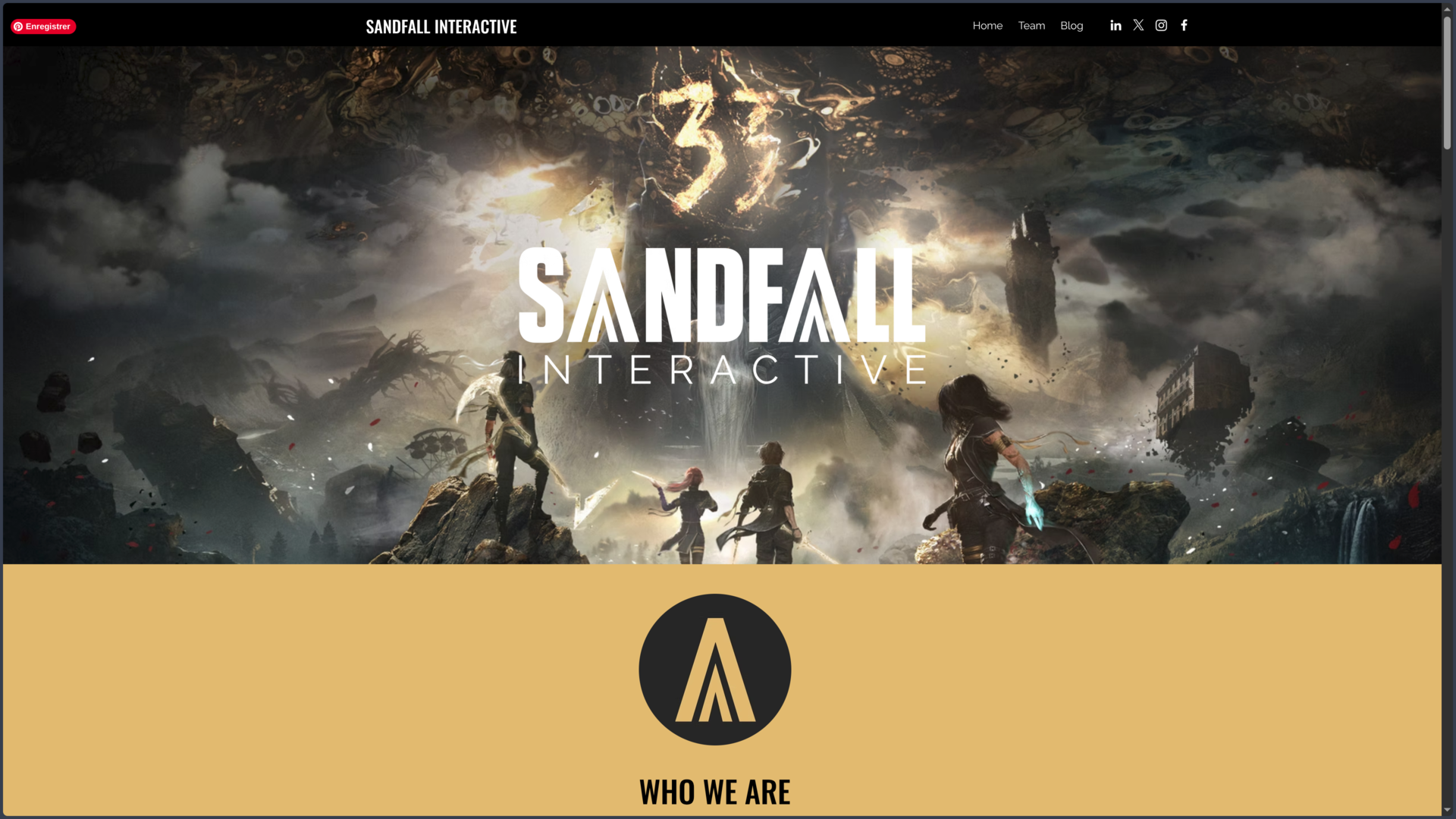
Sandfall Interactive is a French video game development studio founded in 2020 and based in Montpellier. The studio defines itself around a fairly precise idea: modern technologies now allow small independent teams to produce 3D games with high production values without necessarily reproducing the size, structure, and methods of large AAA studios. Sandfall therefore focuses primarily on single-player, narrative experiences populated by carefully developed characters and set in visually ambitious fantasy worlds.

This philosophy was not written as a manifesto after the studio became successful. It predates its first game.

Even before Sandfall officially existed, Guillaume Broche was working alone on what was still only a personal project. At the time, he was employed by another video game company and mainly wanted, for his own enjoyment, to create a turn-based RPG that he felt could bring something different to the genre. When the project required more technical expertise, Tom Guillermin joined him on programming, and other collaborators gradually completed the team. Guillaume Broche has explained that several participants were still working on the project without pay at that stage, before it became serious enough for them to leave their jobs and create Sandfall Interactive in 2020.

The studio was therefore born less from a business plan than from a game that became too large to remain an evening passion project.

That origin explains part of its organization. Sandfall seeks to preserve the speed of decision-making and closeness of a small team while using technologies capable of supporting a much more spectacular production. Its website summarizes this ambition as a search for efficient pipelines capable of preserving production quality, creativity, and agility at the same time.

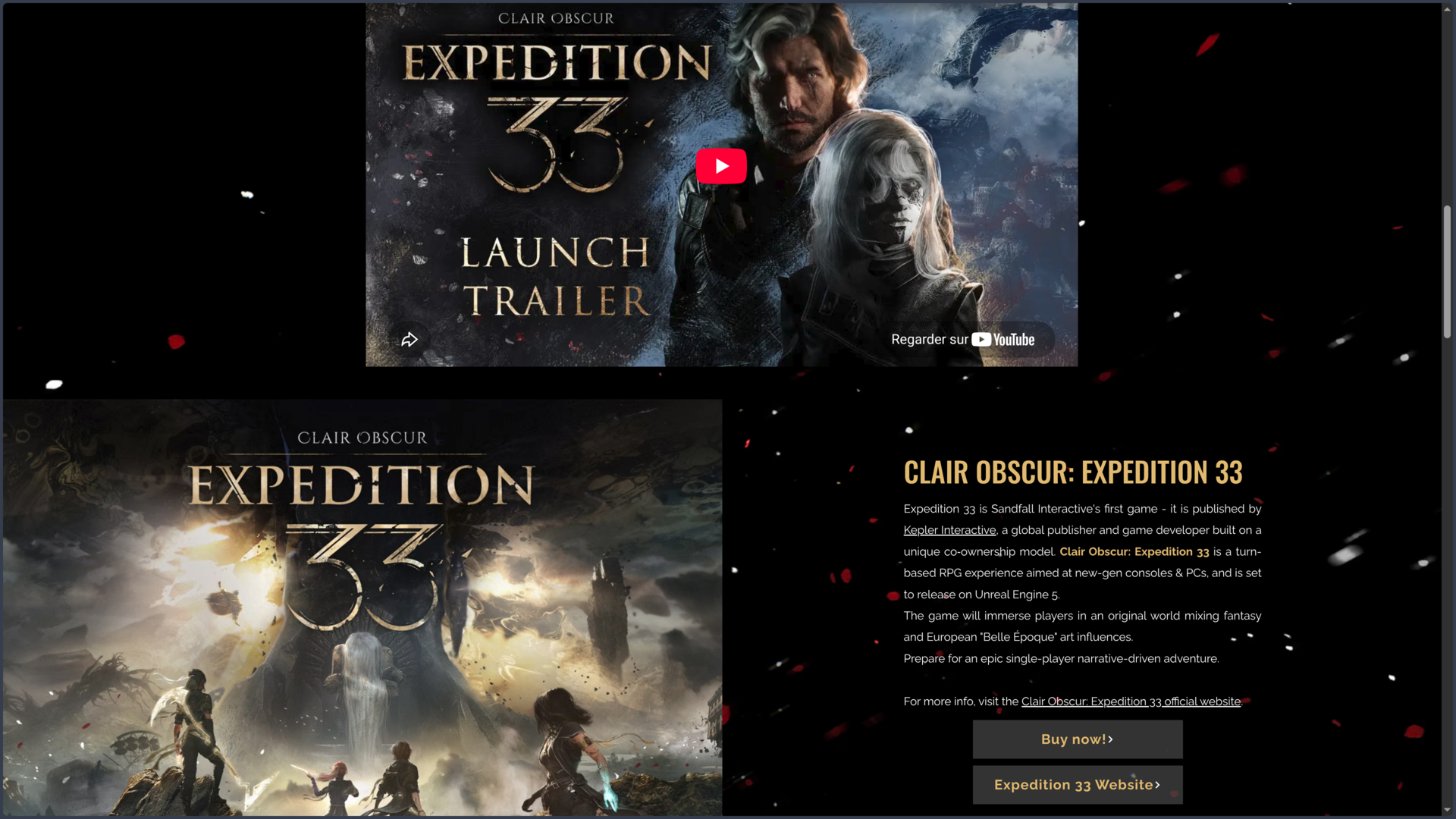
Its first project was known for a long time as Project W. The team gradually grew, moved from Paris to Montpellier in 2021, received support including an Epic MegaGrant, funding from the CNC and the Occitanie Region, and later adopted Unreal Engine 5. In March 2023, Sandfall announced a partnership with Kepler Interactive, which became the game’s publisher and supported the expansion of the team, external collaborations, and the move into new premises.

In June 2024, Project W was finally revealed under its real name: Clair Obscur: Expedition 33. Sandfall presented an RPG inspired both by JRPGs and action games, using turn-based combat enhanced by real-time actions. Its world combines fantasy, surrealism, and references to the French Belle Époque, immediately giving the studio an identity distinct from the medieval or science-fiction imagery that dominates part of the contemporary RPG landscape.

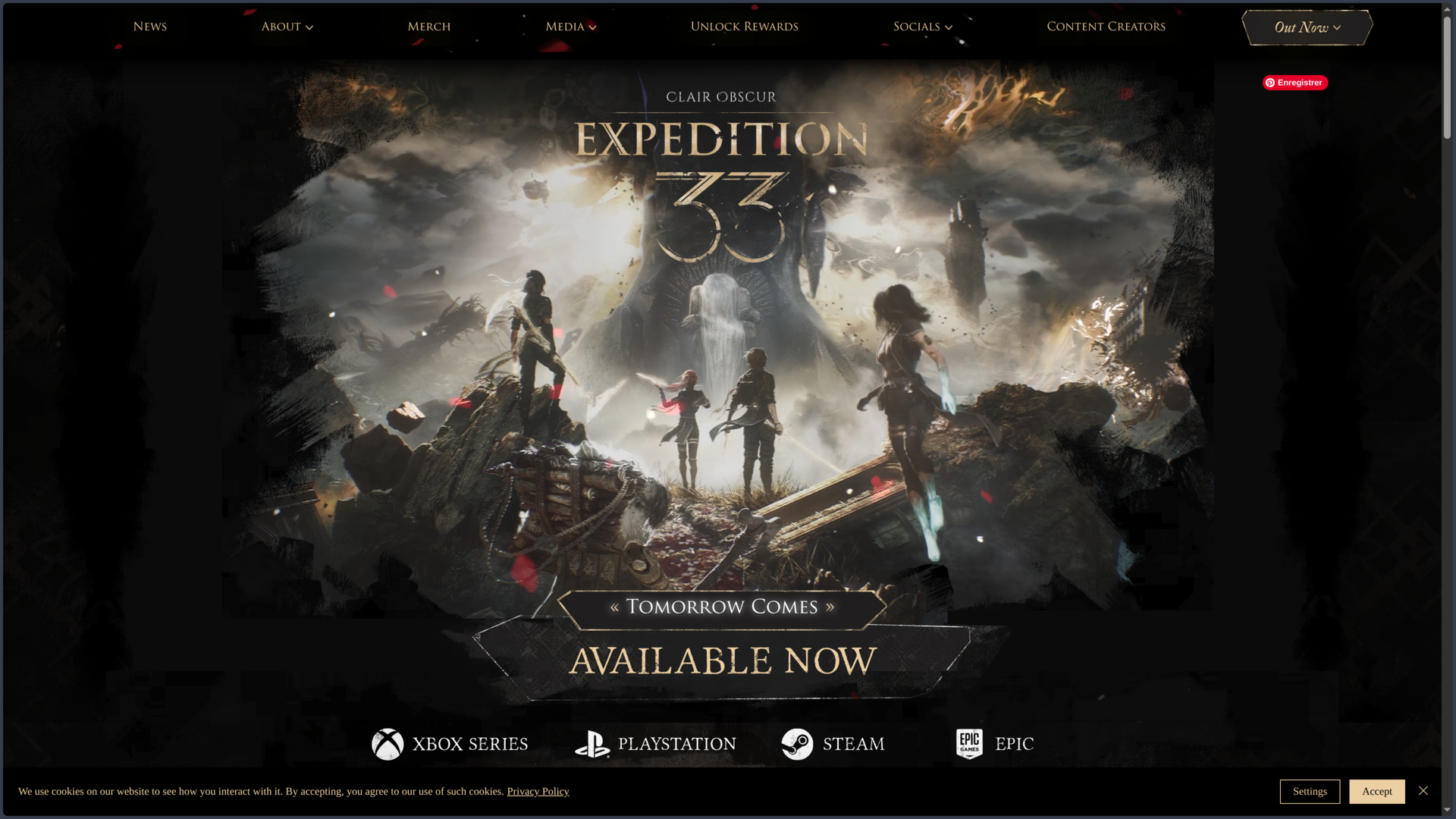
The game launched on April 24, 2025 for PlayStation 5, Xbox Series X|S, and PC after more than five years of development. It was Sandfall’s first commercial game.

What followed went far beyond what a young studio could reasonably consider an ordinary launch. Clair Obscur: Expedition 33 reached five million copies sold in five months, then eight million by its first anniversary in April 2026. It also received the Game of the Year award at The Game Awards 2025 before winning, among other honors, the BAFTA awards for Best Game and Debut Game in 2026.

That success could easily reduce Sandfall to a single label: “the studio behind Expedition 33.”

Yet what makes its journey interesting for PANACHES CULTURE lies as much in the method as in the result. Sandfall built its first work around an industrial question that has become central to contemporary video game development: how far can a small team push the ambition of a production without adopting the structure of a company employing several hundred people?

History

Before Sandfall: an RPG begun as a passion project

The history of Sandfall Interactive begins before the studio existed as a legal entity.

Guillaume Broche was then working in the video game industry while developing a turn-based RPG prototype on the side. He later explained that the project initially had no particular commercial ambition: he simply wanted to create the kind of game he himself wished he could find on the market.

Turn-based combat was already central to that desire.

Broche did not, however, want to reproduce the RPGs of his childhood exactly. He wanted to preserve what he appreciated in their progression systems, character building, and strategic dimension while making battles more active.

This tension between heritage and modernization would become one of the founding ideas of Clair Obscur: Expedition 33.

The project grew through successive needs. When programming became too much for one person, Broche approached Tom Guillermin. When the visual identity required stronger direction, other profiles gradually joined the adventure. Development was therefore structured first around the concrete problems of the game before becoming the work of a company.

2020: the project becomes a studio

In 2020, the team felt that it had both the right core group of collaborators and the right project to go further. Its members left their jobs and officially registered Sandfall Interactive. As early as January 2021, the studio would describe this decision, made during an especially uncertain year, to launch what was still called Project W.

Sandfall’s official website still identifies 2020 as the studio’s founding year.

The current company is legally registered as SANDFALL SAS in the Montpellier commercial register.

The choice of the name “Sandfall” did not tie the company to a specific franchise or universe.

That matters because the studio was built around a method rather than around a pre-existing intellectual property. Its public identity can therefore evolve with future projects without requiring the company itself to abandon its name.

2021: leaving Paris for Montpellier

In April 2021, Sandfall moved from Paris to Montpellier. The core team then consisted of six people before beginning to expand rapidly. By March 2022, Sandfall stated that more than fifteen people were already working on Project W, some from other countries.

The move became more than a simple change of address.

Montpellier gradually became part of the studio’s identity. Sandfall established its main workspace there and, as the project grew, later moved into an early-twentieth-century residence near the historic center that the team nicknamed Le Manoir.

This location also gave the project access to a French institutional environment that would matter during preproduction.

Building big ambitions with a small team requires support

In 2022, Sandfall publicly thanked several organizations that had supported the development of Project W: Epic Games, through a $50,000 MegaGrant, the CNC, particularly through preproduction support and tax mechanisms, and the Occitanie Region. The studio also mentioned the support of friends, relatives, and business angels who had been involved since the project’s early days.

This history adds nuance to the romantic image of a tiny studio creating a spectacular game entirely on its own.

A small team can remain creatively compact while relying on a much larger network of financing, technology, specialized contractors, institutions, and publishing support. That network does not replace the central creative team, but it allows the studio to aim higher than it could if it remained genuinely isolated.

The prototype has to prove that the idea can become a game

By early 2022, Sandfall was nearing completion of a vertical slice of Project W representing more than an hour of gameplay and bringing together the main elements the team wanted to see in the final game.

This stage is fundamental for a young studio.

A concept can work in a presentation, an art direction can be appealing across a few illustrations, and a combat system can seem interesting in an isolated prototype. The vertical slice has to show that all of these elements can actually coexist within a coherent experience.

Sandfall therefore built its project through successive proof rather than through promises alone.

Unreal Engine becomes a way to narrow the gap with major productions

Sandfall gradually adopted Unreal Engine 5 and announced in 2023 that Project W was now running entirely on that generation of the engine, with the team notably exploring technologies such as Lumen and Nanite.

The choice directly matches the studio’s philosophy.

Sandfall considers that contemporary tools allow a small team to produce visually ambitious 3D games using pipelines that would once have been much more difficult to build without considerable resources. During development of Expedition 33, the team would use Blueprint, MetaHuman, MetaSounds, World Partition, Lumen, and Nanite, among other Unreal Engine systems.

The issue is therefore not merely graphical.

A modern engine also provides systems that the studio does not need to develop entirely by itself.

Every month saved on generic infrastructure can be devoted to something more specific to the work itself.

2023: Kepler Interactive enters the story

In March 2023, Sandfall announced that Kepler Interactive would publish Project W. At the same time, the team grew from twelve to twenty-two people, strengthened its collaborations with external specialists in fields such as animation and lighting, and prepared to move into new premises.

The distinction between the two companies must remain clear.

Sandfall Interactive develops the game. Kepler Interactive publishes it. Kepler’s own page for Clair Obscur: Expedition 33 identifies Sandfall as the developer.

The publisher nevertheless provides support that goes beyond simply placing its logo on the box. Production, worldwide distribution, some talent recruitment, and several aspects of the launch benefit from the partnership.

The project remains Sandfall’s.

But Sandfall is no longer carrying it alone.

2023-2024: growing without becoming a large structure

During 2023, Sandfall grew from around eleven to twenty-five people. The studio opened its main workspace at Le Manoir in Montpellier as well as a Paris office containing, among other facilities, a room used for motion-capture sessions.

In June 2024, when the game was publicly revealed, Guillaume Broche still described Sandfall as a team of around thirty developers.

That number quickly became an important part of the narrative surrounding the project because the images being shown resembled productions usually associated with teams many times larger.

The shortcut must nevertheless be avoided.

Around thirty internal developers does not mean that only thirty people contributed to the entire work. Sandfall also works with freelancers, specialists, a publisher, actors, service providers, and various partners.

The small team forms the core.

It is not the entire production chain.

The art direction has to move beyond what the team already knows

The visual identity of Project W evolved considerably during development.

Guillaume Broche has explained that before Nicholas Maxson-Francombe joined the project, the art direction was still not especially convincing. Much of the work was reconsidered once he arrived. The team tried to move away from imagery it considered too familiar and turned toward the French Belle Époque, adding fantasy, surrealism, painterly influences, and forms sometimes inspired by ceramics.

This choice creates an interesting paradox.

Sandfall draws from a profoundly French period in order to create a world that does not attempt to become a historical reconstruction of France.

Lumière resembles Paris without being Paris.

The costumes can evoke the turn of the twentieth century without becoming museum pieces.

The Belle Époque becomes material rather than a cage.

Reinventing turn-based combat rather than replacing it

The combat follows a similar logic.

Sandfall openly embraces its love of turn-based RPGs but rejects the idea that waiting between two commands should be the player’s only form of interaction. Early prototypes combine real-time offensive actions, QTEs, free aiming, dodges, parries, and counters with the strategic structure of turn-based combat.

The objective is therefore not to gradually turn the game into an action RPG.

Turn-based combat remains the central structure.

Real-time actions change the way the player inhabits each turn.

This distinction allows Expedition 33 to preserve skill trees, character builds, passive combinations, and meaningful tactical thinking while also asking the player to read enemy movement.

Sandfall does not choose between two traditions.

It looks for the point where they can meet.

Japanese inspirations pass through a French studio

When the game was revealed, Sandfall explicitly cited its love of fantasy JRPGs and action games. Guillaume Broche has regularly discussed personal references such as Persona, Final Fantasy, and other Japanese RPGs, while the world-map structure itself openly draws from forms that have become much rarer in modern major productions.

Yet Expedition 33 does not attempt to become Japanese.

Its writing, visual imagination, architecture, and part of its sensibility come from a French and European context.

That intersection is precisely what makes the result interesting.

Sandfall takes a game-design language heavily nourished by Japan and uses it to build a work whose cultural identity looks elsewhere.

2024: Project W becomes Clair Obscur: Expedition 33

On June 9, 2024, the first trailer for Clair Obscur: Expedition 33 was shown during the Xbox Games Showcase; Sandfall published its own presentation of the project the following day. After several years of quiet development, the studio finally revealed its first game to the public.

The title already summarizes part of its universe.

Every year, the Paintress writes a number on a monolith and causes everyone of that age to disappear. When the number reaches 33, a new expedition leaves in an attempt to break the cycle.

The narrative device immediately gives mortality a face.

Every year can be counted, and every generation roughly knows when its turn will come. The number is no longer abstract data; it becomes a sentence.

A fantastic story built around characters

Sandfall places considerable emphasis on the narrative dimension of its first game.

Guillaume Broche and lead writer Jennifer Svedberg-Yen develop a story in which the annual disappearance imposed by the Paintress shapes society as much as individual relationships. The studio seeks to provoke very different emotions and build characters strong enough that the player does not experience the expedition as a simple succession of quests.

That ambition also explains the importance placed on voice performances and staging.

The English-language cast notably includes Jennifer English, Ben Starr, Charlie Cox, and Andy Serkis. Broche has explained that some actors were selected through auditions, while Kepler also contributed to finding talent for several important roles.

The size of the internal team therefore does not reduce the importance of performance.

Instead, it encourages the studio to seek those skills elsewhere whenever the project needs them.

Music becomes another voice of the project

The music of Lorien Testard also occupies a particular place within the identity of Clair Obscur. Sandfall presents him as the soundtrack composer and fully integrates him into the creative team highlighted on its website.

That role is not secondary.

The game constantly deals with disappearance, memory, painting, family, and transmission. The music must therefore accompany both the battles and the moments when the world reveals its more fragile side.

After release, the soundtrack itself achieves considerable reach: when the game passes five million sales in October 2025, Sandfall also announces more than 333 million streams of its tracks.

The cultural phenomenon gradually extends beyond the software.

April 24, 2025: the first game finally launches

Clair Obscur: Expedition 33 launches on April 24, 2025 for PlayStation 5, Xbox Series X|S, and PC. After release, Sandfall reiterates that it is the studio’s first game and that its development took more than five years.

The moment is particularly important for a studio with no previously published work behind it.

Before April 24, Sandfall has a promising project.

After that date, it has a work the public can actually judge.

The success abruptly changes the scale of the conversation.

Five million copies in five months

In October 2025, Sandfall announces that Clair Obscur: Expedition 33 has surpassed five million copies sold worldwide only five months after release.

The speed of that success is especially notable for a first game developed by a new team.

It also changes the expectations surrounding the studio.

A first project can be designed almost entirely around the desire to prove that it is possible.

A second project begins with the knowledge that several million people will now be waiting to see what comes next.

Sandfall therefore moves very quickly from the status of a largely unknown young studio to a team watched on an international scale.

The Game Awards 2025: a debut game becomes Game of the Year

At the end of 2025, Clair Obscur: Expedition 33 receives Game of the Year at The Game Awards. The game also wins several other categories, including Best Game Direction, Best Narrative, Best RPG, and Best Independent Game.

The symbolic weight is considerable.

A studio founded only five years earlier receives the top award at one of the industry’s most visible ceremonies for its very first game.

The success does not prove that a small team can systematically reproduce the resources of a major studio.

It demonstrates that a different production organization can sometimes achieve comparable visibility.

The distinction matters.

Sandfall has not invented a universal recipe.

It has demonstrated a possibility.

2026: eight million sales and a first anniversary

On April 24, 2026, for the game’s first anniversary, the team announces that it has reached eight million copies sold.

The studio describes the previous year as something that far exceeded its expectations. Fan art, musical covers, cosplay, discussions, and speedruns show that the reception has extended well beyond sales figures.

A work begins producing its own community when it partially escapes those who created it. Players draw the characters, interpret the endings, replay the music, dress as the cast, and sometimes invent readings the team itself had never considered.

The studio is no longer alone in producing the meaning of its game.

2026: BAFTA also honors a debut game

In April 2026, Clair Obscur: Expedition 33 wins three BAFTA Games Awards: Best Game, Debut Game, and the award for Performer in a Leading Role for Jennifer English.

The combination of Best Game and Debut Game summarizes Sandfall’s situation rather well.

The project is simultaneously recognized as a first work and as a game capable of competing with productions from studios that have existed for much longer.

That obviously guarantees nothing about what comes next.

But few studios begin their catalog with expectations that rise quite so brutally.

2026: from video games to the Musée d’Orsay

In 2026, the world of Clair Obscur also crosses a more unexpected cultural boundary when Sandfall collaborates with the Musée d’Orsay around the event Renoir au Clair Obscur. Screenshots from the game and concept art are presented in the museum’s nave in dialogue with Belle Époque aesthetics and the works on display. Guillaume Broche and Nicholas Maxson-Francombe also take part in a discussion about the artistic references behind the project, while a concert brings more than 1,500 people into the nave.

The encounter has a particular logic.

Painting is not simply decoration in Expedition 33.

It runs through its vocabulary, characters, antagonists, architecture, and even the title Clair Obscur.

Seeing the game enter a museum devoted in part to nineteenth-century art therefore temporarily closes a circle.

The studio borrowed from art history to build its world.

The world then returns to enter into dialogue with that history.

Today: succeeding without losing the reason the studio exists

Sandfall still presents itself today as a studio seeking to produce premium 3D games with the creativity and agility of small teams. Its first project has moved far beyond the stage of an experiment: Clair Obscur: Expedition 33 now has millions of players, international awards, and a cultural presence extending from music to artistic institutions.

The studio’s challenge has therefore changed.

In 2020, it had to prove that a small group could carry its project through to completion.

After 2025, it has to prevent success from erasing precisely what made that organization possible in the first place: proximity, speed of decision-making, personal passion, and the ability to pursue ideas that might not have survived inside a much heavier structure.

What sets it apart

A small team that is not trying to make a “small game”

Sandfall explicitly builds its identity around a fairly simple refusal: a small team does not necessarily have to mean small visual ambition.

The studio believes that modern engines, commercially available tools, and well-designed pipelines allow independent teams to reach a level of production quality that was once far more difficult to access.

That philosophy explains the appearance of Expedition 33.

The studio does not try to disguise its size behind a deliberately minimal aesthetic.

It aims for realistic characters, detailed 3D environments, cinematic staging, and large narrative sequences.

The constraint of size is treated as a problem of method.

Not as an aesthetic obligation.

Agility is a production resource

A small team obviously has fewer people.

It can, however, reduce certain distances between them.

At Sandfall, the founder and creative director can speak directly with the technical lead, art director, designers, or writers without passing through several layers of hierarchy.

That proximity does not automatically make decisions better.

It can nevertheless make them faster.

This is where the studio’s idea of agility makes sense: test, modify, discard, or deepen an idea before it becomes too expensive to question.

Being independent does not mean working alone

Sandfall’s history also demonstrates the limits of the traditional image of the self-sufficient independent studio.

The project benefits from an Epic MegaGrant, support from the CNC and the Occitanie Region, private financing, numerous external collaborators, and publishing support from Kepler Interactive.

That organization is probably more representative of part of contemporary independent development.

Independence can concern structure and creative direction without forcing a company to internalize every skill required for a major production.

The network then replaces part of the permanent payroll.

The studio remains small.

The production itself mobilizes far more people.

Using existing technology instead of rebuilding everything

The choice of Unreal Engine 5 is directly connected to that logic.

Sandfall notably uses Blueprint, MetaHuman, World Partition, Lumen, Nanite, and other engine components to accelerate certain aspects of production.

Every available technology potentially avoids dedicating an entire team to rebuilding an existing solution.

That does not remove the need for engineers.

It allows their energy to be redirected toward problems more specific to the game.

For a small team, that shift can make the difference between a reasonable ambition and an impossible one.

Modernizing turn-based combat without apologizing for it

Another distinctive aspect of Sandfall is its relationship with the turn-based RPG.

The studio does not treat the structure as an embarrassing inheritance that should gradually be transformed into an action game in order to reach a contemporary audience.

It keeps the turns.

But it adds dodges, parries, counters, free aiming, and different timed actions so the player remains engaged during enemy offensives.

The result therefore does not try to answer the question “turn-based or real-time?”

It assumes that both can produce complementary sensations.

Strategy determines what the character attempts.

Execution influences how the action ends.

The game can look toward Japan without copying its cultural identity

Sandfall clearly identifies JRPGs among its major inspirations. Persona, Final Fantasy, and different traditions of Japanese RPG design notably influence the game’s structure, some of its systems, and the importance given to the world map.

But the team does not attempt to artificially reproduce a Japanese aesthetic.

It uses the Belle Époque, French architecture, European painting, and more Western writing traditions to construct its own vocabulary.

That meeting explains much of the singularity of Expedition 33.

The influences remain visible.

Yet the combination does not look exactly like any of them.

France is not merely a backdrop

The French identity of the project extends beyond a few Parisian façades and berets.

The Belle Époque influences the architectural and sartorial setting, while painting structures part of the world’s language. The title itself borrows from the pictorial vocabulary of chiaroscuro. In 2026, Sandfall explicitly describes pictorial art as an integral component of the universe, from its terminology to its creatures and environments.

The studio therefore transforms a historical reference into an imaginary system.

The goal is not to reconstruct 1900.

It is to ask what that cultural memory can become inside a world that never existed.

Artistic references have to become a world, not a moodboard

Sandfall’s art direction accumulates influences: the Belle Époque, surrealism, painting, ceramics, Haussmannian architecture, fantastic forms, and memories of different games. Nicholas Maxson-Francombe has explained that the team deliberately tried to move beyond science-fiction, zombie, and fantasy imagery that felt too familiar in order to discover less expected forms.

The challenge then becomes coherence.

An isolated reference can produce a beautiful image.

A game lasting dozens of hours requires a language strong enough to create different cities, characters, monsters, interfaces, costumes, and environments without feeling like a collage.

Much of the art direction’s success comes from this digestion of its sources.

The combat system wants the player to think and react

The turn-based combat of Expedition 33 does not rely only on its real-time mechanics.

Each character also has distinct systems, skill trees, and different build possibilities. Guillaume Broche emphasizes the desire to allow players to create very different versions of the same character depending on equipment, skills, and passives.

This creates two layers.

The player prepares a system before or during the turn.

Then they have to execute certain actions correctly when the enemy attacks.

A strong build therefore does not automatically guarantee an easy fight.

Good execution does not replace every strategic decision either.

The pleasure comes from the meeting of the two.

The first game is not treated as a preparatory exercise

Many young studios begin with a deliberately contained project in order to build a team, finance the next game, and learn how to finish one.

Sandfall takes almost the opposite approach.

Its first project is already a large-scale 3D narrative RPG, with several playable characters, a complete world, complex combat, an extensive soundtrack, significant staging, and high technical ambitions.

The choice carries an obvious risk.

A studio can disappear before releasing its first game if it aims too high.

Sandfall transformed that risk into part of its identity.

The first game is not the warm-up.

It is already the work the studio was created to make.

Kepler is a publishing partner, not the author of the game

The success of Expedition 33 also makes the distinction between developer and publisher important.

Sandfall Interactive is the studio that develops the game.

Kepler Interactive publishes it and supports its production and distribution. The two companies logically appear together in many credits and awards, but they should not be merged within a cultural entry.

This separation makes the actual role of each more visible.

Without Sandfall, the work would not exist in this form.

Without its network of partners, it probably could not have reached exactly the same scale.

Both statements can be true at the same time.

A work can transform the symbolic scale of a studio in only a few months

In 2024, Sandfall still presents itself to the world as a small team revealing its first project.

In April 2025, the game launches.

By October, five million copies have been sold.

In December, it wins Game of the Year.

In April 2026, it reaches eight million copies and wins the BAFTA for Best Game.

That acceleration is unusual.

It means Sandfall’s public history has unfolded almost entirely in front of the same audience.

There are not yet ten other productions with which to contextualize its success.

For now, a single work carries almost all of the studio’s cultural weight.

The real test may begin after success

Sandfall’s first challenge was finishing Clair Obscur: Expedition 33.

The next one is different.

The studio now knows that it can attract a worldwide audience. It has a recognized property, an award-winning game, a team that has become famous, and expectations its first project did not have to carry.

That situation may encourage rapid growth.

It may also push the studio to reproduce what has just worked.

Yet the identity Sandfall has presented since 2020 rests precisely on a small structure, agility, and the desire to create the games its team would themselves want to play.

The most interesting question in Sandfall’s history is therefore no longer whether it can succeed.

It is to see what becomes of a studio built to make a dream when that dream works far better than expected.

Good to know

  • Sandfall Interactive is a French video game development studio founded in 2020.
  • Its headquarters are located in Montpellier. The legal company SANDFALL SAS is registered in the Montpellier commercial register.
  • The project that would become Clair Obscur: Expedition 33 began before the studio was created, when Guillaume Broche developed it as a passion project alongside his job.
  • Guillaume Broche is the founder, CEO, and creative director of Sandfall Interactive. Before Sandfall, he had worked at Ubisoft as an associate producer and narrative lead on AAA productions.
  • Tom Guillermin is co-founder, CTO, and lead programmer. He had also worked at Ubisoft before Sandfall.
  • François Meurisse is co-founder, COO, and producer, notably responsible for the studio’s business and production activities.
  • Sandfall moved from Paris to Montpellier in April 2021.
  • The project was initially known as Project W.
  • Development notably received a $50,000 Epic MegaGrant as well as support from the CNC and the Occitanie Region.
  • In March 2023, Sandfall announced that Kepler Interactive would publish Project W.
  • Kepler Interactive is the publisher of Clair Obscur: Expedition 33; Sandfall Interactive is its developer.
  • The studio grew from around 11 to 25 people during 2023, then described itself as a team of around 30 developers when the game was revealed in 2024.
  • Sandfall primarily works in Montpellier in a building nicknamed Le Manoir, while part of the team also had access to a Paris space used notably for motion capture.
  • Clair Obscur: Expedition 33 was developed with Unreal Engine 5.
  • The studio cites JRPGs and action games among the major influences on its first game.
  • The world of Clair Obscur: Expedition 33 is notably inspired by the French Belle Époque, combined with elements of fantasy and surrealism.
  • Combat is built around a turn-based structure enhanced by real-time mechanics, including dodges, parries, counters, and free aiming.
  • Clair Obscur: Expedition 33 is the first game published by Sandfall Interactive.
  • The game launched on April 24, 2025 for PlayStation 5, Xbox Series X|S, and PC.
  • It surpassed five million copies sold five months after release.
  • It reached eight million copies sold by its first anniversary on April 24, 2026.
  • Clair Obscur: Expedition 33 won Game of the Year at The Game Awards 2025.
  • The game also won Best Game Direction, Best Narrative, Best RPG, and Best Independent Game at The Game Awards 2025, among other honors.
  • At the 2026 BAFTA Games Awards, Clair Obscur: Expedition 33 won Best Game and Debut Game, while Jennifer English received the Performer in a Leading Role award.
  • In 2026, Sandfall collaborated with the Musée d’Orsay on the Renoir au Clair Obscur event, where game screenshots, concept art, a discussion of its influences, and a concert placed the world of Expedition 33 in dialogue with art history.
  • Sandfall continues to present its philosophy around narrative, visually ambitious single-player experiences produced with the agility of a small team.