Overview
You see a locked door.
In many games, there are two possibilities.
Find the key.
Or wait until the story decides it is time to open it.
In a Larian game, the conversation can quickly become more complicated.
Can you pick the lock?
Break the door?
Go through the roof?
Teleport someone behind it?
Stack crates until you can reach a window?
Turn a character into something small enough to squeeze through somewhere else?
Blow up a wall?
Or discover three hours later that the door never mattered in the first place?
Larian Studios has built itself around questions like these.
Not simply:
“What story do we want to tell?”
But:
“How far can we let the player interfere with that story without everything falling apart?”
Founded in 1996 in Ghent, Belgium, the studio primarily develops role-playing games. It is now known for the Divinity series and Baldur’s Gate 3, but its path has been anything but a smooth rise. Larian itself describes beginning in a small Ghent office before becoming an organization currently spread across seven studios: Ghent, Barcelona, Dublin, Guildford, Kuala Lumpur, Quebec and Warsaw.
Between those two moments, almost thirty years.
Difficult projects.
Contracts with several publishers.
Work-for-hire games.
Ambitions that were sometimes too large.
Periods when the company simply had to figure out how to survive long enough to finish the next project.
Then came a fundamental decision:
take back more control.
Develop.
Finance more itself.
Publish.
Listen directly to players.
And gradually build a very particular way of making RPGs.
In a Larian game, the world is ideally not just a backdrop in front of which the player selects dialogue options.
It is a collection of systems.
The ground can burn.
Water can conduct electricity.
One character may know something another does not.
A race, origin, skill or previous decision can change the way a situation unfolds.
And when four players enter the same adventure together, they are not necessarily required to behave like four perfectly disciplined extras waiting for the main hero to choose the next quest.
Someone can wander off.
Talk to the wrong person.
Steal something.
Start a fight.
And suddenly everyone has a new story to tell.
At Larian, player freedom is not decoration around the RPG. It is the design problem around which almost everything else has to learn how to function.
History
1996: a small office in Ghent
Larian Studios was founded in Ghent in 1996 by Swen Vincke.
The studio still describes Ghent as its place of origin and historical center.
At the time, obviously, there was no Baldur’s Gate 3, no several hundred developers spread around the world, and no rain of awards.
There was mainly the desire to make games.
The early years were much less romantic than the retrospectives written after major success.
Larian took on various kinds of work to finance its activities.
Games.
Applications.
Demonstration technologies.
Consulting work.
The studio had to learn not only how to create, but how to survive.
Its first published game was The LED Wars, a strategy title from the late 1990s.
But the story that would truly define Larian began a few years later.
With a world called Rivellon.
2002: Divine Divinity gives the world a name
In 2002, Larian released Divine Divinity.
The title is strange.
Almost redundant enough to make it sound as if a marketing department had fought with a dictionary.
But behind the name is already much of what Larian would later continue developing.
A vast world to explore.
Objects everywhere.
Characters to interact with.
A structure mixing action, RPG systems, exploration and freedom.
The game tells the story of a struggle against the forces of Chaos in a universe that would become the world of Divinity.
It obviously does not yet possess the systemic sophistication of the studio’s modern productions.
But certain obsessions are already visible.
Explore more than necessary.
Touch the objects.
Leave the main path.
Reward curiosity.
Make the world something more than a decorated corridor.
Divine Divinity did not immediately turn Larian into an international giant.
But it gave the studio something essential:
a world of its own in which it could continue experimenting.
2004-2009: continuing to search for the right form
Beyond Divinity arrived in 2004.
Then Divinity II in 2009. Larian’s current official pages still present both games as part of the series and list their respective release years.
The series did not remain trapped inside one formula.
That was already becoming a constant at Larian.
The studio never seemed completely satisfied with the previous answer.
It changed perspective.
Structure.
Systems.
Technology.
It experimented.
And not every experiment immediately became a reference point.
Larian’s story during this period looks more like a laboratory refusing to close than a perfectly oiled machine.
The studio worked with different publishers.
It depended on partners to bring its productions to market.
And that relationship inevitably influenced what it could make, when it had to release it and how revenue eventually flowed back into development.
After around fifteen years working within that model, Larian would gradually decide to change the relationship completely.
2013: a dragon with a jetpack, because why not
Before that decisive change came Divinity: Dragon Commander, released in 2013.
The game may be one of the best summaries of Larian’s historical tendency to ask:
“What if we mixed all of this together?”
Real-time strategy.
A turn-based campaign.
Political decisions.
RPG systems.
Combat.
And obviously:
a dragon.
With a jetpack.
The concept sounds like a brainstorming session that perhaps should have been stopped slightly earlier.
Larian chose to make the game instead.
Its official page still describes it today as a combination of real-time strategy, turn-based conquest, political decisions and dragon combat.
Dragon Commander was not the game that permanently transformed the company.
But it showed something important.
Larian has never had a particularly narrow idea of what an RPG should be.
Systems can come from elsewhere.
Strategy.
Cooperation.
Simulation.
Tactical combat.
What matters is that they give the player more things to decide.
Divinity: Original Sin: taking back control
The real turning point arrived with Divinity: Original Sin.
After around fifteen years working with different publishers, Larian sought to become much more independent and take responsibility itself for functions such as marketing, localization, public relations and distribution.
Swen Vincke would later devote an entire GDC talk to this transformation toward independence and self-publishing.
The project also used crowdfunding.
Larian now describes Divinity: Original Sin as its first crowdfunded success.
The difference was not only financial.
By regaining more control over the product, Larian could push further into the things that interested it.
And the result looked much more clearly like the studio’s modern philosophy.
Turn-based combat.
Cooperation.
Open exploration.
Environmental interaction.
The ability to discuss certain decisions with your partner.
Elemental systems.
Manipulable objects.
Several possible solutions.
The game was released in 2014.
And this time, something aligned.
Larian’s ambitions.
Its business model.
Its relationship with players.
And the kind of RPG it had been trying to create for years.
The world becomes a system
Divinity: Original Sin formalized one idea in particular that would become essential.
The environment had to be able to participate in gameplay.
A puddle is not simply a shiny texture placed on the ground.
It can become a resource.
Water.
Electricity.
Poison.
Fire.
Steam.
A combat area can change according to the spells and actions of the characters.
The player therefore no longer learns only:
“my spell deals 24 damage.”
They learn:
“my spell changes the situation.”
The difference seems small.
It changes a great deal.
Because when one system can interact with another, the developer no longer needs to manually predict every exact combination in order to create interesting situations.
The rules themselves begin generating stories.
This is where Larian’s RPG gradually becomes systemic.
2017: Original Sin 2 learns to say “yes, but…”
Divinity: Original Sin 2 was released in 2017.
Larian did not simply try to make a larger version of the first game.
Swen Vincke would later summarize the original intention fairly directly: do the same thing, but make it deeper, more engaging and better through a constant process of iteration.
The game expands the formula considerably.
Origin Characters.
Races with specific interactions.
Personal stories.
Tactical combat.
Cooperation.
Consequences.
Objects.
Environment.
Narrative choices.
The possibility of creating your own character or playing one of the already written characters.
The current official page emphasizes precisely this idea:
the world reacts to who you are and the choices you make.
It is almost a perfect description of Larian’s philosophy.
The player should not simply select an answer from a menu.
The game should try to recognize who just spoke.
Origin Characters: being both the hero and a written character
Origin Characters become one of the most important ideas in Original Sin 2.
RPGs often involve a compromise.
Creating a completely custom character gives a great deal of freedom, but can reduce that character’s personal integration into the story.
Playing a predefined hero allows for more precise writing, but reduces customization.
Larian tries to combine the two.
An Origin Character has:
a past;
relationships;
goals;
specific dialogue;
personal conflicts.
But the player can embody them.
They are no longer merely watching that character’s story.
They decide how that character will live it.
This idea would become even more important a few years later.
Astarion.
Shadowheart.
Gale.
Lae’zel.
Wyll.
Karlach.
Baldur’s Gate 3 would not invent this logic.
It would expand it enormously.
Multiplayer as a story generator
Larian also develops a particular approach to cooperation.
In many cooperative RPGs, multiple players essentially means:
the same adventure, with more people during combat.
At Larian, cooperation can be considerably more dangerous.
Players can split up.
Talk to different characters.
Make decisions.
Trigger events.
Have personal objectives.
See information their companions have not seen.
The group itself therefore becomes a source of chaos.
And that chaos produces stories the script could never have written exactly in advance.
The classic:
“You did WHAT while I was talking to the merchant?”
becomes a narrative mechanic in its own right.
Cooperation is no longer simply about sharing fights.
It allows players to share consequences.
2016-2017: Baldur’s Gate enters the story
While Divinity: Original Sin 2 was still in development, another project began.
According to Larian, a small team started working on the story and game design of Baldur’s Gate 3 in late 2016.
In January 2017, Wizards of the Coast officially gave the project the green light.
After the full release of Original Sin 2 in September 2017, the rest of the studio was gradually informed about the new project.
For Larian, the challenge was enormous.
Baldur’s Gate is not just any license.
The first two games hold a fundamental place in the history of the CRPG.
And behind Baldur’s Gate lies something even bigger:
Dungeons & Dragons.
Decades of rules.
Classes.
Spells.
Monsters.
Worlds.
And probably as many opinions about what a Baldur’s Gate game should be as there are players capable of pronouncing “THAC0” correctly.
Adapting Dungeons & Dragons without stopping being Larian
Larian did not simply try to turn the rules of Dungeons & Dragons Fifth Edition into software.
The studio had to make two systems coexist.
On one side:
the rules of D&D.
On the other:
the systemic philosophy developed through Divinity.
The solution inevitably required adaptations.
Surfaces.
Physical interactions.
Movement.
Highly exploitable environments.
A massive dialogue system.
Reactions tied to classes, races, skills and characters.
And above all, the desire to let the player do many things the main path never requires.
Larian worked closely with Wizards of the Coast and placed the game in the Forgotten Realms, using Fifth Edition rules as its foundation.
But the result clearly bears the signature of the Belgian studio.
It is Dungeons & Dragons.
Seen through Larian.
Early Access as a gigantic game table
Baldur’s Gate 3 spent a long period in Early Access before its full release.
That choice continued a method already used with the Original Sin games.
The idea was not simply to sell an unfinished game earlier.
Early Access became a development tool.
Players encountered the systems.
Broke them.
Made unexpected choices.
Found exploits.
Ignored supposedly obvious paths.
And provided an enormous amount of information about what the game truly allowed.
That fits Larian’s philosophy particularly well.
The more freedom you claim to give the player, the more you need to discover what players will actually do with that freedom.
A designer can imagine one hundred behaviors.
A few hundred thousand players will invent the hundred-and-first before lunch.
2023: Baldur’s Gate 3 changes scale
The PC version of Baldur’s Gate 3 was released on August 3, 2023, before the PlayStation 5, macOS and Xbox Series X|S versions later that year.
The success completely changed Larian’s cultural scale.
The studio was no longer simply one of the major names appreciated by CRPG enthusiasts.
It became a developer watched by a much broader audience.
Larian’s official website states that Baldur’s Gate 3 received more than 200 Game of the Year awards, including the top honors from the BAFTA Games Awards, Golden Joysticks, Game Developers Choice Awards, DICE Awards and The Game Awards.
But its importance does not come only from trophies.
The game demonstrates that an RPG that is:
turn-based;
very long;
full of rules;
centered on dialogue;
packed with choices;
and regularly requires the player to read what a spell actually does before using it,
can become an enormous phenomenon.
For years, parts of the industry had sometimes treated certain characteristics of classic CRPGs as commercial limitations.
Larian discovered that they could become strengths.
Provided enough effort was invested in presentation.
Cinematics meet systems
This is probably one of the most important transformations between Original Sin 2 and Baldur’s Gate 3.
Larian already knew how to build choices.
Systems.
Dialogue.
Characters.
But Baldur’s Gate 3 adds a far greater level of spectacle.
Performance capture.
Cameras.
Facial animation.
Cinematic dialogue.
Staging.
Choices are no longer only interesting to read.
They become interesting to watch happen on someone’s face.
That deeply changes the relationship with companions.
A reaction.
A silence.
A glance.
A hesitation.
Systemic writing meets cinematic staging.
And Larian finds a particularly powerful combination:
give the player enormous freedom while making it feel as though the game predicted exactly what they were going to do.
Obviously, it had not always predicted it.
That is precisely the magic trick.
Growing without losing the core
Making Baldur’s Gate 3 also forces Larian to change scale.
The problem becomes organizational.
How do you expand a company without diluting what allowed it to function when it was smaller?
Swen Vincke was already devoting a GDC talk in 2022 to the difficulties of scaling the team while protecting the studio’s core beliefs.
Today, Larian operates across seven locations:
Ghent.
Barcelona.
Dublin.
Guildford.
Kuala Lumpur.
Quebec.
Warsaw.
This organization notably allows development to span several time zones.
But an international structure also creates its own problems.
Communication.
Coordination.
Culture.
Tools.
Decisions.
Knowledge transfer.
The difficulty is no longer simply:
make a good RPG.
It becomes:
make a good RPG with several teams scattered around the world without the result feeling like seven games glued together.
After Baldur’s Gate 3: refusing to become trapped by success
A huge success creates an obvious temptation.
Do the same thing again.
Or, at the very least:
do something else with the same name.
Larian chooses another path.
The studio gradually finishes its major content work on Baldur’s Gate 3 and turns toward new projects.
And one of them brings Larian back to where much of its identity was built.
Divinity.
But not simply as a small interlude between two more important games.
The new Divinity was revealed in 2025.
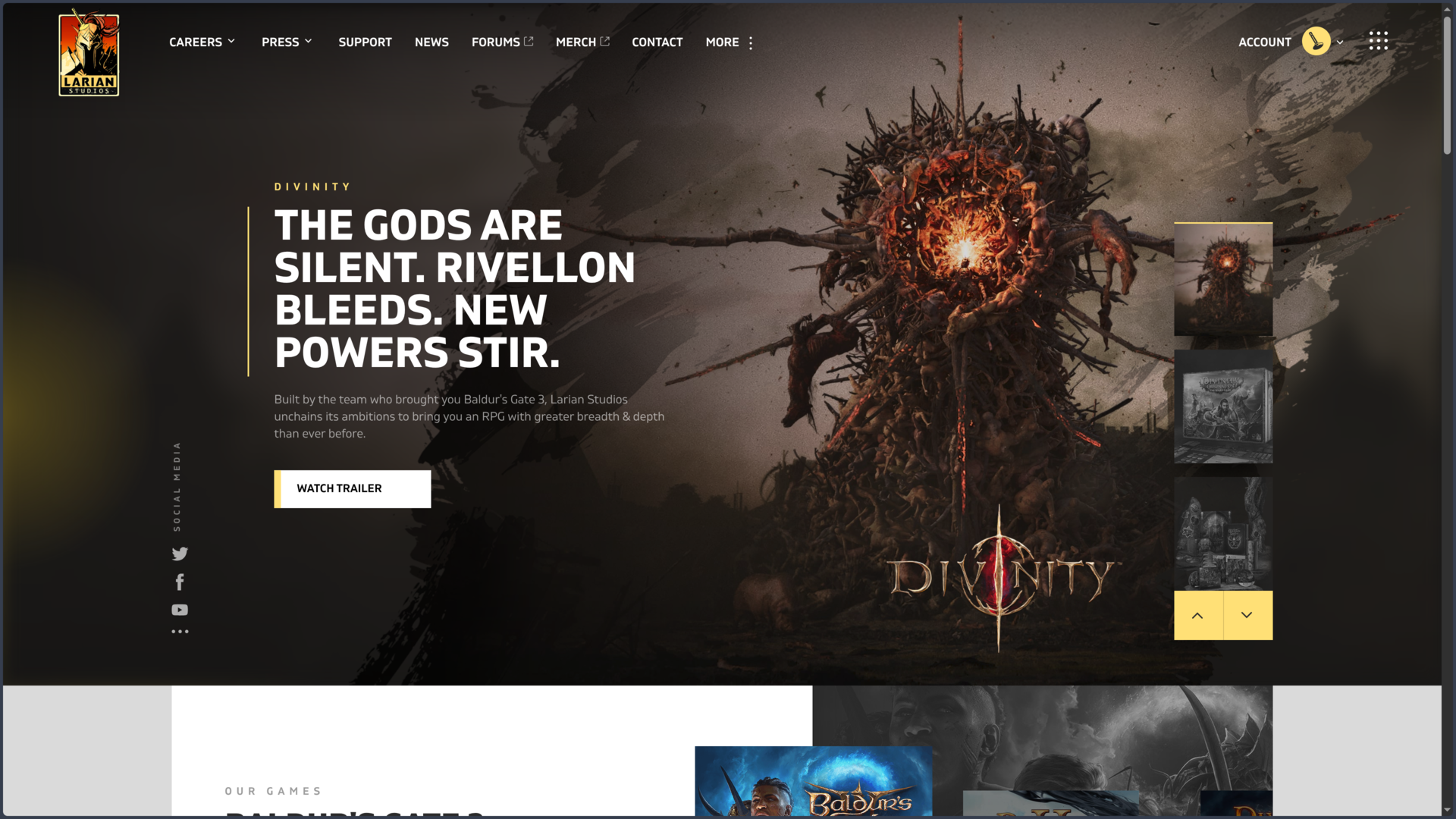
Its current official site presents it as an RPG developed by the team behind Baldur’s Gate 3, with the ambition to offer more breadth and depth than anything Larian has made before.
As of August 9, 2026, no official release date has been announced.
Larian has therefore come home.
But obviously, it is not returning with the same house it had in 2002.
Divinity: returning to Rivellon after Baldur’s Gate 3
The new project occupies a fascinating position in the studio’s history.
Divine Divinity had helped Larian survive.
Original Sin had helped it gain publishing independence.
Original Sin 2 had established it among the major modern names in the CRPG space.
Baldur’s Gate 3 transformed it into a global phenomenon.
And now:
back to Divinity.
The difference is enormous.
Larian no longer needs to prove that a systemic RPG can find an audience.
It now has to answer a much more dangerous question:
what do you do with all that freedom when you finally have the means to realize almost every idea you once had to abandon?
The new Divinity therefore becomes less a nostalgic return than a test.
Larian has more resources.
More experience.
More studios.
More technology.
More expectations.
The risk is no longer lacking ambition.
It may be having too much of it.
What sets it apart
The game should be able to answer: “yes”
One of Larian’s greatest signatures is its willingness to accept the player’s ideas whenever possible.
Not always.
A game is still software.
There are always walls.
But the studio often tries to delay the moment when the system answers:
“Impossible.”
You want to move that object?
Try it.
Burn it?
Try it.
Throw it?
Try it.
Talk to someone using another character?
Try it.
Use a movement ability to bypass the situation?
Try it.
Arrive from somewhere strange?
Try it.
This philosophy obviously comes at enormous cost.
Every additional possibility creates:
potential bugs;
additional interactions;
additional dialogue;
edge cases;
balancing problems;
situations nobody imagined.
But that cost is precisely what creates the feeling of freedom.
Larian does not merely try to give the player several choices. It tries to give them several ideas.
The distinction is fundamental.
A choice exists in a list.
An idea appears in the player’s mind.
Systems need to be able to meet each other
Larian builds many mechanics that do not function only in isolation.
Fire.
Water.
Poison.
Height.
Weight.
Teleportation.
Objects.
Spells.
Electricity.
Terrain.
Stealth.
Dialogue.
Relationships.
Classes.
Origins.
The pleasure often comes from the meeting between two systems.
Not necessarily from each one separately.
A teleportation spell is not only a way to deal damage.
It can move an ally.
An enemy.
An object.
Someone into an ideal tactical position.
Or someone into a place they would probably have preferred never to visit.
The system has a function.
The player invents its use.
That is one of the essential differences between designing a solution and designing tools that allow the player to build their own solution.
The RPG as a consequence machine
Freedom would be meaningless if the world immediately forgot what had just happened.
Larian therefore tries to build reactions.
Who are you?
Who have you spoken to?
Who is alive?
Who is not?
What information do you possess?
What decision did you make?
Which character is present?
Which skill are you using?
Which origin are you playing?
These variables gradually transform the story into a network.
The scenario is no longer simply:
A → B → C → ending.
It looks more like:
A → maybe B → unless D → which may lead to F → unless someone did something completely absurd on the other side of the map.
Obviously, not every branch can become infinite.
The design work consists precisely in letting them diverge enough to feel personal before reconnecting them intelligently.
Turn-based combat as a space for reflection
From the Original Sin games onward, turn-based combat becomes a central part of Larian’s modern language.
That decision matters.
It gives the player time to look.
Measure.
Combine.
Prepare.
Imagine.
Combat is not only a test of execution.
It can become a puzzle.
Where are the enemies?
What height can we reach?
What is inside this room?
What can we push?
Burn?
Move?
Drop?
Turn-based combat slows the action.
But paradoxically, it can increase the number of actions the player is capable of imagining.
Time stops long enough for creativity to enter the fight.
Randomness produces stories
With Baldur’s Gate 3, dice also become extremely visible.
A roll can succeed.
Fail.
Transform a conversation.
Destroy a plan.
Save a situation.
In many games, failure is simply punishment.
At Larian, the goal is often to let failure become another direction.
You fail a check.
The scene continues.
Something changes.
You have to improvise.
It is a philosophy very close to tabletop role-playing.
A bad roll does not necessarily mean:
reload the save.
It can mean:
all right, now this is the story we are telling.
Obviously, not every player resists the temptation to reload.
We are human.
And that save file is right there.
But the system at least tries to make failure interesting before our dignity disappears into F8.
Cooperation accepts chaos
Larian’s multiplayer has another particularity.
It does not always require the entire group to remain perfectly synchronized.
Players can explore separately.
Take part in different conversations.
Trigger events.
Follow their own interests.
That obviously creates disorder.
But that disorder is often exactly where the entertainment comes from.
A cooperative campaign can create memories that are impossible to reproduce exactly during a second playthrough.
Not because the game contains some rare random cinematic.
But because four humans used the systems simultaneously in four incompatible ways.
Larian sometimes turns a lack of coordination into content.
The custom player and the written hero can coexist
With Origin Characters, Larian also tries to solve an old RPG tension.
The fully customized character.
Versus the strongly written hero.
Rather than permanently choosing between the two, the studio offers several levels.
Create someone.
Play an Origin Character.
Meet that character as a companion.
Discover their story from the outside.
Or experience it from within.
This structure dramatically increases the amount of narrative work.
But it produces a powerful advantage:
the same character can be both a potential author of the story and a character inside the story.
The player decides who they are.
Then the game reminds them that this person existed before they started clicking.
Early Access as a design tool
Larian has also made Early Access an important part of its modern development method.
That is not a neutral choice.
Showing a complex RPG before it is finished exposes:
bugs;
imperfect systems;
changes;
missing content;
bad ideas.
But it also provides access to something an internal laboratory can never fully reproduce:
a huge population of players who have absolutely no idea what they are supposed to do.
And that is extremely valuable for a studio that wants to offer freedom.
Developers know the game.
Players do not.
When players misunderstand a mechanic, ignore an obvious path or discover an absurd combination, they reveal something about the actual design.
Larian can then iterate.
This importance of iteration sits explicitly at the heart of Swen Vincke’s postmortem discussions about Original Sin 2.
Independence does not mean a small team
Larian also represents a particular kind of independent studio.
The word can suggest:
a handful of people;
a small office;
a reduced budget;
pixel art made between two coffees.
That is obviously no longer Larian’s reality.
The studio now operates through seven international locations.
But its history of self-publishing remains fundamental to understanding its modern culture.
The independence Larian seeks is primarily about the ability to decide:
which game to make;
how to make it;
how much time to spend on certain problems;
and what should or should not be sacrificed to achieve the chosen vision.
That control also has another side.
When the project blows through its budget:
there is no mysterious outside publisher available to blame for every mistake.
Creative freedom gives you the keys.
It also leaves the bill on the table.
Refusing to turn success into a cage
After Baldur’s Gate 3, Larian could have spent years reproducing the most obvious formula.
Instead, the studio ultimately chooses to return to Divinity.
The decision fits its history rather well.
Larian seems to progress less through repetition than through accumulation.
Original Sin teaches something.
Original Sin 2 develops those lessons.
Baldur’s Gate 3 adds cinematics, scale, richer characters and the experience of working with Dungeons & Dragons.
The new Divinity can now absorb all of that.
Not as a simple Original Sin 3 with more pixels.
But as the next step in an RPG language developed over several decades.
The official website uses a particularly ambitious formulation: an RPG with more breadth and depth than ever before.
That is not a small promise.
After Baldur’s Gate 3, small promises were probably going to be difficult to sell anyway.
Good to know
- Larian Studios was founded in 1996 in Ghent, Belgium. The studio still presents Ghent as its historical birthplace.
- Swen Vincke is the founder of Larian Studios and remains the creative and leadership figure most directly associated with its history.
- Larian’s first published game was The LED Wars, before the studio gradually built its identity around role-playing games and the Divinity universe.
- Divine Divinity was released in 2002 and remains the first major entry in the Divinity universe still presented today in Larian’s official catalogue.
- Beyond Divinity was released in 2004, followed by Divinity II in 2009.
- Divinity: Dragon Commander was released in 2013 and combines real-time strategy, turn-based campaigning, political decisions and direct combat as a dragon.
- Divinity: Original Sin was released in 2014. Larian describes it as its first major success achieved through crowdfunding.
- The development of Original Sin accompanied Larian’s transformation toward greater independence and self-publishing, after around fifteen years working with different publishers.
- Divinity: Original Sin 2 was released in 2017. Its game design notably develops Origin Characters, world reactions to the player’s identity, cooperation for up to four players and systemic tactical combat.
- A small team began working on Baldur’s Gate 3 in late 2016, and Larian received official approval from Wizards of the Coast in January 2017.
- Baldur’s Gate 3 is based on the Dungeons & Dragons universe and Fifth Edition rules, adapted to the game’s needs in collaboration with Wizards of the Coast.
- Baldur’s Gate 3 was released on PC on August 3, 2023, followed by PlayStation 5 on September 6, macOS on September 22 and Xbox Series X|S on December 12, 2023.
- Larian states that Baldur’s Gate 3 has received more than 200 Game of the Year awards, including the top honors from the BAFTA Games Awards, Golden Joysticks, Game Developers Choice Awards, DICE Awards and The Game Awards.
- Larian currently operates seven studios, located in Ghent, Barcelona, Dublin, Guildford, Kuala Lumpur, Quebec and Warsaw.
- The studio remains specialized in RPGs centered on player agency, and describes its own goal as creating immersive RPGs that allow players to shape their own adventures.
- A new game titled simply Divinity was revealed in 2025. It takes place in the world of Rivellon and is currently Larian’s next major announced RPG.
- Larian presents this new Divinity as its most ambitious RPG yet in terms of breadth and depth. As of August 9, 2026, no official release date has been announced on its website.