
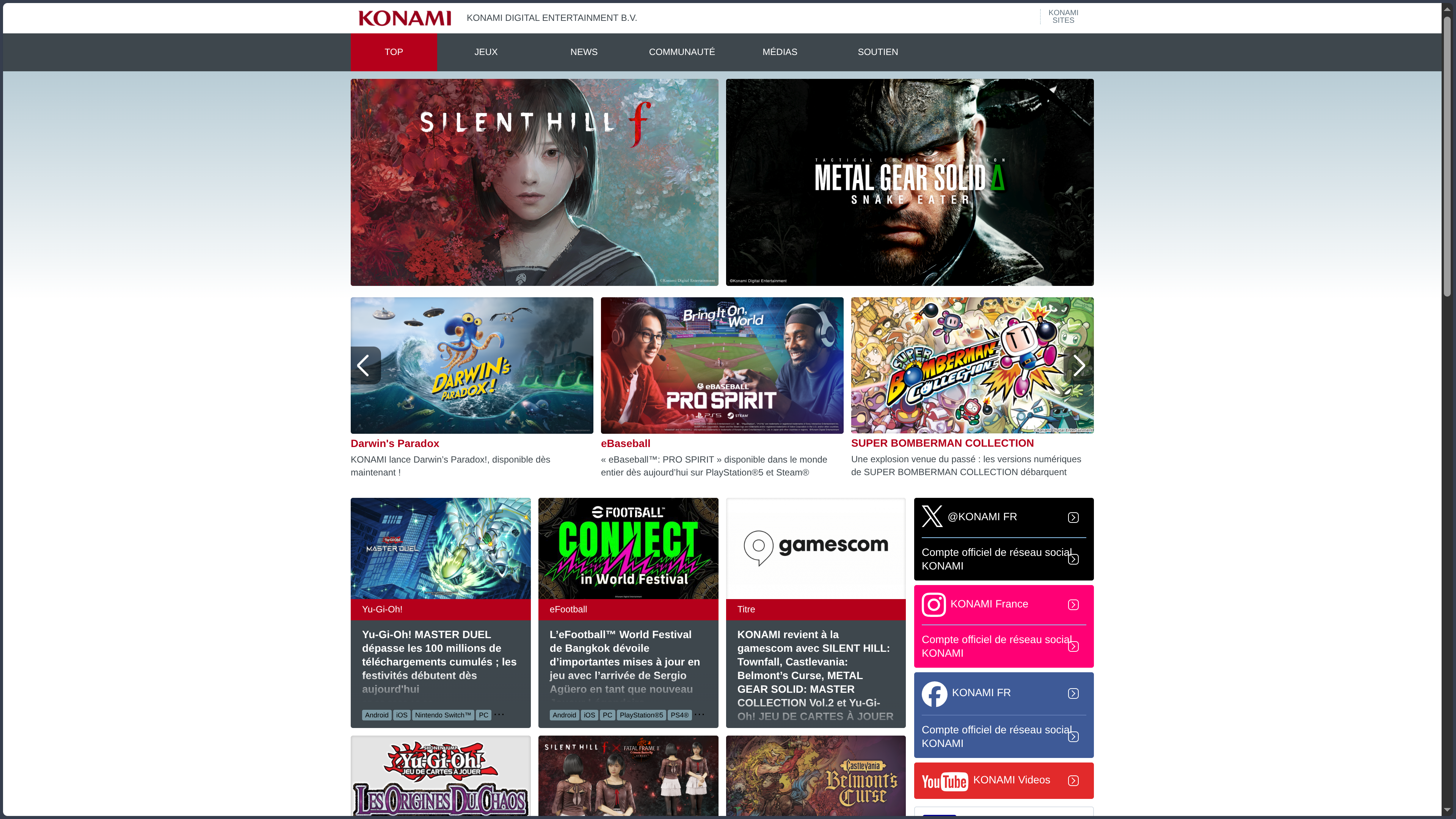
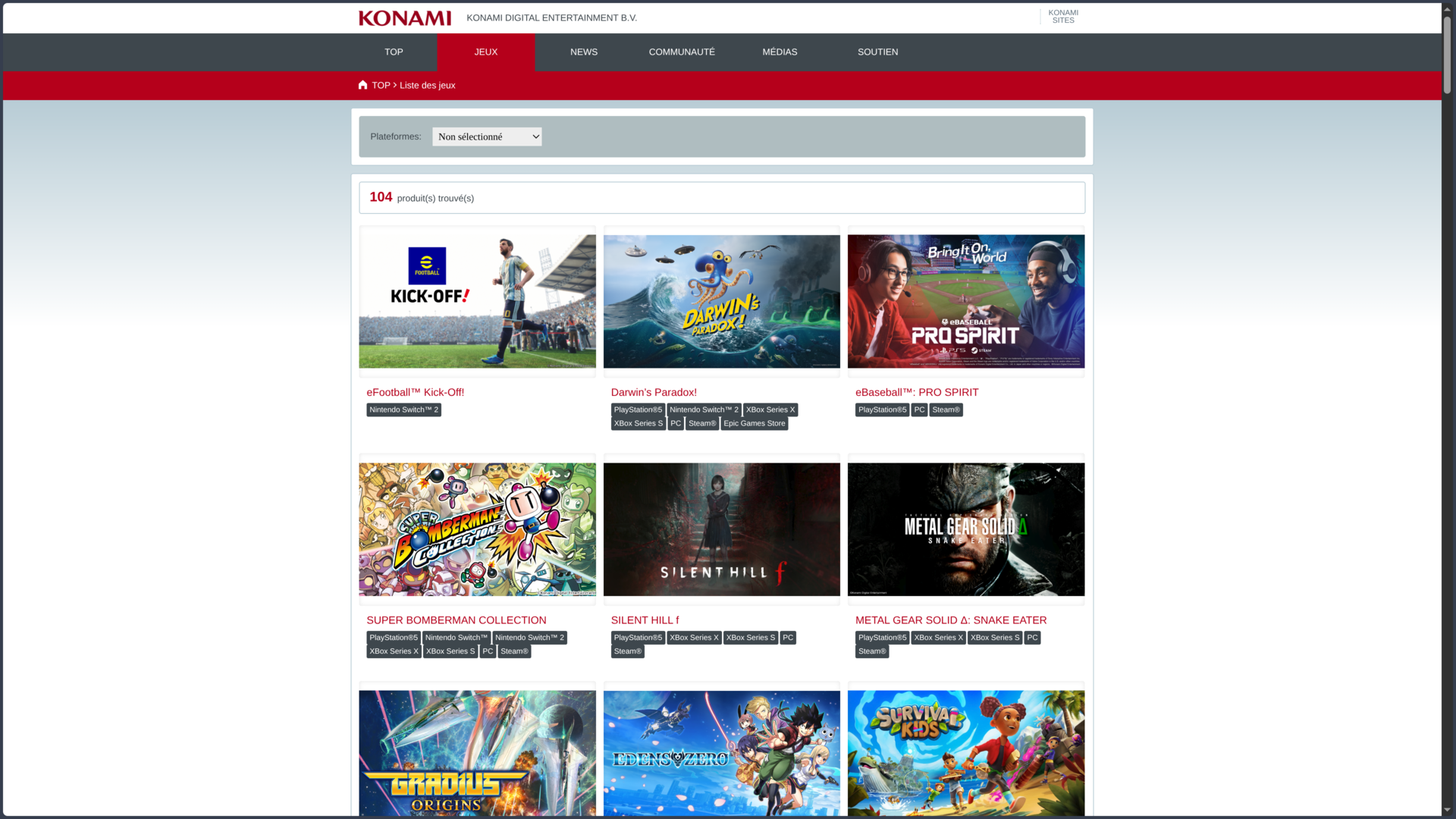
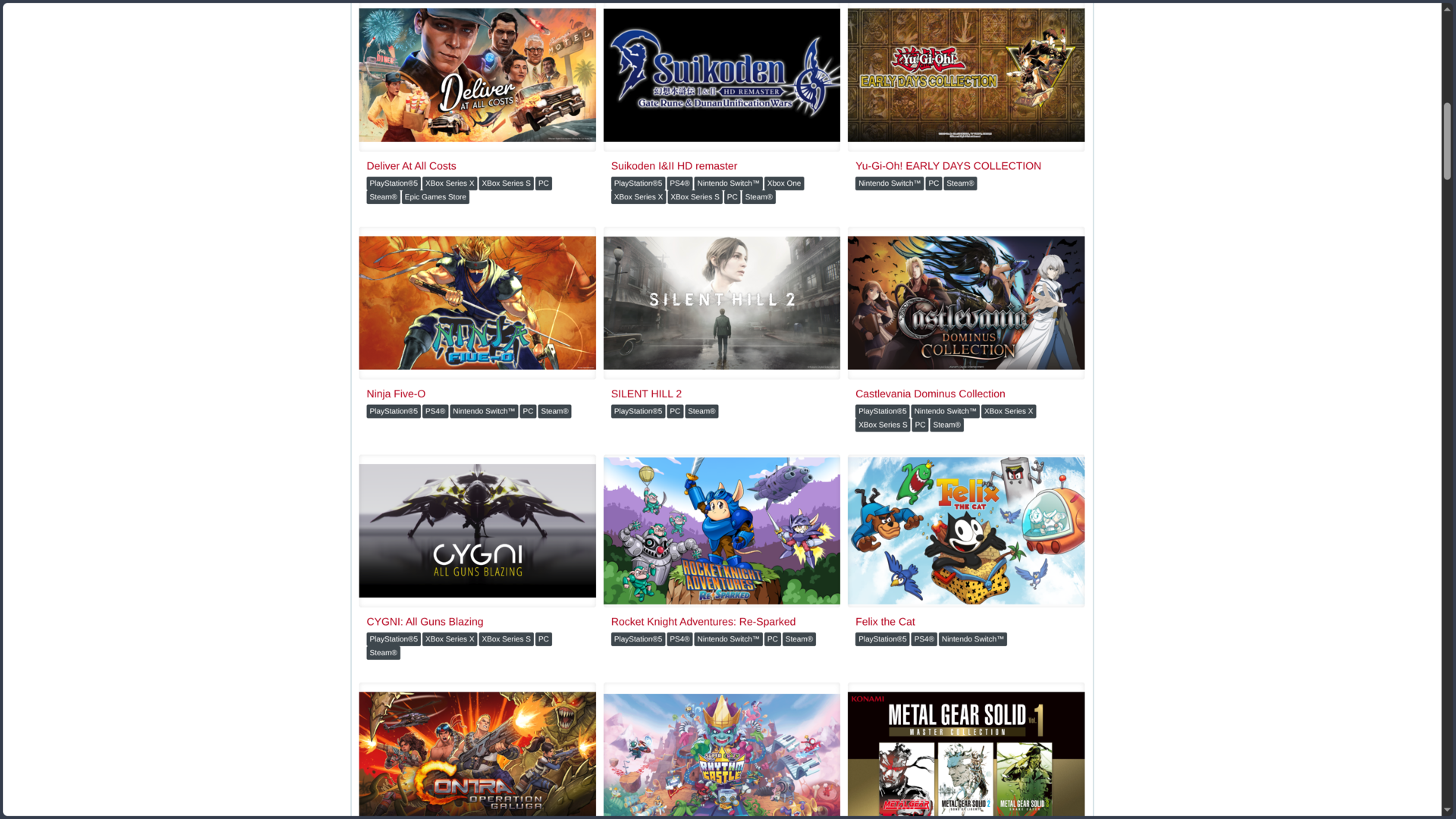
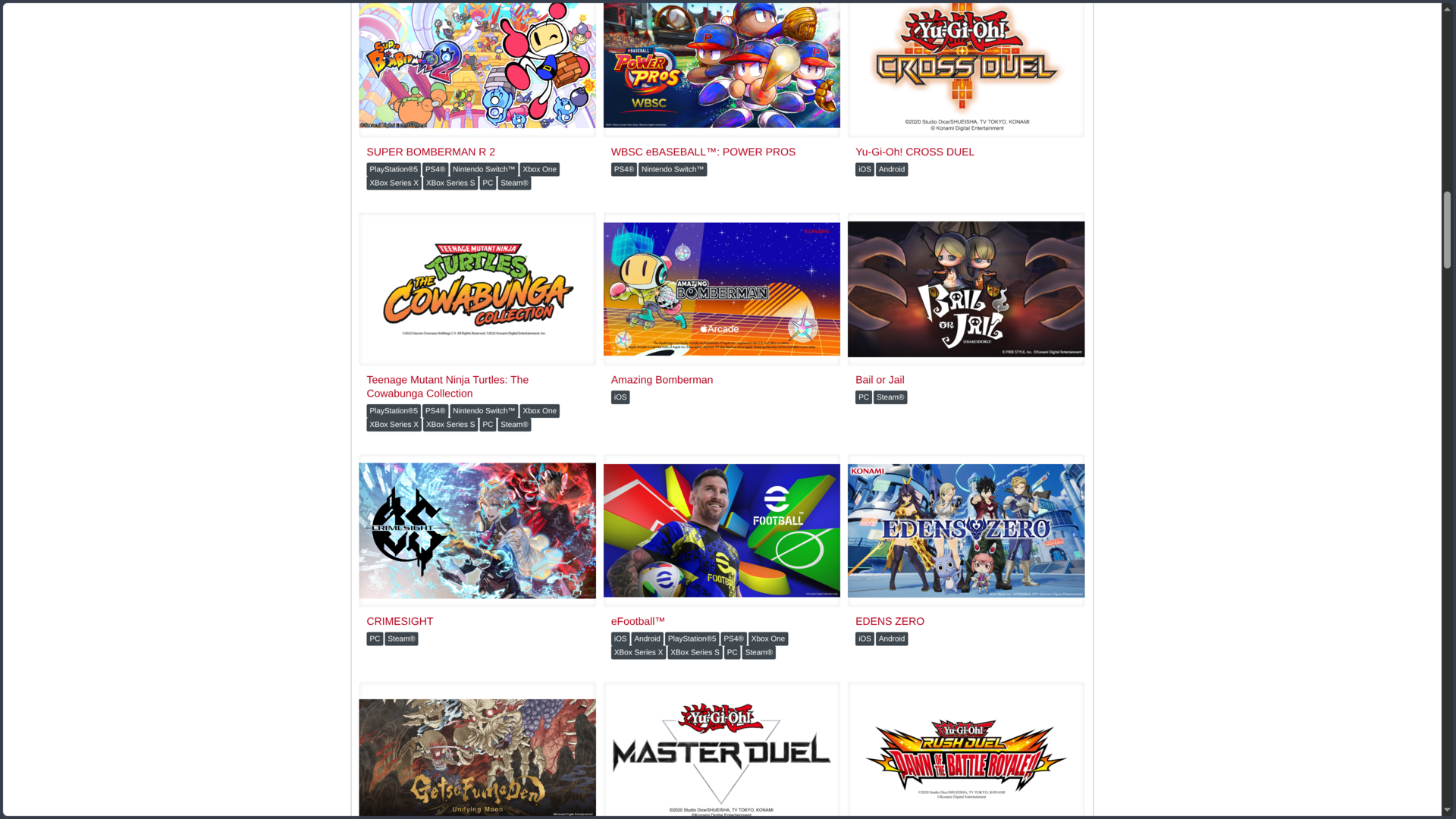
Overview
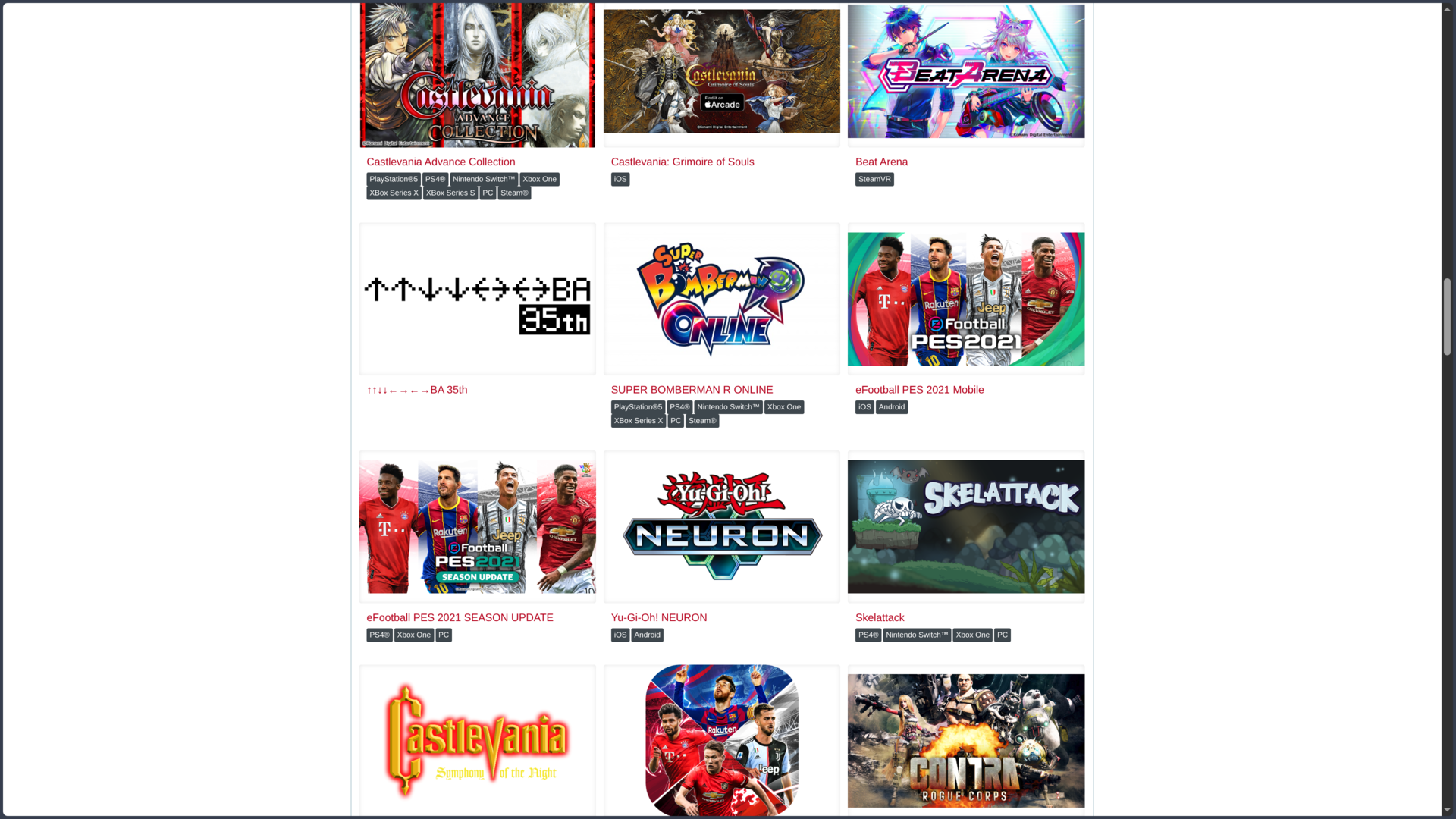
↑ ↑ ↓ ↓ ← → ← → B A.
Even someone who has never finished Gradius may already have encountered this sequence.
The Konami Code has become one of those tiny fragments of video game history that escaped the software where it was born and entered popular culture.
A secret.
A joke.
A wink.
Almost a digital magic spell.
And in a way, it is a pretty good place to begin the story of Konami.
Because this company is difficult to summarize through a single game.
Or even a single genre.
A spaceship crosses a screen filled with projectiles.
A vampire hunter enters Dracula’s castle.
Two soldiers run toward an entire army while shooting in every direction.
A secret agent discovers that sometimes avoiding enemies is more useful than fighting them.
A football player attempts a through ball before even seeing the striker begin their run.
A fog-covered town turns guilt into architecture.
Two duelists place cards on a table.
An arcade machine suddenly asks the player not merely to press buttons, but to move their entire body to the rhythm of music.
Gradius.
Castlevania.
Contra.
Metal Gear.
Winning Eleven / Pro Evolution Soccer / eFootball.
Silent Hill.
Yu-Gi-Oh!
And many others.
Konami has an almost irritating history to summarize because it refuses to remain quietly inside one category.
The company begins in 1969 with a jukebox rental and repair business.
It then becomes a manufacturer of amusement machines.
Then develops arcade games.
PC games.
MSX.
Famicom.
Consoles.
Mobile games.
Cards.
Online services.
Music arcades.
And alongside all of this, the wider group also develops businesses in casino machines and sports.
Konami is therefore not simply a studio.
Today, its video game activity is mainly handled by Konami Digital Entertainment, while the larger group contains several different divisions.
But in the cultural history of video games, the Konami name still sits above dozens of radically different experiences.
So what is the common thread?
Perhaps this:
Konami is very good at turning a rule into a ritual.
In Gradius:
survive, improve your ship, start again.
In Contra:
move forward, learn, die, come back smarter.
In Castlevania:
understand an enemy’s rhythm, the space of a platform, the reach of a whip.
In Metal Gear:
observe before acting.
In PES:
read the pitch a fraction of a second before making the pass.
In Silent Hill:
keep moving even when everything suggests that turning back would probably be more sensible.
In Yu-Gi-Oh!:
build a deck, recognize interactions, imagine the next move.
The worlds change.
The tone changes.
The audience changes.
But much of Konami’s history rests on systems simple enough to understand and rich enough to repeat for years.
Konami has never really had a single genre. Its strange talent has been turning mechanics into habits — and habits into culture.
History
1969: before video games, jukeboxes
Konami’s history begins on March 21, 1969.
Kagemasa Kozuki starts the business in Toyonaka, Osaka Prefecture.
Originally, the company works in the sale, rental and repair of jukeboxes.
No Belmont yet.
No Snake.
No fog.
Not even a Vic Viper.
But already an industry built around a very simple relationship:
a machine;
an audience;
and the desire to repeat an experience in exchange for another coin.
A few years later, that logic naturally leads toward amusement machines.
1973: Konami becomes a company
On March 19, 1973, KONAMI INDUSTRY CO., LTD. is officially incorporated.
The company turns toward the manufacture of amusement machines for arcades.
This distinction between 1969 and 1973 matters.
1969 is the year Konami currently considers its foundation date.
1973 corresponds to the creation of the company that would eventually become today’s KONAMI GROUP CORPORATION.
Those early years therefore place Konami directly inside a machine culture.
Games are not yet something people buy to keep at home.
They need to attract attention.
Be understood quickly.
Create immediate tension.
Then make the player want to try again.
The arcade becomes a school.
And Konami learns several lessons there that it will retain for a very long time.
Readability.
Rhythm.
Difficulty.
Score.
Repetition.
1981: Scramble and the screen that refuses to wait
At the beginning of the 1980s, Konami develops several arcade games that begin establishing its name.
Scramble, released in 1981, becomes an important milestone.
The world moves.
The screen scrolls.
The player does not have time to settle in comfortably.
They have to follow.
React.
Learn.
The game contributes to the evolution of scrolling shoot ‘em ups and directly influences a series that will become one of Konami’s major arcade signatures.
Gradius.
1982-1984: leaving the arcade
In 1982, Konami enters computer gaming.
In 1983, the company develops its activity on MSX.
Then in 1984, it enters the Famicom / Nintendo Entertainment System ecosystem.
The move is fundamental.
The arcade is no longer the only destination.
Games enter the home.
And when a game leaves the cabinet, the relationship with the player changes.
It no longer needs to create a short session designed to encourage another coin insertion as quickly as possible.
An adventure can last longer.
Systems can become more complex.
The player can learn for hours.
Konami will exploit this transformation with remarkable efficiency.
1985: Gradius and the art of making difficulty memorable
In 1985, Konami launches Gradius in arcades.
The player controls the Vic Viper.
The basic form is that of a horizontal shoot ‘em up.
But Gradius builds much of its identity around a very particular upgrade system.
The bonuses you collect do not automatically grant a new ability.
Instead, they move a cursor across an upgrade chain.
Speed.
Missiles.
Double shot.
Laser.
Options.
Shield.
The player chooses when to validate.
So they are not merely collecting power.
They are gradually building their ship.
That mechanic creates another consequence.
Dying hurts.
A lot.
Because you do not only lose a life.
You lose part of the system you had built around yourself.
Gradius belongs to a period when difficulty was not necessarily something designers felt they needed to hide.
It was part of the spectacle.
1986: ten button presses enter history
When Gradius arrives on Famicom in Japan in 1986, a small sequence becomes famous:
↑ ↑ ↓ ↓ ← → ← → B A
The Konami Code.
Originally, the code gives the player a significant advantage.
But its importance quickly exceeds Gradius.
Konami reuses it.
Other games reference it.
Then other developers do too.
Then websites.
TV series.
Software.
The sequence becomes a piece of digital folklore.
There are great technological inventions.
And then there are ten button presses that simply refuse to die.
1986: Castlevania opens the castle doors
That same year in Japan appears Akumajō Dracula, internationally known as Castlevania.
The premise is almost archetypal.
A castle.
Dracula.
A whip.
Creatures.
Candlesticks which, in this universe, are apparently excellent storage locations for weapons.
The first game establishes Simon Belmont and much of the imagery that will accompany the series.
But Castlevania becomes especially interesting through its ability to change.
Linear action.
Exploration.
RPG elements.
More open structures.
Later, with Symphony of the Night, the series contributes to such an influential combination that an entire part of video game vocabulary will eventually attach the Castlevania name to Metroid.
1987: running with Contra, hiding with Metal Gear
The year 1987 perfectly illustrates Konami’s creative strangeness.
On one side:
Contra.
Run.
Shoot.
Jump.
Destroy everything before everything destroys you.
On the other:
Metal Gear.
Avoid.
Observe.
Go around.
Understand patrols.
Reduce unnecessary confrontations.
Two almost opposite philosophies.
And yet both are Konami series.
Contra helps define run-and-gun.
Metal Gear opens an essential path for stealth games.
The Metal Gear idea is particularly strong because it reverses a convention.
In many action games, seeing an enemy means:
fight them.
Metal Gear asks:
are you sure they even need to see you?
That simple question will permanently change part of video game design.
Metal Gear: turning weakness into a system
The first Metal Gear, developed under the direction of Hideo Kojima, rests partly on a technical limitation.
Displaying many enemies and projectiles simultaneously is not ideal on the hardware being used.
The solution could have been to build a less ambitious action game.
The team chooses something else.
It turns the limitation into the concept.
Fewer direct confrontations.
More stealth.
The player must infiltrate a base.
Avoid guards.
Observe their behavior.
Find a route.
The hero becomes interesting not because he can kill everyone, but because the best run may sometimes be the one where nobody realized he passed through at all.
A technical problem has just produced a grammar of game design.
The 1980s: an identity impossible to reduce to one series
By the end of the decade, Konami already has an impressive density of games.
Shoot ‘em up.
Action.
Platforming.
Stealth.
Arcade.
Console.
Computer.
The company also begins expanding internationally, with structures in America and then Europe.
This variety becomes a lasting characteristic.
Konami is not built around one team or one identifiable author.
Its history is more that of a large production house capable of making very different gaming cultures coexist.
Sometimes brilliantly.
Sometimes less gracefully.
1995: the ball begins a thirty-year career
In 1995, Konami launches J.League Jikkyou Winning Eleven in Japan.
This begins the lineage that becomes internationally associated with:
Winning Eleven.
International Superstar Soccer.
And above all:
Pro Evolution Soccer — PES.
Over the following years, the series builds a particular identity.
Football should not merely look like football.
The ball has to feel as though it has weight.
Space has to exist.
A pass can be good even before the receiver is exactly where they need to be.
The competition with FIFA becomes one of the great recurring debates in sports games for years.
During some generations, conversations between players are barely about whether they like football anymore.
They revolve around a much more serious question:
FIFA or PES?
1995: Suikoden and the 108 stars
The same year also begins the story of Suikoden.
An RPG built around political conflict, war, friendship and above all an idea that becomes iconic:
the 108 Stars of Destiny.
The player does not merely gather three or four companions.
They gradually build a community.
An army.
A base.
A network of characters.
Suikoden develops another side of Konami.
Less arcade-driven.
Less immediately mechanical.
More narrative.
But still built around an identifiable system.
Recruiting almost becomes a way of reading the world.
Every new encounter raises a question:
can this person join us?
1997: Castlevania changes structure
With Castlevania: Symphony of the Night, released in 1997, the series deeply transforms the way it organizes space.
The castle becomes vast.
Connected.
Explorable.
Abilities gradually open new areas.
Equipment and statistics gain more importance.
The player no longer simply crosses a succession of levels.
They build a mental understanding of the castle.
An inaccessible corridor becomes a promise.
A door becomes memory.
A new power retroactively transforms a place already visited.
This way of designing exploration obviously does not come only from Konami.
But Symphony of the Night becomes one of the essential games in consolidating that formula.
To the point that the word Metroidvania eventually carries Castlevania in the name of the genre itself.
The late 1990s: when Konami also makes arcades dance
While consoles become increasingly sophisticated, Konami does not abandon arcades.
Quite the opposite.
The company strongly develops its music games through the BEMANI family.
Beatmania.
DanceDanceRevolution.
And other rhythm experiences.
The change is fascinating.
For years, the typical video game interface was:
joystick;
directional pad;
buttons.
With DanceDanceRevolution, the player steps onto a platform and uses their body.
The spectacle also becomes social.
Even someone who is not playing can watch.
Cheer.
Laugh.
Wait for their turn.
The arcade cabinet becomes a stage again.
Konami reminds everyone that arcades do not necessarily need to imitate consoles.
They can create experiences that would feel far less natural in a living room.
1999: Silent Hill turns fog into fear
In 1999, Konami launches Silent Hill.
The game arrives in a landscape where Resident Evil has already firmly established survival horror.
Silent Hill could try to reproduce that formula exactly.
Instead, it chooses another kind of fear.
Fog.
Radio static.
Sound.
An empty town.
Uncertainty.
Fear is no longer simply:
which monster is about to attack?
It becomes:
what does this place mean?
Silent Hill uses its technical limitations to build atmosphere.
The fog hides the draw distance.
But the limitation becomes aesthetic.
You cannot see far enough.
So you imagine.
And imagination works for free.
Silent Hill 2: the monster may come from within
With Silent Hill 2 in 2001, the series pushes its psychological horror much further.
James Sunderland arrives in town after receiving a letter from his dead wife.
From there, space gradually stops being merely a location.
It almost becomes a reading of the character.
Guilt.
Grief.
Desire.
Punishment.
The creatures no longer function only as obstacles.
They can become symbols.
Silent Hill therefore establishes a particular place in video game horror.
The game does not only ask:
are you afraid of this monster?
Sometimes it asks:
why does this monster exist?
1999: Konami also enters card games with Yu-Gi-Oh!
The same period sees the birth of another activity that will become enormous.
In 1999 in Japan, Konami launches the Yu-Gi-Oh! Official Card Game, which becomes the Yu-Gi-Oh! TRADING CARD GAME in international markets.
The change of medium is considerable.
No console required.
No screen.
Two players.
Cards.
Rules.
Decks.
And above all, a structure that can evolve almost endlessly.
New cards.
New strategies.
New interactions.
New formats.
The physical game becomes a platform in itself.
Yu-Gi-Oh! will eventually go far beyond the framework of a manga adaptation.
It becomes one of the major collectible card games in the world.
And Konami finds a new way of doing what it has done since the arcade era:
create a rule strong enough that players want to repeat it again and again.
The 2000s: the catalogue grows tentacles
At the beginning of the 21st century, Konami owns an almost absurd number of active or recent franchises.
Metal Gear Solid.
Silent Hill.
Castlevania.
PES.
Suikoden.
Yu-Gi-Oh!
Contra.
Gradius.
DanceDanceRevolution.
Bomberman will also later join the group’s portfolio through Hudson.
And several series especially important in Japan complete the picture.
The difficulty for a company like this becomes obvious.
How do you maintain all of it?
Not every franchise can receive the same budget.
Not every franchise has the same audience.
Not all of them fit the same platforms.
The catalogue becomes a strength.
But also a management problem.
Metal Gear Solid: stealth becomes spectacle
During this period, Metal Gear Solid occupies a particularly important place.
The first PlayStation entry from 1998 had already turned the formula into a far more cinematic experience.
The sequels continue that ambition.
Staging.
Voices.
Music.
Politics.
Technology.
War.
Information.
Long cutscenes.
Stealth systems that grow increasingly detailed.
With Metal Gear Solid, Konami becomes home to one of the most visible forms of large-scale auteur video game development.
The name Hideo Kojima becomes almost inseparable from the franchise.
That connection will become extremely powerful.
Then extremely complicated.
2006: Konami Digital Entertainment takes its current form
In 2006, Konami Digital Entertainment Co., Ltd. is established as part of the group’s organization.
This company becomes the heart of the business dedicated especially to:
mobile games;
console and PC games;
cards;
IP-related content.
This distinction becomes useful whenever people talk about “Konami.”
The public generally uses that name to mean the games.
But the company in the broader sense is much larger.
It also operates:
arcade games;
machines and systems for casinos;
sports businesses.
Konami has therefore become larger than Konami Games.
And that difference helps explain some strategic decisions that can seem incomprehensible when viewed only from the perspective of console gaming.
The 2010s: the center of gravity shifts
The 2010s become a much stranger period in the way Western audiences perceive Konami.
The market changes.
Mobile becomes enormous.
Online games and persistent services become increasingly important.
The cost of major console productions rises.
Konami strongly develops its digital and mobile businesses.
At the same time, some of its major historical franchises become less visible through new large-scale console entries.
For part of the audience, the impression is brutal.
A company associated with some of the most influential games of previous decades seems to be gradually moving away from the traditional AAA model that built part of its reputation.
2015: Metal Gear Solid V and the break
In 2015, Konami releases Metal Gear Solid V: The Phantom Pain.
The project is enormous.
Open world.
Systemic stealth.
Day-night cycle.
Weather.
Multiple approaches.
Artificial intelligence.
Mother Base management.
The player receives a huge set of tools that allows every mission to become a tactical problem.
It is the culmination of several decades of Metal Gear.
But its release also corresponds with a historic break.
The relationship between Konami and Hideo Kojima ends.
Kojima leaves the company after the project and later relaunches Kojima Productions as an independent studio.
Metal Gear remains Konami’s property.
But one of the most famous creative collaborations in video game history has just ended.
It is impossible to tell Konami’s story without this moment.
Just as it would be reductive to tell the entire company’s story only through it.
Public perception is sometimes different from economic reality
This period creates a paradox.
For some console players:
Konami seems to disappear.
For Konami:
the games business does not disappear at all.
It changes.
Mobile games.
PES.
Yu-Gi-Oh!
Japanese productions.
Online services.
Catalogues.
Arcades.
The company continues producing and operating content.
But some of the symbols that shaped its international image become less visible.
It is a useful reminder.
The cultural importance of a franchise and its immediate economic importance are not necessarily the same thing.
A fan may consider Castlevania one of the centers of the universe.
A publicly listed group also looks at revenue, costs, markets and risk.
Those two logics can collide.
PES becomes eFootball
One of the most visible transformations concerns football.
The series that began in 1995 under the Winning Eleven / PES family gradually evolves into eFootball.
The change goes beyond the name.
The model becomes free-to-play.
Content is updated.
The game spreads across consoles, PC and mobile.
The traditional yearly cycle of sports games gives part of its place to an ongoing service.
The transition is difficult.
Thirty years of habits do not change simply because the logo on the title screen changes.
But the direction reveals Konami’s evolution.
The company no longer necessarily sees a franchise as a box that gets replaced every year.
It can become a platform maintained over time.
The old catalogue starts becoming highly visible again
Then something gradually changes.
Old franchises return to the foreground.
Not all in the same way.
Collections.
Remasters.
Remakes.
New installments.
Partnerships with external studios.
Instead of necessarily producing every project entirely in-house, Konami also relies on collaborations.
This strategy allows a considerable heritage to return to circulation.
Castlevania returns through collections.
Contra returns.
Metal Gear returns.
Silent Hill returns.
Suikoden returns.
Gradius returns.
The past gradually stops being only an archive.
It becomes production material again.
2023: Metal Gear comes back out of the box
In 2023, Konami releases METAL GEAR SOLID: MASTER COLLECTION Vol. 1.
The principle is archival.
Metal Gear.
Metal Gear 2.
Metal Gear Solid.
Metal Gear Solid 2.
Metal Gear Solid 3.
And several additional pieces of content.
The message is simple:
before building a new relationship with Metal Gear, make an important part of its history accessible again.
The collection is not a new installment.
But it is a signal.
The franchise is no longer merely preserved.
It is circulating again.
2024: Silent Hill 2 returns differently
On October 8, 2024, Konami releases the remake of Silent Hill 2, developed by Bloober Team in collaboration with several historical figures from the series such as Akira Yamaoka and Masahiro Ito.
The strategy is interesting.
Konami does not try to rebuild every historic franchise alone.
It can select partners.
Give them access to a property.
Retain oversight.
Then allow another team to rebuild the experience with different technologies and skills.
The remake notably modernizes:
the camera;
combat;
graphics;
sound design;
certain areas.
But it has to accomplish something more difficult:
change the game without destroying the feeling players remember it for.
Its commercial success confirms that carefully reworked heritage can become contemporary again.
At the beginning of 2026, Konami announces that the remake has surpassed five million units worldwide.
2025: Suikoden returns after a long absence
In March 2025, Konami releases Suikoden I&II HD Remaster Gate Rune and Dunan Unification Wars.
Two RPGs from the 1990s return to modern platforms.
Once again, the project does not replace the original.
It makes it accessible.
Reworked graphics.
Improved audio.
Quality-of-life features.
Contemporary platforms.
This logic of active preservation becomes increasingly visible.
An old game is no longer necessarily condemned to survive on:
an old console;
an expensive disc;
an emulator;
or in the memory of a player who has spent twenty years explaining that “the second one really is incredible.”
It can officially return.
2025: Gradius returns to its own roots
In August 2025, Konami releases GRADIUS ORIGINS.
The collection gathers several versions of classic games.
But it does something more interesting than a simple compilation.
It introduces Salamander III.
A new installment.
With an aesthetic deliberately built around the visual language of the old 2D shoot ‘em ups.
It is almost a complete loop.
Forty years after Gradius, Konami does not necessarily try to turn the series into a massive photorealistic 3D shooter.
It can also ask:
what happens if we continue the visual conversation that began in the arcades?
The old language becomes contemporary again precisely because it does not try to hide its age.
2025: Metal Gear Solid Delta rebuilds Snake Eater
On August 28, 2025, Konami releases METAL GEAR SOLID Δ: SNAKE EATER.
The project rebuilds Metal Gear Solid 3: Snake Eater for modern hardware.
The stated objective is particularly conservative in certain areas.
Story.
Characters.
Voices.
Music.
Fundamental structure.
All of these need to remain recognizable.
The environment and presentation are rebuilt.
The remake surpasses one million units sold shortly after release.
The significance goes beyond the number.
Metal Gear must now learn how to exist at Konami without simply continuing the creative organization that produced the previous entries.
Delta is therefore as much a remake as it is a test.
Can the franchise survive the disappearance of its former creative center?
2025: Silent Hill f moves to 1960s Japan
A few weeks later, Konami takes a very different direction with Silent Hill f.
The game is released on September 25, 2025.
This time, it is not a remake of an older entry.
The action leaves the American town traditionally associated with the franchise and moves to 1960s Japan.
Ryukishi07 writes the story.
Kera works on creature design.
Akira Yamaoka returns for part of the music, joined notably by Kensuke Inage.
The project demonstrates the other half of the strategy needed to keep an old franchise alive.
Preserve.
But also:
dare to move it somewhere else.
Silent Hill cannot remain a reproduction of Silent Hill 2 forever.
Otherwise the series becomes its own museum.
Silent Hill f surpasses two million units shipped worldwide in 2026.
The franchise therefore seems to have regained an active place in Konami’s modern catalogue.
2026: Castlevania starts writing again instead of only reissuing
In February 2026, Konami announces Castlevania: Belmont’s Curse.
The project is developed with Evil Empire, with Motion Twin acting as an advisory studio.
Release is planned for 2026.
The setting:
15th-century Paris.
The format:
2D action-exploration.
And above all:
a genuine new Castlevania installment for the series’ fortieth anniversary.
For years, Castlevania has mainly continued to exist through:
collections;
reissues;
adaptations;
collaborations;
spin-off productions.
A major new 2D installment changes the situation.
The catalogue is no longer simply maintained.
It begins growing again.
2026: football keeps changing machine
The eFootball family is now more than thirty years old.
In June 2026, Konami notably launches eFootball Kick-Off! on Nintendo Switch 2.
The detail is interesting because it once again illustrates the group’s multiplatform logic.
Console.
PC.
Mobile.
Switch 2.
Ongoing services.
Competition.
Updated rosters.
Konami football is no longer simply an annual series.
It is gradually becoming an ecosystem.
The name changed.
The business model changed.
The platforms changed.
But the fundamental principle remains exactly what it was in 1995:
put two teams on a pitch and try to understand space a fraction of a second before the other player does.
A catalogue that now looks like an active library
In 2026, looking at Konami’s recent output creates a curious impression.
Gradius.
Metal Gear.
Silent Hill.
Suikoden.
Castlevania.
Yu-Gi-Oh!
eFootball.
Some of these brands are almost forty years old.
Others are more than twenty-five.
And they do not all return in the same way.
Collection.
Remaster.
Remake.
New game.
Free-to-play.
Physical card game.
External partnership.
Konami therefore does not have a single method of resurrection.
Instead, it seems to have understood something simple:
not every old franchise needs the same treatment.
Some need to be preserved.
Others rebuilt.
Others continued.
And some may be better left asleep a little longer until someone finds a genuine reason to wake them.
What sets it apart
A company without a central genre
Nintendo immediately evokes certain types of characters and design.
FromSoftware has a highly recognizable creative identity.
Larian currently builds its image around systemic RPGs.
Konami is much harder to lock into one category.
Shoot ‘em up.
Run-and-gun.
Stealth.
Action-exploration.
Football.
RPG.
Survival horror.
Music games.
Cards.
Arcade.
There is almost no consistency of genre.
The consistency appears elsewhere.
In the strength of the system.
A good historic Konami game often has an extremely identifiable rule.
The Power Meter in Gradius.
Stealth in Metal Gear.
The attack-dodge rhythm of classic Castlevania.
The immediate gunplay of Contra.
The feel of the ball in PES.
The spatial psychology of Silent Hill.
Deck construction in Yu-Gi-Oh!
You can describe the core of the game in a few sentences.
Then spend hundreds of hours trying to master it.
The arcade never completely disappeared from its DNA
Even when Konami develops a narrative game lasting dozens of hours, part of its history comes from somewhere far more brutal.
The arcade.
Understand quickly.
Receive immediate feedback.
Fail.
Try again.
Improve.
That culture perhaps explains why many of its older games remain surprisingly readable.
Contra does not need a forty-five-minute tutorial to explain its intentions.
Gradius reveals its priorities quickly.
A classic Castlevania shows you almost immediately what happens when you mistime a jump.
The game speaks through consequence.
Sometimes with only a limited amount of delicacy.
Turning constraints into ideas
Konami’s history includes several examples where a limitation contributes directly to the identity of a game.
Metal Gear turns the difficulty of displaying lots of action into a stealth principle.
Silent Hill turns technical fog into atmosphere.
Home consoles force arcade designers to rethink length and progression.
Memory limits impose visual or systemic choices.
This mechanism is almost universal in video game history.
But Konami provides several particularly famous examples.
A constraint becomes interesting when it stops being perceived as a problem.
And begins answering the question:
“What if the game worked exactly like this?”
Series capable of changing their own genre
Several Konami franchises do more than evolve within a formula.
They change form.
Castlevania begins as action-platforming and later develops much stronger exploration and RPG structures.
Metal Gear moves from a relatively abstract MSX game to cinematic 3D productions and then to a systemic open world.
PES becomes eFootball and changes business model.
Silent Hill can move from an American town to a Japanese village in the 1960s.
That ability has obviously not always produced graceful transitions.
But it prevents some franchises from becoming simple yearly reproductions.
The author can become enormous — but ownership stays with the company
Konami also has a fascinating relationship with the idea of authorship.
Some works are strongly associated with creators.
Hideo Kojima and Metal Gear.
Koji Igarashi and part of Castlevania.
Akira Yamaoka and Silent Hill’s sonic identity.
Yoshitaka Murayama and Suikoden.
But those creators do not necessarily own the franchises.
The company continues.
That sometimes produces a fundamental tension in industrial video game production.
Who really owns the identity of a collective work?
The company that owns the brand?
The director?
The teams?
The artists?
The players who have interpreted it for twenty years?
The legal answer is often simple.
The cultural answer is much less so.
Modern Konami is particularly interesting precisely because it regularly has to answer that question.
Knowing how to collaborate without producing everything yourself
Konami in the 2020s relies heavily on collaborations.
Bloober Team for Silent Hill 2.
Neobards Entertainment for Silent Hill f.
Evil Empire for Castlevania: Belmont’s Curse.
Different partners contribute to the group’s franchises.
It is a different way of operating compared with the classic image of a publisher maintaining one huge internal team for every property.
Konami can become:
IP owner;
producer;
publisher;
catalogue custodian;
coordinator;
and development partner.
The method carries an obvious risk.
A franchise can lose coherence if it passes from team to team without a clear direction.
But it also carries an advantage.
A universe can meet the team that knows exactly what to do with it.
Heritage is only useful if it remains accessible
Owning Gradius, Castlevania, Metal Gear, Silent Hill or Suikoden is culturally impressive.
But intellectual property locked inside a vault produces no experience.
Recent collections therefore play an important role.
They are not as spectacular as a new AAA production.
But they perform an essential function:
make works available.
Old consoles die.
Physical media age.
Televisions change.
Stores close.
Operating systems evolve.
Commercial preservation is not perfect heritage preservation.
But at least it allows a new generation to encounter the games.
A classic nobody can play gradually becomes a reputation rather than a work.
Nostalgia works better when it creates something new
Konami could perfectly well exploit its history only through compilations.
The risk would be obvious.
Turn forty years of creation into a nostalgia machine.
The most interesting projects are therefore those that use heritage to create something else.
Salamander III inside Gradius Origins.
Silent Hill f.
Castlevania: Belmont’s Curse.
Even Ghost — no, wrong castle.
Konami already has enough vampires without borrowing anyone else’s.
What matters is that the return of a brand has a reason beyond its logo.
An old franchise truly becomes alive again when it starts creating memories that did not exist before.
From sold product to ongoing service
The evolution from PES to eFootball summarizes another major transformation.
Historically:
a game releases.
You buy it.
A new version arrives the following year.
Today:
a service operates.
It receives updates.
Players.
Events.
Updated sports data.
Campaigns.
Competitions.
The relationship is no longer merely transactional.
It becomes continuous.
Konami also uses this Live-Ops expertise in several regions around the world.
This change is one of the major economic shifts in modern video games.
And Konami, a company born around machines people repeatedly returned to in order to play again, strangely finds itself once more inside a logic of continuous attendance.
The technology changes.
The ritual remains.
Cards show that a game does not need a screen
Yu-Gi-Oh! is essential to understanding Konami because it completely broadens what “game” means within its business.
Two people.
A table.
Cards.
A set of rules.
Digital support becomes optional.
And yet the design logic looks very similar to video games.
Interaction.
Deck building.
Metagame.
Resources.
Tempo.
Combinations.
Reading the opponent.
Regular updates to the card pool.
The physical game becomes almost like software updated through printing.
A new expansion modifies the system without anyone downloading a patch.
Machines still matter
Konami has never completely left physical machines behind.
Arcades.
Music games.
Casino machines.
Management systems.
That relationship with hardware recalls its origins.
The company was not born in a bedroom with a personal computer.
It comes from a culture where the experience also passes through an object installed in a physical place.
An arcade cabinet has:
a screen;
controls;
a body;
a sound environment;
a position in space.
The machine is part of the game.
That idea remains especially visible in the group’s arcade and music activities.
A history built from cycles rather than continuous progress
Konami’s history is not:
small studio → masterpiece → growth → even bigger masterpiece.
It is much more irregular.
Highly active franchises.
Then silence.
New directions.
Reorganizations.
Creators leaving.
Mobile.
Collections.
Returns.
Collaborations.
New installments.
Some periods thrill players.
Others frustrate them deeply.
That is precisely what makes the company culturally interesting.
Konami is not a straight trajectory. It is a succession of cycles in which its heritage sometimes disappears long enough for its return to feel almost like a resurrection.
The Konami Code almost summarizes everything
Ten button presses.
A secret designed for one game.
Then reused.
Copied.
Quoted.
Repurposed.
Preserved for forty years.
The Konami Code is obviously not the most important thing the company ever produced.
But it says something about its influence.
Video games sometimes produce more than characters or stories.
They produce gestures.
Sounds.
Habits.
Sequences that the hands remember before the brain even needs to explain them.
And Konami has produced many of those.
Good to know
- Konami considers March 21, 1969 its founding date. Kagemasa Kozuki then began a jukebox sales and repair business in Toyonaka, Osaka Prefecture.
- KONAMI INDUSTRY CO., LTD., now KONAMI GROUP CORPORATION, was officially incorporated on March 19, 1973 and began by manufacturing amusement machines for arcades.
- Konami is classified here as
entrepriserather thanstudio_jeu, because the current group operates in digital entertainment, arcades, casino systems and machines, and sports. - Konami Digital Entertainment Co., Ltd. is currently the group’s main company responsible for video games, mobile games, cards and other digital content. Its current form was established in 2006.
- Konami entered PC gaming in 1982, the MSX ecosystem in 1983 and the Famicom/NES ecosystem in 1984.
- Scramble was released in 1981 and became an important milestone in Konami’s arcade history before Gradius.
- Gradius appeared in arcades in 1985.
- The famous Konami Code appeared in the Japanese Famicom version of Gradius in 1986: ↑ ↑ ↓ ↓ ← → ← → B A.
- The Castlevania series began in Japan on September 26, 1986 with Akumajō Dracula on Famicom Disk System.
- Contra and the first Metal Gear both appeared in 1987, illustrating two almost opposite directions: direct action for one, stealth for the other.
- Metal Gear is one of the series that played a fundamental role in the development of stealth games.
- The football lineage that became Winning Eleven, PES and later eFootball began in Japan in 1995.
- Suikoden also began in 1995 and built much of its identity around the 108 Stars of Destiny.
- Castlevania: Symphony of the Night was released in 1997 and played a major role in the series’ evolution toward an action-exploration structure mixed with RPG elements.
- Silent Hill appeared in 1999 and became one of the major franchises in psychological video game horror.
- Konami launched the Yu-Gi-Oh! Official Card Game in Japan in 1999. The Yu-Gi-Oh! TRADING CARD GAME has become one of the most widely distributed collectible card games in the world.
- Konami’s BEMANI activities played a major role in the rise of music games in arcades, notably through Beatmania and DanceDanceRevolution.
- Metal Gear Solid V: The Phantom Pain was released on September 1, 2015. The project was the final Metal Gear directed by Hideo Kojima before his departure from Konami.
- Winning Eleven / PES evolved into eFootball, now operated as a free-to-play title available across several categories of devices.
- METAL GEAR SOLID: MASTER COLLECTION Vol. 1 was released on October 24, 2023, making several historic entries in the series available again on modern platforms.
- The Silent Hill 2 remake, developed by Bloober Team, was released on October 8, 2024.
- As of January 31, 2026, the Silent Hill 2 remake had surpassed five million units worldwide, according to Konami.
- Suikoden I&II HD Remaster Gate Rune and Dunan Unification Wars was released on March 6, 2025.
- GRADIUS ORIGINS was released on August 7, 2025 and notably includes Salamander III, a new installment developed in the style of the series’ classic 2D shoot ‘em ups.
- METAL GEAR SOLID Δ: SNAKE EATER was released on August 28, 2025 on PlayStation 5, Xbox Series X|S and PC, and surpassed one million units sold shortly after launch.
- Silent Hill f was released on September 25, 2025. It is the first main installment in the series set in Japan.
- Silent Hill f surpassed two million units shipped worldwide in May 2026.
- Castlevania: Belmont’s Curse was announced in February 2026 for release later that year. The game is being developed with Evil Empire, with Motion Twin acting as an advisory studio, and marks the fortieth anniversary of the series.
- eFootball Kick-Off! was released on Nintendo Switch 2 in June 2026, while Konami’s football lineage has now existed for more than thirty years.
- As of March 2026, KONAMI GROUP CORPORATION had more than 9,000 consolidated employees, while Konami Digital Entertainment had more than 2,000 direct employees.
- In 2026, the group’s four official major business sectors are Digital Entertainment, Arcade Game, Gaming & Systems and Sports.