
Presentation
Kepler Interactive looks rather unlike the traditional image of a publisher.
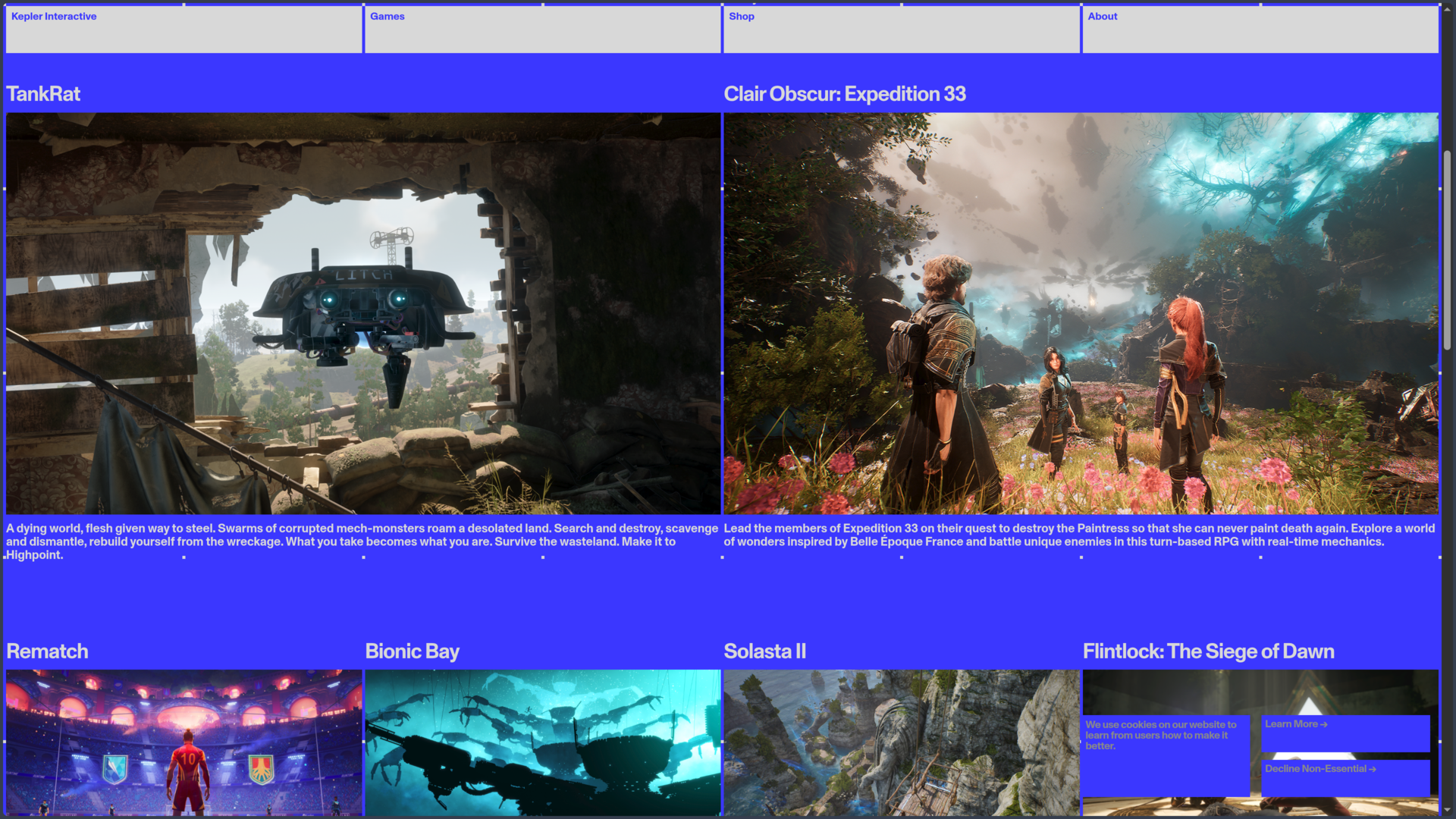
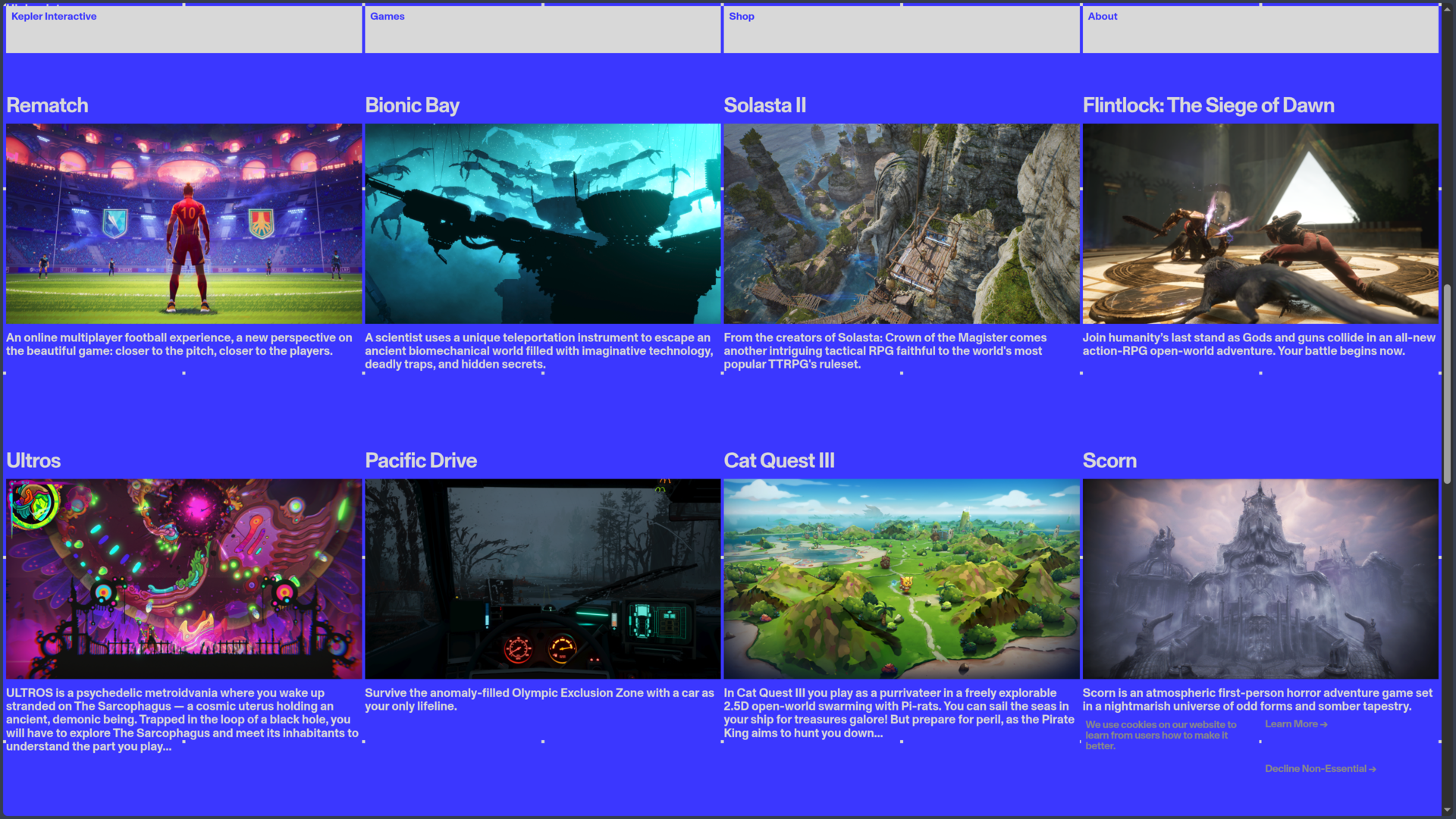
Its catalog brings together games that almost never try to resemble each other: Sifu builds its identity around kung fu and learning, Scorn dives into biomechanical horror, Tchia draws directly from New Caledonia, Pacific Drive turns a car into a refuge, Clair Obscur: Expedition 33 mixes fantasy, Belle Époque, and turn-based combat, while Rematch reinterprets football as a collective action game.
This diversity is precisely its editorial line.
Founded in 2021, Kepler was created around an unusual model: several independent studios participate in the structure while retaining their operational autonomy. NetEase then invested $120 million and became a minority shareholder, giving the new entity significant resources without immediately turning the associated teams into departments of a centralized group.
The idea answers a question that has become central for many independent developers: how to access more funding, marketing, and resources without entirely giving up autonomy?
Kepler then broadened its activity beyond its founding circle. Studios like Ironwood or Sandfall remain independent while working with it as editorial partners. This evolution gradually transforms the initial collective into a true publishing house capable of supporting projects coming from outside.
Its identity does not however rest on a common genre or aesthetic. Kepler seems above all to seek productions whose personality is clear enough not to become interchangeable.
The catalog becomes the signature.
Kepler does not really try to make a "Kepler game." It mainly looks for games able to strongly resemble themselves.
History
2021: building another relationship between publisher and studios
Kepler Interactive appeared in 2021 around several independent development companies, including Sloclap and Alpha Channel.
The model aims to pool resources that are hard to fund alone: publishing, production support, marketing, financing, and access to various expertise. The associated studios nevertheless retain autonomy over their own productions and participate in the structure's major decisions.
This organization differs from a classic acquisition.
Kepler does not simply buy several studios and then promise them they will remain free. The initial idea is to build with them a common structure capable of providing larger resources without removing their decision-making capacity.
The $120 million investment from NetEase gives the project an immediately unusual scale for a new independent structure. But money alone is not enough to create an identity: Kepler still has to demonstrate that very different teams can share a house without being pushed toward a single formula.
2022-2023: diversity becomes the editorial line
The first releases quickly provide an answer.
In 2022, Sloclap's Sifu and Ebb Software's Scorn showed two almost opposite sensibilities. One relies on the precision of martial combat and the player's learning; the other favors a slow, organic, and oppressive experience.
The following year, Tchia, developed by Awaceb, again completely changed universes with an adventure inspired by New Caledonia and its creators' culture.
Three productions were already enough to make one thing obvious: Kepler is not trying to build an identity by asking all its partners to produce the same kind of game.
The coherence comes rather from the strength of intent. Each project must be able to defend an idea, a feeling, or an identifiable art direction.
The collective also becomes a publishing house
Kepler quickly broadened its activity beyond the studios associated with its creation.
Pacific Drive, developed by Ironwood Studios, became an important example. Ironwood did not join Kepler as an internal studio; it remained responsible for development and its identity while Kepler acted as editorial partner.
This relationship shows that the structure is evolving.
Kepler is no longer only a mutualized system between a few founding companies. It becomes a house capable of selecting and supporting external projects while trying to preserve their creators' vision.
The principle remains close to its origin: give more means without automatically asking the studio to become something else.
Clair Obscur: when a singular project changes scale
Clair Obscur: Expedition 33, developed by Sandfall Interactive, represents an important step in this evolution.
The game combines an imaginary France inspired by the Belle Époque, a melancholic fantasy, and a turn-based combat system enriched with real-time actions. This combination fits Kepler's logic particularly well: a project whose personality does not depend on a pre-existing editorial formula.
Its visibility in 2025 shows above all that a catalog built around atypical proposals is not doomed to remain confidential.
A strong identity can become a commercial advantage.
In a saturated market, singularity is not always what prevents a game from being noticed. It can precisely be what makes it visible.
Rematch: allowing studios not to repeat their success
The same year, Sloclap released Rematch with Kepler.
After Sifu, the most obvious solution would have been to stay in martial combat. Sloclap instead chose football and turned the sport into a much more direct multiplayer action experience.
This break says a lot about the relationship Kepler seeks to maintain with its partners.
A studio is not forced to become a prisoner of the project that made it famous. It can change genre or audience as long as the new production has a sufficiently clear vision.
Kepler therefore seems less interested in mechanically reproducing a success than in a team's ability to defend a new idea with the same conviction.
A structure seeking to become broader without becoming uniform
Kepler now presents itself as a video game company and creative studio based in London. Its communication also extends toward influences from art, music, fashion, or cinema.
This openness matches a catalog where several projects already draw their references beyond video games.
The challenge is now that of growth.
A singular editorial line is relatively easy to preserve with a few productions. It becomes harder when the number of partners grows, budgets increase, and some successes naturally create the urge to reproduce what worked.
Kepler's next test will therefore be less to publish more games than to become bigger without starting to make them look alike.
What Sets It Apart
Giving resources without absorbing the vision
Kepler's founding particularity lies in its relationship with developers.
The studios associated with its launch are not only providers coming for funding. They participate in the structure that provides them these resources.
This organization obviously does not eliminate either the economic constraints or the publisher's role. A project must be financed, produced, marketed, and brought to the public.
But the relationship starts from a different principle: the studio's vision must remain the starting point.
This is also what Kepler's "Hands Off" value suggests. It does not mean absence of support. It rather means that the publisher's role is to help a project become viable without immediately replacing it with a formula deemed easier to sell.
A coherence based on difference
Sifu, Scorn, Tchia, Pacific Drive, Clair Obscur, and Rematch share neither a common art direction nor a common genre.
The catalog is nevertheless recognizable for its search for projects with a strong intent.
Kepler thus functions more like a curator than like a factory repeating a formula. Its name does not guarantee a precise feeling of play; it rather suggests that a project was chosen because it has enough personality to justify its presence.
The question is therefore not: "does it look like a Kepler game?"
It becomes: "does it look enough like itself?"
Independence does not require working alone
The Kepler model reminds us that independence and isolation are not synonymous.
Financing, localization, marketing, platform relations, and production expertise require considerable means. A studio may want to keep its creative direction without having any interest in rebuilding all this infrastructure alone.
Kepler precisely seeks this intermediate space.
The actual balance naturally depends on each partnership, but the principle remains interesting: autonomy can also be protected collectively.
A catalog nourished by influences outside gaming
Several productions associated with Kepler draw heavily on cultural references that go beyond the medium.
Tchia is inseparable from New Caledonia. Sifu dialogues with martial arts cinema. Clair Obscur uses a reinvented France and the imagination of the Belle Époque. Scorn invokes a biomechanical aesthetic that goes far beyond video games.
This openness helps avoid a loop where games would only cite other games.
It also gives Kepler additional coherence: publishing works that use video games as a meeting point between several cultures rather than as a single reference.
Good to Know
- Kepler Interactive was founded in 2021 and is headquartered in London.
- The structure was launched around several independent development companies, including Sloclap and Alpha Channel.
- NetEase invested $120 million at launch and became a minority shareholder.
- The original model allows the associated studios to participate in major decisions while retaining their operational autonomy.
- Sifu and Scorn are among the first notable productions associated with Kepler.
- Pacific Drive is developed by Ironwood Studios, an external partner to the founding nucleus.
- Clair Obscur: Expedition 33 is developed by Sandfall Interactive and published with Kepler.
- Rematch, developed by Sloclap, illustrates the willingness to let a team radically change ground after a success.
- Kepler now claims an editorial line attentive to authenticity, know-how, vision, and cultural influences in the broadest sense.