
Overview

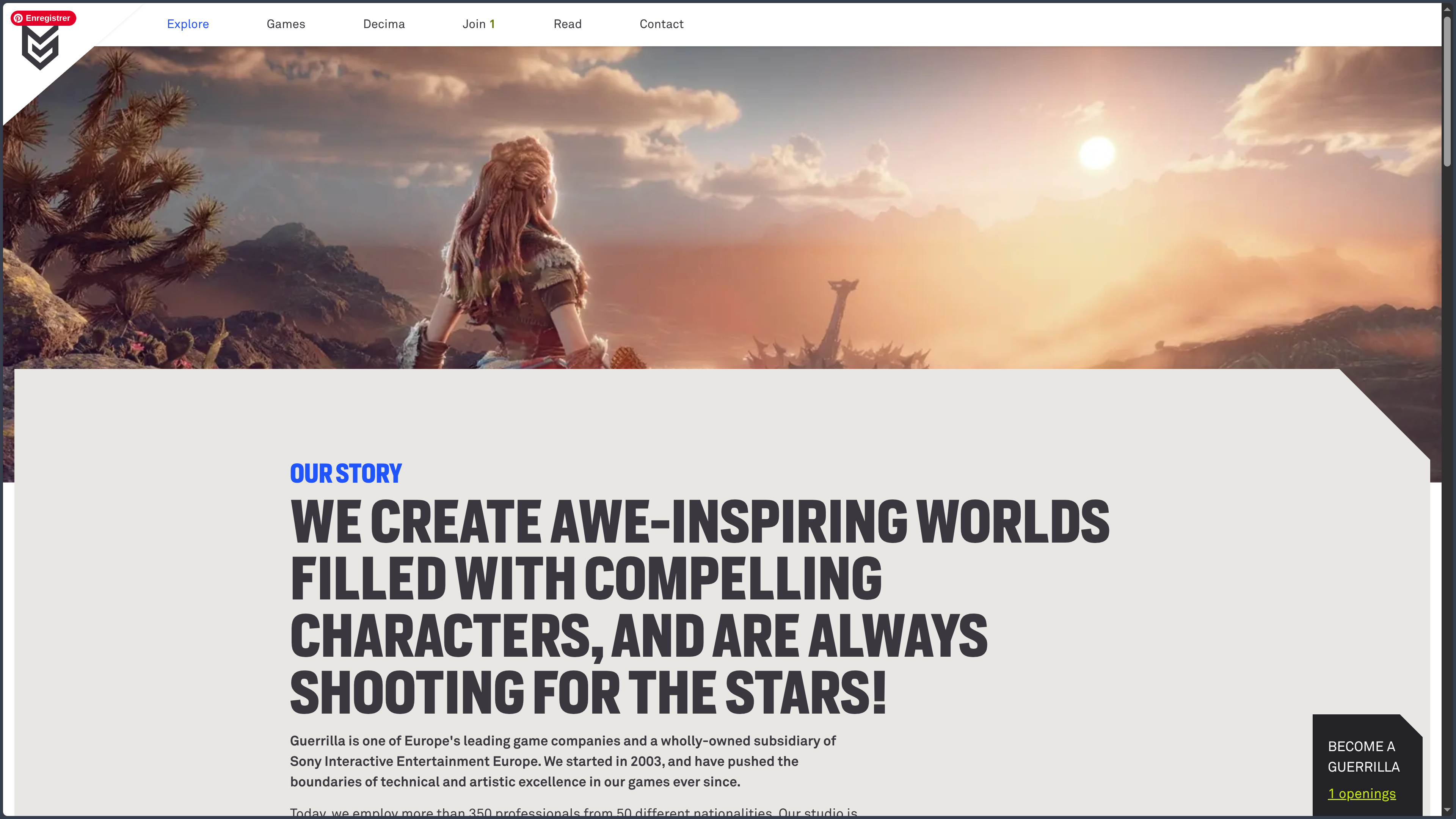
Guerrilla Games is a Dutch video game development studio based in Amsterdam and owned by Sony Interactive Entertainment. The studio officially states that it began operating in 2003. Today, it employs more than 350 professionals representing around fifty nationalities at its studio in the heart of the Dutch capital.

Its modern history can almost be divided into two major periods.

The first is the era of Killzone, a series of shooters that accompanied Guerrilla for more than a decade and helped establish the studio as one of the important technical teams within the PlayStation ecosystem. The second begins when Guerrilla agrees to leave that familiar territory behind to build Horizon Zero Dawn, an open-world action RPG that requires the studio to rethink its tools, artificial intelligence, environment design, and a large part of its production pipeline.

This change of genre is probably the most important moment in its history. Guerrilla does not simply replace science-fiction soldiers with animal-like machines and a new protagonist. The studio moves from relatively contained levels built around tactical encounters to a dense open world where dozens of different types of creatures and characters must move, react, and interact across much larger environments. Its own technical presentations describe this transition as a major transformation of its systems and methods.

At the center of this evolution is also Decima, the technology engine developed by Guerrilla. Its roots lie in the tools created for the Killzone series before evolving to meet the needs of Horizon Zero Dawn. Guerrilla later shared it with Kojima Productions, beginning a technical collaboration that took the engine beyond the studio’s own internal productions.

Guerrilla has belonged to Sony since December 2005. The acquisition came after several years of collaboration and an exclusive development agreement signed with Sony Computer Entertainment Europe in March 2004. The studio then became part of the Worldwide Studios network, now known as PlayStation Studios.

This integration did not, however, trap Guerrilla within a single type of production. Killzone, Horizon, the virtual-reality projects created with Firesprite, LEGO Horizon Adventures developed with Studio Gobo, and newer collaborations around the Horizon universe instead reveal an organization in which the studio develops some games directly while supporting other teams working on projects connected to its technology or properties.

In 2026, this transformation continues with Horizon Hunters Gathering, a cooperative action game developed by Guerrilla for PlayStation 5 and PC. The project takes the machine-hunting concept of the main series and reshapes it around teams of up to three players, showing that the studio continues to use Horizon as a space for experimentation rather than as a fixed formula.

History

2003: Guerrilla begins its history in Amsterdam

Guerrilla officially dates its beginnings to 2003. The studio establishes itself in Amsterdam, a city that has remained its creative and technical center for more than twenty years. That geographic continuity is important enough that Guerrilla still presents Amsterdam today as an essential part of its identity.

The studio emerges at a time when the European video game industry is seeking a larger role in major console productions.

Guerrilla quickly finds its territory.

Military science fiction and shooters become the first languages around which the studio builds its reputation.

2004: Killzone gives the studio a face

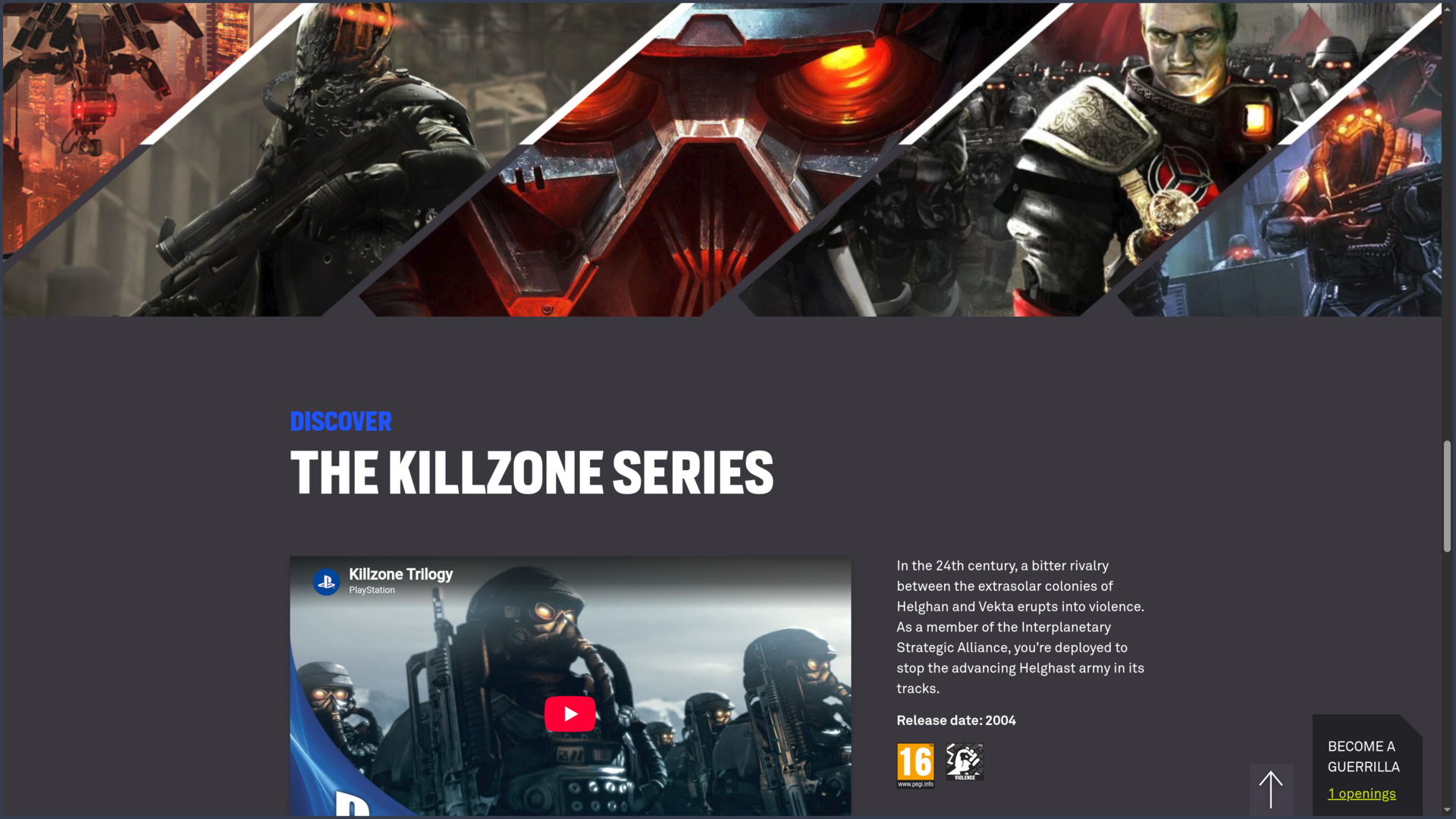
The first Killzone launches in 2004 on PlayStation 2. The game establishes the world of Vekta, the Helghast, and the Interplanetary Strategic Alliance, but above all it places Guerrilla in a much closer relationship with PlayStation. The studio’s current website still considers 2004 the official starting point of the series.

That relationship does not begin after the game’s success.

In March 2004, Guerrilla had already signed an exclusive development agreement with Sony Computer Entertainment Europe. When Sony ultimately acquired the studio the following year, it was therefore formalizing a collaboration that already existed.

Killzone allows Guerrilla to develop around a particularly demanding field: producing shooters capable of serving as technical showcases for PlayStation consoles.

This connection between technology and creation would become lasting.

2005: Sony turns a partner into an internal studio

On December 8, 2005, Sony Computer Entertainment announces the acquisition of Guerrilla. The studio joins the Worldwide Studios network only a few months after the official creation of that global organization intended to bring PlayStation development studios together.

Sony highlights Guerrilla’s combination of creative, technical, and production expertise.

The operation is also revealing of the way PlayStation builds its internal network.

The studio is not acquired before working with Sony.

The creative relationship comes before ownership.

This model would later reappear with other PlayStation studios.

Killzone becomes a PlayStation laboratory

After its acquisition, Guerrilla continues developing the Killzone series across several generations of PlayStation hardware.

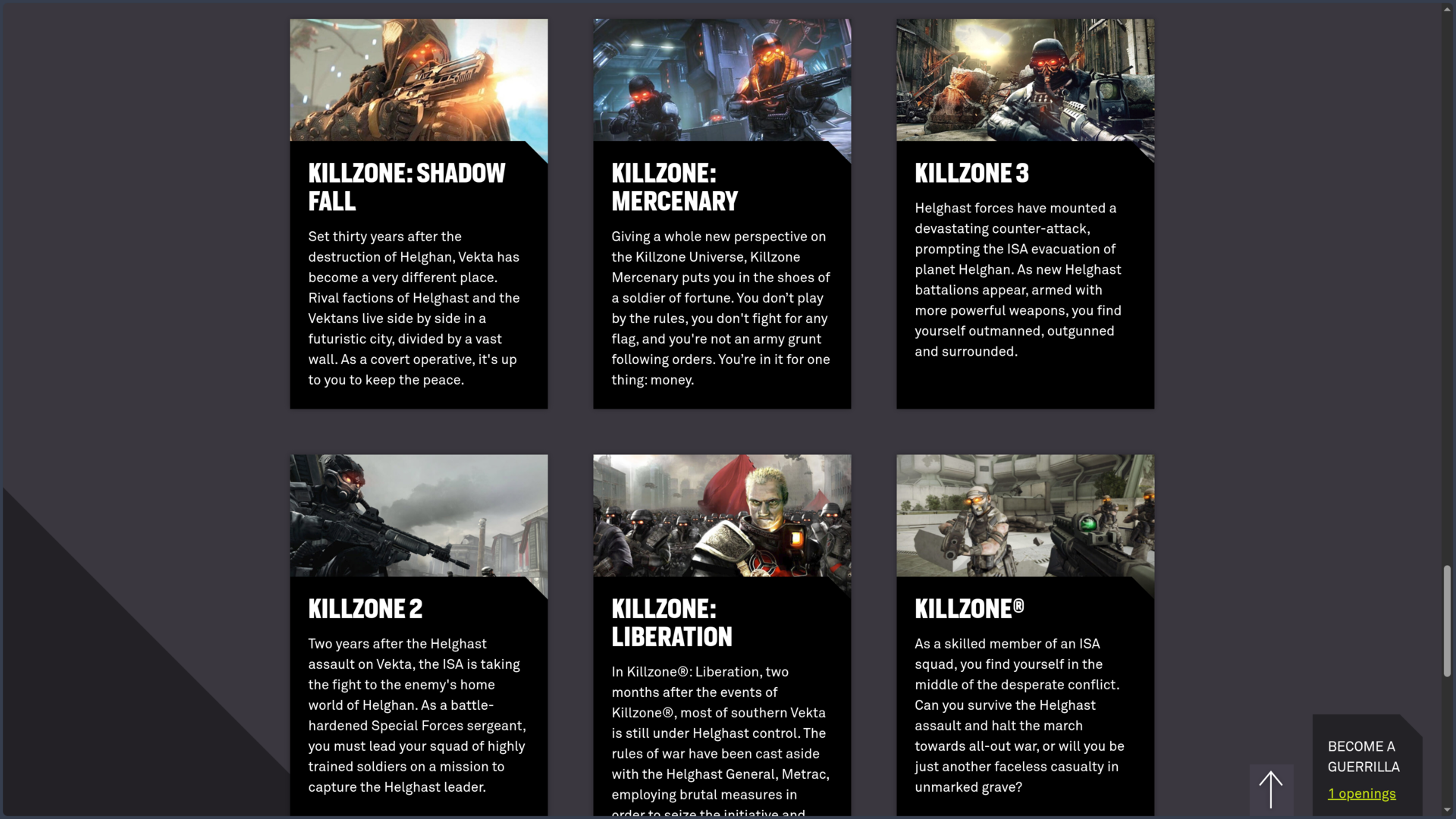
Technical work published by the studio around Killzone 2, Killzone 3, and Killzone Shadow Fall shows constant attention to rendering, artificial intelligence, audio, production tools, and the specific use of hardware. Guerrilla notably documents its work on the PlayStation 3 SPUs, deferred rendering, multiplayer bots, and the systems developed for Shadow Fall on PlayStation 4.

This dimension is important for understanding the studio.

Guerrilla is not only building a series.

At the same time, it is building a technical infrastructure.

Each new project becomes an opportunity to strengthen the tools that will make the next one possible.

Killzone 2 and Killzone 3: technology becomes a visible specialty

At the end of the 2000s and beginning of the 2010s, Killzone 2 and then Killzone 3 reinforce that reputation.

The many technical presentations made public by Guerrilla provide a fairly precise picture of the studio: graphics rendering, AI tools, production, visual effects, animation, and optimization are treated as disciplines that must advance together.

This culture of technical sharing also becomes a lasting characteristic.

Guerrilla regularly publishes presentations and work produced by its developers.

The studio therefore does not present only its finished games.

It also reveals some of the problems encountered during their creation.

2013: Killzone Shadow Fall accompanies the PlayStation 4

Killzone Shadow Fall accompanies the launch of the PlayStation 4 and becomes another demonstration of the close relationship between Guerrilla and PlayStation hardware.

The studio’s technical presentations cover everything from image quality to server architecture, visual effects, art tools, dynamic audio, and lighting.

At that point, Guerrilla could perfectly well continue refining its formula.

The studio has a recognized franchise.

An experienced team.

An engine built across several generations of games.

That is precisely where its history becomes more interesting.

Leaving Killzone means rebuilding part of the studio

For Horizon Zero Dawn, Guerrilla does not simply choose a new intellectual property.

The studio changes genre.

Its developers explicitly describe the transition from the tactical and linear shooters of Killzone to an open-world action RPG as a massive change in direction. The transformation forces the team to build new systems, alter those it already has, and completely rethink its tools pipeline.

The risk is considerable.

A team can become highly efficient when producing several games that resemble one another.

Changing genre means accepting the loss of some of that efficiency.

The problems are no longer the same.

Tools designed for a combat corridor are not necessarily enough to manage an open world.

Horizon demands a new artificial intelligence

The transformation becomes particularly visible in artificial intelligence.

The Killzone games could focus much of their systems on human opponents moving through relatively controlled spaces. Horizon Zero Dawn has to manage more than twenty-five very different types of characters and creatures inside a vast open environment.

Machines therefore become an essential part of the game design.

An enemy has to read as a creature.

It needs behavior.

Components.

Weaknesses.

A way of moving.

A role within the ecosystem.

Artificial intelligence stops being simply a layer of combat and directly contributes to the identity of the world.

Machines connect art, systems, and gameplay

One of the strongest ideas in Horizon lies in its animal-like machines.

Their appearance immediately serves several purposes.

A silhouette identifies a type of threat.

A visible mechanical component can become a target.

A behavior evokes a real animal without trying to reproduce it completely.

Fiction, combat design, and art direction therefore use the same object.

This consistency marks an important break from a more conventional shooter.

The studio’s technology no longer serves only to display more detail.

It has to support creatures whose functioning remains understandable inside a very dense world.

Decima is born from Killzone but grows with Horizon

The engine used by Guerrilla has not always carried the name Decima.

The studio explains that it was initially developed for the Killzone series before evolving to power Horizon Zero Dawn. In 2017, Guerrilla publicly gives it the name Decima as its collaboration with Kojima Productions becomes much more visible.

The engine gradually becomes more than an internal tool.

Guerrilla and Kojima Productions collaborate on its development, while the technology is used for Death Stranding. Decima’s current website also presents the engine as the foundation for Horizon, Killzone, Death Stranding, and other projects.

That openness is unusual for a first-party studio.

A technology developed to serve its own games begins to circulate between several creative cultures.

2017: Horizon Zero Dawn reinvents Guerrilla’s image

Horizon Zero Dawn launches in February 2017.

The game introduces Aloy and a post-post-apocalyptic world in which human societies coexist with enormous animal-like machines. One year after release, Sony announces more than 7.6 million copies sold, making it at the time the strongest launch for a new first-party franchise on PS4.

This success profoundly changes Guerrilla’s public identity.

For more than a decade, the studio’s name had been almost inseparable from Killzone.

From Horizon onward, it becomes possible to see Guerrilla differently.

The studio is no longer only the team behind the PlayStation shooter.

It also becomes the creator of Aloy, the machines, and a world rich enough to be extended in several directions.

The Frozen Wilds: extending a world rather than simply making a sequel

A few months after Horizon Zero Dawn, Guerrilla announces The Frozen Wilds, an expansion adding a new region, additional story content, and new machines.

This first expansion is important for what follows.

Horizon begins to function as a universe rather than as an isolated game.

Aloy can continue her journey.

New tribes can be introduced.

Entire regions can exist beyond those shown in the main game.

The studio now has a world in which several stories can become possible.

2020: Horizon leaves the PlayStation console ecosystem alone

In August 2020, Horizon Zero Dawn Complete Edition arrives on PC. Guerrilla directly supports this new version, which launches on Steam and the Epic Games Store before later reaching GOG as well.

The move is culturally significant.

Guerrilla remains a PlayStation studio.

But its universe is no longer strictly limited to a PlayStation console.

The property begins to reach a different audience, anticipating a broader shift in Sony’s strategy around PC.

2022: Horizon Forbidden West must deepen rather than reinvent

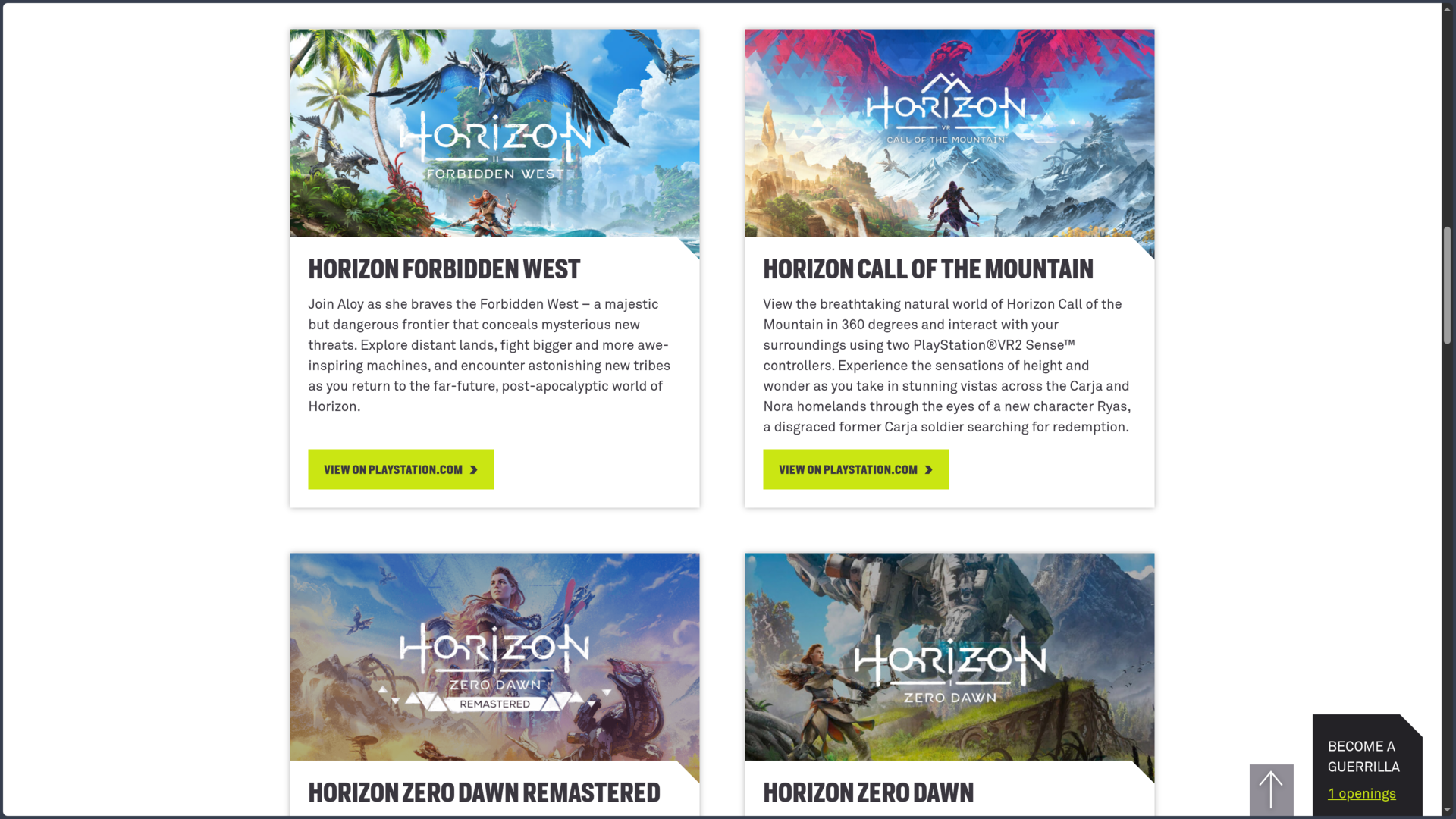
Horizon Forbidden West launches on February 18, 2022 for PlayStation 4 and PlayStation 5. Guerrilla presents the game as a direct continuation of Aloy’s journey, six months after the events of the first title.

This time, the challenge is no longer to prove that Guerrilla can successfully build an open world.

The task is to deepen a formula that is now known.

Underwater exploration, freer climbing, expanded melee combat, and new machines aim to enrich interactions without removing the principles that made Zero Dawn recognizable.

The technology evolves as well.

Work published by Guerrilla shows that Decima now has to manage even richer environments, more assets, and specific behaviors for machines capable of flying or swimming.

Horizon gradually becomes larger than Guerrilla alone

As the property grows, Guerrilla begins sharing it with other teams.

Horizon Call of the Mountain, launched in February 2023 for PlayStation VR2, is jointly developed with Firesprite. The project changes protagonist and adopts a first-person perspective specifically designed for virtual reality.

This collaboration reveals an interesting evolution.

Guerrilla remains the guardian of the universe.

But it no longer has to build every experience set within it by itself.

Consistency across the property becomes shared work.

LEGO Horizon Adventures: letting a different tone enter the world

In 2024, Guerrilla and Studio Gobo co-develop LEGO Horizon Adventures, a lighter and more humorous adaptation inspired by the story of Horizon. The game launches on PlayStation 5, PC, and Nintendo Switch in November 2024.

This transformation matters more than it may seem.

The Horizon universe had until then been strongly associated with a realistic aesthetic, the survival of humanity, and a relatively serious mythology.

The LEGO version accepts bending those codes.

The characters, machines, and places remain recognizable, but the tone changes.

A property strong enough can survive that shift without losing its entire identity.

Decima itself becomes part of technical culture

While Horizon expands, Guerrilla continues to develop and document Decima.

The engine now includes tools covering world creation, animation, game logic, audio, shaders, effects, production tracking, and visual programming. Guerrilla notably presents its NodeGraph framework as a way to let designers and artists create and iterate directly without systematically depending on a programmer.

This direction reflects an important idea within the studio.

Successful technology does not merely produce better images.

It must also allow creators to work more efficiently.

The tool then becomes part of the design.

2025: Horizon begins to be developed outside PlayStation Studios

In November 2025, NCSOFT announces Horizon Steel Frontiers, a cross-platform MMORPG designed primarily for mobile and also playable on PC. The game is developed by NCSOFT with support from Guerrilla.

This collaboration pushes the logic established with Firesprite and Studio Gobo even further.

The universe is no longer shared only with another PlayStation studio.

It can be interpreted by an outside company with its own development culture.

Guerrilla must then take on a different role: helping preserve Horizon’s identity without turning the partner into a simple executor.

2026: Horizon Hunters Gathering returns to multiplayer experience

On February 4, 2026, Guerrilla announces Horizon Hunters Gathering, a new cooperative action game developed for PlayStation 5 and PC. Up to three players can form a team of hunters to fight machines in replayable missions.

Guerrilla explains that the idea of hunting machines together had existed since the earliest thinking around the world of Horizon. The studio also connects the new project to the multiplayer experience it gained during the Killzone years.

That connection summarizes the studio’s history rather well.

Guerrilla never completely abandons what it has learned.

Technologies and ideas change context.

An experience built for a shooter can reappear years later in a very different world.

Today: two decades of history gathered within the same studio

Guerrilla remains based in Amsterdam today, where it brings together more than 350 professionals representing around fifty nationalities. Its public activity is strongly focused on Horizon and Decima, while the history of Killzone remains present in its catalog and in the technical foundations of the engine.

This continuity prevents an overly simple reading of its evolution.

Guerrilla did not become a different studio after Killzone.

It carried part of its expertise into a new territory.

Rendering, AI, tools, attention to PlayStation technology, and multiplayer experience did not disappear.

They changed function.

What sets it apart

Changing genre without erasing accumulated expertise

The transition between Killzone and Horizon Zero Dawn is probably the best key to understanding Guerrilla.

The studio moves from a relatively linear tactical shooter to an open-world action RPG, but it does not truly start over. Its engine, artificial-intelligence expertise, rendering experience, and production methods serve as foundations even when they have to be deeply transformed.

This way of changing is more interesting than a complete break.

The new project forces the studio to learn.

The old one prevents it from having to relearn everything.

Guerrilla therefore moves forward by reusing skills rather than formulas.

A technical culture that does not exist separately from design

Guerrilla has long published extremely detailed presentations about rendering, artificial intelligence, audio, tools, production, and the operation of Decima.

This could create the image of a studio primarily fascinated by technical performance.

Its games nevertheless show that the technology that matters is the technology that produces a perceptible consequence.

In Horizon, AI gives the machines identity.

Streaming allows the studio to build a dense world.

Tools allow designers to iterate.

Volumetric cloud rendering serves the landscape.

Technology is therefore not a layer added after design.

It participates in how the game itself is conceived.

Decima is an engine born from the studio’s real needs

Decima did not appear as a separate product that a team later adopted.

The engine emerged from several generations of development around Killzone before being transformed to answer the problems encountered by Horizon.

That origin explains part of its current philosophy.

Features appear because a production needs them.

The engine has to manage large worlds, enormous amounts of data, real-time rendering, production tools, animation, and complex systems because the games built with it require precisely those things.

The engine and the works therefore grow together.

Building tools so creators can work

Part of Decima’s sophistication directly concerns the autonomy of artists and designers.

Guerrilla explains that it seeks to reduce dependencies on programmers by providing world-creation tools, animation timelines, sequence editing, and visual systems capable of directly manipulating logic, audio, shaders, and effects.

This philosophy shifts the technical question.

The best tool is not only the one capable of performing the most complex operation.

It is also the one that allows the right person to perform it without constantly interrupting someone else.

At large scale, that fluidity becomes a form of performance in itself.

An open world is not simply a question of surface area

Horizon Zero Dawn forces Guerrilla to move from more controlled spaces to large environments capable of containing huge numbers of objects and characters.

The studio’s technical publications show that this change requires new approaches to streaming, visibility, navigation, and artificial intelligence.

It is a reminder that an open world is not merely a larger environment.

Every increase in scale creates systemic problems.

Objects have to be loaded at the right time.

Characters need to know where to go.

Machines have to remain believable.

The player has to perceive the environment without the technology collapsing behind them.

At Guerrilla, the size of the world therefore also becomes a software-architecture problem.

The machines work because they are simultaneously characters and systems

The machines of Horizon are probably the most immediately recognizable idea created by Guerrilla.

Part of their strength comes from functioning on several levels at once.

They have silhouettes and animations that evoke animals.

But they are also combat systems made of destructible elements, weapons, behaviors, and vulnerabilities.

The player can therefore observe them as creatures while reading them as problems to solve.

This dual function directly links art direction, animation, AI, and combat.

It reflects particularly well the way Guerrilla combines visual creation with systemic architecture.

A property can become larger than its original studio

With Firesprite, Studio Gobo, and then NCSOFT, Guerrilla has gradually accepted that Horizon can be interpreted by other teams.

This evolution requires a different form of creative control.

The studio cannot simply ask every partner to make exactly the same game.

Call of the Mountain has to work in virtual reality.

LEGO Horizon Adventures has to accept a much lighter tone.

Steel Frontiers has to meet the demands of an MMORPG.

Consistency therefore cannot come from a single mechanic.

It has to come from a sufficiently solid collection of characters, machines, visual rules, and ideas capable of supporting several interpretations.

Sony provides stability without erasing geographic identity

Guerrilla has belonged to Sony since 2005 but remains deeply associated with Amsterdam.

The studio still describes itself as a company located in the heart of the city, where developers from dozens of countries work together.

That combination is interesting.

Guerrilla belongs to a global organization.

Its games are produced for an international audience.

Its working environment is itself strongly multicultural.

But the company has not been geographically absorbed into an American or Japanese headquarters.

Amsterdam remains its anchor.

A PlayStation studio that also contributes to the wider ecosystem

Guerrilla produces PlayStation games, but Decima has also served as a bridge to other studios.

The collaboration with Kojima Productions is the clearest example: Guerrilla’s engine is used for Death Stranding, while the two teams collaborate on its evolution.

This situation gives the studio a broader role than that of a simple franchise producer.

Technology developed in Amsterdam can influence the creation of a game designed by another team.

Tools then become another way of contributing to PlayStation culture.

Do not confuse intellectual property with an immutable formula

Horizon begins as a single-player open-world action RPG.

It later becomes a VR experience, a LEGO adaptation, an MMORPG project developed by NCSOFT, and a cooperative action game with Horizon Hunters Gathering.

That diversification naturally carries risk.

By multiplying forms, a property can lose what makes it recognizable.

But it can also demonstrate that a universe is strong enough not to depend on a single gameplay structure.

Guerrilla appears to be testing precisely that limit today.

Horizon is no longer only one type of game.

It is gradually becoming a space in which several types of games can exist.

Good to know

  • Guerrilla Games is a development studio based in Amsterdam, the Netherlands. Its legal entity is Guerrilla B.V.
  • The studio officially states that it began in 2003, the year retained for annee_creation.
  • Guerrilla currently employs more than 350 professionals representing around 50 nationalities.
  • Killzone began in 2004 and became the first major franchise associated with the studio.
  • Guerrilla signed an exclusive development agreement with Sony Computer Entertainment Europe in March 2004.
  • Sony Computer Entertainment acquired Guerrilla on December 8, 2005, integrating the studio into Worldwide Studios.
  • The engine now known as Decima has its roots in technology developed for the Killzone series.
  • Horizon Zero Dawn forced Guerrilla to move from a tactical, linear FPS to an open-world action RPG, requiring a major reconstruction of its tools and systems.
  • Horizon Zero Dawn launched in February 2017 and sold more than 7.6 million copies during its first year.
  • Guerrilla shares Decima with Kojima Productions and collaborates with the studio on its development.
  • Horizon Zero Dawn arrived on PC in August 2020, extending the franchise beyond PlayStation consoles.
  • Horizon Forbidden West launched on February 18, 2022 for PS4 and PS5.
  • Horizon Call of the Mountain was co-developed by Guerrilla and Firesprite for PlayStation VR2 and launched in February 2023.
  • LEGO Horizon Adventures was co-developed by Guerrilla and Studio Gobo and launched in November 2024 on PS5, PC, and Nintendo Switch.
  • Horizon Steel Frontiers is developed by NCSOFT with support from Guerrilla and was announced in November 2025.
  • Horizon Hunters Gathering was announced on February 4, 2026. It is a cooperative action game developed by Guerrilla for PS5 and PC, playable by up to three participants.
  • Guerrilla remains a member of PlayStation Studios and a subsidiary of Sony Interactive Entertainment Europe.
  • The studio continues to develop Decima, which is now used by several Guerrilla-related productions and by other projects such as Death Stranding.