Presentation
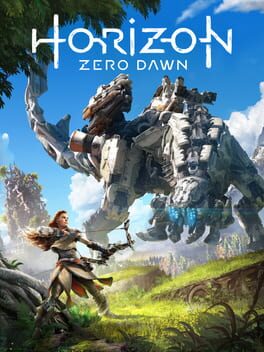
Horizon Zero Dawn marks a major change for Guerrilla Games, previously associated mainly with the linear FPS structure of the Killzone series. Here, the studio creates an open-world action RPG in which combat, exploration and storytelling all emerge from the meeting of two eras: human societies that have returned to tribal structures and the remains of extremely advanced technology.
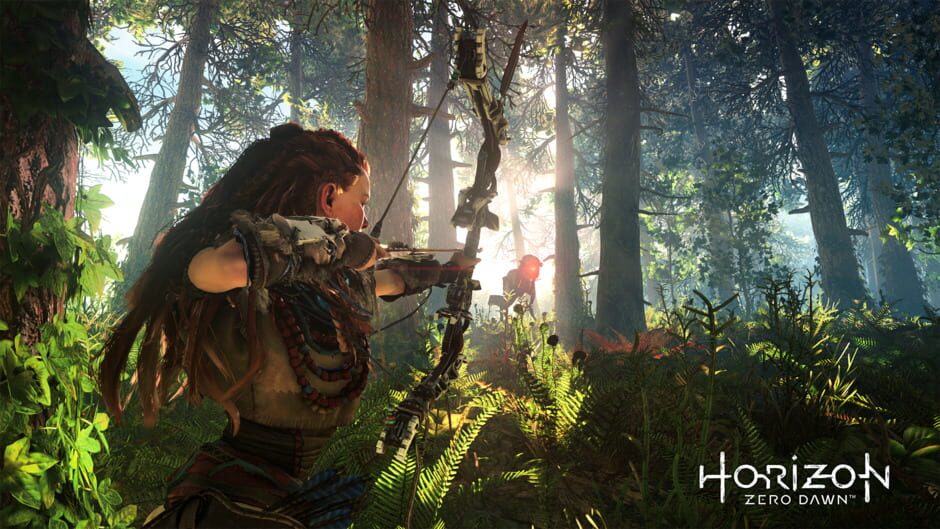
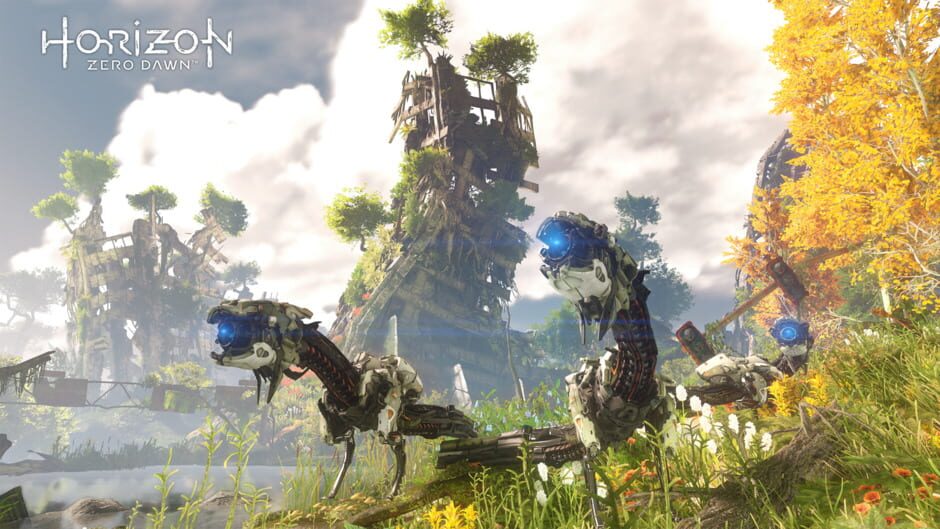
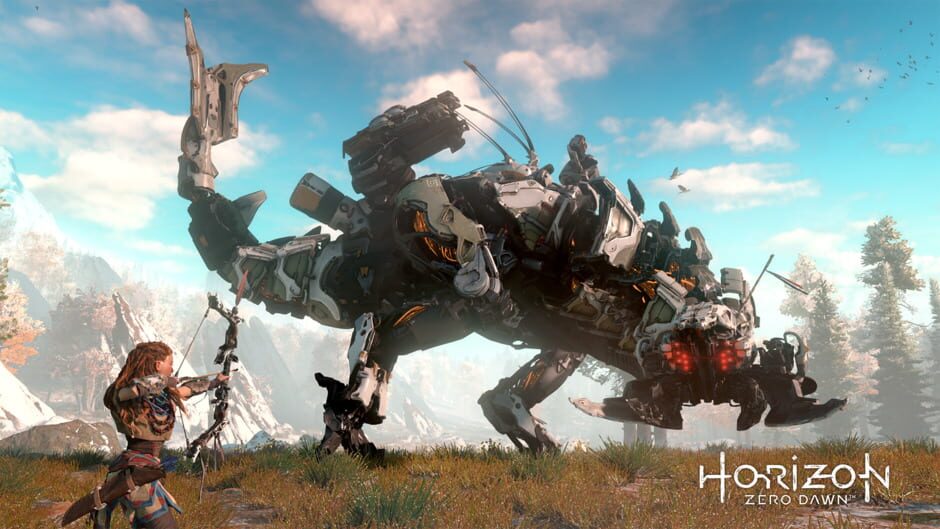
That contrast immediately gives the world its identity. Hunters armed with bows cross landscapes populated by machines resembling deer, birds, large cats or dinosaurs, while collapsed skyscrapers, bunkers and automated facilities constantly remind the player that another civilization once occupied these places. The ruins are not treated as simple scenery: understanding their purpose gradually becomes one of the main forces driving the story.
Aloy has an essential tool for doing so: the Focus. This augmented-reality device allows her to analyze the environment, follow tracks, identify enemies and examine Machine components. Archaeological investigation and hunting therefore rely on the same technology, directly linking the search for information with preparation for combat.
Fighting Machines is the game’s most distinctive system. They do not simply function as enemies with larger health bars: their bodies are made up of components with different functions, resistances and vulnerabilities. The Focus allows these parts to be identified before the player chooses which weapons or ammunition to use.
Tearing off a cannon can remove one of a Machine’s attacks and sometimes allow Aloy to use the weapon herself. Destroying a canister can trigger an elemental reaction, while removing armor exposes a previously protected area. Combat therefore takes on the character of a hunt, where observation and preparation can matter as much as precision.
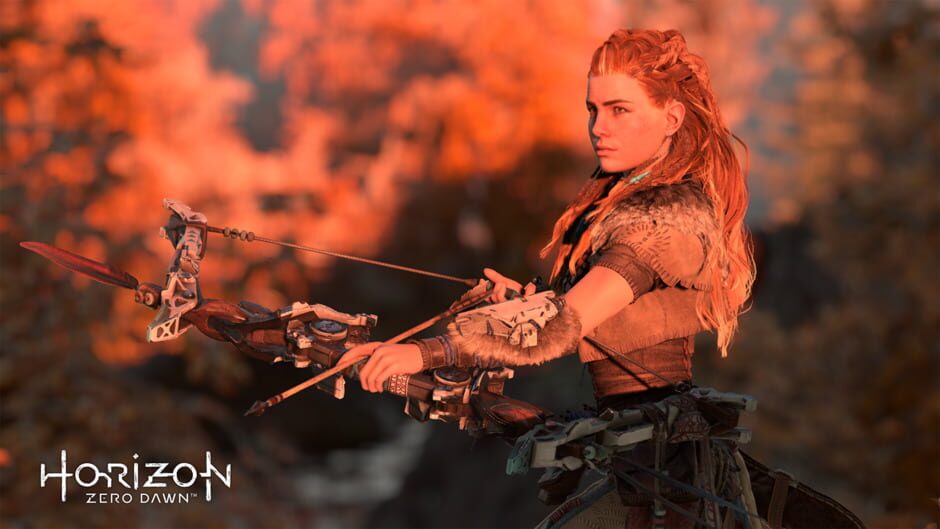
The bow remains the central weapon, but several other tools broaden the tactical possibilities. Slings, Tripcasters, Ropecasters and different arrow types can set traps, immobilize targets or exploit elemental weaknesses. Against the largest Machines, combining these tools is often more effective than simply firing repeatedly at the body.
Human enemies also make up part of the combat, particularly in bandit camps and conflicts involving the various factions. These encounters use stealth, bows and melee attacks, but they are generally less distinctive than hunting Machines, whose behaviors, components and silhouettes give the combat system its strongest personality.
Cauldrons extend Aloy’s relationship with the Machines. These underground facilities reveal part of their manufacturing process and offer more focused spaces combining exploration and combat. Completing them allows Aloy to learn how to override new categories of Machines, which can then become temporary allies or, in the case of certain mounts, provide transportation.
The open world includes several biomes, from the snow-covered Nora lands to the deserts and mesas around Carja territory. Meridian, the Carja capital, serves as one of its main urban centers. Side quests, Hunting Grounds, bandit camps, Cauldrons, collectibles and other activities provide regular reasons to leave the main route.
The different tribes also prevent the setting from being reduced to a simple opposition between primitive humans and ancient technology. The Nora organize their society around matriarchal traditions and a sacred relationship with their land, the Carja have built a powerful urban civilization, the Oseram value craftsmanship and engineering, while the Banuk develop their own spiritual relationship with the Machines. Aloy often stands at a distance from these traditions, allowing her to observe them without fully belonging to any of them.
Progression follows familiar action-RPG principles. Levels grant points used to unlock abilities related to combat, stealth, resource gathering and overriding Machines. Weapons and outfits come in several quality tiers and can be modified to improve particular statistics or resistances.
Crafting accompanies this progression throughout the adventure. Wood, Machine parts, plants and other resources are used to produce ammunition, traps and consumables or increase certain carrying capacities. This economy encourages regular gathering after combat without turning the game into a full survival simulation.
The story forms the other major strength of the experience. Aloy’s origins and the disappearance of the Old Ones are initially presented as two separate mysteries before gradually converging. Ruins, audio recordings and recovered data reconstruct a catastrophe that occurred nearly a thousand years earlier, while events in the present reveal that its consequences have never fully disappeared.
This discovery works especially well because the player begins with almost as little information as Aloy. Elements that initially seem ordinary within the world — the Machines, the ruins or certain names — take on an entirely different meaning once Zero Dawn, GAIA and the events that led to the collapse of the old civilization are gradually explained.
The Frozen Wilds expansion later develops the frozen region known as the Cut, home to the Banuk. It adds new Machines, weapons, skills and quests while expanding several elements connected to artificial intelligence and Machine production. Its story integrates into the main campaign rather than functioning as a separate sequel.
What to remember
- An open-world action RPG set on a future Earth where tribal societies coexist with Machines inspired by animals.
- Aloy, an outcast raised among the Nora, seeks to understand her origins and her connection to the lost civilization of the Old Ones.
- Combat built around analyzing Machines, destroying specific components and exploiting different weaknesses.
- The Focus allows Aloy to examine the environment, follow tracks and identify enemy characteristics.
- Bows, traps, Tripcasters, Ropecasters and elemental ammunition allow strategies to be adapted to each Machine.
- Cauldrons expand Aloy’s override abilities and reveal more about the origins of the Machines.
- A world composed of several peoples, including the Nora, Carja, Oseram and Banuk, each with their own traditions and relationship with technology.
- A central mystery focused on Zero Dawn, GAIA and the events that led to the disappearance of the old human civilization.
Conclusion
Horizon Zero Dawn finds its identity in the connection between its world and its combat system. The Machines are not simply there to give the setting an unusual appearance: their construction from destructible components directly changes how combat works. Observing a creature, understanding its functions and deciding how to disable it creates a style of hunting that fits Aloy particularly well.
The open world itself relies on a more familiar structure, with activities, camps, resources and quests distributed across the map. Some side content follows conventional genre patterns, and combat against humans has less personality than encounters with Machines. The quality of the Machine roster and the variety of tactical approaches compensate strongly for these more traditional elements.
The writing gives unexpected depth to the setting. Tribal societies and technological ruins initially seem combined to create a striking visual contrast, but the story gradually constructs a coherent explanation for why this world exists. The discovery of Zero Dawn then transforms exploration of a post-apocalyptic landscape into an investigation into how that world was created.
Aloy works especially well at the center of the story because her personal search follows the same movement. Understanding who she is requires understanding what happened to the world. Her status as an outcast also gives her enough distance to question the traditions, beliefs and authorities she encounters without making her detached from human relationships.
For Guerrilla, Horizon Zero Dawn therefore represents much more than a change of scenery after Killzone. The studio moves from linear FPS design to a large action RPG and, in this first entry, establishes the foundations of a universe where ecology, artificial intelligence, civilization and technology all belong to the same mystery. Hunting the Machines immediately captures attention; understanding why they exist ultimately gives the adventure its real scope.
Good to know
- Horizon Zero Dawn was developed by Guerrilla and published by Sony Interactive Entertainment.
- The original game was released on February 28, 2017, for PlayStation 4.
- It was Guerrilla’s first new intellectual property after many years primarily devoted to the Killzone series.
- Aloy is a Nora hunter raised as an outcast by Rost; she is voiced in English by Ashly Burch.
- The Frozen Wilds expansion, released in November 2017, adds the Cut region along with new quests, Machines, weapons and skills.
- Horizon Zero Dawn Complete Edition includes the main game and The Frozen Wilds and was also released on PC in August 2020.
- Horizon Zero Dawn Remastered was released for PlayStation 5 and PC on October 31, 2024, and also includes The Frozen Wilds.