

Overview
Founded in February 1999 in Texas by veterans of the video game industry, Gearbox Software was initially built as a studio capable of working on properties owned by other companies before becoming the creator of franchises of its own. Its first game, Half-Life: Opposing Force, was released that same year and immediately established the team within the world of first-person shooters.
This first period is important for understanding Gearbox’s trajectory. The studio developed or adapted several games tied to already established licenses, gaining technical experience across different machines and engines. But its evolution did not simply consist of becoming a specialist in ports or commissioned work. With Brothers in Arms, launched in 2005, and especially Borderlands in 2009, Gearbox began building worlds whose mechanics and identity could belong to it over the long term.
Brothers in Arms combines the FPS with a tactical dimension centered on squad management and a documented representation of the Second World War. Borderlands takes an almost opposite direction: extravagant science fiction, cooperation, humor, enormous numbers of generated weapons and progression inherited from role-playing games. The blend of first-person shooting and the constant search for loot gradually gave rise to a formula that Gearbox and 2K would present as the looter-shooter.
This hybridization became the studio’s most visible contribution. In Borderlands, defeating an enemy is not only a way to progress through a level: every fight can produce a new weapon, alter a character build or encourage a new way of playing. The loot system therefore becomes a central loop connecting combat, exploration, cooperation and progression.
Gearbox pairs this structure with a highly distinctive visual and narrative identity. Pandora and the other worlds of Borderlands mix science fiction, western influences, caricatured violence, absurd humor and immediately recognizable characters. This personality helps transform a progression mechanic into a universe capable of supporting several installments, additional content and derivative works.
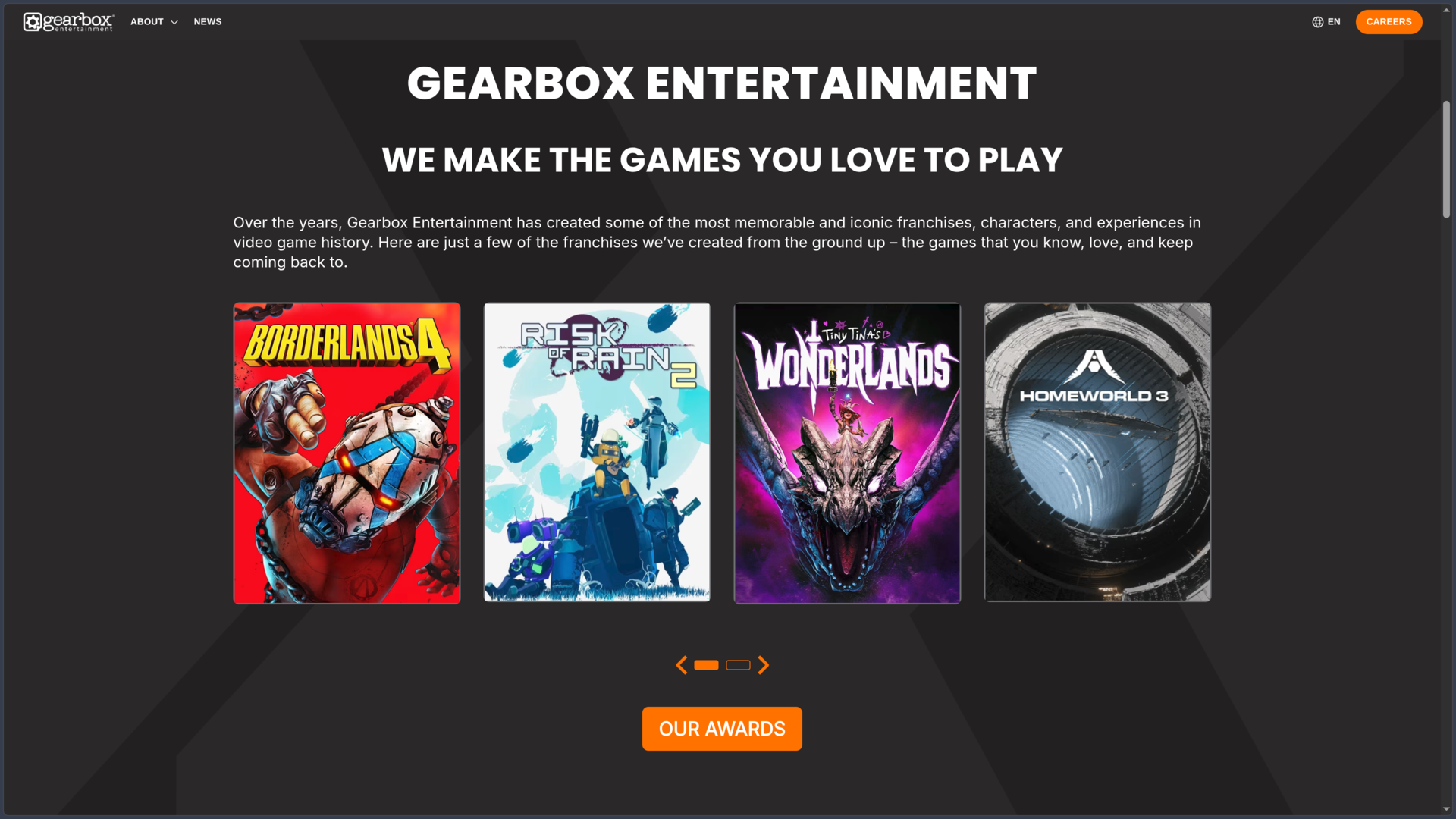
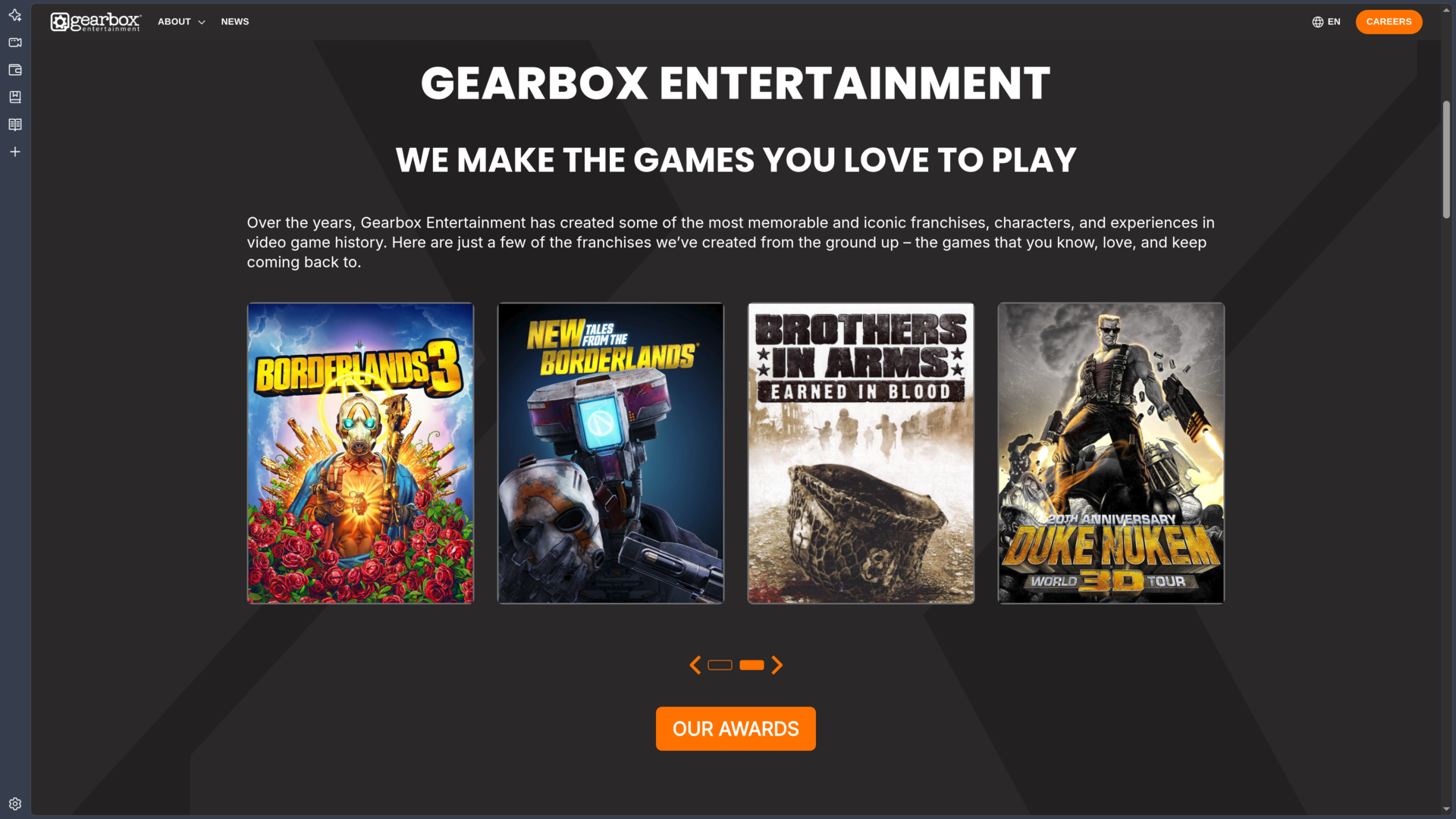
The studio is not limited to Borderlands, however. Its history notably includes Brothers in Arms, Battleborn, Tiny Tina’s Wonderlands and various works involving properties such as Duke Nukem and Homeworld. Gearbox also became part of a much broader organization combining development, publishing and intellectual property management.
This distinction is essential. Gearbox Software refers to the historic development studio. Gearbox Publishing, created later, represents a separate publishing activity, while Gearbox Entertainment served as a broader structure around several activities of the group. Works published or owned by this wider organization should therefore not automatically be attributed to Gearbox Software as developer.
After joining Embracer Group in 2021, Gearbox changed ownership again in 2024. Take-Two Interactive acquired Gearbox Entertainment and integrated it into 2K, with which the studio already had a long-standing relationship around Borderlands. Gearbox Software thus became an internal studio of the publisher that had published its main franchise since the first installment.
This new stage notably led to Borderlands 4, developed by Gearbox Software and published by 2K in September 2025. More than twenty-five years after Half-Life: Opposing Force, the studio therefore remains strongly associated with the FPS, but in a radically different position: from a team working within another developer’s universe, Gearbox became the owner and steward of several major franchises.
History
1999: beginning in the Half-Life universe
Gearbox Software was founded in February 1999 in Texas by a group of developers who already had experience in the industry.
The studio established itself in the Dallas area and very quickly gained the opportunity to work on a particularly important property: Half-Life, created by Valve.
Its first game, Half-Life: Opposing Force, was released the same year. The expansion allows players to experience the events of Black Mesa from another perspective and had to preserve the technical foundations and atmosphere of Half-Life while introducing new characters, weapons and situations.
This first project defined part of Gearbox’s initial skill set: taking an existing system, understanding its rules and producing new content coherent enough to belong to the same universe.
The studio then continued working on existing licenses and conversions. This period allowed it to accumulate significant experience in FPS development, but also in multiplatform production.
Gearbox notably continued working within the Half-Life universe beyond Opposing Force and also contributed to bringing Halo: Combat Evolved to PC.
These projects did not yet define a fully autonomous creative identity, but they established technical expertise on which the studio could build its own productions.
Brothers in Arms: moving from commissioned work to creation
The change became much more visible with Brothers in Arms: Road to Hill 30, released in 2005.
Developed by Gearbox and published by Ubisoft, the game places the player at the head of a small unit of American soldiers during the Normandy campaign.
The project remains an FPS, but Gearbox seeks to move away from an approach based solely on reflexes. The player can command soldiers, suppress an enemy position and then move another team around to flank it. Shooting and tactical positioning are intended to work together.
This approach gives Gearbox one of its first highly identifiable original properties.
The studio continued the series with Brothers in Arms: Earned in Blood, also released in 2005, followed by Brothers in Arms: Hell’s Highway in 2008. Various adaptations accompanied these main entries.
The series also reveals a tendency that would remain present in other Gearbox productions: combining several families of mechanics rather than reproducing the conventions of a single genre exactly.
In Brothers in Arms, the FPS therefore meets squad tactics.
A few years later, Borderlands would push this hybrid logic much further.
2009: Borderlands and the meeting of FPS and RPG
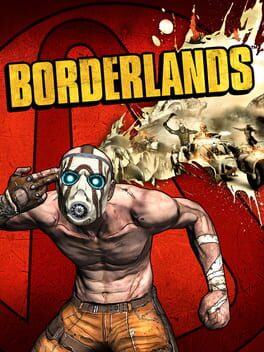
The first Borderlands was released in 2009, developed by Gearbox Software and published by 2K.
The game is built around a combination that was still unusual at that scale: FPS combat, level-based progression, skill trees, character classes, missions and an immense amount of equipment generated from different combinations of characteristics.
Weapon choice no longer depends solely on category. Manufacturer, statistics, effects, rarity and special properties can profoundly alter how a weapon behaves.
This abundance turns reward into a central system.
Killing an enemy, opening a chest or defeating a boss can produce a new piece of equipment interesting enough to immediately change the way the player approaches the game. The FPS loop is therefore combined with that of games built around loot.
Cooperation reinforces this structure. Borderlands can be played with several people and allows different classes to complement one another while sharing the search for equipment.
The visual direction also contributes to its identity. During development, Gearbox abandoned a more realistic representation in favor of a highly stylized look, with outlines, illustrated textures and exaggerated silhouettes.
This combination of loot system, cooperation, FPS and distinctive aesthetics quickly became much more important than any of these elements taken separately.
Borderlands gave Gearbox the franchise that would define its image over the long term.
Borderlands 2: turning a formula into a phenomenon
With Borderlands 2, released in 2012, Gearbox expanded almost every aspect of the first game.
The classes became more differentiated, the environments more varied and the enemies more numerous. The weapon system was reworked to give the different manufacturers more immediately recognizable behaviors.
The narrative universe also became more important.
Characters such as Handsome Jack gave the conflict a much stronger presence, while humor and dialogue became structural elements of the series’ identity.
Borderlands was no longer simply a shooting experience built around a large number of weapons. Pandora became a universe with its own corporations, creatures, Vault Hunters, conflicts and comedic codes.
Gearbox also supported the game for a long period with expansions.
Among them, Tiny Tina’s Assault on Dragon Keep places the characters inside an imaginary role-playing game narrated by Tiny Tina. This mix of fantasy and firearms proved popular enough to become, several years later, the starting point for Tiny Tina’s Wonderlands.
This ability to develop a new production from a secondary element illustrates how Gearbox began treating Borderlands as an expandable universe rather than a simple numbered series.
Acquiring and preserving other properties
Gearbox’s growth also involved acquiring properties created elsewhere.
The studio notably became associated with Duke Nukem and participated in completing Duke Nukem Forever, a project whose development had gone through an unusually long history before its release in 2011.
In 2013, Gearbox also acquired the rights to Homeworld during the sale of THQ assets.
The situation differs from Borderlands or Brothers in Arms: Gearbox did not create Homeworld. The series originated at Relic Entertainment.
The company first undertook preservation and modernization work around the older games. This process resulted in Homeworld Remastered Collection in 2015.
The franchise later continued with productions developed by other studios, notably Blackbird Interactive.
These cases show why it is necessary to distinguish several roles in Gearbox’s history. A property can belong to the company without Gearbox Software having created every work associated with it.
This role as an IP holder became even more visible when the organization began developing a genuine publishing activity.
Battleborn and experimentation beyond Borderlands
In 2016, Gearbox Software launched Battleborn, published by 2K.
The game combines first-person shooting, characters with very different abilities, cooperation and mechanics influenced by competitive arena games.
It represents an important new intellectual property for the studio and an attempt to build a universe distinct from Borderlands.
Battleborn, however, did not follow the same long-term trajectory. Its operation eventually ended after several years.
The project remains interesting within the studio’s history because it extends tendencies already visible elsewhere: specialized characters, cooperation, progression and the mixing of several gameplay traditions.
That same year, the Gearbox structure expanded with the creation of Gearbox Publishing.
This new activity should not be confused with Gearbox Software. The studio continued developing its games, while the publishing branch supported productions made by Gearbox or by external developers.
The wider organization thus began becoming more complex than the original studio founded in 1999.
Borderlands 3: bringing the franchise back at large scale
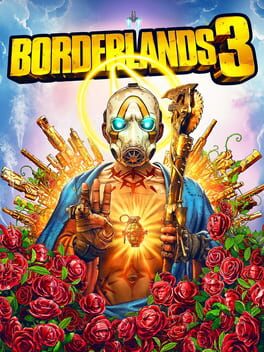
After several years without a new mainline entry developed directly by Gearbox, Borderlands 3 was released in 2019.
The studio retained the fundamental structure of the series — Vault Hunters, generated weapons, cooperation, classes and progression — while expanding mobility, character abilities and environmental variety.
The adventure moved more broadly beyond Pandora and allowed players to explore several planets, giving the universe a new scale.
The game also continued the principle of long-term support with expansions, events and updates.
The release above all confirmed the weight the franchise had achieved. Borderlands was no longer an experiment born from blending two genres: it was now an international property around which main games, spin-offs, additional content and narrative projects could exist.
The collaboration with 2K remained central to this growth.
Gearbox was still an independent company at the time, but the relationship between the two companies around Borderlands had already lasted more than a decade.
2021: joining Embracer Group
In 2021, a major transformation occurred when Embracer Group acquired Gearbox Entertainment.
Gearbox joined the Swedish group as one of its operating groups while retaining its leadership and activities.
This transaction did not make Gearbox Software disappear. The studio remained a central creative component of the wider organization.
The period was nevertheless accompanied by broader expansion of Gearbox Entertainment into publishing, acquisitions and property management.
For the studio’s history, the essential point is therefore less the detail of every operation carried out by the wider group than the change in status: Gearbox was no longer an independent company financed solely under its own structure.
Internal development continued during this period.
In 2022, Gearbox Software and 2K released Tiny Tina’s Wonderlands, transforming the fantasy concept introduced in Assault on Dragon Keep into a full game.
The system retains much of the Borderlands DNA — shooting, loot, cooperation and progression — but adapts it to a universe parodying tabletop role-playing games.
That same year, New Tales from the Borderlands was developed primarily by Gearbox’s teams in Quebec with participation from former Telltale Games developers.
Gearbox thus demonstrated that the Borderlands universe could support both a shooting-focused production and a narrative adventure.
2024: Gearbox joins Take-Two and 2K
The Embracer period ended with another major transaction.
In March 2024, Take-Two Interactive announced an agreement to acquire The Gearbox Entertainment Company from Embracer Group.
The transaction was completed on June 11, 2024.
For Gearbox Software, this acquisition had a particular logic: it permanently brought the studio closer to 2K, its historic partner on Borderlands.
Gearbox thus joined 2K’s internal studios.
Through the transaction, Take-Two acquired several important properties associated with Gearbox, including Borderlands, Tiny Tina’s Wonderlands, Brothers in Arms, Homeworld, Risk of Rain and Duke Nukem.
Not all assets from the former Gearbox organization necessarily followed the same path, however. Once again, the scope of the acquired company was broader than Gearbox Software as a development studio.
Integration into 2K above all gave Gearbox a new organizational stability around a collaboration that had already existed since the first Borderlands.
Borderlands 4: continuing the franchise under 2K
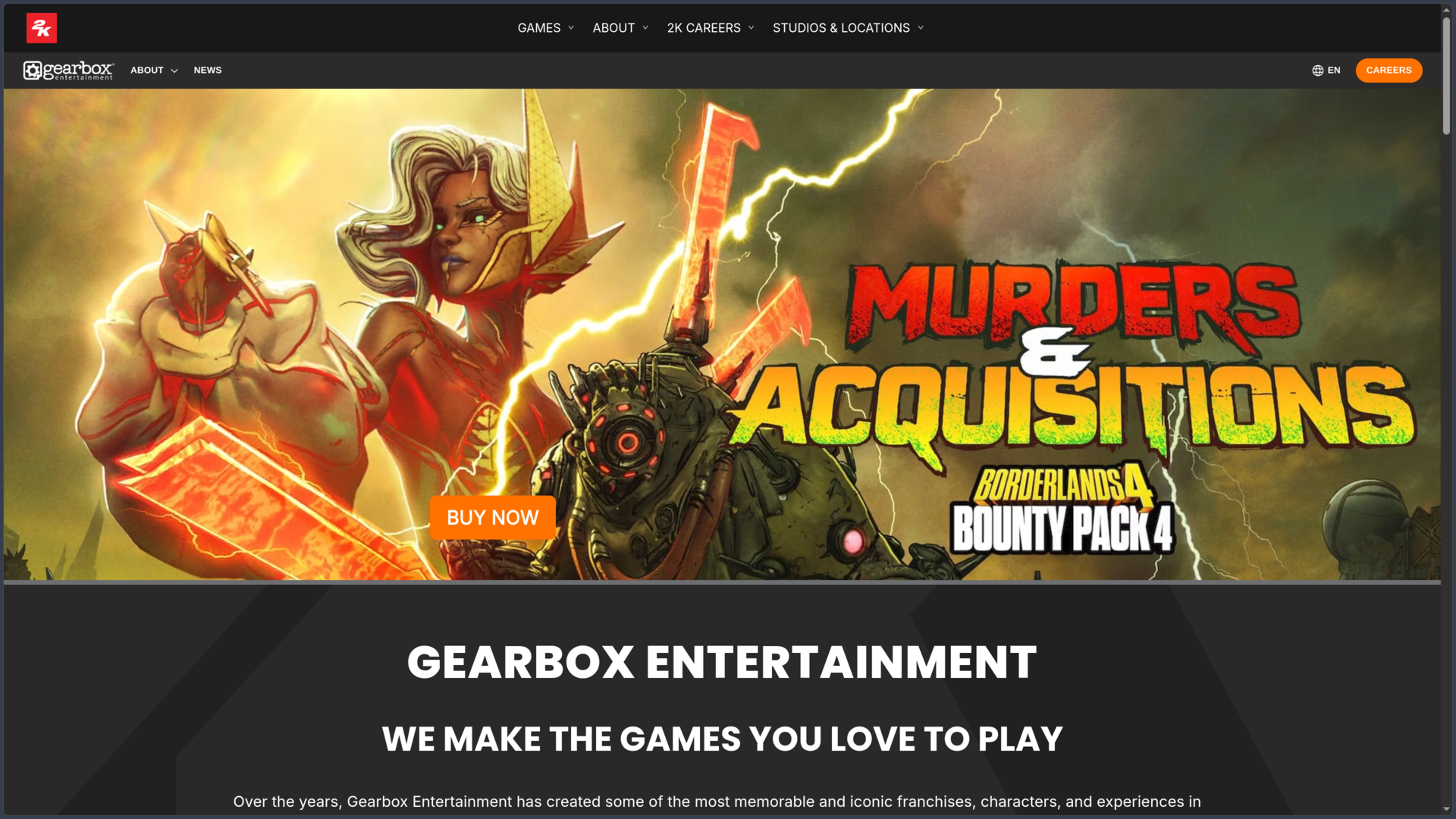
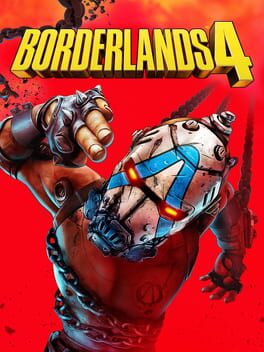
The first major entry of this new period is Borderlands 4.
Developed by Gearbox Software and published by 2K, the game launched worldwide on September 12, 2025 on PC, PlayStation 5 and Xbox Series X|S.
The game retains the fundamental looter-shooter loop but seeks to make its world and movement more continuous. New mobility abilities — sliding, double jumping, dodging, grappling and other options — give movement greater importance during both combat and exploration.
The new planet Kairos also allows the studio to move the series beyond its most familiar settings while preserving its essential principles: four Vault Hunters, differentiated abilities, cooperation, a considerable number of weapons and a constant search for new combinations.
After release, Gearbox continued developing the game through new content, events, packs and adjustments.
In 2026, the studio therefore continues to occupy a very particular position within 2K: that of a team whose relationship with the publisher existed for nearly two decades before its direct integration.
What sets it apart
Mixing genres until a new loop emerges
Gearbox’s most important characteristic is probably not that it separately invented the FPS, the role-playing game or the loot system.
It lies in the way the studio assembled them with Borderlands.
Shooting produces loot. Loot changes the way the player shoots. New skills influence which weapons the player seeks. More powerful enemies provide access to better rewards, which in turn make it possible to take on greater challenges.
These systems form a continuous loop.
A character’s progression therefore does not rely solely on level, solely on equipment or only on the player’s mechanical skill. All three dimensions reinforce one another.
This hybridization helped establish the term looter-shooter within video game vocabulary and provided a structure later explored by many other productions.
Gearbox had already shown with Brothers in Arms its interest in combining several forms of gameplay. Borderlands transformed that tendency into a true identity.
Making loot a permanent source of curiosity
The abundance of weapons in Borderlands is one of the most recognizable elements of Gearbox’s work.
The principle is not simply to offer a very long catalogue of predefined objects.
Different elements can be combined to produce a large variety of weapons with their own statistics, behaviors and effects.
The manufacturers themselves gradually become gameplay families: some favor particular fire rates, reload behaviors, projectile types or specific characteristics.
The player therefore learns to recognize not only the raw power of a weapon, but also what it can bring to a character and play style.
This structure constantly maintains uncertainty around rewards.
Even after many hours, a chest or enemy can produce a combination different from what the player already owns.
Gearbox therefore turns loot into a driver of curiosity, rather than simply a statistical system placed around combat.
Building cooperation around complementary characters
Cooperation also occupies an important place in the studio’s identity.
In Borderlands, the different Vault Hunters have abilities, skill trees and roles that can function alone but also complement one another in a group.
Gearbox generally avoids making one specific party composition mandatory. The goal is instead to allow several character builds to coexist and produce their own combinations.
This philosophy gives cooperation a particular social dimension: two players using the same character can sometimes develop very different approaches depending on their skills and equipment.
The principle appears in other forms across several of the studio’s productions.
Cooperation is therefore not simply a mode added to a campaign designed independently. It influences the construction of the progression and combat systems themselves.
Giving systems a strong personality
Gearbox rarely pairs its mechanics with a neutral presentation.
In Borderlands, weapon manufacturers have their own behaviors but also visual, commercial and sometimes narrative identities.
Enemies, corporations and characters are built around immediately recognizable exaggerations.
The interfaces themselves contribute to the overall tone.
This desire to integrate the personality of the universe directly into the systems allows the studio to avoid having story, aesthetics and gameplay function as three completely separate layers.
The loot system says something about the manufacturers. Characters have abilities corresponding to their identities. Environments reflect the economic and social excesses of the universe.
This coherence contributes greatly to the longevity of Borderlands: players return as much for a progression structure as for a world whose tone they immediately recognize.
Moving from licensed work to control of its own properties
Gearbox’s history finally illustrates a particularly clear industrial transformation.
The studio begins with Half-Life: Opposing Force, within another company’s universe.
It then works on various licenses and adaptations before creating Brothers in Arms and later Borderlands.
Over time, Gearbox also acquires properties such as Homeworld and Duke Nukem and participates in an organization capable of publishing games beyond its own developments.
This evolution should not erase the distinctions between roles: owning, developing and publishing a work are three different functions.
But it shows how far the studio has come.
Gearbox Software went from a technical team working on properties owned by other companies to a studio whose main franchise is now itself one of the major properties in 2K’s catalogue.
Good to know
- Gearbox Software was founded in February 1999 in Texas by veterans of the video game industry.
- Its first game was Half-Life: Opposing Force, an expansion for Half-Life released in 1999.
- Brothers in Arms: Road to Hill 30, released in 2005, established one of the studio’s first major original properties around tactical FPS gameplay.
- Borderlands, developed by Gearbox and published by 2K in 2009, combines FPS, RPG progression, cooperation and generated loot in a formula that became central to the studio.
- Borderlands 2, released in 2012, consolidated the franchise and significantly expanded its narrative identity, weapon manufacturers and characters.
- Gearbox acquired the Homeworld property during the sale of THQ assets in 2013 and later contributed to its preservation with Homeworld Remastered Collection.
- Gearbox Publishing, created in 2016, is a publishing activity distinct from Gearbox Software and should not be confused with the development studio.
- Gearbox joined Embracer Group in 2021, after more than twenty years of independent activity.
- Take-Two completed its acquisition of Gearbox on June 11, 2024, integrating the studio and several of its properties into 2K.
- Borderlands 4, developed by Gearbox Software and published by 2K, launched worldwide on September 12, 2025 on PC, PlayStation 5 and Xbox Series X|S.
- In 2026, Gearbox is presented by 2K as one of its studios, while the Gearbox name continues to operate and develop several universes including Borderlands, Risk of Rain, Homeworld and Brothers in Arms.