Presentation
Borderlands 2 retains the first game’s blend of FPS combat and role-playing progression while expanding almost every part of it. Exploration, missions, combat and the constant pursuit of new weapons remain the foundation, but Gearbox introduces greater variety in environments, enemies, characters and the ways each Vault Hunter can be developed.
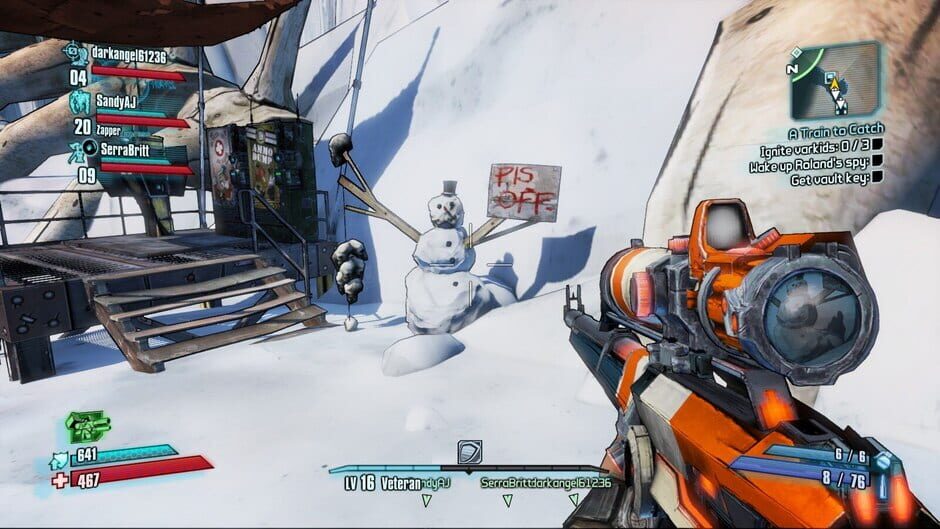
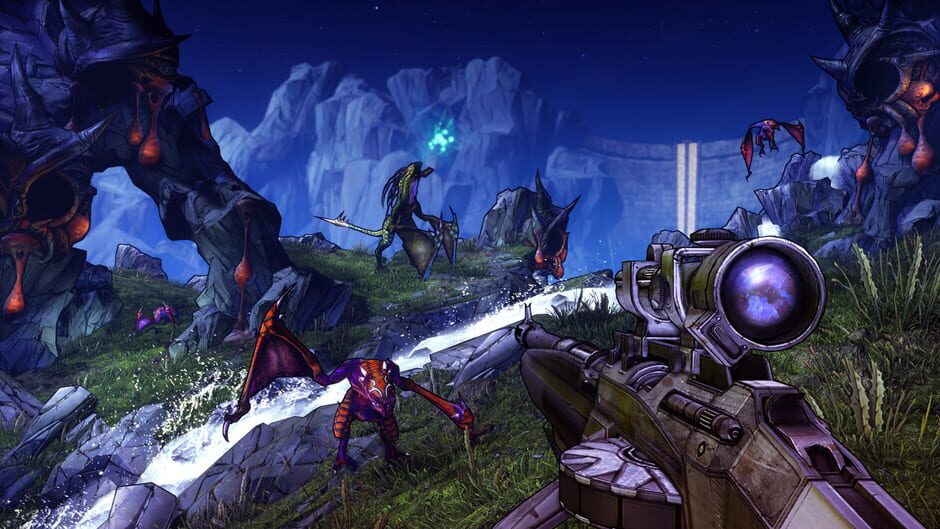
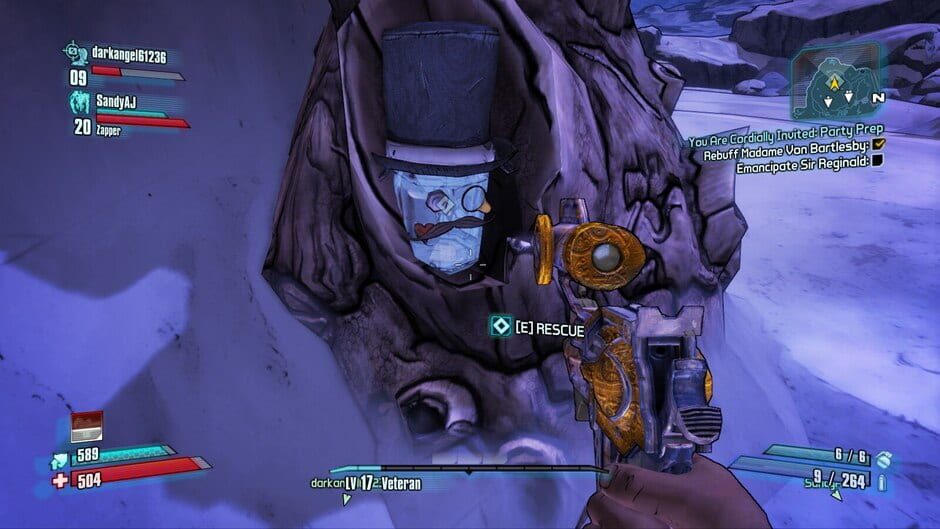
Pandora is no longer dominated almost entirely by the desert landscapes that defined the first game. The adventure moves through frozen tundras, industrial areas controlled by Hyperion, caves, greener regions, settlements and territories occupied by bandits or local creatures. This variety keeps encounters from feeling too uniform and gives the planet more substance than the vast wasteland presented before.
Weapons remain at the center of the experience. Manufacturers now have much stronger visual and mechanical identities. Jakobs generally favors raw power and a more traditional style, Maliwan specializes in elemental damage, Tediore notably turns reloading into weapon throwing, while Vladof emphasizes high rates of fire. Other manufacturers follow their own philosophies, making the brand name almost as important as the statistics displayed on the weapon.
This differentiation makes loot more interesting. Two weapons from the same category can feel completely different depending on their manufacturer, properties, elemental type or special effects. Legendary equipment pushes this further through unique behaviors that can significantly change the way a character is played. Finding an upgrade therefore does not simply mean replacing one number with a higher one; some weapons can encourage a player to adjust their equipment or skill tree around their particular strengths.
The four base-game Vault Hunters reinforce this depth through very different abilities. Axton the Commando can deploy a Sabre Turret whose functions evolve through his skills. Maya the Siren uses Phaselock to temporarily suspend a target and can specialize in elemental damage, crowd control or support. Salvador the Gunzerker can wield two weapons at the same time, while Zer0 relies on Decepti0n, which creates a decoy and allows him to prepare a particularly powerful attack.
Their three skill trees allow these abilities to be specialized over time and support builds suited to solo play or co-op. Additional playable characters Gaige the Mechromancer and Krieg the Psycho later expanded these possibilities with substantially different mechanics.
Four-player co-op remains one of the pillars of the formula. Character skills can complement one another, and the number of enemies and pace of encounters work particularly well in a group. The campaign is not dependent on multiplayer, however, and remains fully playable solo with builds capable of functioning independently.
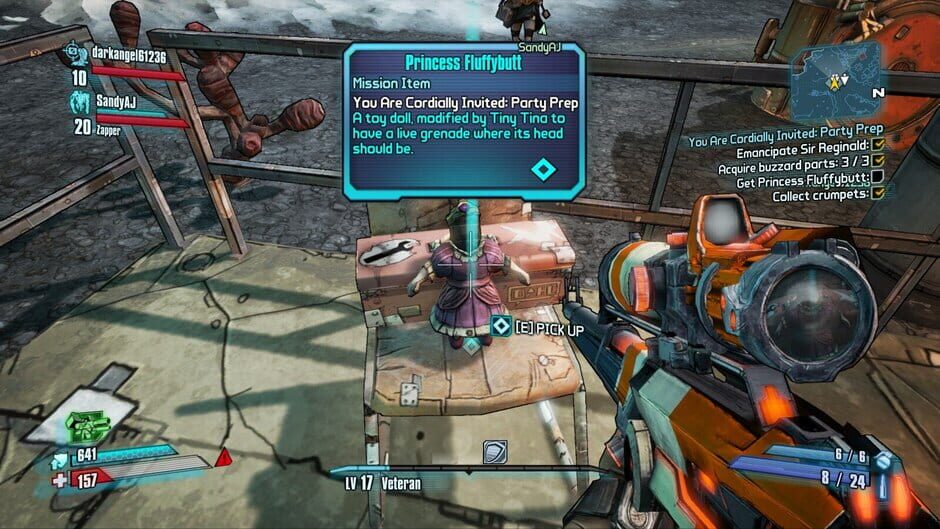
Side missions contribute more to Pandora’s identity than they did in the first game. They introduce new characters, expand certain areas and extend the absurd situations that define much of the series’ humor. Not every mission escapes familiar objectives such as collecting items, killing groups of enemies or activating several devices, but the writing and characters often give them enough personality to rise above their basic structure.
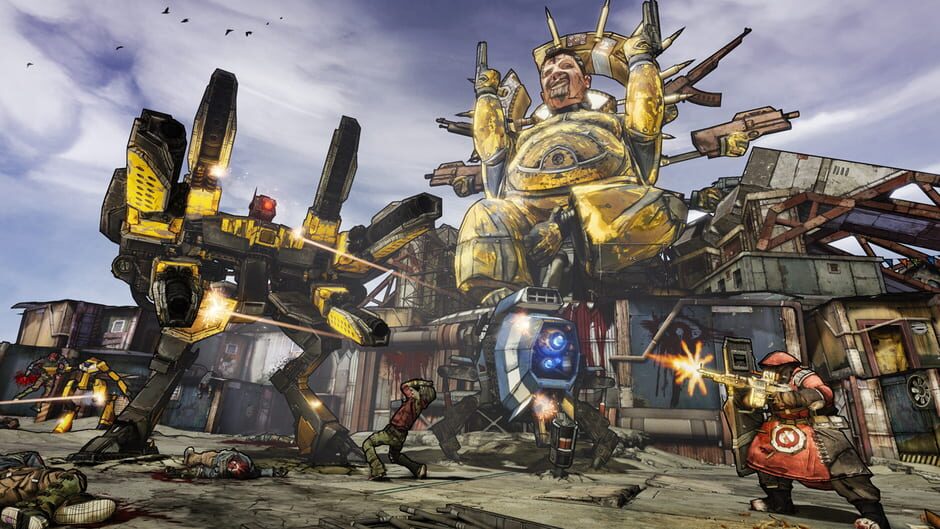
Handsome Jack plays an essential role in this stronger narrative focus. Instead of remaining a distant threat until the final hours, he regularly contacts the player by radio and comments directly on their actions. His humor, narcissism and conviction that he is the hero of the story accompany increasingly visible acts of cruelty. This constant presence makes the conflict more personal and turns Jack into one of the main driving forces of the adventure.
The return of Roland, Lilith, Mordecai and Brick also connects the first two games more directly. They are no longer silent player avatars, but characters integrated into the world with relationships and a role in the resistance. Sanctuary becomes the main gathering point for a larger cast that also includes Claptrap, Scooter, Marcus, Moxxi, Patricia Tannis and several new figures who would later remain closely associated with the franchise.
This stronger focus on characters also changes the overall tone. Borderlands 2 keeps the exaggerated violence, absurd humor and references already present in its predecessor, but places them inside a more structured story. It also allows certain consequences to carry greater weight when the conflict with Jack directly affects members of the resistance.
Progression beyond the campaign extends the loot chase through additional difficulty modes, stronger enemies and the pursuit of rare equipment. The large amount of downloadable content significantly expanded the game’s lifespan through new regions, campaigns and playable characters. Tiny Tina’s Assault on Dragon Keep stands out in particular by transforming the rules and setting of Borderlands through a tabletop role-playing game imagined by Tiny Tina.
What to remember
- Four new Vault Hunters in the base game: Axton, Maya, Salvador and Zer0, each with an Action Skill and three progression trees.
- Handsome Jack and Hyperion as the main enemies in a story directly connected to the consequences of the first Borderlands.
- A far more varied Pandora featuring tundras, caves, cities, industrial installations and new regions beyond its deserts.
- A loot system greatly expanded by manufacturers with distinct behaviors, elemental damage and numerous rare or legendary items.
- Co-op for up to four players while keeping the entire campaign fully playable solo.
- The return of Roland, Lilith, Mordecai and Brick as central members of the resistance, joined by many characters who became iconic within the series.
- A substantial amount of additional content, including playable characters Gaige and Krieg and several full campaign expansions.
Conclusion
Borderlands 2 expands the original formula on a much larger scale without changing its foundations. The experience still revolves around gunplay, experience, skills and the regular discovery of new equipment, but the stronger differentiation between manufacturers and Vault Hunters gives this loop far more possibilities.
Pandora’s evolution also matters. The greater environmental variety prevents the planet from feeling like one desert repeated throughout the entire adventure, while missions and characters give each region more presence. Some activities still rely on repetitive structures, and the game’s constant humor will not work equally well for every player, but the overall experience has a much stronger identity than its predecessor.
Handsome Jack contributes greatly to that cohesion. His constant presence gives Hyperion’s power a recognizable face and creates a personal antagonism that follows the player through much of the campaign. The returning Vault Hunters and the inhabitants of Sanctuary build a real cast around that conflict.
With its arsenal, classes, co-op and the amount of content developed around its campaign, Borderlands 2 is the entry where many of the ideas introduced by the first game reach a far more complete form. It establishes much of the cast, mechanics and tone that would continue to shape the series in later entries.
Good to know
- Borderlands 2 was developed by Gearbox Software and published by 2K.
- The game was originally released on September 18, 2012.
- The four base-game Vault Hunters are Axton the Commando, Maya the Siren, Salvador the Gunzerker and Zer0 the Assassin.
- Gaige the Mechromancer and Krieg the Psycho were later added as additional playable characters.
- The campaign can be played solo or in co-op with up to four players.
- The adventure explores several new regions of Pandora, including tundras, greener areas and caves in addition to its desert territories.
- Borderlands 2 and Borderlands: The Pre-Sequel were later collected with their additional content in Borderlands: The Handsome Collection.