Presentation
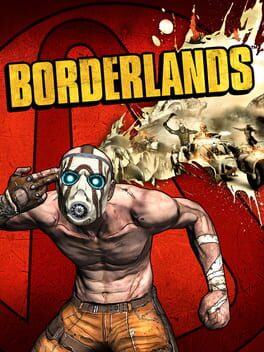
Borderlands builds its formula around the meeting point between first-person shooting and role-playing progression. Combat takes place entirely from a first-person perspective, but enemies award experience, characters gain levels, develop skills and regularly replace their equipment. This combination creates a straightforward loop: explore, fight, collect loot and use that loot to survive more dangerous areas.
Weapons immediately become the main engine of progression. The system combines different characteristics to generate a huge number of assault rifles, revolvers, submachine guns, sniper rifles, rocket launchers and other weapons. Damage, accuracy, fire rate, magazine size, elemental effects and special properties can vary enough for two weapons from the same category to serve noticeably different purposes.
This abundance gives loot particular importance. A chest, a powerful enemy or a mission reward can provide a weapon capable of immediately replacing what the player was using before. Equipment is therefore constantly compared, with players deciding whether better statistics compensate for a different rate of fire, an elemental effect or simply more satisfying handling. The search for the next good weapon quickly becomes almost as important as the objective that leads to it.
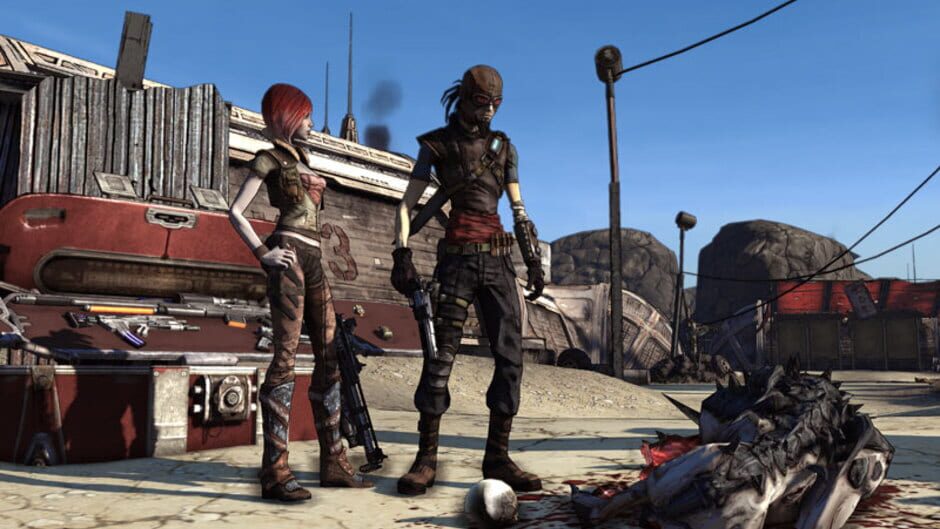
The four playable characters complement this system with distinct specialties. Roland the Soldier can deploy a Scorpio Turret and easily develop abilities suited to sustained combat or group support. Lilith the Siren uses Phasewalk to temporarily enter a special state and can strengthen both her mobility and elemental damage.
Mordecai the Hunter focuses more on precision and can send his bird of prey Bloodwing to attack enemies, while Brick the Berserker has an Action Skill built around close-quarters combat. Their skill trees allow different aspects of these abilities to be strengthened without completely locking each character into a single weapon type.
Co-op for up to four players is another important part of the game. Characters retain their progression and skills while exploring Pandora together. Differences between the classes become more meaningful in a group, especially when their abilities complement one another during encounters with large groups of enemies or tougher opponents.
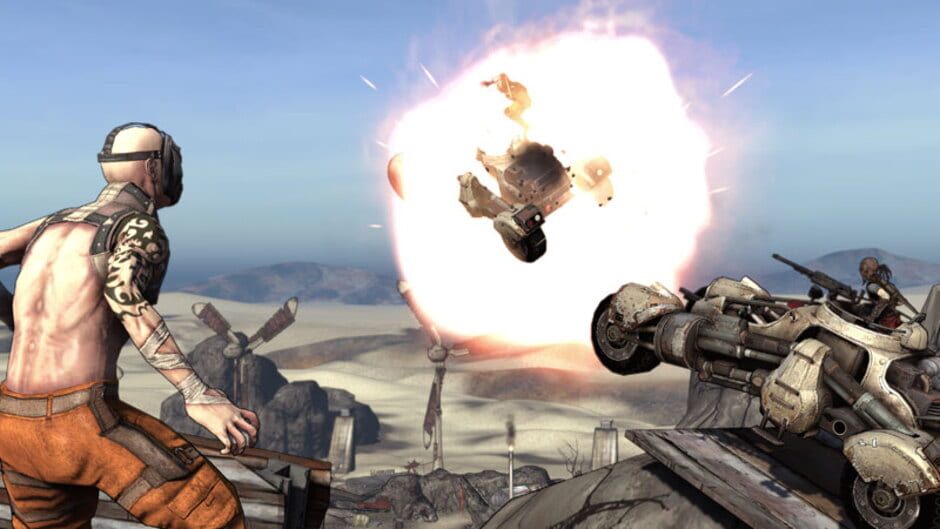
Pandora supports this progression through a structure made up of large areas connected by different passages and travel points. Much of the game takes place in desert, rocky and industrial environments where human settlements seem to have been abandoned as the planet lost its economic value. Vehicles make it easier to cover larger distances and can also be used to fight enemies and other vehicles.
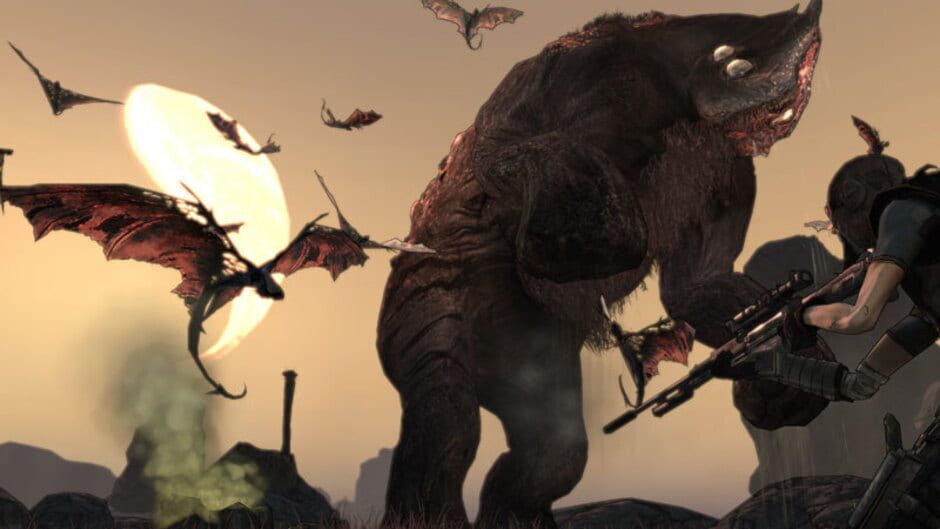
This desolation plays an important role in the identity of the first game. Small settlements often feel isolated, bandits occupy abandoned facilities and much of the population appears to be surviving among the remains of an old resource rush. The mixture of science fiction, western imagery and scavenged technology gives Pandora an immediately recognizable personality.
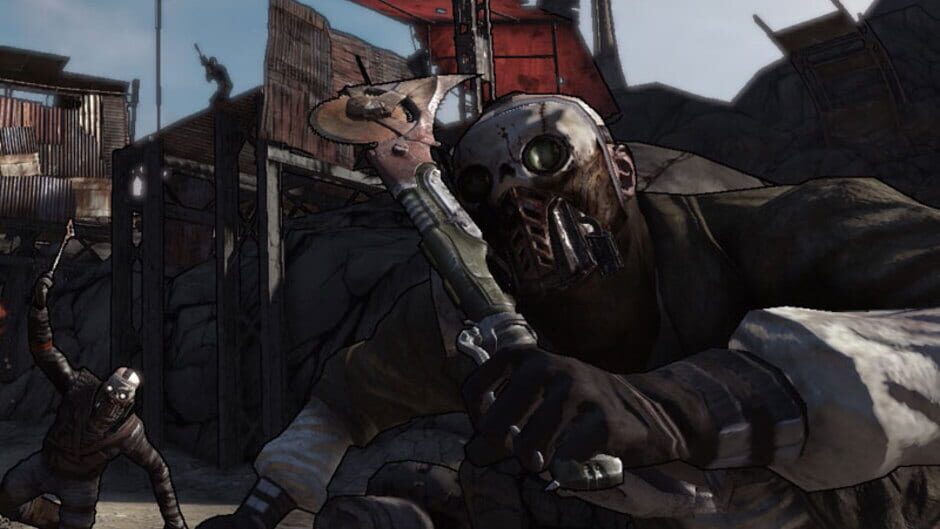
The visual direction strongly reinforces that identity. Characters and environments use heavy outlines and illustrated textures that move the game away from realism. This style also allows exaggerated violence, strange creatures and absurd equipment to coexist naturally within a world that remains generally hostile.
The tone of the first Borderlands is more restrained than that of several sequels. Humor is already present through Claptrap, Pandora’s inhabitants, item descriptions and many missions, but the adventure leaves more room for silence and isolation. Much of the story is delivered through objectives, communications and encounters rather than long narrative sequences.
That restraint also applies to the four Vault Hunters. Roland, Lilith, Mordecai and Brick each have a clear visual and mechanical identity, but remain relatively underdeveloped as characters during the campaign itself. Later games would give them far more personality by integrating them directly into the events and relationships of the wider universe.
Borderlands therefore feels rougher than its successors. Its environments are less varied, its writing less prominent and several missions rely on repetitive structures. But the essential elements of the series are already present: a dangerous planet, specialized characters, an enormous quantity of weapons, co-op and a progression system that constantly encourages the player to inspect whatever the latest enemy has dropped.
What to remember
- The first entry in the Borderlands series, set on Pandora and centered on the search for a mysterious alien Vault.
- Four playable Vault Hunters: Roland, Lilith, Mordecai and Brick, each with an Action Skill and several progression paths.
- A formula combining first-person shooting, levels, skill trees and the constant pursuit of new weapons and equipment.
- A weapon-generation system capable of producing a very large number of variants with different statistics and properties.
- A campaign playable solo or in co-op with up to four players.
- Desert and industrial environments whose visual identity blends science fiction, western influences and scavenged technology.
- The first appearances of several characters who would become important to the series, including Claptrap, Patricia Tannis, Marcus and Scooter.
Conclusion
Borderlands establishes a formula that later entries would greatly expand. The combination of FPS combat and progression works because loot directly affects the feel of combat: a new weapon can change how encounters are approached, while skills gradually give the four characters clearer specializations.
The first journey across Pandora also has a distinctive atmosphere. The planet feels emptier and more hostile than in the sequels, with vast desert territories and settlements built among the remains of abandoned exploitation. This visual consistency gives the world a strong personality, even if it also results in a more limited variety of environments.
The game shows its age more clearly in the structure of some missions, the long travel distances and a narrative that is far less developed than in later entries. The four protagonists are mainly defined by their abilities and appearance, while several characters who later become important still play relatively minor roles.
These limitations do not prevent the central concept from working. The desire to test a new weapon, gain another level or improve a skill naturally drives progression and adapts particularly well to co-op. Borderlands is therefore an imperfect but already highly recognizable foundation, one whose main ideas would be expanded by Borderlands 2 with greater variety, stronger characters and a broader sense of scale.
Good to know
- Borderlands was developed by Gearbox Software and published by 2K.
- The original game was released on October 20, 2009.
- The four playable characters are Roland the Soldier, Lilith the Siren, Mordecai the Hunter and Brick the Berserker.
- The campaign takes place on Pandora and can be played solo or in co-op with up to four players.
- The game combines first-person shooting, level and skill progression, loot collection and vehicles.
- Four major expansions were released: The Zombie Island of Dr. Ned, Mad Moxxi’s Underdome Riot, The Secret Armory of General Knoxx and Claptrap’s New Robot Revolution.
- Borderlands: Game of the Year Edition, an expanded version including the four major add-ons, was released in 2019 for PlayStation 4, Xbox One and PC.