
Overview

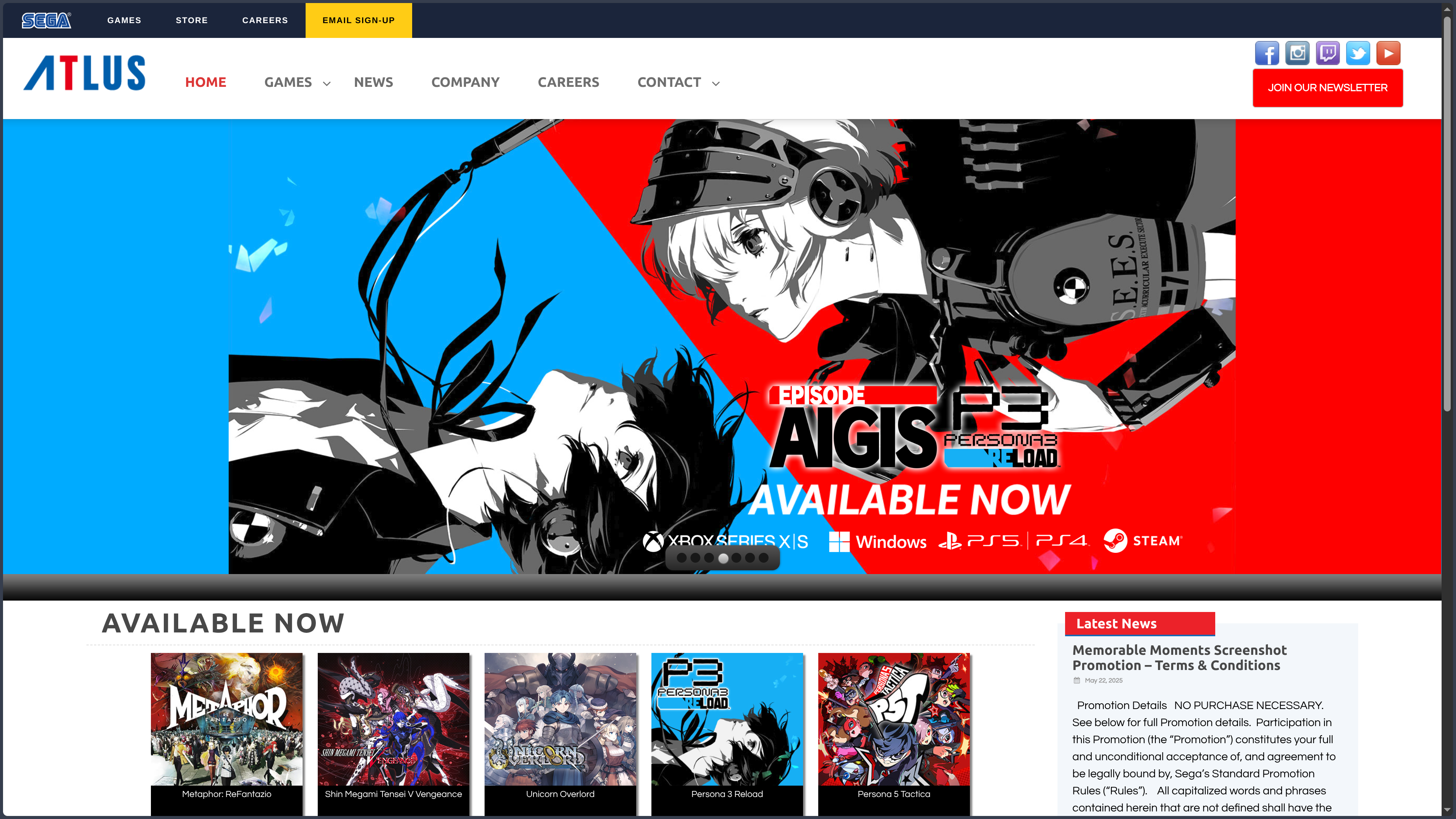
Atlus is a Japanese video game development and publishing company whose history begins in 1986. Its own historical account states that it was created in Iidabashi by just six people as a computer game development company. Nearly forty years later, Atlus still presents 1986 as the starting point of its identity, even though the current legal company, Atlus Co., Ltd., was incorporated in September 2013 and is now part of the Sega Sammy Group.

This distinction between cultural continuity and legal continuity matters. PANACHES CULTURE retains 1986, because Atlus itself tells its story as a continuous trajectory beginning with that first company: Shin Megami Tensei, Persona, Etrian Odyssey, Catherine, and later Metaphor: ReFantazio are presented as successive stages of the same creative history. The 2013 reorganization changes the corporate framework, not the way Atlus claims its heritage.

The name “Atlus” also refers to more than a simple studio producing one game after another. The company brings together development, sales, promotion, localization, licensing, music, and different activities intended to extend its properties beyond software. Its recruitment site explicitly presents positions linked not only to development, but also sales, promotion, licensing, and music business. This breadth of functions justifies the editeur_jeu classification here, even though Atlus also remains a major developer of its own titles.

Its identity has been built almost entirely around RPGs, but with a conception of the genre that often refuses neutrality. Atlus currently promotes the value “Unique & Universal”: creating experiences the company considers genuinely distinctive while also trying to make them capable of reaching a much broader audience. The phrase neatly summarizes a tension that has run through its catalog for several decades.

Atlus games often ask the player to make choices, understand systems, and live with the consequences. In Shin Megami Tensei, talking to demons, recruiting them, and then fusing them is as much part of the series’ identity as the battles themselves. In Persona, dungeons and combat coexist with school, social relationships, a calendar, and time management. Etrian Odyssey turns dungeon exploration into an exercise in cartography and party building, while Metaphor: ReFantazio takes several decades of Atlus RPG experience and uses it to construct a new fantasy universe. The setting changes, but the catalog retains a fascination with systems that force the player to organize their progression rather than simply move forward.

That coherence does not prevent Atlus from being several things at once.

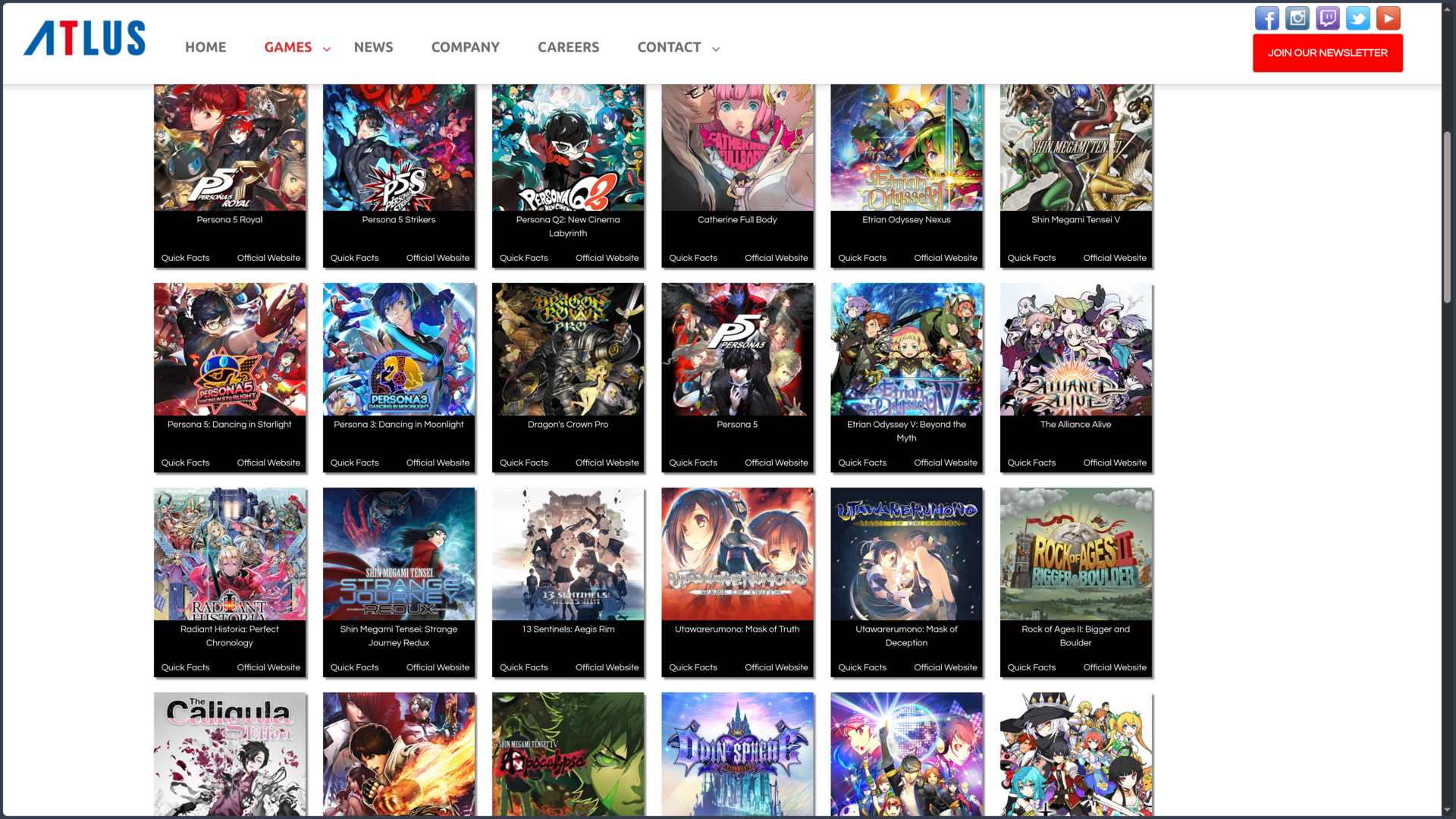
The company directly develops some of its most important properties, but also works with external studios. Its official catalog, for example, presents an ATLUS × VANILLAWARE grouping that brings together projects created through its collaboration with Vanillaware, including 13 Sentinels: Aegis Rim and Unicorn Overlord. In those cases, Atlus takes on a publishing role around works that were not developed by its own internal teams.

This ability to preserve a strong identity while changing teams, series, or even legal structure is an essential part of its history.

History

1986: six people and a development company

Atlus dates its foundation to 1986. The former company is created in Iidabashi with only six people and begins as a computer game development business. From 1987 onward, it also expands into domestic distribution of amusement equipment, showing that its history is not immediately limited to home consoles alone.

That small beginning contrasts sharply with the importance its properties would later acquire.

Atlus does not appear with Persona already defined, nor with an immutable RPG formula. Its identity develops gradually through different projects, genres, and commercial experiments.

The studio first has to learn how to exist.

The major franchises come later.

1989: Atlus begins putting its own name on games

In 1989, Puzzle Boy becomes the first title released under the Atlus brand itself according to the company’s official history. That same year, Atlus also opens the Atlus City amusement facility.

This stage matters because it gradually moves Atlus from the role of developer toward that of a brand visible to the public.

Creating a game for someone else and beginning to build your own catalog do not produce exactly the same kind of company.

The second activity forces you to think about continuity.

A logo begins to promise something.

1992: Shin Megami Tensei gives Atlus RPGs a lasting identity

In 1992, Atlus releases Shin Megami Tensei. The company now presents the game as one of the titles that established its identity through a particularly distinctive world and story.

The series develops a combination that would become deeply associated with the Atlus name: a contemporary or near-contemporary world, the collapse of familiar reference points, creatures drawn from many mythologies, demon negotiation, party building, and ideological choices.

A demon is not merely an enemy to eliminate.

It can become an ally.

Then fusion material.

Then a new ally.

This circulation gives the bestiary a systemic function very different from a simple monster catalog.

Atlus gradually builds an RPG in which the world, collection systems, and progression mechanics all use the same creatures.

Mythologies become game-design material

One lasting characteristic of Megami Tensei lies in its relationship with mythology.

Demons, deities, folkloric creatures, and religious figures drawn from very different traditions can all appear within the same system.

The game therefore does not attempt to build an exclusively original bestiary.

It reinterprets centuries of cultural imagination and integrates them into a game structure.

This approach produces an extraordinarily recognizable catalog.

Jack Frost becomes one of its most visible symbols.

A small creature originally drawn from a demon system eventually comes to function almost like the company’s unofficial mascot, to the point of being heavily featured at Atlus Fes in 2024.

1995: Atlus also invents outside consoles

The history of Atlus is not limited to its RPGs.

In 1995, the company develops and commercializes Print Club, or Purikura, a photo-booth system that allows users to produce and personalize small sticker photographs. Atlus includes this episode directly in its official timeline.

The project is a reminder that the company was then operating within the broader culture of Japanese amusement.

Arcades.

Photography.

Games.

Collectible objects.

Social interaction.

The boundaries between those practices are less sealed than they may appear from the outside.

This period therefore gives Atlus a stranger and broader image than that of the RPG specialist it would later be strongly associated with.

1996: Persona moves Megami Tensei toward school and intimacy

In 1996, Atlus launches Megami Ibunroku Persona, the first entry in the Persona series. The company now highlights this moment as one of the major milestones in its history.

Persona is born within the orbit of Megami Tensei, but the shift is decisive.

The supernatural moves closer to adolescence.

The characters no longer simply pass through supernatural crises.

They also have to live with themselves.

Psychology, social masks, repressed identities, and relationships gradually become as important as the summoned creatures.

The series would continue changing across its early installments before Persona 3 largely stabilized the modern structure that audiences now associate with the Persona name.

1997: Atlus becomes a publicly listed company

In 1997, Atlus lists on JASDAQ. Around the same period, the catalog continues to expand with Devil Summoner: Soul Hackers and various arcade-related productions.

The growth of the company now goes beyond that of a small development team.

The paradox that will accompany Atlus for a long time begins to appear: its works often cultivate a highly particular identity, while the company itself has to learn to operate at an increasingly large commercial scale.

That tension between creative niche and audience expansion never completely disappears.

It eventually becomes part of its modern strategy.

1999: Atlus establishes an American presence

In 1999, Atlus creates its American subsidiary Atlus U.S.A., Inc.

This presence would play an important role in the Western distribution of Atlus games and various Japanese titles that might otherwise have had much more difficulty finding an international audience.

The Atlus name therefore acquires a double meaning for part of the Western public.

It refers to the creator of series such as Persona or Shin Megami Tensei.

But it can also appear as publisher on productions developed by other teams.

This publishing dimension explains why reducing Atlus to a simple “Persona studio” quickly becomes insufficient.

2003: Shin Megami Tensei III brings the series into 3D

In 2003, Atlus releases Shin Megami Tensei III: Nocturne.

The move into 3D does not erase the identity built previously.

Demon negotiation, recruitment, fusion, and the brutality of the battles remain central, while the depiction of a transformed Tokyo gives the game a much more stripped-back and unsettling direction.

Atlus already demonstrates an ability that will return repeatedly throughout its history: modernizing a property without removing what makes it uncomfortable or unusual.

The games remain demanding.

The systems remain highly visible.

The company does not necessarily try to eliminate every source of friction in order to make the experience immediately familiar.

2006: Persona 3 finds the formula that changes Persona’s scale

Persona 3 launches in 2006.

The game establishes a structure that becomes fundamental to the modern series: alternation between everyday life and supernatural exploration, calendar management, relationships with other characters, and Persona progression.

Time becomes a real gameplay resource.

Going to class.

Seeing someone.

Studying.

Exploring.

Resting.

Every activity consumes part of that limited time.

This choice turns social storytelling into a mechanic.

Relationships are not simply optional scenes triggered from a menu.

They occupy space in the character’s schedule.

The player has to decide how to live.

The calendar becomes a narrative architecture

The calendar idea almost seems ordinary today because it is so strongly associated with Persona.

Yet it produces a profound consequence.

In many RPGs, the story waits for the player.

In Persona, the days advance.

A deadline approaches.

A school term ends.

An exam is coming.

A character is only available on certain days.

Everyday life therefore creates a gentle pressure that coexists with supernatural danger.

This architecture allows Atlus to tell the story of a year of life rather than a simple succession of levels.

It also helps explain why attachment to characters can work differently.

You do not simply meet a companion during a quest.

You spend time with them.

2007: Etrian Odyssey turns the player into a cartographer

In 2007, Atlus launches Etrian Odyssey on Nintendo DS.

The series chooses a direction very different from Persona.

The player forms a party, explores labyrinths, and uses the console’s touch screen to gradually draw their own map.

This mechanic places a task that is often automated directly back into the player’s hands.

Notice a dead end.

Spot a door.

Mark a danger.

Remember a shortcut.

Cartography becomes part of the game rather than an interface external to it.

Atlus therefore demonstrates that the same company can defend several almost opposing conceptions of the RPG: one focused on characters and the calendar, the other on navigation, preparation, and the gradual acquisition of knowledge about a hostile space.

2008: Persona 4 turns a small town into an entire world

In 2008, Persona 4 continues the modern Persona structure.

This time, the story leaves the large metropolis for the rural town of Inaba.

Paradoxically, the change reduces the size of the space while strengthening the sense of community.

The same places return.

The same residents are encountered.

Relationships overlap.

The mystery works because the environment feels small enough that every disappearance might affect someone you know.

Atlus therefore uses the RPG to produce a form of repetitive everyday life that gradually becomes familiar to the player.

A world does not have to be enormous when it feels inhabited.

2010: Atlus enters the Index Group

In 2010, Atlus joins Index Group.

This period is one of the most complex passages in its corporate history.

The brand, teams, and productions continue to exist while their legal framework changes.

For PANACHES CULTURE, the important point is not to turn every one of those restructurings into a new creative entity.

Atlus continues to release works under its own name.

The catalog remains culturally continuous.

The history of the modern company therefore has to distinguish the company as a legal entity from the brand and teams as cultural entities.

2011: Catherine shows Atlus can step outside its major series

In 2011, Atlus launches Catherine.

The game uses a structure that is almost difficult to classify comfortably.

Adult romantic drama.

Vertical puzzle game.

Social sequences.

Nightmares.

Questions asked directly to the player.

Animation.

The work borrows certain kinds of expertise from Persona without becoming another Persona installment.

That freedom matters.

A company heavily dependent on major franchises can easily end up exploring only variations of them.

Catherine shows that Atlus is still capable of making a project whose simple summary already sounds like someone made a bad decision in a meeting — and that the bad decision might be exactly what makes it interesting.

2013: the Sega Sammy Group absorbs Atlus operations

In 2013, Atlus enters the Sega Sammy Group. Its official timeline directly presents this integration as a stage in its history. At the same time, the current legal company, Atlus Co., Ltd., is created in September 2013.

This is where the two important dates must be distinguished.

1986 corresponds to the historical foundation claimed by Atlus.

2013 corresponds to the incorporation of the current legal entity.

For a cultural database built around the continuity of works, 1986 is therefore the most relevant date.

For a strictly legal database, it would be 2013.

PANACHES CULTURE retains the first interpretation.

Sega becomes the owner without making the Atlus brand disappear

Integration into Sega could have led to the Atlus name gradually being absorbed.

Instead, almost the opposite happens.

The brand continues to appear clearly.

The series continue to be identified as Atlus properties.

Official sites continue to distinguish the ATLUS and SEGA identities, while the company retains its own development, sales, promotion, music, and licensing functions.

This brand autonomy is essential for understanding its current place.

Atlus belongs to a larger group.

But culturally, Atlus remains Atlus.

2016: Persona 5 turns distinctiveness into spectacle

Persona 5 launches in Japan in 2016, the twentieth anniversary year of the Persona series.

The game retains the calendar, social relationships, dungeons, and Personas, but pushes much further the unification of interface, music, animation, visual identity, and theme.

The menus themselves take part in the staging.

Changing screens is no longer a neutral transition.

The interface moves, strikes, cuts, and extends the graphic energy of the Phantom Thieves.

This coherence becomes one of the most visible signatures of modern Atlus.

System and presentation are no longer two separate layers.

Even choosing a command can become part of the spectacle.

Persona becomes global without ceasing to be deeply Japanese

The Persona series is built extensively around contemporary Japan.

School.

Subway systems.

Urban neighborhoods.

Vacations.

Exams.

Part-time jobs.

Relationships between students, teachers, families, and adults.

Rather than neutralizing that cultural grounding to make the series more international, Atlus ultimately discovers that the specificity itself can interest a global audience.

Its modern “Unique & Universal” approach can be read precisely in this way: do not remove what makes a work distinctive in order to make it accessible, but instead ask how that distinction can become understandable and attractive elsewhere.

Internationalization therefore does not necessarily require cultural erasure.

It can come through a better translation of difference.

2017: a third production has to invent something else

Development of Metaphor: ReFantazio begins in 2017. Atlus explains that at the time its production teams were primarily organized around a first production connected notably to Shin Megami Tensei and a second connected to Persona. A third production is then created with the goal of developing a new property capable of existing alongside these historical series.

The choice is revealing.

Atlus already has two machines capable of producing recognized franchises.

But keeping only those machines creates a risk.

A company can become a prisoner of its own success.

The third production therefore has to learn how to be Atlus without simply making a third Persona or another Shin Megami Tensei.

Building fantasy forces Atlus to lose certain shortcuts

The Metaphor team quickly encounters an interesting problem.

Persona mainly uses contemporary Japan.

Its creators can therefore rely on real-world references for a street, a school, an apartment, an object, or a social behavior.

In a completely invented fantasy world, that shortcut disappears.

Atlus explains that even a simple nail or coin now has to be considered in relation to the world’s culture, technology, and geography.

The change forces the team to build a coherence it could previously borrow in part from reality.

The world becomes a system.

Every object needs a reason to exist.

Reusing Persona expertise without making Persona in fantasy

The Metaphor project is led by several creators who worked on Persona 3, Persona 4, and Persona 5. Atlus explicitly presents this creative continuity.

Yet the challenge is precisely not to copy the previous series.

Certain skills naturally carry over: time management, travel structure, party building, the importance of relationships, and command-based combat.

But the new universe has to produce its own reasons for using those systems.

This distinction summarizes much of how Atlus operates.

A method can survive a franchise.

A formula does not necessarily have to survive unchanged.

2018: Atlus moves into the group’s new headquarters

In 2018, Atlus moves its headquarters to Osaki Garden Tower in Tokyo. The company remains there today.

This geographic proximity to other Sega Sammy structures accompanies an organization now fully integrated into the group.

It does not, however, erase internal production cultures.

Atlus continues to operate around several teams and properties, with methods distinct enough that the Metaphor project itself required the gradual construction of a new production culture.

Belonging to the same group therefore does not mean every team makes games the same way.

Refinement sometimes requires destruction

Testimony from the Metaphor team offers a particularly interesting glimpse into Atlus development culture.

The developers describe a logic of building, destroying, then improving, with significant time deliberately reserved near the end of the process to rework what already exists. The game only truly reveals its strengths once it is assembled enough to be played, which pushes the team to accept heavy revisions to elements that have already been produced.

The method can be expensive.

It can also be frustrating.

But it explains part of the importance given to the final “feel.”

A system is not validated simply because it works.

It also has to produce the right sensation.

2021: Shin Megami Tensei V brings the main series back to the forefront

In 2021, Atlus releases Shin Megami Tensei V.

The historical series regains major visibility after years during which Persona had gradually taken a more spectacular place in the company’s international image.

This coexistence is a reminder that Atlus does not treat Persona as a replacement for Shin Megami Tensei.

The two series respond to different sensibilities.

Persona turns social relationships and the calendar into structural pillars.

Shin Megami Tensei remains much more focused on confrontation with demons, party construction, and a world in which values themselves can become material for conflict.

One does not cancel the other.

The contrast instead broadens the publisher’s identity.

2022-2024: Atlus seeks a broader audience across more platforms

The 2020s see many Atlus works reach more platforms. Persona 5 Royal, Persona 4 Golden, and Persona 3 Portable receive new editions, while newer productions are increasingly designed for simultaneous or rapid release across several systems.

This evolution becomes especially visible with Metaphor: ReFantazio. The team explains that simultaneous multilingual and multiplatform development proved a much greater challenge than originally expected, but also allowed them to experience international reception almost immediately.

Modern Atlus can therefore no longer think only from the perspective of a single market or console.

Its games remain Japanese in their creation.

Their launches have become global in organization.

2024: Persona 3 Reload returns to a foundational work

In 2024, Atlus releases Persona 3 Reload, a new interpretation of the episode that had largely defined Persona’s modern structure. The company’s official timeline places the game directly among the year’s major releases.

The project exposes another problem faced by publishers with old catalogs.

How do you modernize a work whose ideas have already influenced everything that came after it?

A remake cannot simply add polygons.

It has to decide which rough edges belong to the original era, which intentions must be preserved, and which modern conventions can be integrated without producing an entirely different game.

Atlus therefore gradually turns its own past into creative material.

2024: Shin Megami Tensei V Vengeance revisits rather than replaces

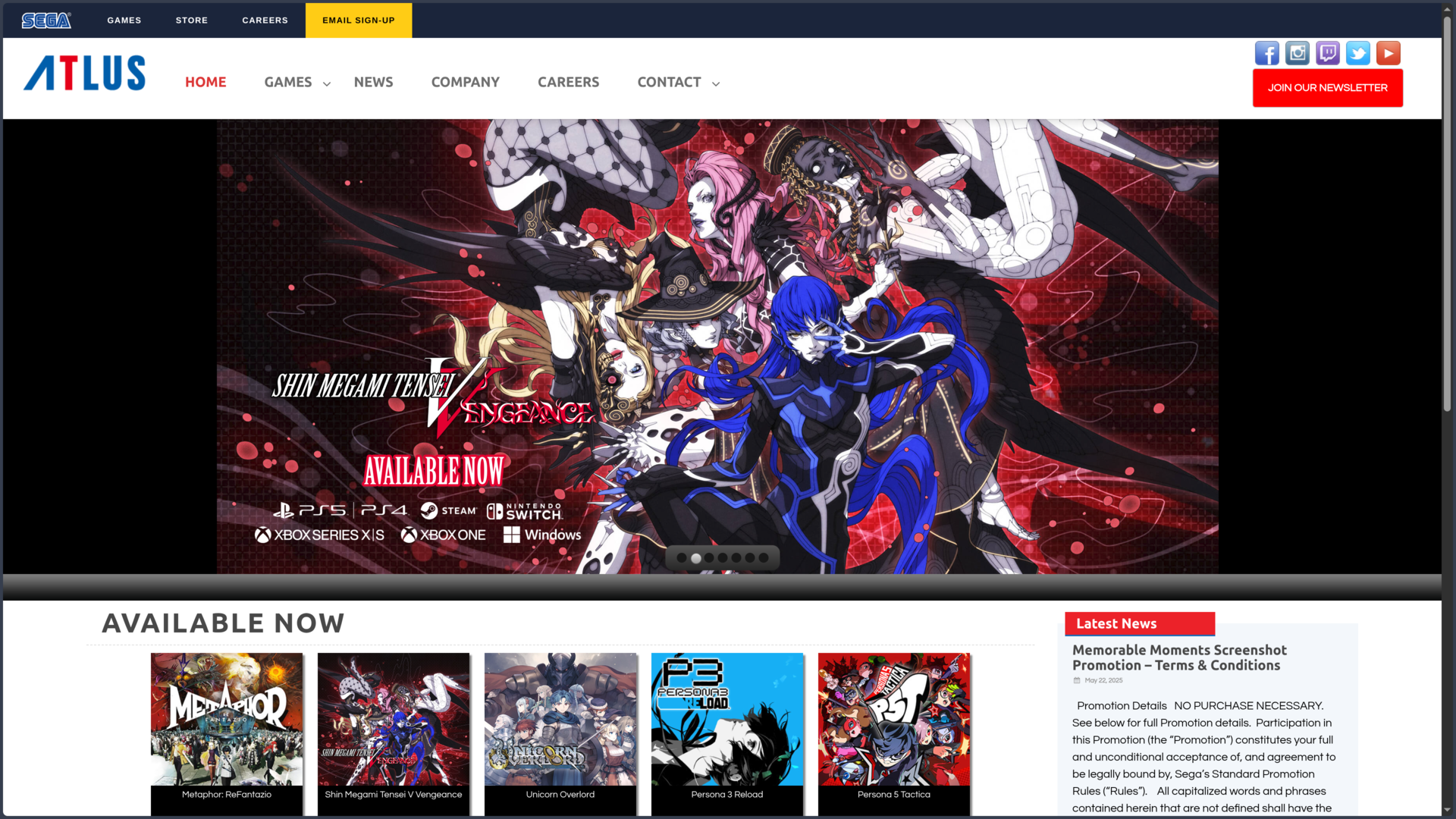
A few months later, Shin Megami Tensei V Vengeance appears. Atlus lists it among its major 2024 releases.

The project adds a new narrative route and expands the original game while allowing the property to reach more platforms.

This habit of revisiting a work rather than simply leaving it behind is fairly common at Atlus.

Enhanced versions.

Re-releases.

Remasters.

Remakes.

Spin-offs.

The company maintains its properties over long periods of time.

The strategy can look complicated from the outside, but it also turns the catalog into something alive rather than a simple archive.

2024: Metaphor: ReFantazio proves Atlus can create a new pillar

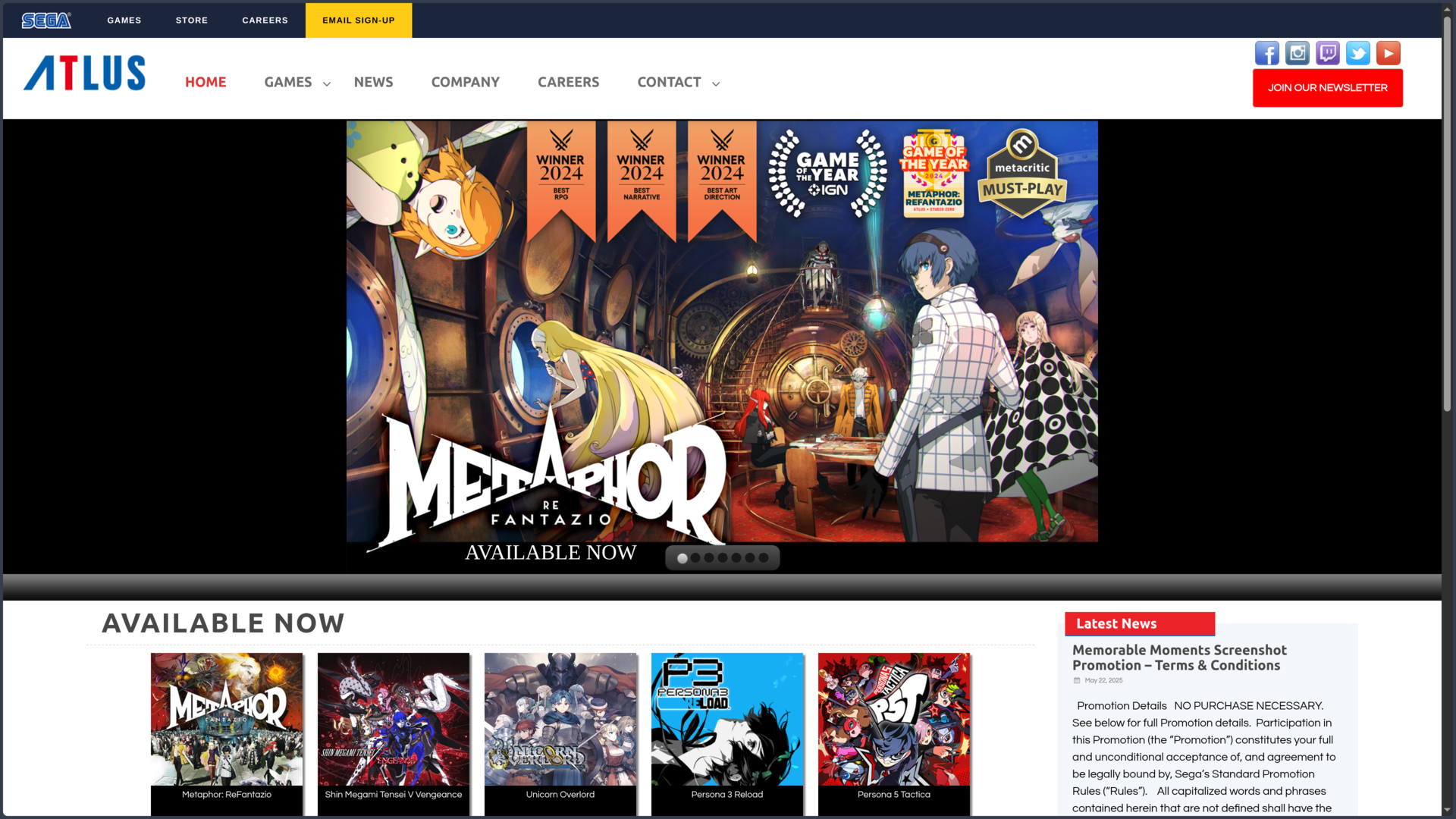
Metaphor: ReFantazio launches on October 11, 2024 after around eight years of development. Atlus says the game reaches one million copies sold on its launch day and emphasizes the importance of its international reception.

The result validates a hypothesis that began several years earlier.

Creators from Persona can build something else.

Atlus can create a new property without abandoning the way it thinks about RPGs.

And a completely invented fantasy world can carry social and political concerns that would have created a far more direct reading in a contemporary setting.

Fantasy therefore becomes distance.

Not escape.

It allows the game to speak about reality without pretending that the represented world is reality.

Metaphor confirms that command-based combat is not necessarily a relic

The developers of Metaphor also explain that the project allowed them to rediscover the potential of the command-based RPG at a time when many major productions favor direct action. The game itself combines real-time movement and attacks with a more traditional command system for actual encounters.

Atlus returns here to an idea that runs through much of its catalog.

Modernization does not necessarily mean removing turn-based combat.

It can mean improving its pacing.

Its readability.

Its presentation.

The depth of its decisions.

The studio therefore seems less interested in following the trend than in discovering what its own language can still produce.

Atlus and Vanillaware: publishing without standardizing

Alongside its internal productions, Atlus maintains a long-running collaboration with Vanillaware.

Its official site explicitly groups several projects under the ATLUS × VANILLAWARE banner, including 13 Sentinels: Aegis Rim and Unicorn Overlord. It highlights the combination of the partner studio’s distinctive painterly art with particularly elaborate narratives or systems.

The relationship is interesting because the games remain immediately recognizable as Vanillaware productions.

Atlus does not need to turn them into Persona.

Publishing can mean helping a work reach its audience without erasing the culture of the studio that created it.

This difference between developing and publishing is precisely why Atlus deserves a separate entry from the studios it works with.

Music becomes an autonomous cultural activity

Music has long held an important place in Atlus games, particularly around Persona.

The company now has functions specifically devoted to soundtrack production, digital distribution, promotion, and the supervision of concerts, shows, and events.

That changes the nature of a soundtrack.

It no longer disappears when the player turns off the console.

It can become an album.

A concert.

A performance.

An autonomous cultural product.

Persona is especially visible in this area, but the activity more broadly reveals how Atlus now treats its works as universes capable of continuing through music, events, and licensing.

2024: Atlus Fes turns the brand itself into an event

In June 2024, Atlus organizes its first major standalone event, Atlus Fes, in Akihabara, marking thirty-five years since its first release under its own brand. The event brings together game demos, exhibitions, merchandise, characters, and elements retracing the company’s history.

The simple fact that a publisher can organize an event around its own name says something.

Players no longer come only for one specific game.

They also come because “Atlus” has become a recognizable cultural identity.

The logo now promises a family of sensibilities.

Not one genre.

Not one universe.

But a way of making RPGs that audiences can reasonably expect will not choose the most neutral path.

2025: Raidou returns from a catalog the company continues to maintain

In 2025, Atlus releases RAIDOU Remastered: The Mystery of the Soulless Army, a new version of Devil Summoner: Raidou Kuzunoha vs. The Soulless Army. The official Japanese catalog lists a June 19, 2025 release across several platforms.

Raidou’s return illustrates the depth of the Atlus catalog.

Persona occupies an enormous place in its modern image.

But behind it, the company retains a network of series, subseries, and experiments accumulated over several decades.

That depth allows it to return to branches that sometimes seemed dormant.

The past becomes a library of possibilities.

2026: Persona turns thirty without becoming only nostalgia

In 2026, Persona celebrates its thirtieth anniversary. Atlus organizes new events and campaigns around the series, while its current lineup now includes Persona 4 Revival and a new numbered entry, Persona 6, announced in June 2026. The official Japanese site lists both among current projects, with Persona 4 Revival scheduled for February 2027 while Persona 6 still has no announced release date.

This situation summarizes the current operation of Atlus fairly well.

The old catalog is reworked.

Historical series continue.

New properties are developed.

Works circulate across more platforms.

Music and licensing extend their existence.

The company constantly looks backward without being able to afford becoming only a museum of its own successes.

The current Atlus is legally a company created in September 2013, based in Tokyo and belonging to the Sega Sammy Group. Yet the company explicitly claims a history beginning in 1986, continues to use its historical series as pillars of its identity, and presents its catalog as a continuous trajectory.

These two realities are not contradictory.

One describes the company.

The other describes the culture.

PANACHES CULTURE is interested precisely in this second continuity when it connects works, creators, publishers, and series.

Atlus is therefore not merely a corporate structure owned by Sega.

It is nearly forty years of accumulated ideas around a question that has never completely disappeared: how far can an RPG be made distinctive without making it inaccessible to everyone who does not already know its rules?

What sets it apart

The RPG as a system of choices rather than a simple sequence of battles

Atlus is deeply associated with the RPG, but its most recognizable productions often use the genre to multiply decisions.

Choose a demon to recruit.

Decide which one to fuse.

Organize a party.

Spend a day with a character.

Enter a dungeon or study.

Draw a map.

Change a build.

Answer a question.

These decisions do not all have the same importance, but their accumulation gives the player the feeling of constructing their own path.

An Atlus RPG often asks less “can you win this battle?” than “how do you want to prepare everything that will make this battle winnable?”

Demons are characters, tools, and resources

In Shin Megami Tensei and the different branches derived from it, creatures perform several functions at once.

A demon can be encountered as an enemy, recruited, added to the party, and later fused in order to produce another creature.

This circulation turns the bestiary into an economic and strategic system.

The player does not necessarily collect because they want to keep everything.

They also collect in order to transform.

A favorite creature can become raw material for a more powerful combination.

This mechanic gives monsters a particular temporality.

They accompany the player.

Then sometimes they have to disappear so the party can progress.

Negotiation sometimes replaces confrontation

Another historical characteristic of Shin Megami Tensei lies in the possibility of talking to demons.

An encounter therefore does not automatically lead to a fight to the death.

The player can negotiate.

Answer.

Give money.

Items.

Try to understand a temperament that may be completely absurd.

This mechanic gives the world a strange tone.

The creatures are not merely obstacles.

They have desires, reactions, and sometimes humor unpredictable enough to turn a tactical encounter into a small conversation scene.

Atlus therefore gives a voice to what many other RPGs would treat only as an enemy stat block.

Everyday life can matter as much as saving the world

Persona pushes this logic in another direction.

Supernatural events may threaten several lives or the entire world, but the character still has to go to school.

Take exams.

Reply to someone.

Take the subway.

Work.

Go shopping.

See a friend.

This contrast gives the series a highly particular identity.

The supernatural does not erase everyday life.

It makes it more precious.

An ordinary evening can matter precisely because the calendar reminds the player that it will not come back.

Time becomes an invisible currency

In modern Persona games, money and experience are not the only resources.

Time is often more valuable.

A day spent with one person cannot necessarily be used for another activity.

The player therefore cannot optimize everything at once during a first playthrough unless they already know the system deeply.

This limit creates a form of intentional frustration.

The life represented by Persona cannot be consumed completely.

You have to choose.

And choosing means leaving something else aside.

The system then naturally meets the theme.

The interface does more than communicate information

Especially since Persona 5, Atlus has shown how far interface design can become part of art direction.

Menus, transitions, typography, portraits, graphic movement, and sound all create continuity with the game world.

The player therefore does not truly leave the experience when opening a menu.

The menu belongs to the experience.

The idea seems obvious when it works.

It nevertheless requires enormous coherence.

A spectacular interface that slows down play would quickly become irritating.

The real work lies in making style readable.

Music contributes to identity before the player even understands the systems

Atlus gives music enough importance today to maintain activities dedicated to its soundtracks, their distribution, and their extensions into concerts and events.

Across several series, the soundtrack immediately establishes identity.

Jazz and acid jazz.

Rock.

Pop.

Electronic music.

Choirs.

Orchestration.

The styles change from one work to another.

The goal is not to create one single “Atlus sound.”

It is to give each project a sufficiently strong musical color that the soundtrack becomes part of the memory of the game at the same level as its characters or interface.

The publisher often prefers to deepen turn-based combat rather than run from it

While part of the major RPG industry has gradually moved toward more directly action-oriented combat, Atlus continues to invest heavily in command-based systems.

Persona.

Shin Megami Tensei.

Metaphor.

The studio does not preserve exactly the same functionality everywhere.

Press Turn.

Elemental weaknesses.

One More.

Baton Pass.

Archetypes.

The rules evolve.

What remains is the conviction that choosing a command from a menu can still be exciting if the system produces enough decisions, rhythm, and spectacle.

The Metaphor team has also said that the project helped it rediscover the remaining depth available in this kind of RPG.

Exploiting a weakness should change the rhythm of combat

One recurring idea in modern Atlus RPGs is to make weaknesses more than a simple damage multiplier.

Finding the correct element may grant an extra action.

Cause someone to lose a turn.

Open a group sequence.

Abruptly shift the tactical advantage.

Combat then becomes a problem of knowledge.

Understanding the enemy is almost as valuable as possessing a powerful attack.

This structure also makes mistakes more dangerous.

Enemies can sometimes exploit the same rules.

The system is only interesting if the player accepts being subjected to it as well.

Difficulty often exists to force understanding

Atlus has a long-standing reputation for games that can be demanding.

That difficulty is not always elegant, and some older entries can be openly hostile.

But in its best systems, difficulty serves a teaching function.

It prevents the player from ignoring the mechanics.

Fusion.

Buffs.

Debuffs.

Resistances.

Weaknesses.

Party composition.

Resource management.

A player can sometimes win despite poor understanding.

They cannot always continue like that for very long.

The game then asks them to learn rather than simply repeat.

The same mythologies can be reinterpreted for decades

The catalog of demons, Personas, and creatures produces a particularly rare form of continuity.

A mythological figure can reappear across several games.

Its design becomes familiar.

Its affinities may be partly recognizable.

The player gradually develops a memory that crosses individual entries.

Atlus therefore turns its own bestiary into a language.

Recognizing Jack Frost, Pixie, Thor, or Alice can provide information before a menu is even opened.

Repetition does not necessarily mean laziness.

It can become shared vocabulary.

Persona turns psychology into fantastic architecture

The very name Persona comes directly from psychological vocabulary.

The series uses shadows, Personas, masks, desires, and inner worlds to give visible form to conflicts that might otherwise remain abstract.

A character does not simply say that they have a part of themselves they refuse to accept.

That part can appear.

Speak.

Attack.

Build an entire dungeon around itself.

The game therefore gives psychology a geography.

This method can sometimes make extremely literal ideas that would otherwise be difficult to represent.

Atlus knows how to use reality without reproducing it exactly

Persona makes extensive use of contemporary Japan, but does not attempt perfect documentary reproduction.

A station.

A street.

A school.

A neighborhood.

These spaces are recognizable enough to evoke reality, then transformed to serve movement, storytelling, and the rhythm of the game.

Metaphor demonstrates the opposite extreme: when no real world exists as an immediate reference, Atlus has to build that coherence from scratch. The team explains that it had to justify even the smallest objects in order to make the world believable.

The two approaches ultimately pursue the same goal.

Build a world the player believes in enough to accept its rules.

Major series should not prevent new properties from being born

Creating a third production for Metaphor is a particularly revealing decision.

Atlus could have concentrated all of its resources on Persona and Shin Megami Tensei.

Those brands already have audiences.

The financial risk is easier to estimate.

Yet the company itself identifies the need to create a new property capable of existing alongside its established series.

That risk matters for a catalog-driven company.

A famous franchise protects the business.

It can also eventually occupy all available space.

Being “unique” is not enough if nobody wants to play

The official value “Unique & Universal” is interesting precisely because it rejects two extremes.

Being original is not enough.

Being popular is not enough either.

Atlus says it seeks works that combine a distinctiveness specific to the company with an ability to reach more people across many countries and regions.

That is a much more difficult problem than originality alone.

An idea that is completely inaccessible can remain unique without creating any encounter.

A completely standardized idea can reach many people without leaving a trace.

The “&” in the phrase therefore becomes where the real work happens.

Atlus globalization also happens inside production itself

For a long time, some Japanese games could experience major delays between domestic and international releases.

Modern Atlus increasingly tries to build productions capable of launching simultaneously in several languages and across multiple platforms.

The Metaphor team specifically describes the technical and organizational difficulties involved in achieving a global release, but also the advantage of immediately being able to see reactions from players in many territories.

Localization therefore no longer necessarily arrives at the very end.

It becomes a production constraint.

The whole world begins to exist in the schedule long before release.

Atlus can publish a work without imposing its own aesthetic

The collaborations with Vanillaware are particularly useful for understanding Atlus as a publisher.

13 Sentinels: Aegis Rim and Unicorn Overlord do not look like Persona.

They should not.

The Atlus site presents them as projects connecting the two companies and specifically highlights the artistic identity of the partner.

A good publisher does not necessarily have to make all of its games look the same.

It can also build a catalog whose coherence comes from the works it chooses rather than from forcing them into uniformity.

Maintaining a catalog can become a form of creation

Atlus regularly revisits older works through enhanced versions, remasters, and remakes.

The practice obviously has commercial logic.

It also has a cultural consequence.

Games designed for older hardware remain available.

New players can enter a series without hunting down a discontinued console.

Teams can re-examine systems that belonged to a different moment in game design.

The risk exists: looking too heavily toward the catalog can reduce the space devoted to new ideas.

The balance between preservation and creation therefore becomes a permanent question.

A company can change legally without losing all cultural continuity

Atlus ultimately provides a good example of a classic PANACHES CULTURE problem.

Which date should be used when a company changes ownership, structure, or legal entity?

The corporate site gives September 2013 as the creation date of the current company.

The historical and recruitment sites nevertheless explicitly refer to 1986 as the founding of Atlus and tell all subsequent works as a single history.

For a legal database, the first date matters.

For a cultural map, the second is much more useful.

That is why this entry keeps 1986.

Good to know

  • Atlus is a Japanese video game development and publishing company whose official history begins in 1986. The former company was created in Iidabashi by six people.
  • The PANACHES CULTURE entry retains 1986 as annee_creation, because Atlus explicitly presents that date as the beginning of its cultural history.
  • The current legal entity Atlus Co., Ltd. was nevertheless incorporated in September 2013.
  • Atlus is now part of the Sega Sammy Group, which it joined in 2013.
  • Atlus currently has its headquarters at Osaki Garden Tower in Tokyo. The company moved there in 2018.
  • Puzzle Boy, released in 1989, is presented by Atlus as the first title published under its own brand.
  • Shin Megami Tensei began in 1992 and became one of the company’s most important historical properties.
  • Persona began in 1996 with Megami Ibunroku Persona.
  • Atlus created Atlus U.S.A., Inc. in 1999, strengthening its presence and publishing activity in North America.
  • Persona 3 launched in 2006 and helped establish the modern structure of the series around the calendar, everyday life, social relationships, and supernatural exploration.
  • Etrian Odyssey began in 2007, giving Atlus another major RPG series centered on dungeon exploration and party building.
  • Persona 4 launched in 2008, followed by Catherine in 2011, also demonstrating Atlus’s ability to develop projects outside its main series.
  • Atlus entered the Index Group in 2010, before its operations were integrated into the Sega Sammy Group in 2013.
  • Persona 5 launched in 2016, the twentieth anniversary year of Persona.
  • The project that would become Metaphor: ReFantazio began in 2017 within a new third production created to develop an original property alongside the company’s established major series.
  • Atlus organized its first major standalone event, Atlus Fes, in June 2024, marking thirty-five years since its first publications under its own brand.
  • Persona 3 Reload, Shin Megami Tensei V Vengeance, and Metaphor: ReFantazio were among Atlus’s major 2024 releases.
  • Metaphor: ReFantazio launched on October 11, 2024 after around eight years of development and reached one million copies sold at launch according to Atlus.
  • RAIDOU Remastered: The Mystery of the Soulless Army launched on June 19, 2025, continuing Atlus’s work around its historical catalog.
  • In 2026, Persona celebrates its thirtieth anniversary. Atlus has also announced Persona 6, while Persona 4 Revival is scheduled for February 18, 2027.
  • Atlus does not necessarily develop every game it publishes. Its official catalog notably distinguishes ATLUS × VANILLAWARE projects, including 13 Sentinels: Aegis Rim and Unicorn Overlord.
  • Atlus’s current activity extends beyond pure development: the company also has sales, promotion, localization, licensing, and music business functions.
  • Atlus currently presents “Unique & Universal” as its core value, with the stated goal of combining creative distinctiveness with the ability to reach players across many countries and regions.