How can we distinguish truth from falsehood and build knowledge on solid foundations? In Discourse on the Method, René Descartes begins with a conviction: reason is naturally shared by all human beings, but using it properly requires a rigorous method. Through an account of his intellectual journey, he questions received knowledge and proposes four rules for guiding thought with order and discernment. This investigation leads him to examine doubt, the principles of morality, the certainty of his own existence, and the foundations of scientific knowledge. By combining philosophical reflection with the rational investigation of nature, Descartes presents an approach intended to free judgment from prejudice and pursue truth through the methodical exercise of reason.
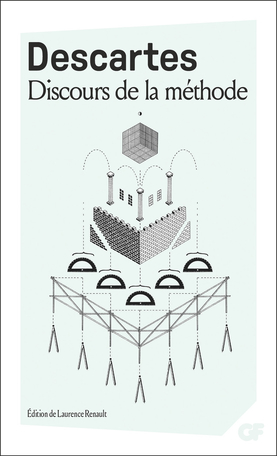
Descartes: Discourse on the Method
Discourse on the Method
- BnF collection ebooks Publisher
- Hachette Livre Publisher
- Flammarion Publisher
- Gallimard Publisher
- Fayard Publisher
- René Descartes Author
To discover the truth, we must first learn how to guide our own reason.
Details
- Type
- Book
- Original title
- Discourse on the Method
- Genres
- Essay, Philosophy
- ISBN
- 9782346042036
Synopsis
Descartes: Discourse on the Method
Glossary terms: Act, Argument, Author, Belief, Book, Certainty, Critical apparatus, Desire, Dimension, Discourse, End in itself, Essay, Existence, Fundamental, Knowledge, Metaphysics, Narrative, Necessity, Observation, Part, Philosophy, Publication, Reflection, Resolution, Short story, Story, Subject matter, Text, Title, Work
Overview
Overview
In Discourse on the Method, René Descartes sets out to define the conditions necessary for the pursuit of certain knowledge. Starting from the observation that human beings possess the ability to reason yet arrive at different opinions, he argues that what matters is not simply having the capacity for judgment, but knowing how to use it correctly. The work combines an account of his personal intellectual journey with an investigation into the means of distinguishing truth from error. Descartes presents his ambition to reconstruct knowledge from principles sufficiently reliable to withstand doubt.
This ambition leads to the development of a method based on four fundamental rules. The first consists in accepting as true only what appears clearly and distinctly to the mind, without haste or prejudice. The second recommends dividing each difficulty into simpler problems. The third requires reasoning to proceed in an orderly sequence, moving from the simplest and most accessible elements to the more complex. Finally, the fourth calls for sufficiently complete enumerations and reviews to avoid omissions. Inspired particularly by the rigor of mathematics, this method seeks to make reasoning more reliable.
Descartes does not, however, limit his reflections to theoretical knowledge. In the third part, he introduces a provisional morality, intended to guide his conduct while he questions his previous certainties. This morality rests particularly on respect for the laws and customs of his country, firmness in action, mastery over his desires, and a commitment to pursuing truth. He thus distinguishes the need for caution in philosophical reflection from the necessity of acting in a world where decisions cannot always await absolutely certain knowledge.
The fourth part develops the metaphysical foundations of his approach. By subjecting his beliefs to doubt, Descartes searches for a truth that cannot be denied. He discovers that the very act of doubting necessarily presupposes the existence of the person who thinks. This certainty is expressed in the famous statement, "I think, therefore I am." From this first principle, he examines the nature of the mind, the criteria of truth, and arguments concerning the existence of God. Doubt is therefore not an end in itself, but an instrument for attaining more securely grounded knowledge.
The work also devotes considerable attention to the rational study of nature. Descartes seeks to explain physical phenomena through intelligible principles and natural mechanisms. He addresses the functioning of the human body, the movement of the heart, and the distinction between human beings and animals. His conception of science rests on the possibility of understanding phenomena through their causes, while recognizing the importance of observation and experimentation in advancing knowledge.
In the final part, Descartes reflects on the conditions of scientific progress and the communication of knowledge. He explains why he decided to make certain investigations public and emphasizes the need to continue research into nature. The Discourse was originally accompanied by three scientific essays, Dioptrics, Meteorology, and Geometry, intended to demonstrate how the method could be applied in different fields. This connection between philosophy, mathematics, and natural science constitutes an essential dimension of his intellectual project.
Key Takeaways
Reason must be guided by a rigorous method. Descartes maintains that the ability to judge does not, by itself, guarantee access to truth. The four rules of method—evidence, analysis, orderly progression, and verification—provide a structure for reasoning and help limit errors arising from haste or prejudice.
Doubt serves as an instrument of inquiry. By questioning insufficiently supported knowledge, Descartes seeks to identify absolutely certain truths. This approach does not represent a commitment to permanent skepticism: its purpose is to establish principles on which knowledge can be reconstructed. The certainty of the thinking subject's existence constitutes its first step.
Provisional morality makes action possible during the search for truth. Descartes distinguishes the suspension of theoretical judgment from the practical necessities of life. He proposes temporary principles of conduct based on moderation, determination, and self-control, allowing him to continue his intellectual investigation without becoming paralyzed by uncertainty.
The method connects philosophy with scientific research. Descartes aims to apply the requirements of clarity and order to the study of natural phenomena. Rational explanation, mathematics, observation, and experimentation contribute to an approach intended to develop more reliable knowledge of the physical world.
Conclusion
With Discourse on the Method, René Descartes proposes a new approach to knowledge, grounded in the critical examination of beliefs and the methodical use of reason. By connecting the rules of reasoning, doubt, moral reflection, and scientific investigation, he presents the different dimensions of a project intended to establish knowledge on solid foundations.
The work occupies a fundamental place in the history of modern philosophy. Its conception of the thinking subject, its demand for rigorous demonstration, and its pursuit of a method applicable to the sciences have had a lasting influence on debates concerning truth, knowledge, and the independence of judgment.
Good to Know
- The work's full title is commonly rendered in English as Discourse on the Method of Rightly Conducting One's Reason and of Seeking Truth in the Sciences. It directly expresses Descartes' philosophical and scientific ambitions.
- The work consists of six parts, addressing the author's intellectual journey, the rules of method, provisional morality, metaphysical foundations, questions of physics, and the conditions of scientific progress.
- The four rules of method appear in the second part. They summarize the principles of reasoning that Descartes intends to apply throughout his investigations.
- The statement "I think, therefore I am" appears in the fourth part of the Discourse. It expresses the certainty that the existence of the thinking subject cannot be denied at the very moment that the subject doubts.
- Discourse on the Method was originally published alongside three scientific essays: Dioptrics, dealing particularly with optics; Meteorology, concerning natural phenomena; and Geometry, devoted to mathematical problems.
- The original French text is available in several editions, including those published by Flammarion, Gallimard, Fayard, Hachette Livre, and BnF collection ebooks. Critical introductions, annotations, and supplementary texts may differ between publications.
Link graph
Open in the full graphLoading the graph…
Only the strongest links are shown.