Presentation
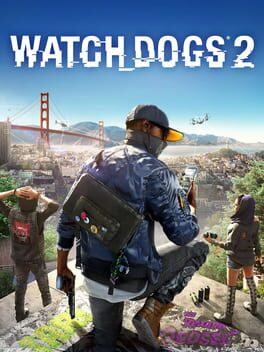
Developed primarily by Ubisoft Montreal and published by Ubisoft, Watch Dogs 2 was released in 2016 under the direction of Danny Bélanger, with Jonathan Morin and Patrick Plourde serving as Creative Directors and Dominic Guay as Senior Producer. The game retains the open-world hacking concept introduced by Watch Dogs but moves the action from Chicago to the San Francisco Bay Area and considerably expands the number of elements players can manipulate.
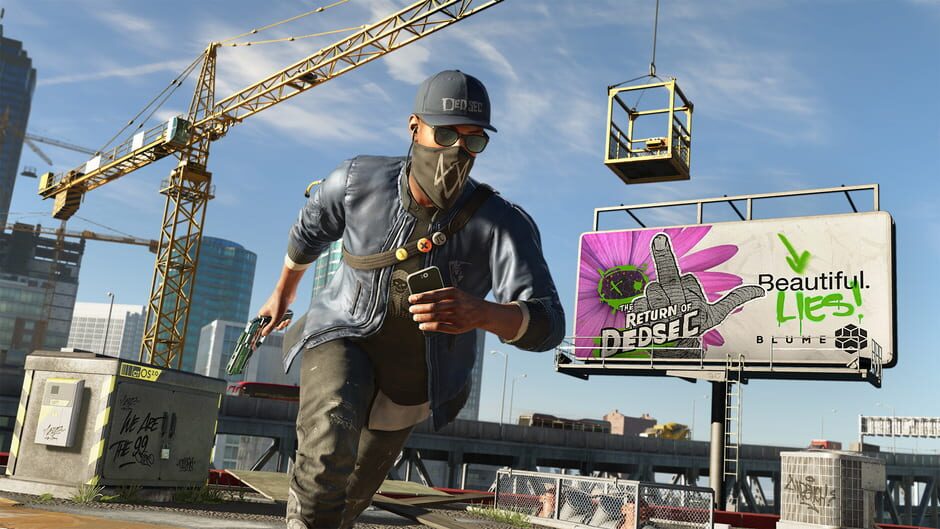
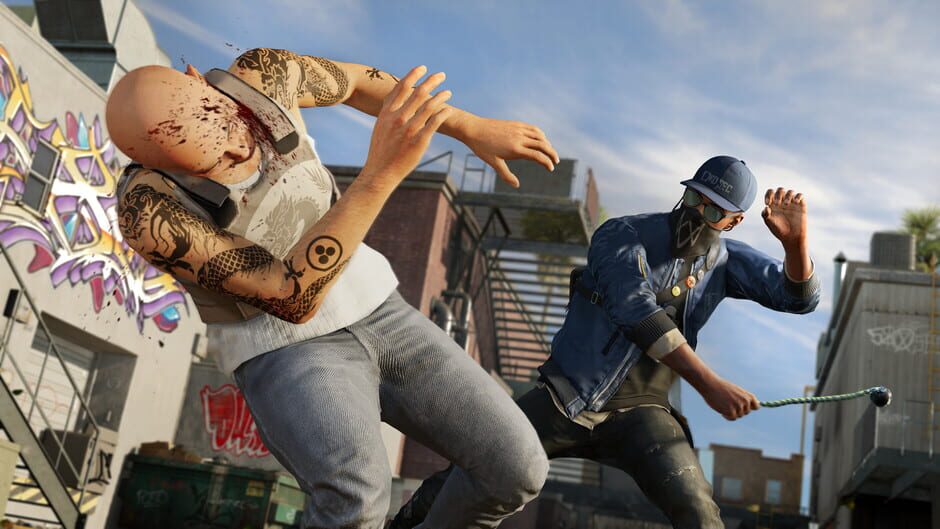
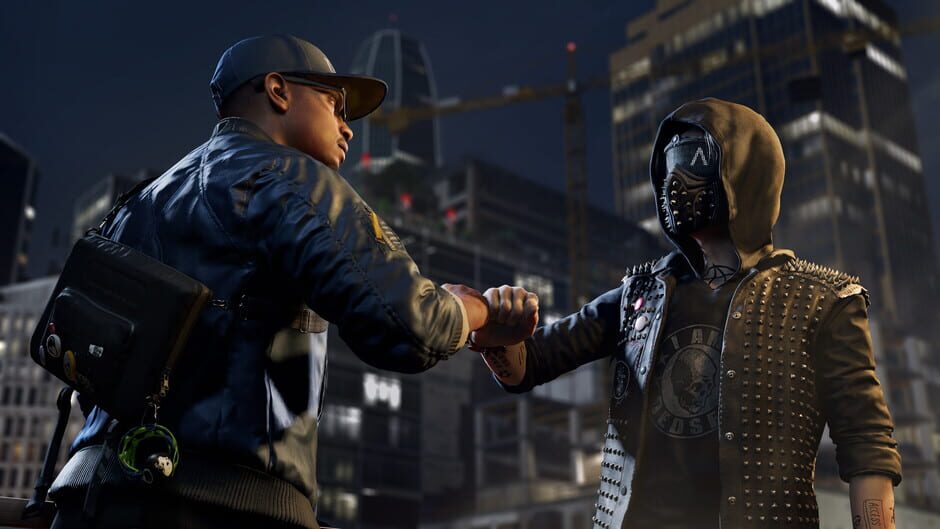
The protagonist also changes. Marcus Holloway is a hacker from Oakland who joins DedSec after becoming a victim of ctOS 2.0's predictive systems himself. He quickly forms a group with Sitara Dhawan, Wrench, Josh Sauchak and Horatio Carlin, each bringing a different personality and set of skills to the collective's operations.
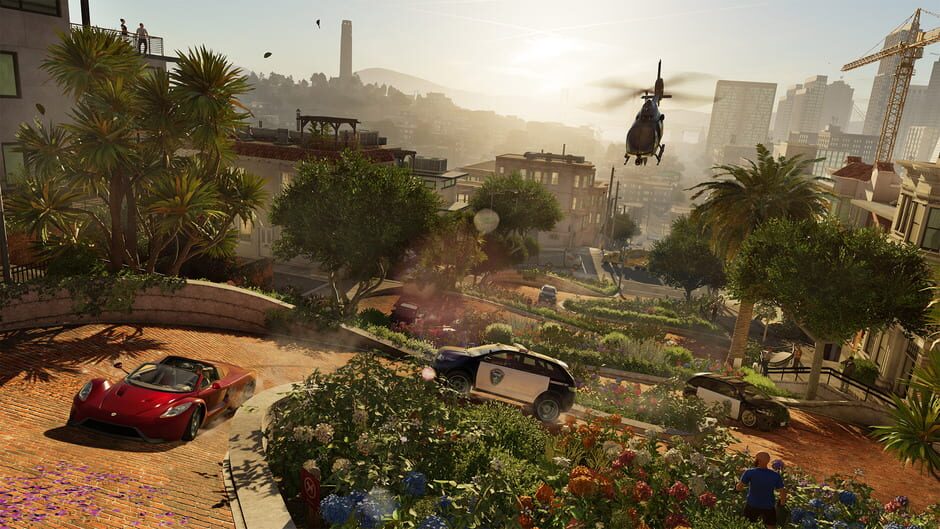
The map brings together several parts of the San Francisco Bay Area, including San Francisco, Oakland, Marin County and Silicon Valley. Residential districts, urban centers, industrial areas and the offices of technology companies provide a more varied environment than the Chicago of the first installment and directly support themes involving social networks, personal data and the technology industry.
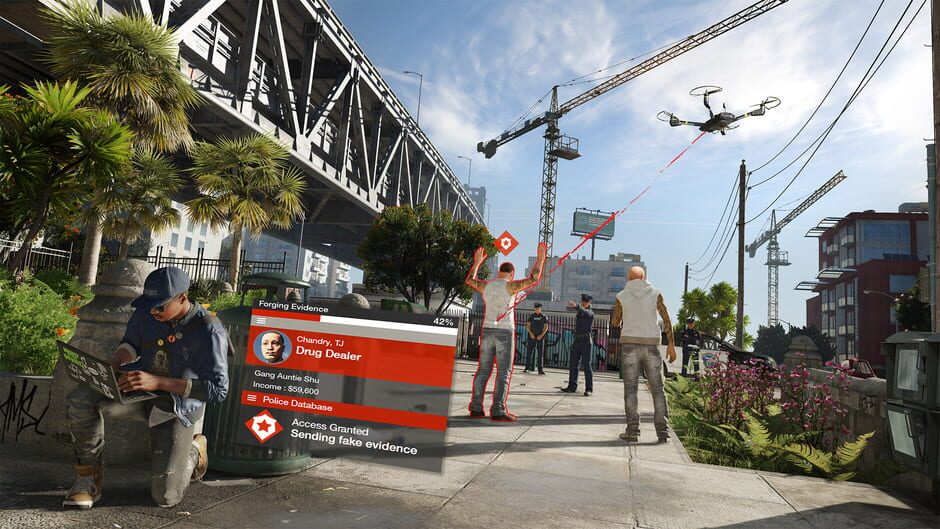
Hacking remains the primary mechanic but becomes considerably more flexible. Marcus can access the city's infrastructure, connected devices and personal databases. He can also directly manipulate certain vehicles, cranes, doors, security robots and urban equipment to create distractions, open routes or trigger chains of events.
This freedom allows many missions to be approached without immediately entering a hostile area. Players can observe locations through cameras, take remote control of devices and use equipment to reach certain objectives. An infiltration can therefore be handled almost entirely through the network before Marcus physically crosses into a building.
Two remote-controlled tools play a particularly important role: the Jumper, a small vehicle capable of entering tight spaces and interacting with certain systems, and the quadcopter, used to observe environments from the air and reach otherwise difficult positions. Together, they greatly expand remote exploration and infiltration.
Marcus also retains significant physical abilities. More mobile than Aiden Pearce, he can use parkour to cross obstacles and move quickly through urban environments. In combat, he has access to firearms, a melee weapon and several gadgets, but the game also supports less lethal approaches through non-lethal weapons, distractions and hacking.
Progression relies on research points that unlock new abilities across several branches. Players can improve hacking, remote control, engineering and environmental manipulation skills. Certain research data must be discovered directly in the world, encouraging exploration beyond the main missions.
Driving remains important but also benefits from expanded hacking possibilities. Marcus can remotely control certain vehicles, disrupt traffic and use urban infrastructure during pursuits. Manipulating cars therefore goes beyond causing accidents and can become a genuine method of infiltration, distraction or movement.
Watch Dogs 2 also develops a multiplayer experience integrated into the open world. Cooperative activities allow several players to complete certain operations together, while hacking invasions and other competitive modes reintroduce the idea of a human opponent appearing directly inside the environment. Ubisoft later expanded the online component through free updates, including a mode supporting four players.
The game gives far greater importance to DedSec and its culture. The group's operations aim both to expose abuses and attract new followers, who symbolically represent the computing power available for its actions. This mechanic directly connects player progression with the collective's public visibility.
Watch Dogs 2 therefore expands the formula of the first installment by turning hacking into a much more systemic tool. People, vehicles, drones, devices and infrastructure can all participate in the same situation, allowing players to combine several solutions rather than treating the network as a simple supplement to weapons and driving.
What to remember
- Marcus Holloway as the new protagonist, an Oakland hacker who joins DedSec after being unfairly targeted by ctOS 2.0's predictive algorithms.
- The San Francisco Bay Area as the open world, with San Francisco, Oakland, Marin County and Silicon Valley among its major locations.
- A considerably expanded hacking system, allowing players to control or manipulate inhabitants, vehicles, drones, cranes, security robots and numerous connected devices.
- The Jumper and quadcopter, allowing players to explore, observe and infiltrate entire areas without directly moving Marcus into them.
- Progression built around DedSec, research points and followers earned by exposing corporations and institutions exploiting citizens' data.
- Multiplayer integrated into the open world, combining cooperation, hacking invasions and competitive activities directly accessible during exploration.
Conclusion
Watch Dogs 2 retains the fundamental idea of the first installment but gives hacking a much broader role in the functioning of its open world. Where Aiden mainly used the network as an extension of his infiltration and combat abilities, Marcus can manipulate far more elements and build solutions based almost entirely on remote control.
The Jumper and quadcopter summarize this evolution particularly well. They allow players to virtually move through an area, reach protected systems and prepare an operation without immediately exposing the protagonist. Missions therefore become less dependent on a single physical route and more open to experimentation.
The San Francisco Bay Area directly supports this approach. Silicon Valley, Oakland and San Francisco allow technology companies, social networks, predictive algorithms and large-scale data collection to be integrated into the environment rather than restricted to the story. The open world and the narrative themes consequently rely on the same infrastructure.
DedSec also gives the adventure a different identity. Marcus does not act alone, and his operations serve a group seeking public attention as much as it seeks to compromise its opponents. Wrench, Sitara, Josh and the other members place greater emphasis on character interaction and the collective dimension of hacking.
By expanding interactions, developing cooperation and turning the network into a genuine toolbox, Watch Dogs 2 significantly deepens the formula introduced in 2014. Its main contribution to the series lies in this freedom: technology is no longer simply a way to access information, but a collection of systems that players can combine to directly transform the city.
Good to know
- Watch Dogs 2 was developed primarily by Ubisoft Montreal and published by Ubisoft, with contributions from several other Ubisoft studios.
- Danny Bélanger is credited as Game Director, Jonathan Morin and Patrick Plourde as Creative Directors and Dominic Guay as Senior Producer.
- The game was released for PlayStation 4 and Xbox One on November 15, 2016, followed by Windows on November 29, 2016.
- Marcus Holloway joins the San Francisco DedSec cell, whose members notably include Sitara, Wrench, Josh and Horatio.
- Ubisoft officially describes the map as covering several parts of the Bay Area: San Francisco, Oakland, Marin County and Silicon Valley.
- The game launched with cooperative and competitive activities integrated into the open world; a free update later added a four-player Party mode in 2017.
- Watch Dogs 2 is the second main installment in the franchise, following Watch Dogs in 2014 and preceding Watch Dogs: Legion in 2020.
```