


Synopsis
After developing powers similar to Peter Parker's, Miles Morales gradually learns how to become Spider-Man under the guidance of his mentor. But when Peter temporarily leaves New York, the young hero must protect the city almost entirely on his own for the first time.
Now living with his mother Rio in East Harlem, Miles is also trying to find his place in a neighborhood to which his family is deeply attached. That fragile balance is threatened when a conflict erupts between the energy corporation Roxxon and the Underground, a criminal group equipped with highly advanced technology.
Caught between this war, his family responsibilities and a heroic identity he still has to build, Miles gradually realizes that being Spider-Man does not mean becoming a copy of Peter Parker. To protect his neighborhood and the people he loves, he will have to learn how to master his own powers and decide what kind of hero he wants to become.
Overview
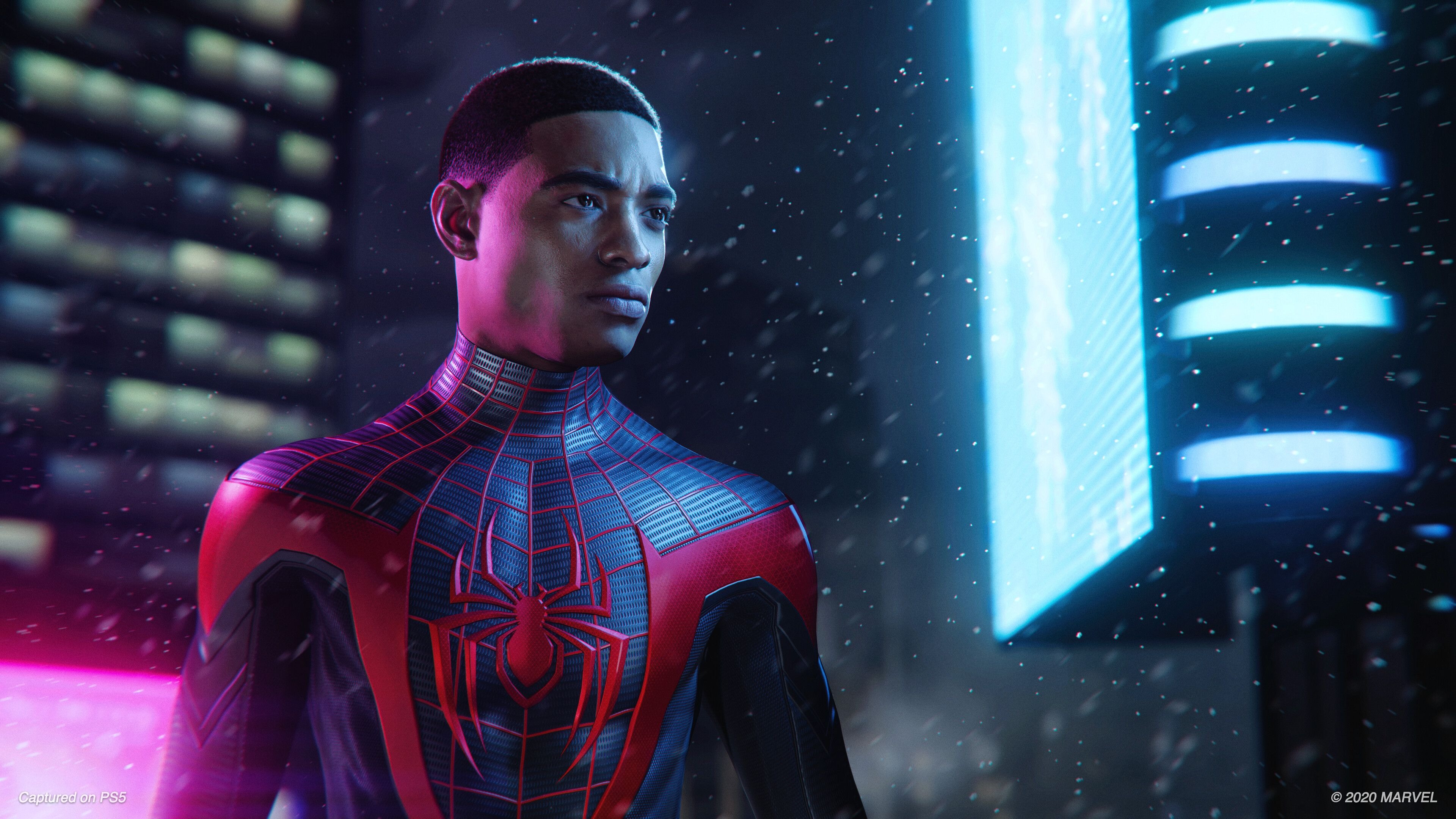
Marvel's Spider-Man devoted much of its energy to making the player feel like an already experienced Peter Parker. Miles Morales almost takes the opposite approach: its Spider-Man already knows how to swing between buildings, but he still does not really know who he is when he wears the mask.
That difference is enough to give its own personality to a formula that remains very close to the 2018 game. Insomniac's New York is still recognizable, but winter, snow, holiday decorations and especially the attention given to East Harlem give the adventure a more intimate scale. The neighborhood is not simply another part of the map: it is where Miles lives, knows local residents and tries to understand what it means to protect a community rather than an abstraction called New York.
Traversal retains the immediate pleasure of web-swinging, but Miles does not simply reproduce Peter's animations. His movements sometimes seem more disorganized, more acrobatic or less perfectly controlled, as though his personality continues to emerge even in the way he falls between two buildings before recovering his trajectory.
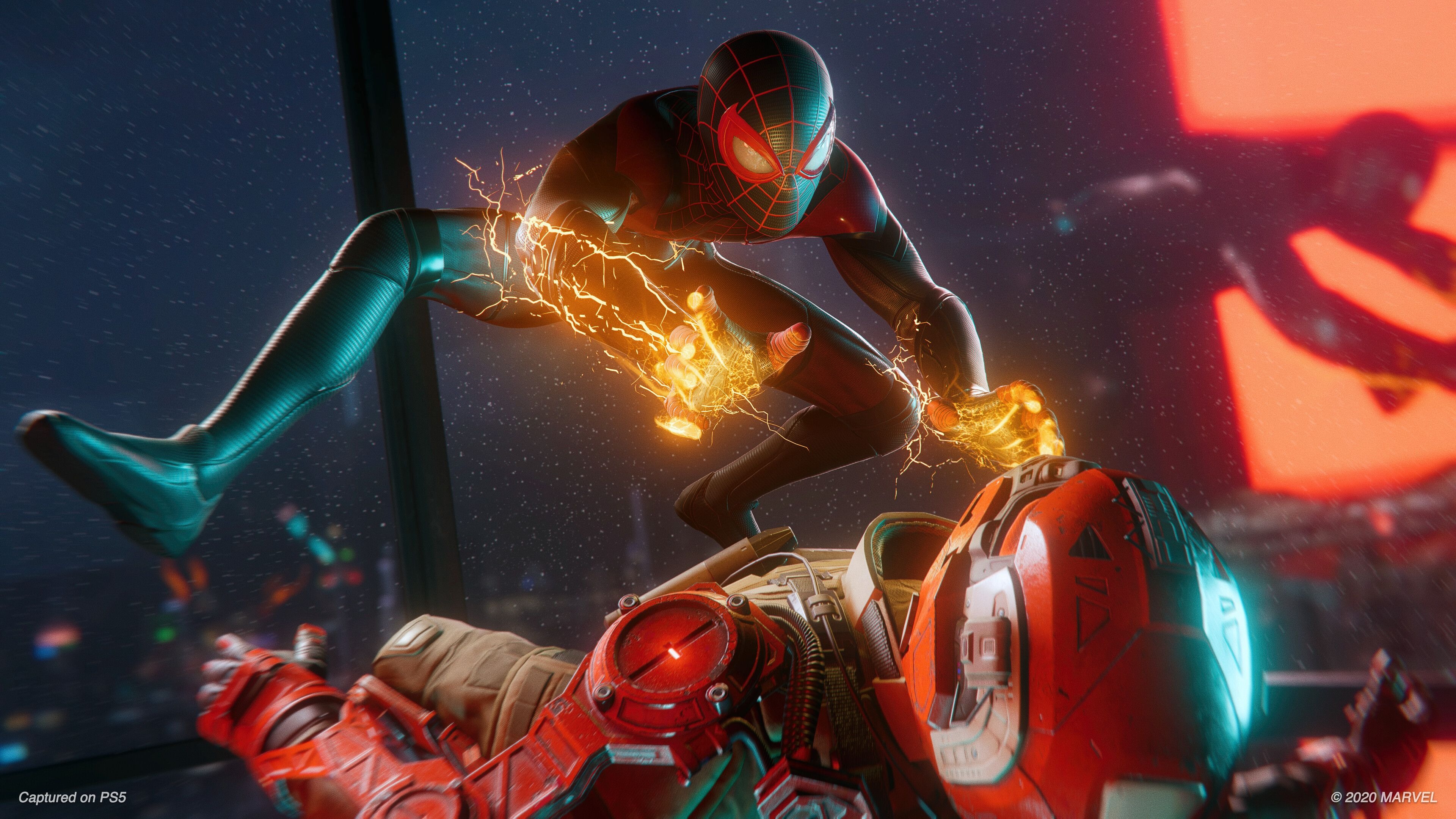
Combat emphasizes that difference even further. Miles has his own bioelectric abilities, capable of charging his attacks and disrupting certain enemies, as well as a camouflage power that changes the possibilities of stealth. These mechanics do not replace the gadgets, dodges and combos inherited from the first game, but they prevent the character from feeling like a simple costume swap.
The adventure also adopts a much tighter format. Miles Morales does not try to reproduce exactly the same amount of content as the previous game. Its shorter length allows it to focus more closely on a few relationships, one neighborhood and a central conflict — even if it also makes the structural similarities with Marvel's Spider-Man more visible.
Key takeaways
- Miles has his own Spider-Man identity. His bioelectric powers, camouflage and animations immediately distinguish his gameplay from Peter Parker's.
- East Harlem plays a central role. The neighborhood is simultaneously Miles' new home, the setting of the story and an essential part of his relationship with the idea of community.
- The structure remains very close to Marvel's Spider-Man. Open-world traversal, urban crimes, side activities, stealth and acrobatic combat retain many of the principles established in 2018.
- The adventure is deliberately more compact. The game focuses its story more closely on Miles, his family, his loved ones and his transformation into an independent hero.
- The PS5 version accompanied the launch of a new generation. SSD technology, haptic feedback, adaptive triggers, ray tracing and a mode targeting 60 frames per second help distinguish this version from the PS4 edition.
PANACHES review
Marvel's Spider-Man: Miles Morales could easily have become the game of “the same Spider-Man, but in a different suit.” Insomniac does something far more interesting: it begins by preserving almost all of the first game's grammar, then gradually looks for the places where Miles can bend it.
It begins with movement.
Peter Parker swung through the city like someone who had spent years perfecting every trajectory. Miles feels more like someone turning a fall into an acrobatic move at the very last second. His arms sometimes go elsewhere, his body rotates more and his animations carry a slightly less disciplined energy. Technically, both characters cross the same city using webs. Visually, they are already telling slightly different stories.
The Venom powers strengthen that identity. A bioelectric attack can suddenly turn an ordinary combo into an explosion of energy, while camouflage gives Miles a different way to regain control when stealth goes wrong. The game understands something essential: to make a new hero exist, changing their story is not enough. You also have to change the way their hands respond to the player's.
That distinction is still built on extremely familiar foundations. Open-world activities, encounters, gadgets, progression and part of the narrative structure constantly recall Marvel's Spider-Man. Anyone looking for a complete revolution may therefore find Miles Morales much closer to a particularly generous extension than to a truly new installment.
But its shorter format suits it.
The 2018 game had to tell the story of Peter Parker, Mary Jane, several antagonists, the entire city and eight years of heroic experience. Miles Morales can narrow the frame. An apartment. A mother. A best friend. A snow-covered neighborhood. A few streets where the residents begin to recognize the person swinging above their windows.
That scale gives East Harlem particular importance. Major superhero games constantly talk about saving a city, but an entire city remains difficult to love in any concrete way. Insomniac gives Miles something more specific to protect: a place where people know who his mother is, where his friend is waiting for him and where a neighborhood festival can feel almost as important as a fight on a bridge.
The story remains more conventional than this idea might suggest. Some revelations can be guessed fairly early, and the conflict between Roxxon and the Underground uses familiar superhero blockbuster structures. The writing works better when it simply allows Miles to talk with his family and friends than when it insists on building a threat large enough to shake the entire city.
That may be why the game's identity survives best in its smaller moments.
Miles translates for his mother. Ganke turns a bedroom into an improvised headquarters. A family conversation blends several cultures without the game needing to stop its story to explain that it is representing several cultures. The character gradually comes into existence through an accumulation of details rather than through declaration.
And that is exactly what his story needed to accomplish.
Miles Morales becomes Spider-Man when he stops trying to determine whether he is close enough to Peter to deserve the title. The game works in the same way. It remains built on the foundations of Marvel's Spider-Man, but its best moments arrive when it stops apologizing for being smaller, more personal and slightly different.
It is not yet the series' major second step. It is something more modest: the moment when a supporting character realizes he can now carry his own game.
Good to know
- Marvel's Spider-Man: Miles Morales was released on November 12, 2020 for PlayStation 4 and PlayStation 5. It continues the universe established by Marvel's Spider-Man and places Miles at the center of his own adventure.
- The game was developed primarily by Insomniac Games and published by Sony Interactive Entertainment.
- With Peter Parker temporarily away from New York at the beginning of the adventure, Miles has to take on much of Spider-Man's responsibility by himself.
- His abilities notably include bioelectric Venom attacks and camouflage, complementing the web-swinging, gadgets and combat techniques already established in the series.
- The PS5 version notably takes advantage of the SSD, haptic feedback and the DualSense's adaptive triggers. PlayStation also offers graphics modes making use of features such as ray tracing or targeting 60 frames per second.
- PlayStation currently lists 24 accessibility features across PS4 and PS5, covering areas including visuals, audio, subtitles, controls and different gameplay assists.
- A PC version was released on November 18, 2022, developed in collaboration with Nixxes Software. It notably offers an unlocked frame rate, several upscaling technologies, ray tracing and support for multiple ultra-wide display formats.
- The Ultimate Edition available on consoles also includes Marvel's Spider-Man Remastered, along with the three chapters of The City That Never Sleeps adventure.
- SensCritique currently displays an average score of 6.9/10.