Presentation
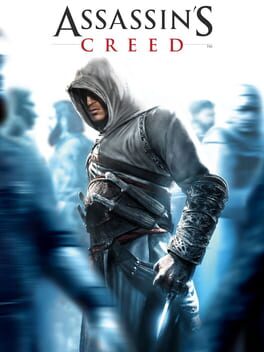
Assassin’s Creed builds its identity around a simple idea: an assassin should not merely know how to kill a target. He should be able to reach that target in the middle of a city, understand his surroundings and then disappear into the crowd.
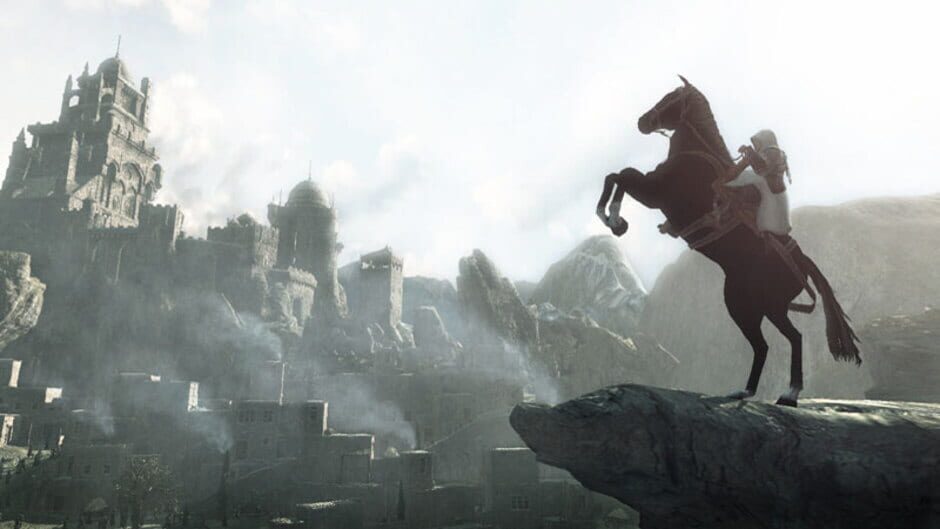
Altaïr moves through several major cities of the Holy Land during the Third Crusade. Damascus, Acre and Jerusalem each have their own districts, architecture and atmosphere, while Masyaf serves as the Brotherhood’s anchor point.
Movement immediately becomes one of the game’s defining features.
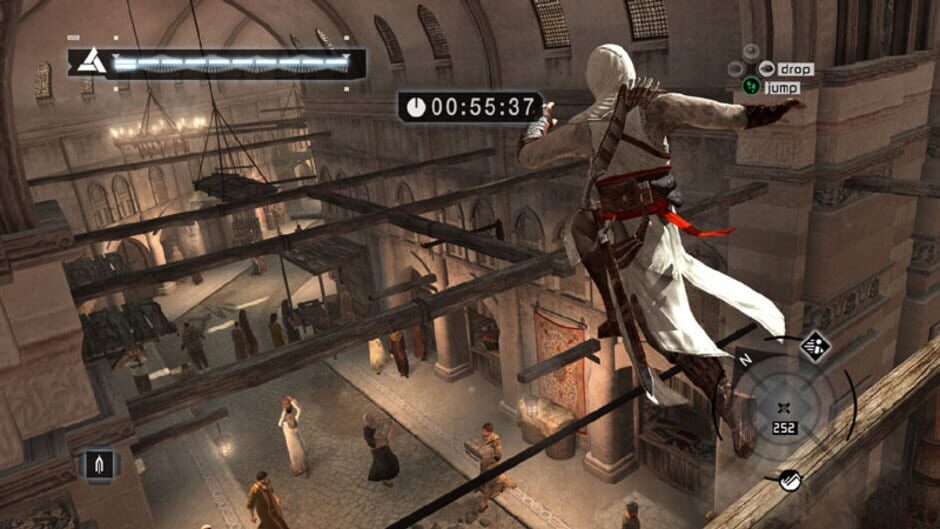
Altaïr can climb façades, towers, beams and monuments, run across rooftops and move quickly between different levels of the city. Buildings are no longer merely historical scenery: they become a network of vertical routes.
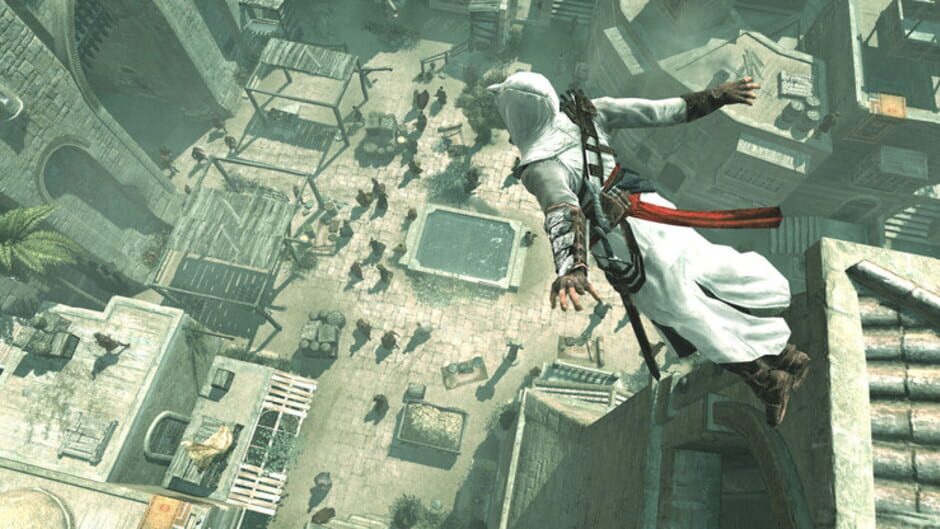
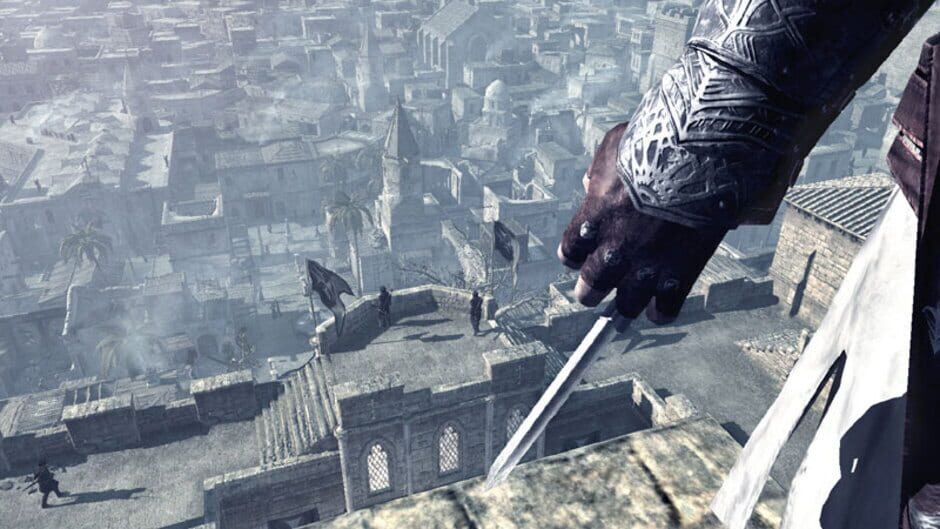
Viewpoints directly support this idea. Reaching their summit gives a better understanding of the surrounding area before performing a Leap of Faith to return quickly toward the streets. This alternation between height, observation and descent establishes one of the series’ most recognizable gestures from the very first game.
The crowd forms the other half of this urban space.
Altaïr can blend among certain groups, adopt a less suspicious demeanor or take advantage of urban activity to approach an objective. Stealth therefore does not rely only on staying behind a wall: it also means becoming ordinary enough to stop attracting attention.
This “social stealth” is accompanied by a distinction between different behaviors. Running, climbing aggressively or shoving pedestrians increases the risk of alerting guards. Moving more calmly, by contrast, allows Altaïr to cross certain spaces without immediately provoking a reaction.
An assassination generally comes at the end of a preparation phase.
Before reaching his main target, Altaïr gathers information throughout the city. Listening to conversations, interrogating a character, discreetly stealing a document or completing tasks for informants helps him understand the person he must eliminate and the conditions surrounding the mission.
Once sufficiently informed, he returns to the local Assassin Bureau to prepare the operation.
This structure gives each target a ritual-like rhythm: arrive in a city, observe, investigate, identify opportunities, assassinate, then escape the guards.
The Hidden Blade perfectly embodies this approach. Discreet and instantly lethal when used under the right conditions, it allows Altaïr to eliminate a target in a public space before the situation collapses into chaos.
Because infiltration can very quickly become pursuit.
Once discovered, Altaïr must run across rooftops, break his pursuers’ line of sight and find somewhere to hide. The city then changes function: the same beams, alleys and façades observed only minutes earlier become the elements of an improvised escape route.
Combat takes over when escape fails or confrontation becomes unavoidable.
Altaïr uses a sword, short blade, throwing knives and the Hidden Blade. Encounters rely more on timing, counters and managing opponents than on rapidly chaining long combinations. An Assassin surrounded by enemies remains dangerous, but the game repeatedly reminds the player that his best weapon is control of the situation before it deteriorates.
This logic directly accompanies the character’s journey.
Altaïr begins the story convinced that his talent is enough to justify his behavior. His demotion therefore turns mechanical progression into a reconstruction of his status. As he completes his missions, he regains equipment and abilities while being forced to think more seriously about the meaning of the Creed he claims to serve.
The conversations before or after assassinations play an important role here. Altaïr’s victims do not always match the simple image he formed of them before reaching them. Several defend their actions, explain their worldview or suggest that the Assassin’s mission rests on an incomplete understanding of events.
The conflict between Assassins and Templars therefore begins to take on an ideological dimension.
The Assassins defend the ability of individuals to determine their own path, while their enemies believe that sufficiently powerful order can prevent humanity from falling into chaos. The first game establishes this opposition without constantly reducing its characters to a simple divide between heroes and villains.
The Animus adds another layer to this construction.
Interfaces, visual disruptions and certain anomalies constantly remind the player that the Holy Land being explored is a reconstruction of memories observed from the modern era. Altaïr stands at the center of the historical adventure, but Desmond remains the person whose presence makes it possible to relive it.
This dual timeline would become fundamental to the series.
Above all, it allows the first Assassin’s Creed to be more than a historical game. The Crusades, the cities and the figures of the 12th century also serve as the setting for a fiction in which secret organizations have been attempting to influence the course of history for generations.
What to remember
- The first entry in the Assassin’s Creed series, set mainly in 1191 during the Third Crusade.
- Altaïr Ibn-La’Ahad, an Assassin of Masyaf forced to regain his rank after seriously violating the principles of his order.
- Damascus, Acre and Jerusalem as the main cities where Altaïr investigates his targets and prepares their assassinations.
- A movement system built around parkour, climbing, rooftops, viewpoints and the Leap of Faith.
- Social stealth allowing the player to use crowds and public behavior to avoid attracting attention.
- A structure where gathering information, assassination and escape form the central mission cycle.
- A parallel narrative in which Desmond Miles is forced to use the Animus to relive the memories of his ancestor Altaïr.
Conclusion
The first Assassin’s Creed already contains almost the entire fundamental idea of the series, but in a much more stripped-down form than its successors.
The city is simultaneously an investigation ground, a vertical space and a means of escape. A target is not merely an enemy to defeat: they must be found, understood and approached. And history is never entirely alone, because the Animus constantly reminds the player that a second story is observing the first.
That coherence comes at a cost.
Preparation for assassinations often relies on the same categories of activities, and their repetition becomes noticeable over the course of the adventure. The possibilities offered by the cities can feel broader than the ways missions actually ask the player to use them.
Combat itself is relatively simple compared with the systems developed by later entries.
Yet this austerity also gives the game a distinctive identity. Altaïr is not yet an adventurer burdened with dozens of side activities. He belongs to an order, receives a target, gathers information and carries out his work.
The character’s journey reinforces that discipline. His true progression does not consist only of recovering the equipment he lost. He must move from the certainty that he is the greatest Assassin in his order to understanding that the Creed demands more than simply knowing how to wield a blade.
The game ultimately puts the player through a similar evolution. The first targets seem relatively easy to condemn. Then their arguments begin to echo one another, their motivations become less comfortable, and a shared structure emerges behind men who belong to opposing sides.
Assassin’s Creed therefore begins as a story of assassinations during the Crusades.
It ends by asking the question that would accompany the entire series: who should decide how other people are allowed to live?
Good to know
- Assassin’s Creed was developed primarily by Ubisoft Montreal and published by Ubisoft.
- The game was originally released in November 2007 on PlayStation 3 and Xbox 360, before later coming to PC.
- Altaïr’s story takes place mainly in 1191 during the Third Crusade.
- The game notably allows players to explore Damascus, Acre, Jerusalem and the Assassin fortress of Masyaf.
- Desmond Miles is the protagonist of the modern-day storyline and is forced to relive Altaïr’s memories through the Animus.
- Several elements that became iconic to the series are already present: the Hidden Blade, Leap of Faith, parkour, viewpoints and social stealth.
- This entry establishes the foundations of the conflict between Assassins and Templars that would structure much of the series.