Presentation
Assassin's Creed Syndicate brings the series back to a dense major metropolis after the revolutionary Paris of Unity, but this time chooses a city profoundly transformed by industrialization. London is crossed by railways, factories, vehicles and constant activity that directly changes the way players move through it. Streets are wider, districts larger and distances more significant.
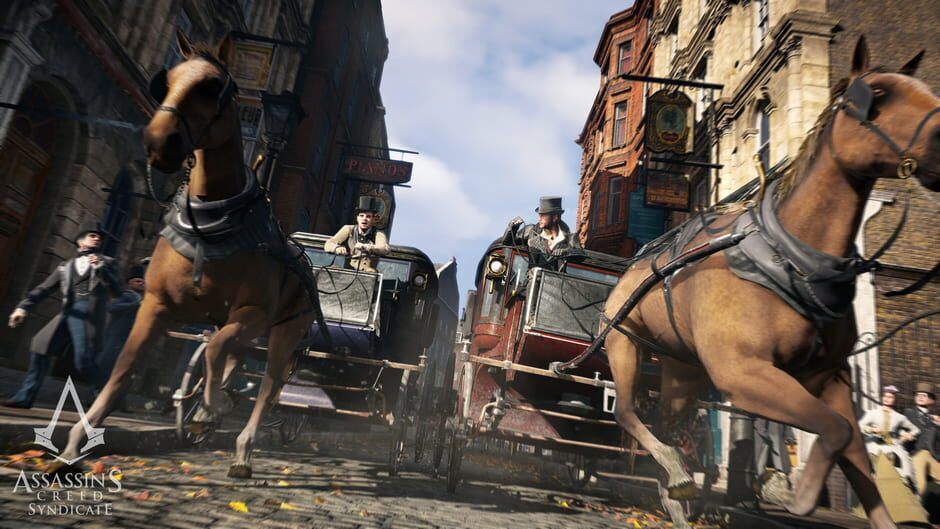
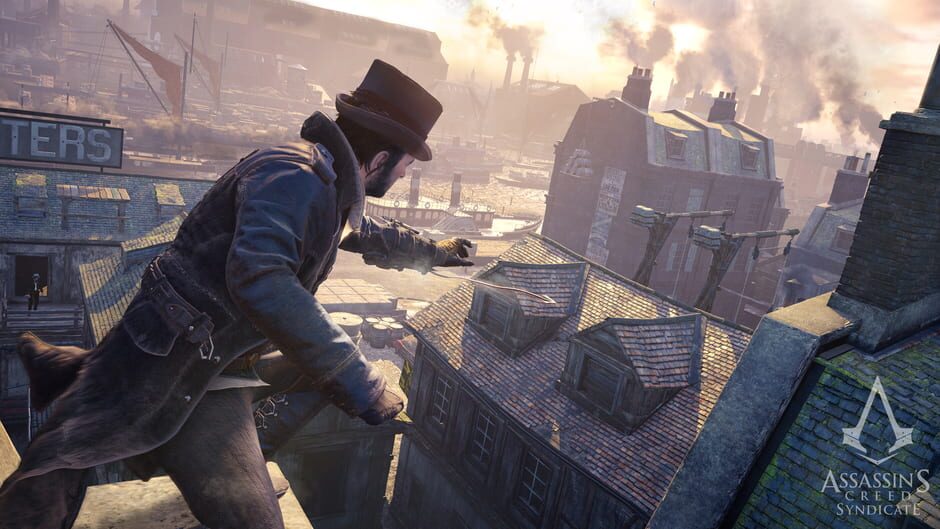
To accommodate this new scale, the game notably introduces a rope launcher that allows the protagonists to quickly reach rooftops or cross certain streets from above. Carriages also become an essential means of transportation and can lead to pursuits through London traffic. These tools significantly speed up movement and give this installment a different sense of mobility from its predecessors.
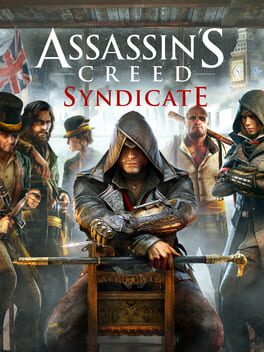
The main distinctive feature of Syndicate, however, is the presence of two protagonists. Jacob and Evie share the same adventure but embody two different sensibilities. Jacob favors direct action, combat and the creation of a gang capable of challenging control of the streets. Evie remains closer to the traditional image of an Assassin, with greater emphasis on discretion, observation and the search for artifacts.
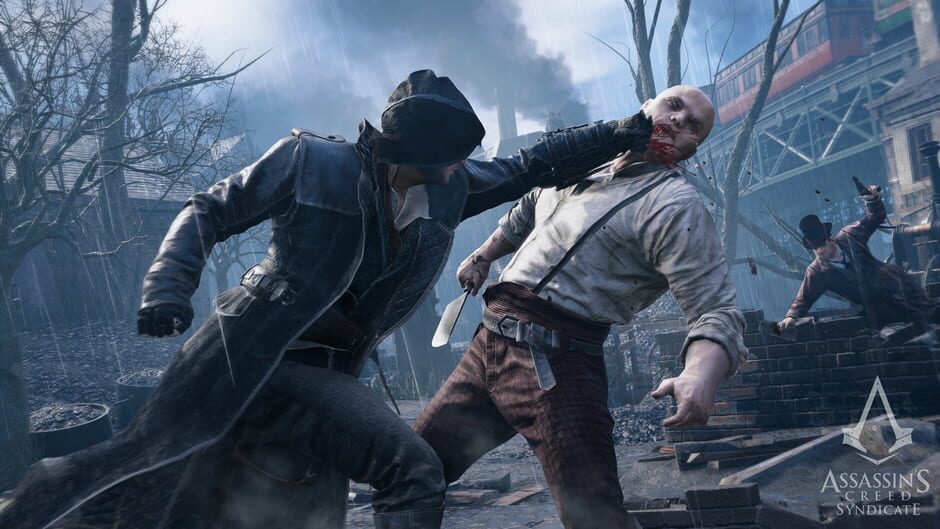
This contrast is also reflected in character progression. Both characters share a common foundation but can develop certain abilities that better match their respective specialties. The game retains the stealth, assassinations and vertical exploration characteristic of the series while strengthening close-quarters combat, which becomes faster and more physical.
The conquest of London structures a large part of the open world. The districts are under the influence of the Blighters, the gang associated with the Templars, and various activities gradually reduce their control. At the same time, Jacob founds the Rooks, a gang allied with the Assassins that gains a stronger presence as the player takes back the city.
This territorial dimension gives Syndicate a particular identity: the conflict between Assassins and Templars becomes directly visible in the streets. The Industrial Revolution is not merely an aesthetic backdrop; it also allows the game to explore a world where technological progress, wealth and social exploitation advance side by side.
What to remember
- An open-world adventure set in Victorian London in 1868, during the Industrial Revolution.
- Two playable protagonists, Jacob and Evie Frye, offering complementary personalities and approaches.
- A city designed around new forms of movement, particularly the rope launcher, carriages and trains.
- A territorial war between Jacob's Rooks and the Blighters supported by the Templars.
- A mix of traditional stealth, more direct combat and the gradual conquest of districts.
- A depiction of London where industrialization, technological progress and deep social inequalities directly shape the atmosphere.
Conclusion
Assassin's Creed Syndicate finds much of its personality in its pair of protagonists. Jacob brings a more impulsive energy and willingly turns the secret war into a territorial conflict, while Evie remains closer to the Brotherhood's methodical and discreet traditions. Their complementarity allows the game to explore two different ways of being an Assassin without completely opposing them.
The conquest system and the multiplication of district activities can, however, become repetitive, particularly when the liberation of London follows similar patterns from one area to another. The arrival of the rope launcher also simplifies part of the parkour by favoring speed over more deliberate routes across building façades.
But this acceleration also suits the world the game seeks to represent. London is no longer a medieval or Renaissance city designed to be slowly crossed over rooftops: it is an immense, noisy and mechanical industrial capital. Syndicate thus adapts the historical formula of the series to an era when machines themselves are beginning to reshape the way people live, work and control the city.
Good to know
- Assassin's Creed Syndicate was primarily developed by Ubisoft Quebec.
- The game was released in 2015.
- The main story takes place in London in 1868, during the Victorian era and the Industrial Revolution.
- Jacob and Evie Frye are twins and the two main protagonists of the adventure.
- The game introduces the Rooks, a gang founded by Jacob to fight the influence of the Blighters and the Templars in London.
- Several historical figures from the Victorian era appear throughout the adventure, including Charles Dickens, Charles Darwin and Alexander Graham Bell.