Presentation
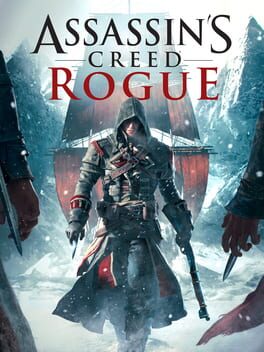
Assassin’s Creed Rogue takes an already familiar formula and turns it against the person using it.
Shay knows how to climb, disappear into crowds, strike from above and use the tools of an Assassin.
So do his enemies.
That is the main idea distinguishing the game beyond its change of allegiance.
For the first time in a main entry in the series, the protagonist belongs to the Templars for most of his journey. Yet this reversal does not make Shay mechanically unrecognizable compared with previous heroes.
He has precisely the same skills because he was trained by the Brotherhood.
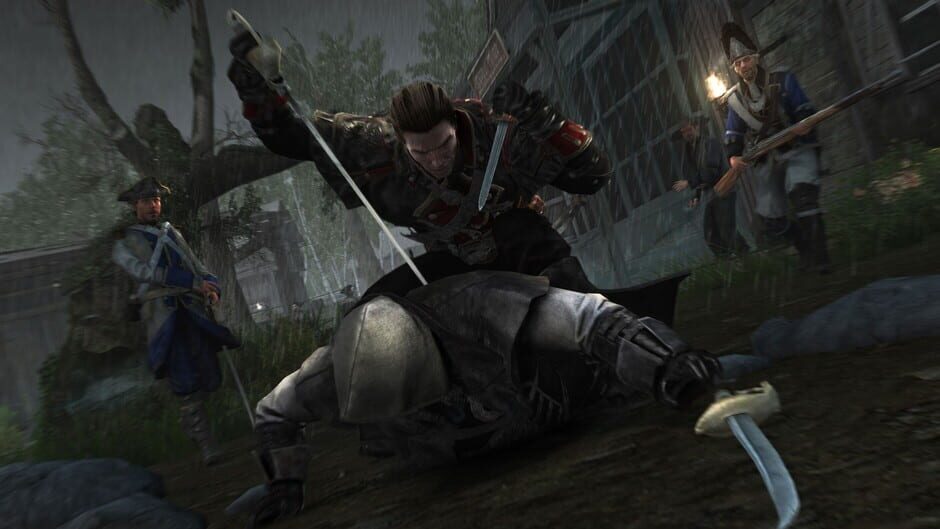
The game uses this background to reverse several traditional situations. Assassins can hide in concealed spaces, wait above the streets or prepare surprise attacks against Shay. An audio and visual signal gradually warns the player when a hidden enemy is nearby, but their exact position still has to be identified before they strike.
A haystack, once synonymous with safety, can therefore become a threat.
This simple reversal works because it turns a language the player already understands against them. After several games spent watching guards fail to notice an Assassin positioned only a few meters above them, Rogue asks what it feels like to be the target when you know an Assassin is somewhere nearby.
Shay naturally gains new tools to answer this threat.
The air rifle can fire different types of ammunition and allows him to act at range without relying solely on traditional firearms. The grenade launcher later expands his arsenal with a far less discreet approach.
Hidden Blades, swords, pistols and other equipment inherited from previous entries remain available. The game therefore does not attempt to completely reinvent the land combat of Black Flag, but instead gives the player a few additional options suited to Shay’s new role as a hunter.
Assassin Interceptions directly develop this idea.
Shay can recover messages intended for the Brotherhood, determine which target is under threat and intervene before the assassination is carried out. The objective is no longer to prepare someone’s death: it is to identify the Assassins sent after them and eliminate them before they complete their mission.
The familiar structure is reversed.
This inversion also appears in districts controlled by gangs connected to the Assassins. Taking them back reduces their influence and contributes to the gradual transformation of the territory, following a logic reminiscent of some of the reconquest systems already seen in Brotherhood.
The open world nevertheless retains much of the maritime legacy of Black Flag.
Shay commands his own ship, the Morrigan.
Smaller and more maneuverable than Edward Kenway’s Jackdaw, it allows him to travel across the waters of the North Atlantic and the river networks running through part of the continent.
The naval system remains immediately recognizable.
The Morrigan can attack other vessels, recover resources and receive different upgrades. Battles still depend on positioning, cannon fire and the ability to expose an enemy ship without leaving your own broadside vulnerable for too long.
The new environment, however, introduces several distinctive elements.
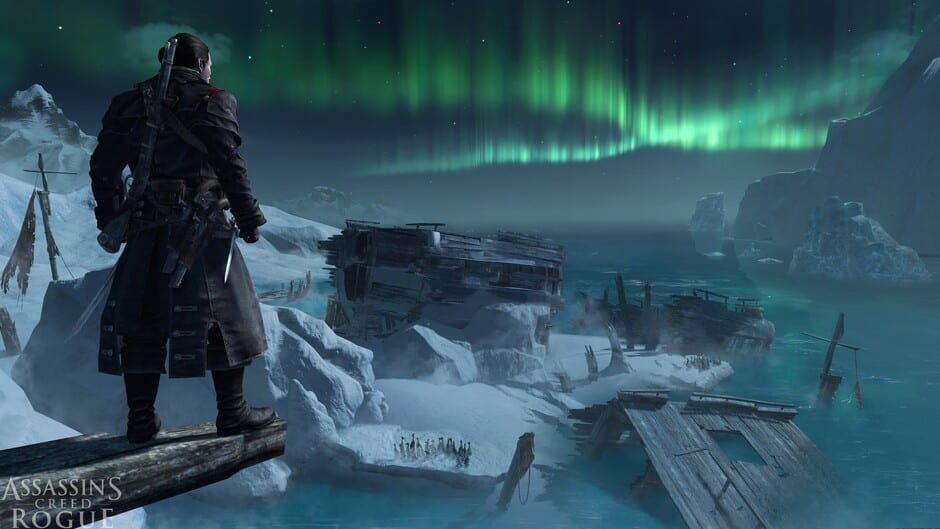
The North Atlantic is filled with ice. Some sheets can be broken through using the Morrigan’s ice-breaking ram, while icebergs and narrow passages alter the routes available.
Burning oil also allows Shay to create a wall of fire behind the ship, particularly useful when an enemy tries to stay in his wake.
Enemies can board the Morrigan as well.
After spending Black Flag sending his crew onto enemy decks, the player must now sometimes defend his own ship from an attacking crew. Once again, Rogue prefers reversing a familiar mechanic rather than creating something entirely new.
Exploration is divided between three main types of territory.
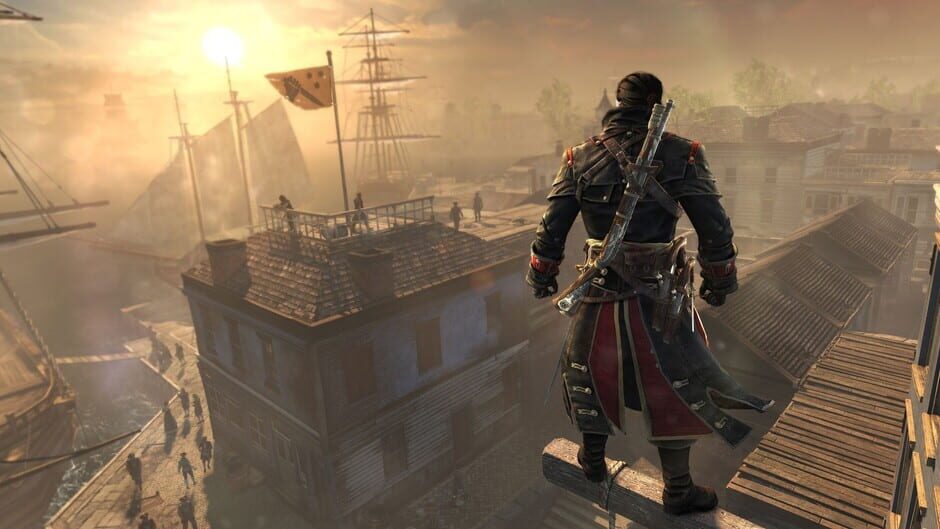
New York provides the urban environment, with its streets, buildings and activities. The River Valley combines inland navigation, settlements and natural spaces. The North Atlantic instead offers icy landscapes, small communities and areas where the ship is the main means of connection.
This variety gives the game a particular geography.
The Caribbean of Black Flag created a sense of warmth, openness and almost limitless horizons. Rogue uses the same maritime foundation to build something colder and more constrained. Ice, snow and dark waters naturally accompany a story in which Shay gradually moves away from the world where his training began.
The Seven Years’ War serves as the backdrop for this transformation.
The British and French fight for control of North American territory while Templars and Assassins support their own networks. As often in the series, the visible historical conflict therefore conceals a second struggle whose objectives reach beyond official political borders.
Several characters also connect Rogue to the games surrounding it.
Achilles Davenport appears before becoming the aging Mentor encountered by Connor in Assassin’s Creed III. Adéwalé, former quartermaster to Edward Kenway and now an Assassin, belongs to the generation Shay must confront. Haytham Kenway, meanwhile, occupies an important position within the North American Templar Order.
These encounters give the game an almost transitional role.
Rogue takes place after much of Black Flag and before the events of Assassin’s Creed III. It notably shows how a once-powerful North American Brotherhood could reach the disastrous condition in which Connor later finds it.
But the game’s interest does not rest only on chronological connections.
Shay mainly allows the conflict to be viewed from the other side.
The Assassins retain their desire to protect human freedom, but their certainty can lead them to underestimate the consequences of their actions. The Templars continue to defend order and control, yet some of them appear to Shay more cautious and responsible than the people he has just left behind.
The game therefore does not dismantle the philosophy of the series.
Instead, it shows what happens when an individual judges both orders by their actions rather than their slogans.
What to remember
- An entry set mainly during the Seven Years’ War and centered on Shay Patrick Cormac, a former Assassin who joins the Templars.
- A reversal of the series’ traditional perspective, allowing the conflict between Assassins and Templars to be experienced from the Templar side.
- New York, the River Valley and the North Atlantic as the main territories, alternating between parkour, land exploration and sailing.
- The Morrigan, Shay’s personal ship, equipped notably with an ice-breaking ram and capable of using new naval weapons.
- Assassins who can now ambush the player, forcing Shay to use his own knowledge of their methods to detect them.
- An arsenal including the air rifle and grenade launcher alongside the weapons and techniques already familiar from the series.
- A story that directly connects several characters and events from Black Flag, Assassin’s Creed III and, through its conclusion, Assassin’s Creed Unity.
Conclusion
Assassin’s Creed Rogue does not become interesting simply because it finally allows the player to control a Templar.
Its real subject is trust.
Shay begins his story convinced that the Assassins are pursuing a just cause. He does not suddenly discover that their Creed is wrong. He discovers something harder to accept: a cause he respects can produce consequences he considers unforgivable.
Lisbon is the breaking point.
After that catastrophe, obedience is no longer possible for him. When his warnings are not enough, the conflict stops being theoretical. Shay would rather betray his order than risk seeing the same mistake happen again.
That is what distinguishes his journey from a simple change of color between two factions.
Once he becomes a Templar, he loses none of the skills he learned from the Assassins. He understands their techniques because they are also his own. When an unseen presence hides in a crowd or waits inside a haystack, the player suddenly finds themselves on the side of those they were used to hunting.
This reversal could probably have gone even further. The overall structure remains very close to Black Flag, several activities reuse familiar patterns and the campaign is more compact than those of many other main entries.
But that familiarity also serves the game’s purpose.
Everything feels recognizable even though the perspective has changed.
The Morrigan sails waters that recall the Jackdaw. Shay moves like the Assassins who came before him. Haytham, Achilles and Adéwalé belong to a history the player already knows.
Only this time, the lines are drawn somewhere else.
Rogue therefore reminds us of something the series has claimed since its first entry without always taking the time to explore it: possessing a Creed does not guarantee that every decision made in its name is right.
Shay never stops believing that people should be prevented from imposing their will on others.
He simply stops believing that the Assassins are always right about how to achieve that.
Good to know
- Assassin’s Creed Rogue was developed primarily by Ubisoft Sofia and published by Ubisoft.
- The game was originally released on November 11, 2014, on PlayStation 3 and Xbox 360, before coming to PC in 2015.
- Its story takes place in the 18th century, mainly during the Seven Years’ War in North America.
- Shay Patrick Cormac begins the adventure as a member of the Assassin Brotherhood before joining the Templar Order.
- The Morrigan is Shay’s ship and extends the maritime mechanics developed in Assassin’s Creed IV: Black Flag with several adaptations for the icy waters of the North Atlantic.
- Achilles Davenport, Haytham Kenway and Adéwalé are among the previously established characters who appear in the story.
- The chronology of Rogue helps explain the weakening of the North American Brotherhood before Assassin’s Creed III, while its conclusion creates a direct link with Assassin’s Creed Unity.