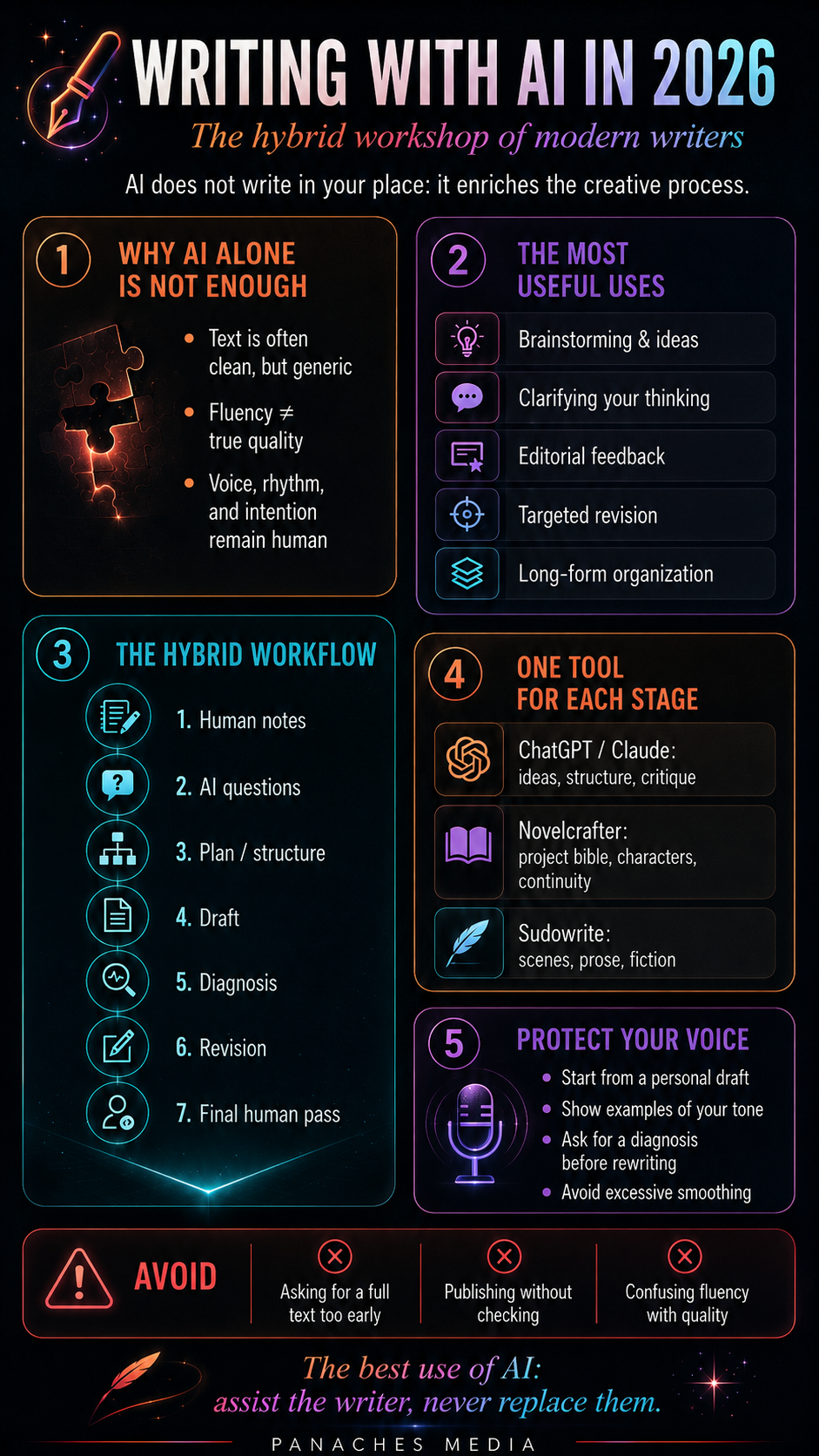
AI is not an automatic author: it is a workshop
For a long time, writing with artificial intelligence was presented as a slightly magical promise: give a prompt, wait a few seconds, and receive a finished text. An article, a short story, a chapter, sometimes even an entire novel. On paper, the idea is tempting. In practice, it often produces the same result: clean, fluent text, but without real necessity.
The problem is not that AI writes “badly”. On the contrary, it often writes too correctly. It can organize, reformulate, smooth, connect ideas, and produce a reassuring structure. But that comfort comes at a cost: automatically generated texts can quickly lose what makes human writing powerful — a voice, a tension, an experience, a particular way of seeing the world.
In 2026, the interesting question is no longer: “Which AI can write my text for me?” The real question becomes: “How can I build a writing workshop where AI helps me without erasing me?”
That is where the topic becomes much richer. AI can become a first reader, a brainstorming partner, a research assistant, a structure coach, an editing tool, a generator of variations, or a project memory. But it should not become the center of decision-making. The center is still the author.
Why AI texts often feel similar
An AI-generated text can make an excellent first impression. The sentences are clean. The paragraphs are balanced. The transitions are smooth. The ideas seem arranged in the right order. And yet, after a few lines, something may feel hollow.
Certain signs are easy to recognize: overly general introductions, very safe sentences, expected formulas, weak conclusions, abstract vocabulary, lack of lived detail. The text explains a lot, but shows very little. It moves forward correctly, but it does not surprise.
This is normal: a language model produces text from probabilities. It tends to choose what is plausible, expected, and statistically coherent. But living writing is not only a matter of coherence. It also depends on a point of view, a rhythm, an angle, a cut, a risk.
A writer does not only try to produce acceptable sentences. A writer chooses what to keep, what to remove, what to hide, what to reveal. A writer sometimes knows how to break a sentence, reject a transition that is too clean, let an image breathe, introduce a strange detail, or maintain ambiguity. AI can suggest. The author must decide.
The truly useful ways to use AI for writing
AI becomes truly interesting when it is not used as a “write” button, but as a set of tools around the creative process.
1. Finding ideas without getting trapped
Brainstorming is one of the most natural uses. AI can suggest angles, titles, conflicts, scenes, formats, metaphors, and questions to explore. It can help you move past the initial block more quickly.
But you should avoid accepting the first answer. The first answer is often the most average one. A better use is to ask for variations: darker, more intimate, funnier, stranger, more documented, more sensory, more contradictory.
AI does not replace intuition. It increases the number of possible paths.
2. Clarifying your thinking
Writing is not only about formulation. It is also about understanding what you really want to say. AI can help reformulate a vague idea, ask questions, detect a contradiction, suggest a plan, or prioritize arguments.
This is especially useful when working from raw notes: fragments, quotes, scattered ideas, drafts, conversations, notebooks, research. AI can help turn that chaos into structure.
But once again, you need to stay alert. A clear structure is not necessarily the right structure. It must serve the intention of the text, not merely look logical.
3. Getting a first editorial response
A writer does not always have an editor, beta reader, or trusted friend available at the right moment. AI can play the role of an immediate first reader: it can point out a scene that feels too slow, a repetitive argument, a weak transition, an unclear character, or an unmet promise.
The most useful question is not: “Is this good?” That question is too vague.
It is better to ask:
- Where does the text lose energy?
- Which idea remains unclear?
- Which passage feels generic?
- Which character lacks contradiction?
- Which sentence could be cut?
- What promise does the beginning create, and does the ending fulfill it?
AI then becomes a diagnostic tool, not a final judge.
4. Revising without losing your voice
AI writing tools are very effective for correcting, shortening, simplifying, reformulating, or translating. But this is also the most dangerous use for voice.
An overly automatic correction can smooth out the style. A rewrite that is too polished can remove the rough edges. A neutral translation can lose the music of the original. An efficient summary can remove the emotion.
The right method is to ask for targeted revision:
- correct only the mistakes;
- improve clarity without changing the tone;
- suggest three variations but do not rewrite directly;
- point out heavy sentences without replacing them;
- preserve images, breaks, and personal expressions.
AI should help clean the text, not make it interchangeable.
The hybrid workflow: one tool for each stage
The classic trap is to look for “the best AI writing tool” as if there were a single winner. In reality, the needs are not the same at every stage.
A writer does not need the same assistant to find an idea, organize a novel, write a scene, correct a sentence, verify information, or prepare a publication.
The strongest approach in 2026 is therefore hybrid.
Step 1: ideation and exploration
For ideas, a powerful general-purpose model is often enough. It can help generate premises, compare angles, imagine conflicts, create scene lists, suggest tonal variations, or ask unexpected questions.
This is the stage where abundance is useful. Not everything will be good. That is fine. AI’s role is to open paths, not to choose them for the author.
Step 2: documentation and raw material
For an article, essay, or documented narrative, AI can help organize sources, produce a synthesis, extract key points, prepare a question grid, or transform research into a plan.
But all information must be checked. AI can mix facts, invent references, simplify a debate, or make an error sound very convincing. The time saved is real, but it shifts: you gain speed in exploration, but you must invest in verification.
Step 3: long-form structure
For a novel, series, fictional universe, or long editorial project, the main problem is not only the sentence. It is memory.
Who knows what? Which character has already met which other character? Which location appears in which chapter? Which narrative promise has been opened? Which worldbuilding rule must not be contradicted?
This is where specialized tools become interesting. A system like Novelcrafter, with its Codex, helps track characters, locations, plots, and world elements inside an integrated story bible. For long projects, this organized memory becomes as important as the model itself.
Step 4: drafting and scenes
For fiction, tools like Sudowrite are designed specifically around scenes, narrative rhythm, characters, and prose. The point is not only to produce text, but to support a writer in very concrete tasks: unblocking a scene, enriching a description, exploring an emotion, testing tension, or extending a dialogue.
This type of tool is a reminder of something important: creative writing is not simply a sentence-generation problem. It is a problem of situation, intention, subtext, rhythm, and choice.
Step 5: critique and revision
Once the draft exists, AI can become much more useful than at the beginning. It can read the existing text, identify slow passages, compare two versions, suggest cuts, analyze tone, point out repetitions, or identify sections that feel too generic.
This is often where AI gives its best results: not when it invents from nothing, but when it works on material that is already personal.
How to keep your voice with AI
A writer’s voice does not come only from style. It comes from obsessions, images, contradictions, memories, silences. If you give AI a prompt that is too poor, it fills the blanks with average text.
To keep your voice, you need to feed the tool with human material.
A few simple methods work very well.
Give personal examples
Before asking for a rewrite, providing two or three excerpts of your own style helps AI understand rhythm, sentence length, language level, recurring images, humor, or restraint.
Do not simply say “write in my style”. Show it.
Start from an imperfect draft
A clumsy human draft is often better than a perfect prompt. Even if it is messy, it already contains an intention, an angle, an energy. AI can help clarify that material, but it starts from something that truly belongs to the author.
Forbid excessive smoothing
It can be useful to add a simple constraint:
Do not make the text more neutral. Keep the rough edges, personal images, rhythm breaks, and unusual formulations if they serve the tone.
This instruction avoids part of the problem: AI’s tendency to make everything polite, fluent, and predictable.
Ask for diagnosis before rewriting
Instead of asking directly, “Rewrite this passage,” it is better to start with:
Analyze this passage. Tell me what works, what is confusing, what feels generic, and what absolutely needs to be kept.
This step protects the voice. It forces AI to distinguish what should be improved from what must not be erased.
The human role: choosing, cutting, owning
The more powerful AI becomes, the more the author’s role shifts. It is no longer only about producing every sentence by hand. It is about directing a process.
The author chooses the angle. The author provides the material. The author recognizes what rings false. The author cuts. The author decides what deserves to remain. The author owns the final text.
This is a creative responsibility, but also an editorial one. An AI-assisted text can contain errors, banalities, formulations too close to existing sources, hollow stylistic effects, or unchecked claims. Publication remains a human act.
AI can accelerate. It should not remove responsibility.
A simple workflow for writers
Here is a realistic workflow for writing with AI without losing control.
1. Raw notes
Start by writing a few lines yourself: an idea, emotion, scene, subject, question, memory, thesis, contradiction. Even if it is poorly written.
Goal: provide human material at the start.
2. Clarifying questions
Ask AI to ask ten questions to better understand the project. Do not ask for a text yet.
Goal: reveal what is missing.
3. Plan or architecture
Ask for three possible structures: one classic, one more narrative, one more daring.
Goal: compare paths before choosing.
4. Human or semi-human draft
Write a first version, even imperfect. AI can help with specific passages, but the text must keep a personal direction.
Goal: avoid a fully generic text.
5. Editorial diagnosis
Ask for a structured critique: clarity, rhythm, repetitions, weak passages, strong passages, promise of the beginning, effectiveness of the ending.
Goal: improve without smoothing everything.
6. Targeted revision
Use AI only for precise tasks: shorten a section, strengthen a transition, suggest a title variation, simplify a sentence, correct mistakes.
Goal: keep control line by line.
7. Final human pass
Read aloud. Cut sentences that feel automatic. Add concrete details. Check facts. Restore rhythm, silence, and intention.
Goal: truly sign the text.
Mistakes to avoid
The first mistake is asking for a full text too early. The earlier AI intervenes with a long answer, the more it risks imposing its average structure.
The second mistake is confusing fluency with quality. A text can be clear, pleasant, well organized, and still lack force.
The third mistake is reformulating everything automatically. By improving too much, you can erase what made the text alive.
The fourth mistake is publishing without checking. AI can invent, distort, generalize, or misquote.
The fifth mistake is looking for the perfect tool. The most important thing is not the tool alone, but the workflow: what you give it, what you ask from it, what you refuse, what you keep.
Why the future belongs to workshops, not generators
AI writing is evolving toward something more interesting than a simple text generator. Writers need spaces where they can gather notes, drafts, sources, characters, outlines, images, corrections, and versions.
A chatbot alone can help occasionally. But a long writing project requires memory, organization, and continuity. This is true for a novel, but also for a blog, a screenplay, a newsletter, an essay, a video game universe, or an editorial dossier.
The future of writing with AI therefore looks less like a machine writing in our place, and more like an augmented workshop: a space where we think, organize, test, critique, rewrite, compare, and publish.
In that workshop, AI is not the author. It is the assistant, the reader, the challenger, the documentalist, sometimes the idea prompter.
But the final voice must remain human.
FAQ
Can AI write an entire novel?
Technically, it can generate very long texts. But writing a novel is not only about producing pages. It requires vision, continuity, coherent characters, tension, rhythm choices, emotional progression, and real revision. AI can help at every stage, but a strong novel still requires strong human direction.
What is the best AI tool for writing?
There is no single best tool. A general-purpose model can be excellent for thinking, structuring, or reformulating. A fiction-specific tool may better support scenes and characters. A project memory tool can be more useful for long novels. The right choice depends on the type of text and the stage of the work.
How can you avoid making a text sound “AI-written”?
You need to start from personal material: notes, examples, memories, drafts, constraints, concrete details. You also need to avoid prompts that are too general. Finally, the last human pass is essential: cut banalities, vary rhythm, replace abstractions with precise images, and remove transitions that feel too automatic.
Does AI make writers less creative?
Not necessarily. Used poorly, it can make the process lazy, smooth out the style, and produce interchangeable texts. Used well, it can help explore more options, clarify ideas, and overcome blocks. Everything depends on the role you give it: replacement or partner.
Should you disclose that a text was written with AI?
It depends on the context: commercial publication, school, publishing, company policy, platform, contract, or specific regulation. A good practice is to remain transparent when AI generated a significant part of the content, and to check the relevant publication rules.
Conclusion: writing with AI means better directing your own workshop
AI does not solve the essential question of writing: having something to say. It can speed up certain steps, open paths, correct, reformulate, organize, and critique. But it does not replace the author’s perspective, experience, or responsibility.
The best use of AI in 2026 is therefore not to hand over the entire text. It is to build a hybrid workshop: human notes, suitable tools, project memory, assisted critique, demanding revision, and a final voice that is fully owned.
Writing with AI does not mean disappearing behind the machine. It means learning to better direct your own creative process.