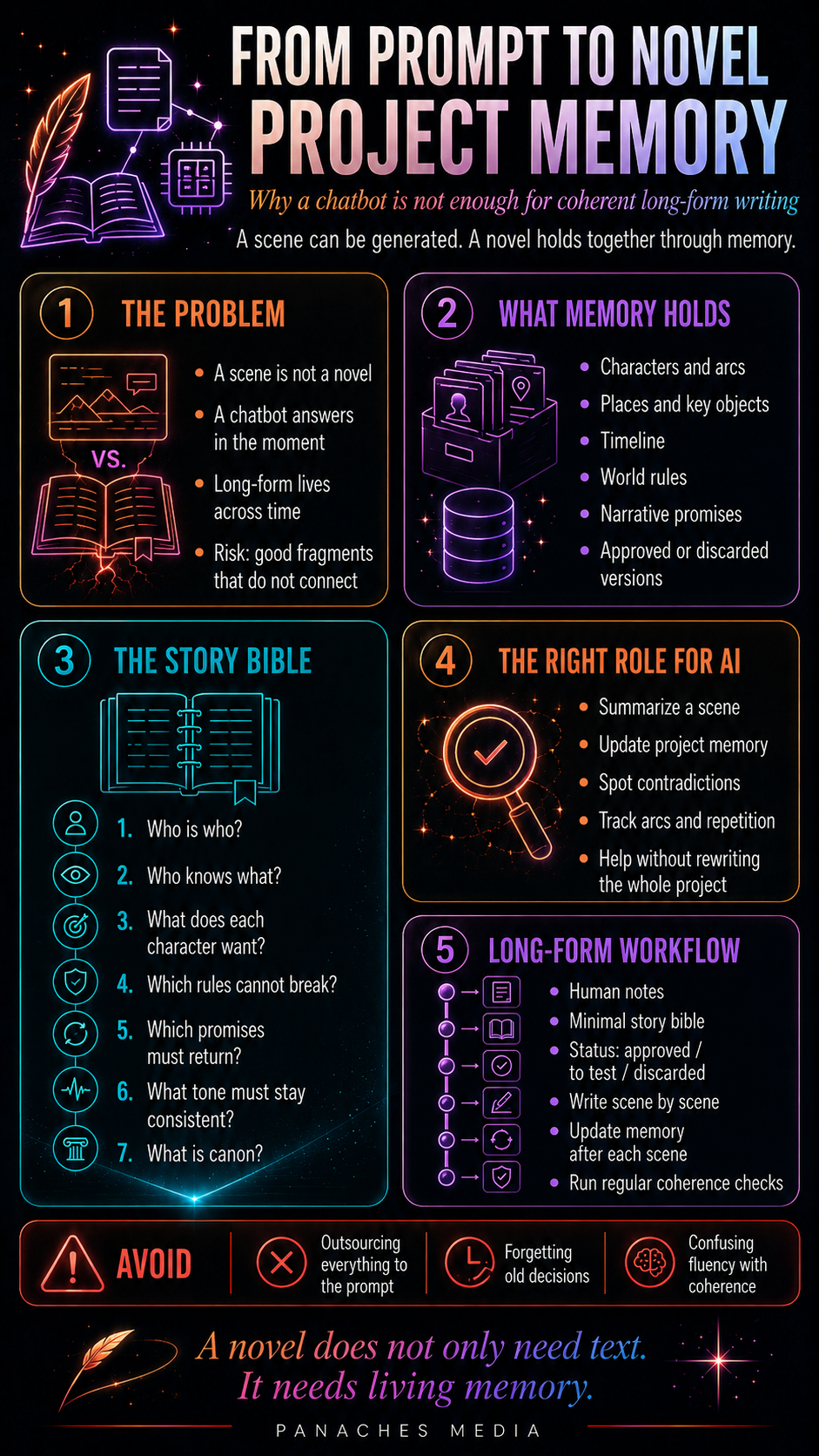
A scene is easy. Holding a novel together is another story.
Asking AI to write a scene has become almost ordinary. You give it a situation, two characters, a dramatic intention, a tone, and the tool produces a proposal. Sometimes it is decent. Sometimes surprisingly fluent. Sometimes too smooth, but still useful as raw material.
But writing a scene is not writing a novel.
A novel is not just a sequence of well-written passages. It is an architecture. A memory. A tension that evolves. A set of characters who change, places that return, details that matter, promises opened and then fulfilled — or deliberately betrayed.
That is where the simple prompt reaches its limit.
A prompt can launch an idea. Project memory can hold a work together.
And for writers using AI, this difference is becoming central. The longer the project, the less the problem is simply generating text. The real problem is maintaining coherence.
A chatbot is good in the moment. A novel lives over time.
A chatbot works very well in the moment. It answers a request, develops an idea, suggests an outline, rewrites a passage, gives feedback. It can be an excellent brainstorming partner, first reader, or formulation assistant.
But a novel is not built only in the moment. It is built over time.
There is what was decided in chapter 2. What was forgotten in chapter 9. What must explode in chapter 17. What a character still does not know. What the reader understood before them. What a place means emotionally. What a repeated sentence is supposed to reveal later.
A novel is full of invisible debts.
A detail introduced too early can become a promise. A contradiction can break trust. A secondary character can take too much space. A poorly maintained world rule can destroy immersion. A well-written scene can be useless if it serves no progression.
The danger of AI is therefore not only producing bad text. The danger is producing good fragments that do not hold together.
Project memory is not a luxury
For long-form writers, project memory is not a comfortable extra. It is a survival condition.
It helps answer questions that seem simple, but are essential:
- Who are the characters?
- What do they truly want?
- What do they know at this precise moment?
- Which places already exist?
- Which rules of the world have been established?
- Which conflicts are open?
- Which narrative promises must be paid off?
- Which tone must remain consistent?
- Which scenes have already served a similar function?
- Which versions were abandoned?
Without memory, the writer has to carry everything in their head. At the beginning, that is possible. With ten scenes, it works. With thirty chapters, several arcs, a universe, research notes, and variations, it quickly becomes a forest.
And in a forest, an AI without a map invents paths.
Why the prompt is not enough
The prompt is often presented as the magic key to AI writing. You just need to ask properly. Specify the tone. Add constraints. Give a few examples. Then the tool will do the rest.
The prompt matters, of course. But it is not enough.
A prompt is a punctual instruction. Project memory is a living system.
The prompt says: “Write this scene.” Memory remembers: “This scene comes after a betrayal, the character no longer trusts anyone, the place has already been associated with loss, and the object mentioned here must return in the finale.”
That is not the same level of work.
A prompt can give direction. Memory gives context.
And in long-form writing, context is king.
What AI easily forgets
Even with large context windows, AI can lose important information. Not necessarily because it “forgets” in a human sense, but because not all elements carry the same weight during generation. Some details become blurry. Some names change. Some motivations are simplified. Some tensions disappear.
The most common losses are often subtle.
A character becomes kinder than they should be. A moral conflict becomes a simple misunderstanding. A voice becomes neutral. A symbolic detail is treated like decoration. A world rule is contradicted. A scene repeats a previous scene without noticing. An emotional arc moves too quickly. A narrative promise remains forgotten.
AI can write a beautiful scene while betraying the project.
That is why memory should not be only an archive. It must be active, searchable, structured, and connected to the work in progress.
The story bible: the heart of the project
The first layer of project memory is the story bible.
It gathers the fundamental elements of the work: characters, places, timeline, world rules, themes, conflicts, important objects, relationships, secrets, revelations, and vocabulary specific to the universe.
But a good bible is not a dead encyclopedia.
It must remain practical. It must help the writer write, not bury them under useless sheets. It should be able to answer concrete questions during the work:
- How does this character speak?
- What is their wound?
- What are they hiding?
- What is their relationship to the hero?
- Which information do they already have?
- Which place is associated with which emotion?
- Which rule must never be contradicted?
- Which promise must be fulfilled before the end?
A story bible is not there to decorate the project. It maintains the internal pressure of the story.
Characters: more than profiles
Project memory is especially important for characters.
A weak character sheet often looks like an ID card: age, appearance, job, goal, fear, strength, flaw. Useful, but insufficient.
For a real long-form project, you need to track evolution.
A character is not only what they are. It is what they become.
So you need to keep track of their arc:
- what they want at the beginning;
- what they actually need;
- what they refuse to see;
- what they learn;
- what they lose;
- what they lie about to others;
- what they lie about to themselves;
- what they know at each stage of the story.
This is essential with AI, because a model can easily bring a character back toward an average version: more explicit, more reasonable, more coherent on the surface, but less dramatic.
A good character is not always reasonable. They can be contradictory, unfair, funny at the wrong time, brilliant and blind, brave and cowardly on the same day.
Memory protects that complexity.
Places, objects, rules: invisible coherence
Places also need memory.
In poor AI usage, a place becomes an interchangeable backdrop: a tavern, an office, an alley, a meeting room, a forest, a spaceship. The text may be fluent, but the world feels made of cardboard.
In a solid project, places have a function.
One place can be associated with fear. Another with loss. Another with a promise. Another with social class. Another with a political lie. Another with a physical rule of the universe.
Memory keeps these layers.
The same is true for objects. A medallion, a key, a notebook, a weapon, a photograph, an old phone, a song: if they return, they must return with weight. AI may treat them as props. The writer must treat them as narrative charges.
And in fantasy, science fiction, fantastical, thriller, or video game universes, rules are even more sensitive. An established rule must be respected, unless breaking it becomes a narrative event.
Project memory prevents AI from improvising too freely with the foundations of the world.
Timeline: the most ordinary trap
Timeline is one of the places where long projects break most easily.
Who was where? How many days have passed? Which event happens before which other event? When does the character discover the truth? How long does travel take? When can an injury heal? When does a relationship truly change?
AI can easily produce an emotionally effective scene that is chronologically impossible.
It can refer to information the character should not yet know. It can accelerate an evolution. It can forget a time constraint. It can bring someone back too early. It can resolve a conflict before it has matured.
Project memory should therefore contain a clear timeline.
Not necessarily a complicated mural. But at minimum: major events, scene order, revelations, movements, injuries, delays, relationship changes.
Chronological coherence is invisible when it works. It becomes catastrophic when it breaks.
Narrative promises: what the reader does not forget
The writer may forget. The reader forgets less than we think.
An intriguing detail. A strange sentence. A fear mentioned at the beginning. A debt. A prophecy. A hidden photograph. A closed door. A character avoiding a question.
All of this creates promises.
Project memory must keep track of these narrative promises. Some must be paid off. Others can be redirected. Some can remain deliberately open. But they must not disappear by accident.
AI is very capable of suggesting new paths. Sometimes too capable. It adds a mystery, an object, a tension, a potential revelation. It is exciting. But if every scene adds new promises without managing the old ones, the story becomes a basement full of locked doors.
Healthy memory does not only help invent. It helps keep debts.
Versions: the memory of abandoned paths
A writing project does not move forward in a straight line.
You change a character. You delete a chapter. You move a revelation. You merge two roles. You rename a city. You abandon a subplot. You keep a scene for later.
Without version management, AI can bring back obsolete elements. It can reuse an old motivation, an old name, an old rule, an old plan. The writer themselves can get lost.
Project memory must therefore distinguish what is active, archived, abandoned, or uncertain.
This is crucial: not all notes are equal.
A validated note does not have the same status as a tested idea. A deleted scene does not have the same weight as a canonical scene. A character under consideration does not have the same status as a character present in the manuscript.
A good writing workshop should keep the trace without putting everything back into the story.
The right role of AI in a long project
In a long-form project, AI should not only produce text. It should help maintain the system.
Its most useful tasks can be very concrete:
- summarize a scene and update the bible;
- spot contradictions;
- signal open narrative promises;
- compare a scene with a character arc;
- check whether a revelation comes too early;
- suggest coherence questions;
- review repetitions;
- generate variations without changing canon;
- distinguish new ideas from validated decisions;
- help prepare a chapter summary.
That is much more interesting than “write the next part”.
AI then becomes a continuity assistant. A structural reader. A guardian of coherence. Not an automatic author.
Example of a long-form workflow with AI
Here is a simple workflow for using AI in a novel, series, or universe project without losing control.
1. Create the human base
Start with personal notes: central idea, desire, theme, emotional tone, references, promise of the project. It does not need to be clean. It needs to be true.
2. Build a minimal bible
Before generating too much text, create the essential sheets: main characters, major places, central conflict, world rules, tone, timeline.
3. Define statuses
Separate what is validated, to be tested, abandoned, or uncertain. This distinction prevents AI from mixing all possible paths.
4. Plan without freezing everything
Create a flexible outline: acts, major movements, revelations, emotional pivots. The plan should guide without suffocating.
5. Write scene by scene
Ask AI for help on short zones: one scene, one transition, one dialogue, one description, one diagnosis. Avoid delegating too large a block at once.
6. Update memory after each scene
After every important scene, note what changed: information revealed, relationship modified, object introduced, promise opened, wound, movement, canonical decision.
7. Run regular audits
Every few scenes, ask for a check: contradictions, arcs moving too fast, forgotten promises, repetitions, tone inconsistencies, redundant scenes.
8. Keep the final human decision
AI suggests. Memory remembers. But the writer decides.
What a real writer’s workshop should do
A good AI writing workshop should not be limited to a chat window.
It should connect several spaces:
- free notes;
- character sheets;
- places;
- timeline;
- scenes;
- sources;
- moodboards;
- versions;
- drafts;
- comments;
- corrections;
- important prompts;
- final export.
The ideal is not to have AI answering everywhere. The ideal is to have AI understand where it is intervening.
When it corrects, it corrects. When it brainstorms, it brainstorms. When it updates memory, it does not rewrite everything. When it analyzes a scene, it does not replace the voice. When it suggests an idea, it does not automatically turn it into canon.
Clear roles protect the project.
The trap of overly heavy memory
There is still an opposite trap: wanting to document everything.
Project memory can become so heavy that it blocks writing. Too many sheets. Too many details. Too many categories. Too many statuses. Too many rules. The writer spends more time organizing than writing.
The best memory is not the most complete. It is the most useful.
It must remain alive, light, searchable, and modifiable. It must help write the next scene, not turn the novel into an administrative database.
The question is simple:
Does this information help write better, decide better, or verify better?
If yes, it deserves to be kept. If not, it can stay outside.
Why Panaches is concerned
This topic directly touches the vision of Panaches.
A writer does not only need a chatbot. They need a workspace. A place where they can gather notes, documents, images, research, drafts, versions, mind maps, characters, references, scenes.
AI becomes truly useful when it is not floating in the void, but connected to a project.
In Panaches, the point is not to say: “AI writes for you.” The point is rather: “AI helps you navigate your own workshop.”
A creative project, especially a long one, needs continuity. It needs a space where thought can spread out, return, correct itself, connect. A space where the author keeps control.
Project memory, in this logic, is not a gadget. It is the foundation of AI that is truly useful to creators.
FAQ
Why is a simple chatbot not enough to write a novel?
Because a novel requires long-term continuity: characters, places, timeline, arcs, narrative promises, world rules, versions, and coherence. A chatbot can help occasionally, but it must be connected to structured memory to avoid contradictions.
What is project memory?
It is the organized set of important information in a writing project: story bible, characters, places, timeline, rules, scenes, versions, notes, validated decisions, and abandoned elements. It allows the writer and AI to work with the same context.
Does a story bible need to be very detailed?
Not necessarily. A good bible must above all be useful. It should contain the information that helps write, decide, and verify. Too many details can slow the work down if memory becomes heavier than the project.
How can AI help maintain coherence?
It can summarize scenes, spot contradictions, track narrative promises, compare a scene with a character arc, point out repetitions, or help update the project bible. Its role then becomes structural, not only generative.
What is the biggest risk with AI in a long project?
The biggest risk is producing fluent scenes that are incoherent with the whole. A scene can be well written and still betray a character, contradict a rule, forget a promise, or repeat a function already fulfilled.
Conclusion: a novel does not need a prompt, it needs a workshop
The prompt is useful. It triggers, directs, tests, unblocks. But it is not enough to carry a novel, a series, or a universe.
A long project needs memory. It needs to know what has been decided, what remains open, what has been abandoned, what must return, what must not be contradicted. It needs a living architecture.
AI can help writers, but it becomes truly powerful when it works inside a structured workshop: notes, bible, scenes, versions, timeline, sources, corrections, decisions.
The future of AI writing will not only come from better models. It will come from better creative environments.
Because a novel is not an answer to a prompt. It is a memory taking shape.