The problem is not that AI writes badly
The most common criticism of AI-generated texts is not always that they are false, unreadable, or clumsy. Often, it is the opposite: they are too clean.
The sentences flow well. The paragraphs are balanced. The transitions are neat. The tone is reasonable. The text seems organized, polished, efficient. At first glance, everything works.
And yet, something is missing.
After a few lines, you may get that strange impression: the text is not bad, but it does not really stand there as a presence. It speaks without inhabiting what it says. It explains without seeing. It concludes without having crossed through much. It feels optimized not to disturb anyone.
That is precisely the problem with AI texts: they can be correct without being alive.
So the question is not only: “How can we detect a text written by AI?” The more useful question is: “Why does this text sound generic, and how can we give it back a voice?”
The AI style: fluent, but often interchangeable
A typical AI text is not necessarily full of visible mistakes. It can even be very pleasant to read on the surface. But several signs often return.
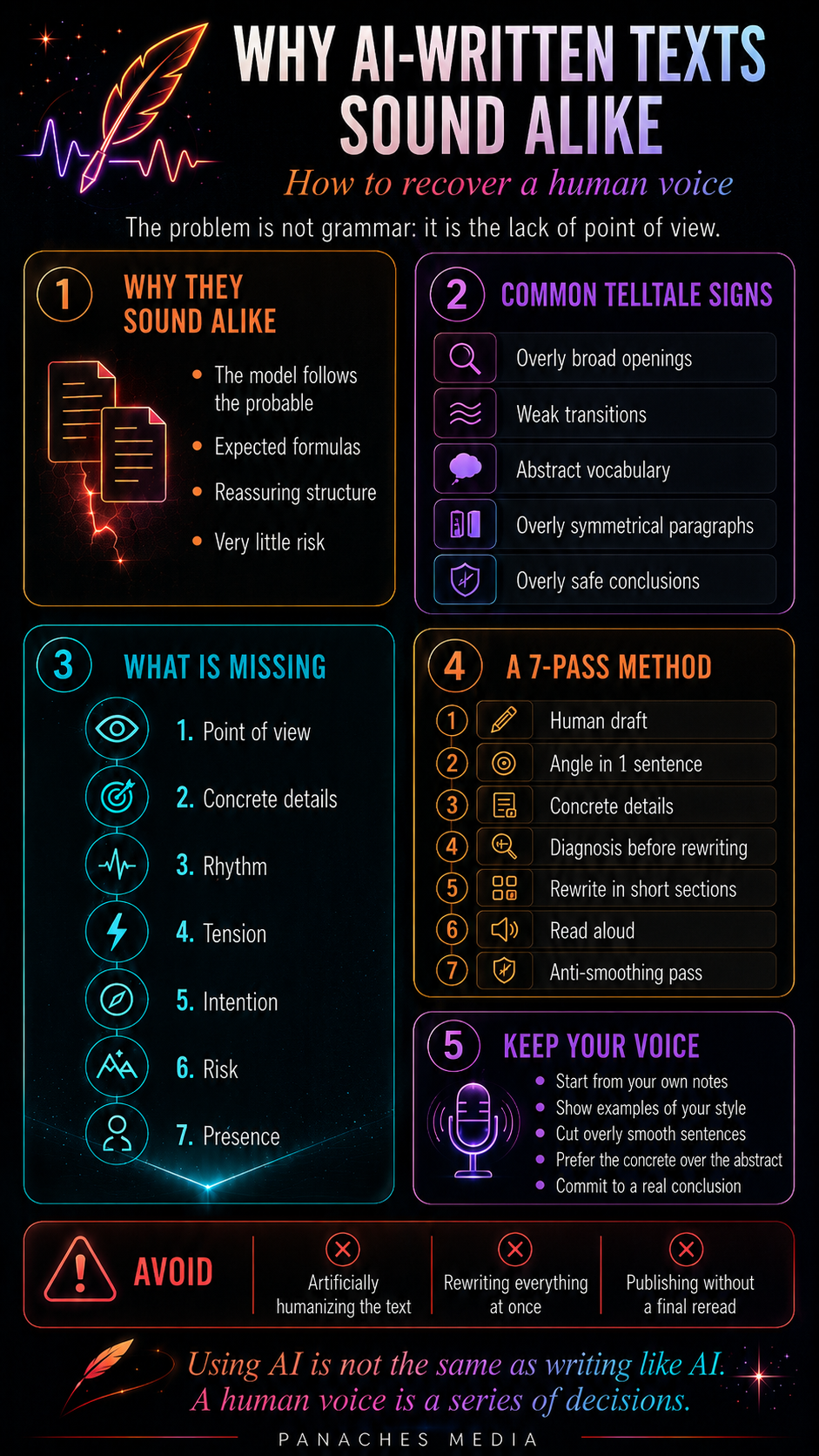
It begins with a very general sentence, like: “In a world where…” or “In the digital age…”. It introduces the topic without a strong angle. It links paragraphs with predictable transitions. It multiplies balanced formulas: “it is not only…, it is also…”. It ends with a wise, inspiring, but vague sentence.
All of this creates an impression of control. But that control is often a façade.
A good text does not only need clarity. It needs a point of view. It must choose what it looks at, what it rejects, what it puts under tension. Sometimes it must be less perfectly fluent in order to become more accurate.
A human text can hesitate, cut short, change rhythm, introduce an unexpected image, carry anger, tenderness, discomfort, or contradiction. It bears traces of decision.
A poorly directed AI text tends to erase those traces.
Why AI texts sound so similar
A language model does not think like a writer. It produces plausible sequences of words based on patterns learned from massive amounts of text. It can recognize forms, reproduce structures, imitate tones, and complete arguments.
That is very powerful. But it naturally pushes the text toward the probable.
And the probable is rarely what creates a strong voice. The probable often gives an expected introduction, a correct sentence, a reassuring transition, a balanced conclusion. It avoids risk. It chooses what seems suitable for the largest number of readers.
That is why AI texts can sometimes feel as if they were written by a very competent person who has experienced nothing of the subject.
They can explain loneliness without loneliness. They can talk about creation without desire. They can describe a city without smell, without noise, without a street corner. They can write about writing without ever showing a truly necessary sentence.
AI does not only lack style. It lacks situation.
It does not naturally know where it is speaking from, why it is speaking, what it risks, what it wants to defend, or what it keeps silent. If the author does not provide that material, the model fills the blanks with average text.
The telltale signs of AI writing
Not all AI texts sound alike, and not all human texts are original. But some patterns appear often enough to be useful.
Panoramic introductions
The text begins very high, very wide, very far from the concrete:
“In the age of artificial intelligence…” “In a constantly changing world…” “For several years, technology has been transforming our daily lives…”
These sentences are not always false. They are simply weak. They create a generic backdrop instead of entering the subject through a scene, a tension, a question, or an image.
A stronger opening can begin closer:
A writer rereads a perfect page and no longer recognizes their voice. A student deletes three paragraphs because they sound too clean. An editor understands that the text is clear, but no one will remember it.
Concrete detail wakes the text up.
Weak transitions
AI texts love clean transitions:
“It is important to note that…” “However, it should also be said that…” “In addition…” “Furthermore…” “This shows that…”
These formulas create an impression of logic, but they can also put the rhythm to sleep. They connect ideas without creating tension.
A strong transition does not merely move from one section to another. It makes a shift felt. It announces a problem, a contrast, a consequence.
Instead of “However, this should be nuanced,” you can write:
“But this fluency has a trap.” “This is where the text begins to empty itself.” “The problem appears precisely when everything seems to work.”
The text immediately gains presence.
Abstract vocabulary
AI texts easily use words such as transformation, innovation, experience, optimization, creativity, engagement, potential, dynamic, approach, process.
These words are useful, but they quickly become hollow if they are not attached to precise examples.
“Improving the creative process” is correct. “Rereading a scene and realizing the character speaks like a brochure” is more alive.
The human voice often returns through detail.
Overly symmetrical paragraphs
Another frequent sign: all paragraphs have almost the same length. Each idea arrives in a clean, stable, well-proportioned block. It is visually pleasant, but it can create a mechanical rhythm.
A living text breathes differently. It can have a very short paragraph.
Like this one.
Then it can return to a longer, slower sentence that develops an idea and lets the thought take its time. Rhythm is not just decorative. It guides attention.
Conclusions without loss or choice
Many AI texts end with a cautious conclusion: we must find balance, use the tool wisely, remain human, and move forward responsibly.
All of that is true. But if the conclusion decides nothing, it leaves little trace.
A good conclusion does not have to be brutal. But it must own something: a position, a final image, an unresolved tension, a sentence that stays.
The end of a text is not only the closing of a plan. It is the place where the author signs their way of seeing.
The wrong solution: artificially “humanizing” the text
When faced with texts that are too smooth, one temptation appears: using a tool or a prompt to “humanize” the text. Add imperfections. Vary the sentences. Insert a few conversational expressions. Make the style feel more natural.
This can improve the surface. But it is not enough.
A human text is not human because it contains two contractions, three breaks, and one informal phrase. It is human because it carries an intention. It comes from somewhere. It chooses a distance, an angle, a rhythm, a level of precision.
“Humanizing” an AI text by adding flaws often amounts to disguising a deeper problem: the text does not have enough material.
The real solution is not to make AI less recognizable. The real solution is to make the text more necessary.
The right method: give the text human material again
To avoid generic text, you must begin before generation. A good result does not only depend on the model, but on what you give it.
AI needs material: notes, scenes, examples, memories, constraints, fragments of voice, sources, disagreements, images, references, intentions. The more personal that material is, the more the text can recover a singularity.
A vague prompt often produces a vague text:
“Write an article about writing with AI.”
A more human prompt gives direction:
“I want to write an article for authors who already use AI but feel that their texts are becoming too smooth. The main idea: the problem is not using AI, but the absence of human direction. I want a lucid, concrete, slightly critical tone, without technophobic rejection. Here are my notes…”
The second prompt does not only ask for text. It gives a situation.
And writing begins with situation.
A 7-pass method to recover a voice
You can use AI without losing your voice, as long as you do not hand over the entire process at once. Here is a simple method.
1. Start from a human draft
Before asking for generation, write a few lines yourself. Even bad ones. Even messy ones. Even too long.
A human draft already contains a temperature. It shows what obsesses, what irritates, what attracts. It gives AI material to work with instead of letting it invent an average intention.
2. State the angle in one sentence
Before developing, summarize the angle:
“I want to show that AI texts do not lack grammar, but point of view.”
This sentence becomes a compass. It prevents the text from drifting into a general synthesis without a backbone.
3. Add concrete details
For each abstract idea, add an example, image, or situation.
Not just “the text is generic”. But: “the text says creativity is important without ever showing a hand crossing out a sentence.”
Not just “you must keep your voice”. But: “you must recognize the turns of phrase you would never have written yourself.”
Details lower the automatic temperature of the text.
4. Ask for diagnosis, not immediate rewriting
Before asking AI to correct, ask:
- What sounds generic?
- What deserves to be kept?
- Where does the text lose its angle?
- Which sentence feels too expected?
- Which passage lacks concrete detail?
This step avoids smoothing everything. It turns AI into a critical reader rather than a replacement machine.
5. Rewrite in short sections
The more you ask AI to rewrite a large block, the more it risks imposing its own rhythm. It is better to work in short sections: an introduction, a transition, a weak paragraph, a conclusion.
The author keeps control over the overall direction.
6. Read aloud
Voice is tested by the ear. A text can look very good on screen and become artificial as soon as it is read aloud.
Out loud, you hear repetitions, overly safe sentences, transitions without energy, and words that do not belong to you.
It is one of the best human detectors.
7. Do an anti-smoothing pass
The final pass should look for everything AI has made too neutral:
- replace generalities with images;
- cut sentences that explain too much;
- break overly regular paragraphs;
- restore tension in transitions;
- remove overly safe conclusions;
- reintroduce personal phrasing.
This pass is not about making the text look “less AI”. It is about turning the text back into a space of choice.
Detectors do not replace judgment
The temptation to automatically detect AI texts is strong. In schools, publishing, journalism, or platforms, many would like to have a simple tool: human or AI.
But real writing is becoming increasingly hybrid. A text can be thought through by a human, structured with AI, corrected by a tool, partially rewritten, then revised line by line. In that case, the question “human or AI?” becomes too poor.
Detectors can point to probabilities, patterns, anomalies. They can be useful as indicators. But they can also be wrong, especially with short texts, very academic styles, non-native writing, rewrites, or deliberately “humanized” content.
The real issue is not only detection. It is documenting the process.
Who wrote what? What was generated? What was revised? Which decisions were made by the author? Which parts of the text carry an identifiable human intention?
That is a more mature question than simply hunting for AI texts.
Writing with AI without writing like AI
Two things should not be confused: using AI and writing like AI.
Using AI can be intelligent, creative, and demanding. You can use it to test angles, clarify a thought, get feedback, find variations, organize notes, or correct mistakes.
Writing like AI, however, means abandoning direction. It means accepting the most probable sentences. It means publishing a smooth version because it seems “professional”. It means letting the tool choose the rhythm, the level of precision, the images, the transitions, the conclusion.
The problem is not assistance. The problem is the total delegation of taste.
A writer can work with AI and remain fully a writer if they keep three powers:
- the power to choose;
- the power to cut;
- the power to reject a correct but dead sentence.
Anti-generic text checklist
Before publishing an AI-assisted text, you can use this checklist.
Does the text have a real angle?
If the text can be summarized as “there are advantages and limits”, it is probably too weak. It needs a sharper tension.
Are there concrete details?
A text without scenes, examples, images, or precise cases quickly becomes abstract.
Do the transitions say something?
A transition should not only connect. It should move the text forward.
Do the sentences truly belong to the author?
Some formulations are correct, but foreign. They must be spotted and replaced.
Does the rhythm vary?
If all paragraphs have the same shape, the text may become mechanical.
Does the conclusion own an idea?
A conclusion that is too safe is quickly forgotten. It must leave a direction, an image, or a position.
Has the text been read again by a human?
The final pass should not be automatic. It is the moment when the author takes possession of the text again.
FAQ
Why do AI texts often feel generic?
Because language models naturally favor probable and coherent formulations. Without a strong angle, personal examples, and precise constraints, they often produce average text: clear, but not very singular.
How can you make an AI text more human?
It is not enough to add imperfections. You need to give the text real human material: a personal draft, concrete details, a point of view, examples, rhythm, cutting decisions, and a final human revision.
Are AI detectors reliable?
They can provide indications, but they should not be treated as absolute proof. They can produce false positives, miss rewritten AI texts, or misread certain styles. The writing process matters as much as the final result.
Is it wrong to use AI for writing?
No. The problem is not using AI, but losing direction. AI can help think, structure, correct, and revise. It becomes problematic when it entirely replaces the author’s intention, verification, and responsibility.
What is the best way to keep your voice?
Start from a personal draft, provide examples of your style, work in small sections, ask for diagnosis before rewriting, then do a demanding final human pass. Voice is protected through repeated choices, not through one magic instruction.
Conclusion: a human voice is a series of decisions
AI texts sound alike because they tend toward the probable. They seek the acceptable sentence, the reassuring structure, the balanced tone. That is useful for producing quickly. But writing is not only about producing quickly.
A good text carries decisions. It chooses an entry point, a distance, a detail, a rhythm, a cut. Sometimes it accepts being less smooth in order to be more true.
The point of writing with AI is not to hide the machine. It is not to fool a detector or add a few flaws to appear human. The point is deeper: to give the text an intention again.
AI can help write. But the voice still comes from what the author decides to keep, cut, and own.