The dream of a perfect detector
Since AI writing tools became available to the general public, one question has appeared everywhere: can we recognize a text written by a machine?
In schools, universities, publishing houses, literary contests, publication platforms, media organizations, and online communities, many people would like to have a simple tool. Paste a text, click, and get a verdict: human or AI.
That dream is understandable. It responds to a real concern. If AI can produce an assignment, article, short story, application, customer review, or professional message in a few seconds, how can we trust what we read? How can we protect honest authors? How can we prevent fraud? How can we identify texts produced without effort, transparency, or responsibility?
But the problem is more complicated than it seems.
Real writing is no longer always entirely human or entirely artificial. It is becoming hybrid. A text can be thought through by a person, structured with AI help, corrected by a tool, partially reformulated, then rewritten line by line. Another text can be almost entirely generated by a machine, then “humanized” by hand. A third can be fully human, but so clean, academic, or standardized that it resembles an AI output.
In this landscape, the question “human or machine?” becomes too poor.
The real question is rather: what can be proven, with what level of confidence, and with what consequences for the people being accused?
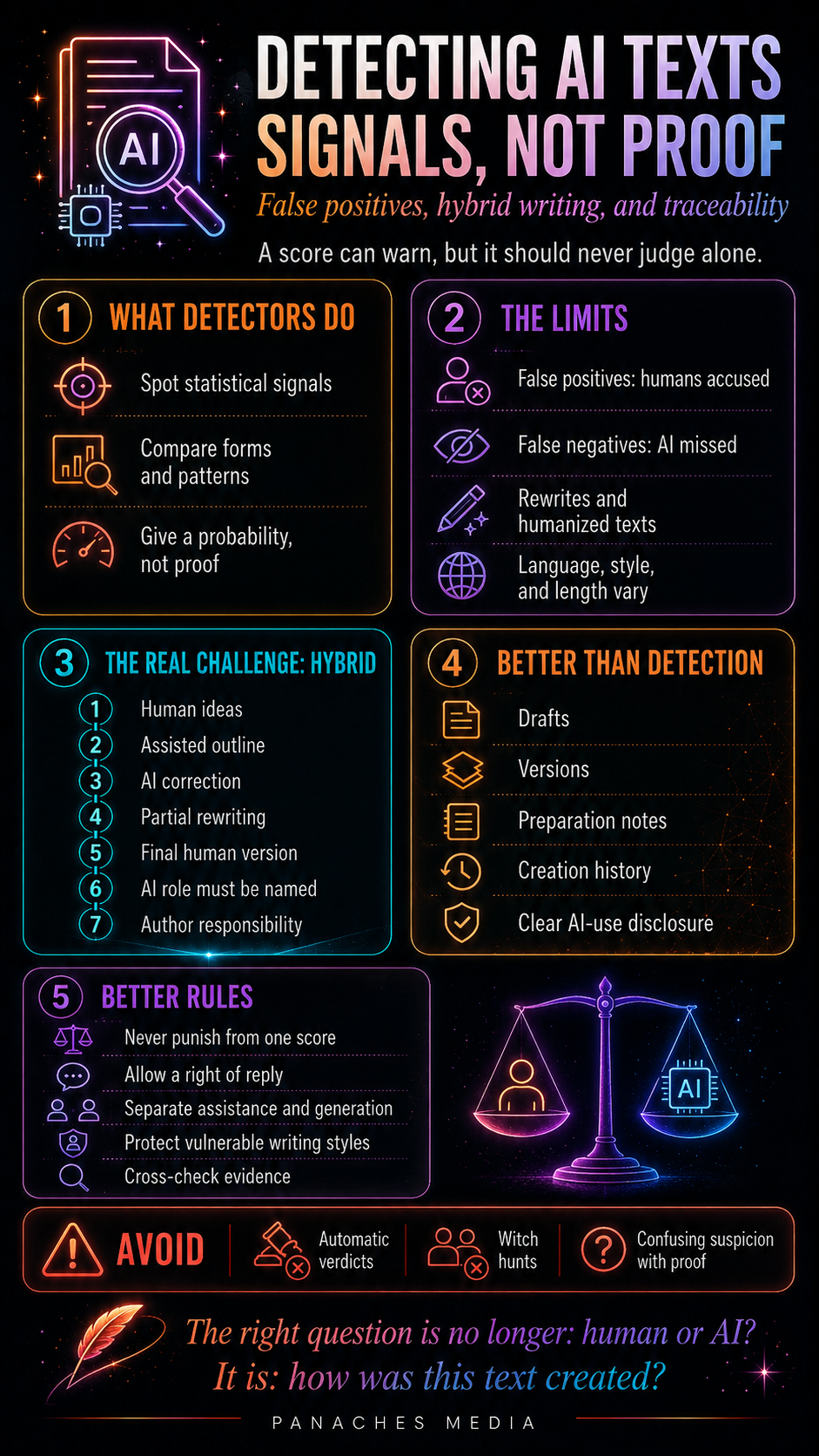
What AI detectors actually do
An AI text detector does not read a text like a teacher, editor, or reader. It does not understand the author’s intention. It does not know whether a sentence comes from lived experience, a human draft, a reformulation, or an automatic generation.
It looks for signals.
These signals can be statistical, stylistic, or structural: sentence regularity, vocabulary choices, word distribution, level of predictability, repetitions, overly smooth coherence, similarity to known model outputs. Some systems also look for technical traces, such as copy-paste artifacts, formatting marks, or metadata.
So the detector does not say: “I know this text was written by AI.” It says something closer to: “According to my criteria, this text resembles texts produced by AI.”
That nuance is essential.
A detection score is not absolute proof. It is an indicator. Sometimes useful, sometimes misleading, always dependent on context.
Why detectors can work
It would be wrong to say that all AI detectors are useless. In some cases, they can identify raw generated texts, especially when the text is long, barely modified, and produced by a known model.
A fully generated assignment, repetitive product description, very generic article, or untouched response can leave traces. The style can be too regular. The vocabulary too probable. The structure too balanced. The text may lack rough edges, precise details, and natural variation.
Some commercial or academic detectors achieve decent performance under specific test conditions. They can be useful to draw attention, prioritize verification, or open a discussion.
But that is where the important word appears: conditions.
A tool can work well on a given corpus, with certain models, certain text types, certain languages, and certain lengths. That does not mean it will be reliable in every real-life situation.
A detector is not a magic magnifying glass. It is a statistical instrument.
And a statistical instrument must be used carefully.
The problem of false positives
A false positive is the nightmare of AI detection.
A false positive happens when a human text is flagged as artificial. On paper, this may look like one technical error among others. In real life, it is much more serious.
A student can be accused of cheating. An author can see their reputation damaged. A candidate can be suspected of lying. A writer can lose a client. A non-native speaker can be unfairly penalized because their style is simpler, more regular, or more academic.
A false positive is not only a classification error. It is a social error.
That is why detectors should never be used as automatic judges. They can indicate that a text deserves discussion or further verification. But they should never be enough to punish someone.
A score does not know the drafts. A score does not know the context. A score does not know the history of a text.
The problem of false negatives
Conversely, a false negative happens when an AI-generated text is not detected.
And that problem is real too.
A user can ask AI to vary the style, add imperfections, rewrite with more orality, simulate a personal voice, produce a draft, and then edit it. They can also run the text through several reformulation tools. The more the text is modified, the weaker the signals become.
A generated text can then slip through the net.
This reveals a fundamental limit: detectors often look for traces of generation, but these traces can be erased, transformed, or diluted.
The more writing becomes hybrid, the more binary detection becomes fragile.
Hybrid texts blur everything
The biggest challenge may not be the 100% AI text. It may be the hybrid text.
Imagine several cases.
An author writes a draft by hand, then asks AI to correct the mistakes. A student writes their outline, asks for structure suggestions, then writes everything themselves. A journalist uses AI to summarize a report, but writes the final article. A novelist asks for ten scene variations, keeps two ideas, then rewrites everything. A creator generates an entire article, changes a few sentences, and publishes it.
All of these texts may contain AI. But they do not raise the same problem.
Putting them all in the same category, “AI text”, is too crude. We need to distinguish assistance, generation, reformulation, correction, documentation, organization, and final responsibility.
The real question is not only: “Was AI involved?” The real question is: “What role did AI play?”
Stylistic clues are not enough
Many readers believe they can recognize AI texts through their habits: general introductions, weak transitions, abstract vocabulary, balanced conclusions, overly smooth sentences.
These clues exist. They can be useful.
But they are not enough.
A human text can be banal, academic, generic, or highly structured. A text written by a non-native speaker can seem simple or regular. A professional text can use standardized formulas. An academic text can be intentionally neutral. Conversely, a well-guided AI can produce more vivid, irregular, concrete texts.
Style creates suspicion, not certainty.
You can say: “this text sounds generic.” You cannot always say: “therefore this text was written by AI.”
Confusing the two is dangerous.
When detection becomes a witch hunt
The problem with detectors is not only technical. It quickly becomes communal.
In some writing communities, especially online, AI use has become an explosive subject. Texts are suspected, reported, publicly commented on. Authors can be accused based on a score, a technical artifact, a sentence considered too smooth, or a collective intuition.
This dynamic can become toxic.
A community that wants to protect human writing can end up hurting human authors. It can discourage beginners, non-native speakers, atypical styles, very polished texts, or anxious writers who no longer dare to explain their process.
Fear of AI can create a climate of generalized suspicion.
And in that climate, even honesty becomes risky: if someone explains that they used AI to correct mistakes or structure notes, they may be treated as if they delegated everything to a machine.
That is not healthy.
The case of contests, schools, and publishers
Institutions still have a real problem to solve.
A school must be able to fight cheating. A literary contest must be able to preserve its rules. A publisher must know whether a manuscript respects its conditions. A platform must be able to limit mass-generated content. A media organization must protect its credibility.
So we cannot simply say: “detect nothing.”
But we need fair procedures.
A detector can be one element among others. It can trigger a request for explanation, a review of drafts, a discussion about the process, or a human analysis. But it should not be the sole basis for a sanction or rejection.
The most reasonable method is to cross-check evidence:
- drafts and versions;
- work history;
- preparatory notes;
- sources used;
- consistency with the author’s usual style;
- interview with the author;
- declared level of AI involvement;
- human analysis of the text.
Trust does not come from a single score. It comes from a body of evidence.
Watermarking, provenance, and traceability
Given the limits of detectors, another path is becoming more important: provenance.
Instead of trying to guess after the fact whether a text was written by AI, we can try to document how it was produced. This approach can take several forms: watermarking, cryptographic signatures, version history, metadata, writing logs, tracking passages created or modified by AI.
The idea is simple: it is better to prove a process than to guess an origin.
That is exactly what makes writing tracking tools interesting. Instead of assigning an abstract score, they can indicate which parts were written by the user, which parts were generated, which parts were modified by a tool, and how the document evolved.
This approach is not perfect. It raises questions about privacy, surveillance, interoperability, trust in tools, and possible falsification. But it is more mature than simple detection after publication.
The future may not be: “Is this text AI?” It may be: “What is the journey of this text?”
Transparency can also be costly
Still, we need to be careful with a word that always sounds positive: transparency.
Saying you used AI can be honest. But depending on the context, it can also penalize the author. A student who declares light assistance may become more suspicious than someone who says nothing. An author who explains their hybrid process may be judged less “authentic”, even if their human work is real.
Transparency is fair only if the rules are clear.
If an institution asks people to disclose AI use, it must explain what is allowed, forbidden, acceptable, or debatable. Otherwise, it encourages silence.
A good policy should not only say: “declare AI.” It should say: “these uses are allowed, these uses are forbidden, this is how we assess the human contribution, these are the consequences, and these are the possible appeals.”
Without that, transparency becomes a trap.
What a detector will never see
Even the best detector cannot see everything.
It does not see intention. It does not see doubt. It does not see the hours spent cutting. It does not see the notes in a notebook. It does not see why a sentence was kept. It does not see an author’s intimate relationship with their text.
Writing is not reduced to the final result. It is also a process of choices.
Two texts can look similar on the surface, yet come from completely different processes. One can be a raw generation. The other can be the result of highly controlled, highly revised, highly restrained human work.
A detector can compare forms. It cannot always judge a process.
That is why humans remain essential.
A good detection policy should protect humans
If an organization uses AI detectors, it should respect a few simple principles.
Never punish based on one score alone
A score should open a verification process, not replace an investigation.
Provide a right of reply
The accused person must be able to explain their process, provide drafts, show notes, and answer questions.
Distinguish between uses
Grammar correction, working translation, brainstorming, reformulation, full generation: these are not the same actions.
Protect vulnerable styles
Texts by students, non-native speakers, beginners, or authors with very standardized styles may be more exposed to suspicion. We must avoid turning stylistic normality into evidence.
Document the rules before evaluation
The rules cannot be changed after the fact. If AI is forbidden or limited, that must be clearly written before the text is produced.
Prefer traceability to suspicion
Asking for a clear process is healthier than trying to trap authors after publication.
What authors can do
Authors, students, journalists, writers, and creators can also adopt a few habits.
Keep drafts
Successive versions show how the text evolved. They can prove that human work exists.
Keep notes
An outline, a list of ideas, research excerpts, or sentence fragments can document the origin of the project.
Describe AI use
It is useful to be able to say precisely: correction, ideas, summary, translation, outline, critique, partial reformulation.
Avoid raw generations
Publishing an AI output directly without rereading or transformation creates ethical, stylistic, and sometimes contractual risk.
Do a final human pass
Reread, verify, cut, rewrite, own. This final pass is what restores responsibility to the text.
What Panaches can defend
For Panaches, this subject directly touches the idea of a writing workshop.
A good writing environment should not only generate text. It should help the author keep control of the process: notes, sources, drafts, versions, corrections, AI interventions, exports, history.
The future is not necessarily a detector watching the user. It may be a space that allows the user to prove their work without betraying it.
Panaches can defend a healthier approach:
- AI as assistance, not invisible substitution;
- versions as memory of the work;
- notes as proof of intention;
- AI corrections clearly distinguished;
- confidentiality of creative projects;
- author sovereignty over the text.
Trust should not come from style policing. It should come from a clear process.
FAQ
Can AI-written text be detected with certainty?
No. Some generated texts can be identified, especially if they are raw, long, and barely modified. But there is no perfect method for all texts, all models, all languages, and all contexts.
Are AI detectors useless?
No. They can provide useful signals, but they must be used as indicators, not absolute proof. Their results must always be placed in context.
Why are false positives serious?
Because they accuse people who actually wrote their text. In education, publishing, or work, this can have serious consequences: sanctions, humiliation, loss of trust, damaged reputation.
Is a text corrected by AI an AI text?
Not necessarily. It depends on the role of the tool. Grammar correction, an outline suggestion, or partial reformulation are not equivalent to full generation. The level of involvement must be specified.
What is the best alternative to detectors?
The best path is traceability: drafts, versions, notes, creation history, and clear disclosure of AI use. Instead of guessing after the fact, we document the path of the text.
Conclusion: detection is no longer enough
AI detection responds to a real concern. We need to know how texts are produced, who owns them, and what role AI plays in their creation.
But looking for a simple verdict — human or machine — is no longer enough.
Texts are becoming hybrid. Tools are mixing together. Styles are contaminating one another. Suspicion can hurt as much as fraud. A detector can provide a signal, but it must not become an automatic court.
The fairest future is not only detection. It is traceability, clear transparency, explicit rules, and human responsibility.
The right question is no longer only: “Was this text written by AI?” The right question becomes: “How was this text created, and who takes responsibility for its choices?”