The debate is no longer theoretical
Artificial intelligence entered writing through the door of efficiency: finding ideas, correcting a text, reformulating a sentence, preparing an outline, summarizing a source, unblocking a draft. For many authors, it has become a daily work tool, like a spellchecker, a dictionary, a notebook, or a note-taking app.
But very quickly, another question appeared.
If AI helps us write, what did it learn to write from? Which texts were used to train the models? Did authors give their consent? Can they be compensated? And when a final text is published, which part still comes from an identifiable human creation?
This is where the debate becomes sensitive. AI can be a creative assistant. But it can also be seen as a machine trained on human works without sufficient transparency, then used to produce competing texts.
The problem is therefore not only technical. It is cultural, economic, and political.
Two different debates are often mixed together
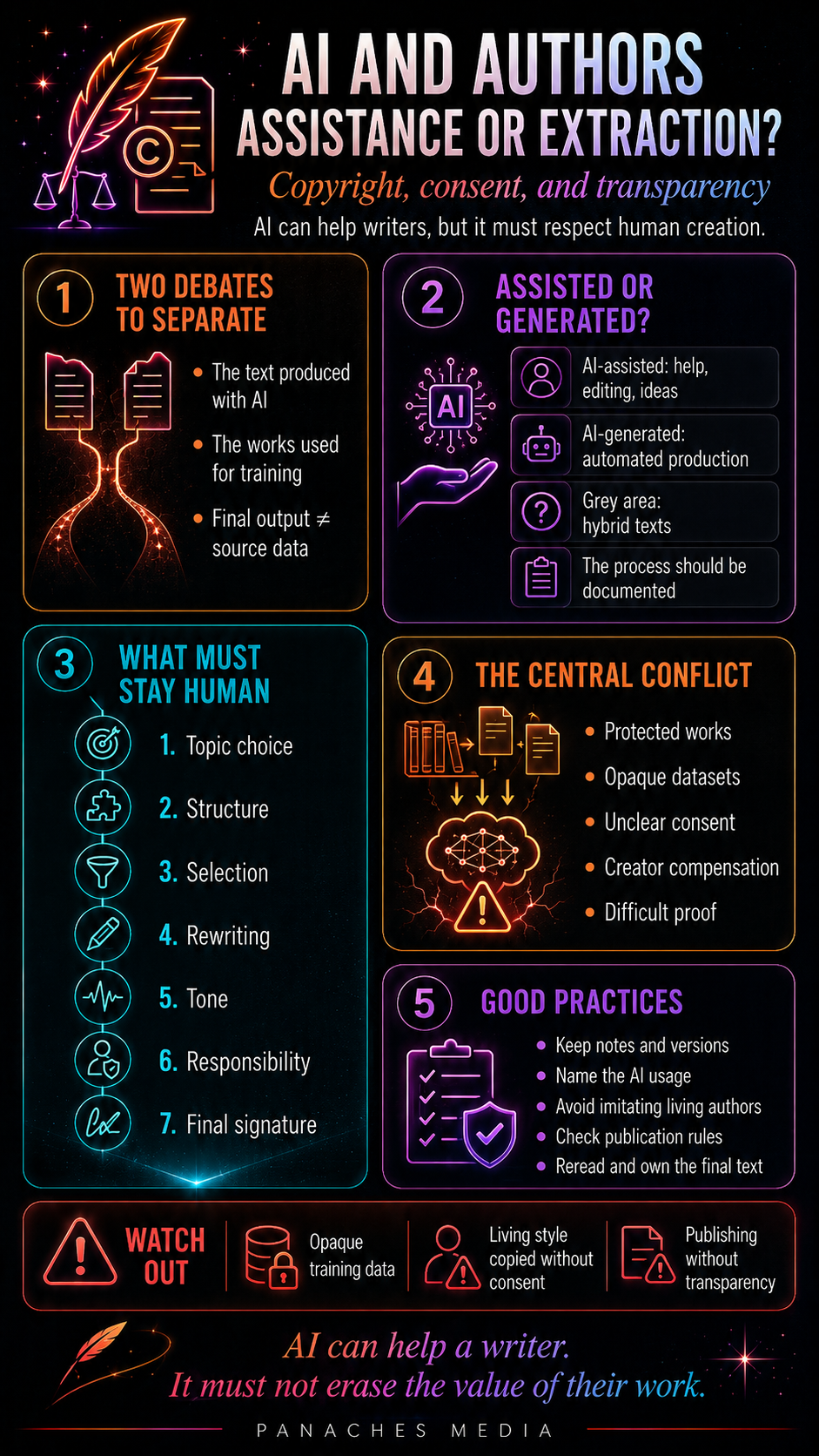
When people talk about AI and copyright, they often mix two subjects that should be separated.
The first concerns texts produced with AI: who is the author of the result? Can an AI-generated work be protected? At what point is human intervention sufficient?
The second concerns model training: do AI companies have the right to use protected books, articles, images, songs, or scripts to train their systems? If so, under what conditions? If not, how can that be proven?
These two debates are connected, but they do not ask the same question.
In the first case, we look at the final output. In the second, we look at the raw materials that allowed the model to exist.
For authors, both issues are essential: protecting what they create, but also knowing whether their works are being used to train tools that can compete with them.
AI as an assistant is not the same as AI as an author
One distinction is becoming central: AI-assisted content and AI-generated content.
An AI-assisted text can be imagined, structured, written, cut, revised, and owned by a person, with occasional help from a tool. AI then acts as a corrector, adviser, reader, translator, or generator of variations.
An AI-generated text relies much more directly on automated production. The user gives an instruction, then the tool produces a substantial part of the final content.
Between the two, of course, there is a grey area. An author can write a scene, ask for a rewrite, keep three sentences, delete the rest, add a new ending, and start again. The final text becomes hybrid.
That is exactly why the question “human or AI?” is often too simple. The better question is:
Which creative decisions were made by the author? What human material was provided? What was generated? What was chosen, cut, transformed, and owned?
The future of writing will not only be about generation. It will also be about the traceability of the process.
The core of copyright remains human intervention
In most current legal debates, one idea keeps returning: copyright protects an original human creation, not a simple automatic machine output.
This does not mean that an author loses all rights as soon as they use AI. A text can still be protectable if the human contributes real creative work: choice of subject, structure, selection, arrangement, rewriting, tone, composition, editorial direction.
But raw automatically generated content, without sufficient human input, raises far more difficulties.
This distinction matters for authors. It reminds us that value does not only lie in obtaining a result, but in the decisions that led to that result.
An author who uses AI as a workshop, who works from notes, directs versions, cuts, rewrites, and owns the final text, is not in the same situation as someone who publishes a raw generation directly.
The law is slowly trying to name that difference.
The real conflict: model training
The most explosive question is not only: “Can I protect what I made with AI?”
The most explosive question is: “Was the AI trained on protected works without authorization?”
Large models need massive amounts of data. Yet a large part of the world’s written culture — novels, essays, articles, manuals, scripts, forums, blogs, archives — already exists in digital form. For AI companies, these corpora are a strategic resource. For authors, they represent years of work, rights, an economy, sometimes even an artistic identity.
This gap fuels the anger.
From the point of view of AI companies, training can be presented as a form of statistical analysis, text mining, or transformative learning. From the point of view of authors, it can look like a massive extraction of value: their works help build commercial products, without clear consent or compensation.
This conflict will not disappear with a few disclaimers. It touches a fundamental question: who funds the creation that feeds the machines?
Why proof is so difficult
For an author, proving that a model used their work is extremely complicated.
Training corpora are often opaque. Models do not necessarily reproduce texts word for word. Even when they imitate a style or seem to know a work, that is not always enough to establish clear proof. Data can come from multiple sources, be filtered, deduplicated, and transformed.
This asymmetry is at the heart of the French debate around a presumption of use of cultural content. The idea is simple: today, rights holders often have to prove something that only AI providers can truly know. That is why some propose shifting the burden of proof.
But that idea also raises objections: how can a company demonstrate the absence of a specific work in massive corpora? How far is transparency technically possible? How can industrial secrecy, security, auditability, and creators’ rights be reconciled?
The issue is therefore not only moral. It is also evidentiary: the facts must be establishable.
Transparency: the word that keeps returning
The further the debate moves, the more one word becomes central: transparency.
Transparency about training data. Transparency about generated content. Transparency about the use of AI in a published text. Transparency about contracts, licenses, opt-outs, and compensation.
The European Union is moving in this direction with the AI Act, which introduces transparency obligations for certain uses of generative AI. This does not solve the entire copyright problem, but it is an important shift: synthetic, manipulated, or generated content cannot always circulate as if it were indistinguishable from everything else.
For authors, transparency is a condition for negotiation. Without information, it is difficult to refuse, authorize, charge, or contest. Without traceability, the creator remains alone in front of an opaque machine.
But transparency should not be only symbolic labeling. Saying “this content uses AI” is useful, but insufficient. The deeper question is: how was AI used, with which sources, at which stage, and under whose human responsibility?
Platforms are already imposing their own rules
While laws are still stabilizing, platforms are creating their own rules.
Amazon KDP, for example, distinguishes AI-generated content from content that is simply AI-assisted. This difference matters a lot for independent authors. It shows that platforms are not only interested in the final text, but also in the way it was produced.
This logic could become increasingly common: book publishing, image banks, video platforms, social networks, resource marketplaces, competitions, calls for projects, schools, publishers.
Authors will therefore need to learn how to document their uses. Not necessarily to justify themselves constantly, but to avoid unpleasant surprises.
Keeping drafts, versions, notes, sources, revision traces, important prompts, and an honest description of AI’s role could become a new form of editorial hygiene.
Style imitation: a particularly sensitive area
One of the most delicate points concerns style imitation.
Asking AI to “write like Victor Hugo” does not carry the same cultural and legal weight as asking it to “write like a living contemporary author”. In the first case, we are dealing with heritage, exercise, pastiche, and literary history. In the second, we are touching a person, a career, and an active signature.
Even when the text does not copy any sentence, it can try to capture a voice, a reputation, a recognizable manner. That is where the debate goes beyond copyright in the strict sense. It also touches consent, identity, unfair competition, and creative ethics.
For an author, style is not a simple filter. It is the result of years of reading, attempts, failures, choices, constraints, and work. Turning it into a commercial preset raises a real problem.
AI can learn from traditions. It can help study techniques. It can suggest exercises. But using the name of a living creator as a stylistic shortcut should become a much more cautious practice.
The economic risk: producing more, paying less
One of the strongest arguments from authors is not only about the moral ownership of their texts. It is about their economy.
If models are trained on thousands or millions of works, then make it possible to generate competing texts at very low cost, authors can end up in a paradoxical situation: their work has fed the system, but the system then reduces the market value of their work.
This is especially sensitive for already fragile professions: translators, illustrators, screenwriters, copywriters, editors, journalists, children’s authors, commissioned authors, genre writers, educational resource creators.
AI does not replace everything at once. It often begins by shifting budgets. A task that once required a person becomes an automatic option. A paid commission becomes an “AI touch-up”. A professional voice becomes an imitable style.
The copyright debate is therefore also a debate about the compensation of creative work.
AI can still be a real tool for authors
Recognizing the risks does not mean rejecting AI entirely.
For many authors, AI can be useful: unblocking a scene, getting feedback, summarizing documentation, comparing two outlines, correcting a heavy sentence, preparing a working translation, organizing a fictional universe, restoring consistency.
The problem is not assistance. The problem is opaque exploitation.
We must therefore avoid two caricatures.
First caricature: any use of AI is a betrayal of writing. That is false. An author can use tools without giving up their voice.
Second caricature: any criticism of AI is fear of progress. That is false too. Asking for consent, transparency, and compensation is not refusing technology. It is asking that the creation feeding this technology should not be treated as a free resource.
The fairest path is probably between the two: using AI as a tool, while refusing to let it erase creators’ rights.
Toward a new author hygiene
For authors, the current period requires new habits.
Keep traces of creation
Keeping notes, outlines, drafts, versions, corrections, and work histories helps document the human part of the process. This is not only useful legally. It is also useful creatively: it helps understand how the text was built.
Distinguish assistance from generation
We need to learn how to name uses precisely: correction, reformulation, summary, ideation, translation, scene generation, critique, organization. Saying “I used AI” is not enough. We need to know how.
Avoid directly imitating living creators
Asking for an atmosphere, a period, a formal constraint, or a narrative technique is cleaner than asking “write like this contemporary author”. You can learn from a style without copying a signature.
Check publication rules
Publishers, platforms, competitions, schools, and clients may have different rules. Before publishing or selling an AI-assisted text, it is better to check the applicable conditions.
Prefer transparent tools
When possible, it is better to use tools that explain their data policies, privacy options, training position, and content ownership rules.
Remain responsible for the final text
The author must reread, verify, cut, and own the work. AI can suggest. It should not become an excuse for an unchecked text.
What Panaches can defend
For a project like Panaches, the subject is central.
Panaches should not sell the idea of a machine that replaces the author. The strongest vision is that of a local, organized, modular workshop where AI helps without taking the place of the person creating.
A good AI writing tool should respect several principles:
- let the user keep control of their documents;
- allow work from notes and drafts;
- clearly distinguish generation, correction, and revision;
- make version traceability easier;
- help the author preserve their voice;
- avoid pushing users to publish raw, unread content;
- respect the confidentiality of creative projects.
The goal is not only to produce faster. It is to create an environment where the author remains sovereign over their work.
FAQ
Can a text written with AI be protected by copyright?
It depends on the amount of human contribution. A text that is simply generated automatically raises far more difficulties than a text designed, structured, revised, and owned by an author. Protection generally depends on identifiable human creative choices.
What is the difference between AI-assisted and AI-generated?
AI-assisted content uses the tool as help: correction, ideas, reformulation, organization, critical feedback. AI-generated content relies more heavily on substantial automatic production. In practice, many texts are hybrid, which is why documenting the process matters.
Can authors refuse to have their works used to train AI?
It depends on the country, applicable rules, licenses, contracts, opt-out mechanisms, and evolving legal frameworks. In Europe, the questions of text and data mining, objection, and transparency are central. Authors should follow the mechanisms offered by their professional organizations.
Should AI use be disclosed when publishing a book?
It depends on the platform or publisher. Some platforms distinguish AI-generated content from simply assisted content. The good practice is to check the rules before publication and keep a clear trace of the process.
Is it ethical to ask AI to write “like” a living author?
It is very sensitive. Even without copying a sentence, it can exploit a signature, reputation, or artistic identity without consent. It is healthier to describe techniques, constraints, or an atmosphere rather than using the name of a living creator as a stylistic shortcut.
Conclusion: the author must remain at the center
AI can become a powerful writing tool. It can help think, structure, correct, translate, organize, and critique. But it should not make us forget where the texts, styles, corpora, and imaginaries that made it possible came from.
The real debate does not simply oppose authors and technology. It opposes two visions of creation.
In the first, human works become a silent raw material, absorbed by opaque systems, then transformed into competing products.
In the second, AI becomes a framed, transparent, negotiated tool, used by creators who keep their rights, their voice, and their responsibility.
The issue is therefore not to reject all assistance. The issue is to refuse erasure.
AI can help an author. It must not become a way to make the value of their work disappear.