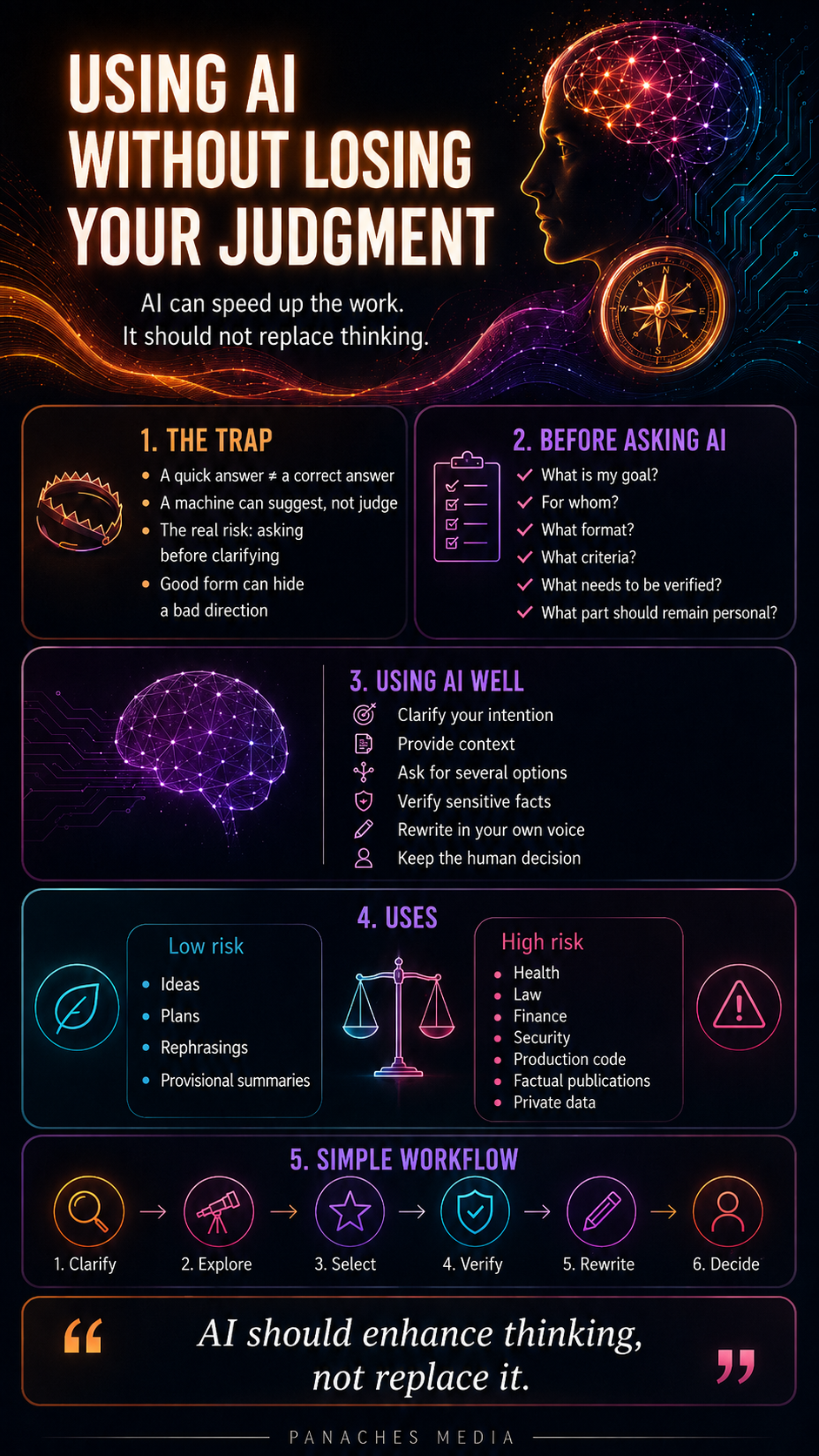
Why AI sometimes feels like it is thinking for us
Artificial intelligence has become very easy to use.
You open a tool. You write a sentence. You receive an answer.
A plan. A summary. A text. An image. An idea. A piece of code. An explanation. A suggestion.
Everything arrives quickly. Often too quickly for us to understand what just happened.
That is one of the great strengths of generative AI: it lowers friction. It turns a vague intention into usable material. It gives a first shape to something that was still only an intuition.
But that is also its trap.
When a machine answers quickly, clearly, and confidently, it can make us feel as if the work is already done.
In reality, the important work often begins after the answer.
Reading. Comparing. Checking. Correcting. Choosing. Taking responsibility.
AI can produce a proposal.
But it cannot carry our judgment for us.
The real risk: no longer clarifying before asking
The problem is not using AI.
The problem is using it before we have even started thinking.
It is very tempting.
We do not know where to begin, so we ask AI. We do not feel like structuring, so we ask AI. We hesitate, so we ask AI. We doubt, so we ask AI. We want to go faster, so we ask AI.
And sometimes, without noticing it, we replace reflection with the request.
Once, it is not a big deal. Often, it is not necessarily a big deal either.
But over time, a shift can happen: we stop formulating our own criteria and wait for the tool to invent them. We stop looking for our angle and ask for a list of angles. We stop writing a bad first sentence and ask for a version that is already polished.
The danger is not that AI thinks better than we do.
The danger is that it teaches us to stop beginning.
Creating, learning, writing, coding, or deciding often requires a first friction.
That friction is not a defect.
Sometimes it is exactly where thought begins to take shape.
AI should augment thought, not replace it
A good use of AI is not saying:
Do the work for me.
It is closer to saying:
Help me work better.
The difference is enormous.
In the first case, we delegate. In the second, we dialogue.
AI can be very useful to:
- reformulate an idea;
- test a hypothesis;
- suggest several angles;
- summarize a long text;
- compare two options;
- detect inconsistencies;
- simplify an explanation;
- generate a first draft;
- turn raw notes into an outline;
- list useful questions;
- produce a counterargument.
But it becomes less healthy when it is used to systematically avoid:
- the effort of clarification;
- careful reading;
- personal decision-making;
- verification;
- responsibility;
- useful doubt.
AI is a good work partner when it makes thought more visible.
It becomes problematic when it replaces thought with a stream of pleasant answers.
Start with your intention
Before asking AI anything, it helps to ask one simple question:
What do I really want to obtain?
Not just “a text”. Not just “an image”. Not just “an answer”.
A precise intention.
For example:
- I want to understand a topic;
- I want to find an angle;
- I want to improve a draft;
- I want to test a hypothesis;
- I want to simplify an explanation;
- I want to obtain a contradiction;
- I want to save time on a repetitive task;
- I want to explore several possibilities before choosing.
A vague request often produces a vague answer.
A clear intention produces a more useful tool.
The difference between these two prompts is huge:
Write me an article about AI.
And:
Help me build an accessible, pedagogical, and critical article about the use of AI, aimed at curious creators and developers. I want a clear, human tone, without techno-optimism, with concrete examples and a conclusion about human judgment.
In the first case, AI guesses.
In the second, it works within a frame.
And the clearer the frame, the less the tool takes the wrong kind of freedom.
Give context, or AI will invent the frame
AI does not naturally know your project, your audience, your style, your constraints, your level of quality, or what you refuse.
It can improvise.
And it often improvises very well.
That is precisely the problem.
An answer can look clean, but fail to respect the real intention. It can be correct on the surface, but wrong for the context. It can produce a well-written text, but one that is too generic. It can suggest a technically plausible solution, but one that is risky in a real project.
Context is not a detail.
It is the difference between a decorative answer and a useful answer.
Before asking AI, it can help to specify:
- the target audience;
- the expected tone;
- the desired format;
- the level of detail;
- the technical constraints;
- what must absolutely not be done;
- the project context;
- the expected result;
- the criteria for success.
A good request does not have to be long.
But it must be oriented.
It is not chatter.
It is framing.
Ask for options, not a truth
One of the best ways to use AI is to ask for several paths.
Not a single answer.
Several options.
Several angles.
Several formulations.
Several hypotheses.
Why?
Because one answer can create an impression of authority. It arrives like a conclusion.
Several proposals force us to compare.
And comparing is already a way of taking back control.
You can ask for:
- three possible angles;
- two opposite versions;
- a simple version and a deeper version;
- the advantages and limits of an idea;
- the risks of a decision;
- possible objections;
- a critical reading of a draft.
AI then becomes a space for exploration.
Not an oracle.
And that is much healthier.
An oracle imposes an answer.
An exploration tool opens a choice.
Verify what really matters
AI can be wrong.
It can invent a source. It can confuse two concepts. It can summarize too quickly. It can misunderstand a context. It can produce an answer that is plausible but false. It can be convincing without being reliable.
That is why it is important to distinguish between two types of use.
Low-risk uses: reformulating a sentence, finding ideas, generating an outline, producing a temporary synthesis, getting examples.
In these cases, AI can serve as a fast draft.
Higher-risk uses: medical, legal, or financial information, cybersecurity, important professional decisions, factual publication, production code, private data.
In these cases, the AI answer should never be the endpoint.
It should be a starting point.
The rule is simple:
The higher the stakes, the more verification must be human, sourced, and methodical.
AI can help us go faster.
But it does not replace proof.
Learn to say no to a good answer
An answer can be well written and wrong.
That is one of AI’s most subtle traps.
It can produce a fluent, pleasant, structured, almost elegant text.
But too smooth. Too neutral. Too generic. Too conventional. Too far from the voice you are looking for.
In that case, you need to know how to refuse it.
Not because the answer is “bad”.
But because it is not right.
A good use of AI therefore requires a slightly strange skill: not being seduced by polish.
Clean is not always alive.
Clear is not always true.
Well phrased is not always good.
This is especially important for creators, writers, designers, developers, teachers, and independent workers.
Because AI knows how to produce form.
But direction remains human.
Keep track of your criteria
To avoid getting lost in generated answers, it helps to keep your criteria visible.
Before working with AI, you can write down a few reference points:
- what is the goal?
- for whom?
- with what tone?
- how long should it be?
- what points are essential?
- what would make it a bad answer?
- what must be checked?
- what level of risk is involved?
- what part must remain personal?
These criteria act like a compass.
Without a compass, AI can take you very far.
Not necessarily in the wrong direction.
But not necessarily in yours.
And in a world where tools can produce quickly, keeping your direction becomes a central skill.
AI as a critical partner
One of the best ways to use AI is not to ask it to agree.
You can ask it to criticize.
To find weaknesses.
To spot blind spots.
To propose objections.
To make an idea clearer.
To say what is missing.
To distinguish what is solid from what is fragile.
This is often more useful than asking for validation.
Instead of:
Is my idea good?
You can ask:
Analyze this idea. Give me its strengths, its limits, its risks, what is missing, and the questions I should ask before continuing.
Then AI becomes a mirror.
Not a compliment machine.
And a useful mirror is not always pleasant.
But it helps us see better.
Do not automate everything
Automation is seductive.
It promises to save time, avoid repetitive tasks, and produce faster.
But not everything should be automated.
Some tasks are painful because they are useless.
Others are painful because they shape our judgment.
Rereading a text can be slow, but that is where we discover what we truly think. Fixing a bug can be frustrating, but that is where we understand the system. Making an outline can feel slow, but that is where we choose a direction. Writing an imperfect first draft can be uncomfortable, but that is where a voice appears.
So the question is not:
Can AI do it?
The real question is:
Should I really delegate this part?
Sometimes, yes.
Sometimes, no.
And knowing the difference is becoming essential.
A good workflow with AI
A simple method can help us stay in control.
Clarify
Before AI, write what you want to obtain.
Even in a few lines.
Goal, audience, constraints, expected result.
Explore
Ask for several paths, angles, examples, or hypotheses.
Do not take the first answer as truth.
Select
Choose what truly serves the project.
Remove the rest.
Verify
Check the facts, sources, logic, and consequences.
Especially if the content will be published or used in an important context.
Rewrite
Bring the answer back into your own voice.
Adapt, cut, move, reformulate.
Decide
Do not let the tool conclude for you.
AI can suggest.
The decision must remain human.
What AI reveals about the way we work
AI does not only save time.
It also reveals weaknesses in our methods.
If our request is vague, it produces vagueness.
If our intention is weak, it fills the void.
If our criteria are absent, it invents its own.
If we want to go too fast, it can help us produce a bad direction faster.
But the opposite is also true.
With a clear intention, it becomes powerful.
With good criteria, it becomes useful.
With a critical eye, it becomes stimulating.
With a method, it becomes a real work partner.
AI does not replace rigor.
It makes it more visible.
The real luxury: staying in control of your attention
As AI enters our tools, texts, searches, images, and decisions, one skill becomes precious: keeping our attention.
Not asking too quickly. Not accepting too quickly. Not publishing too quickly. Not delegating too quickly.
AI can be an accelerator.
But if we accelerate without direction, we do not save time.
We simply drift away faster.
Using AI well does not mean using it everywhere.
It means using it in the right place, at the right time, with the right level of trust.
It means accepting its help without abandoning your thinking.
It means keeping enough distance to say:
Thank you for the suggestion. Now I choose.
And perhaps that is the real intelligent use of AI: not producing more mechanically, but remaining able to create, decide, and think with greater clarity.