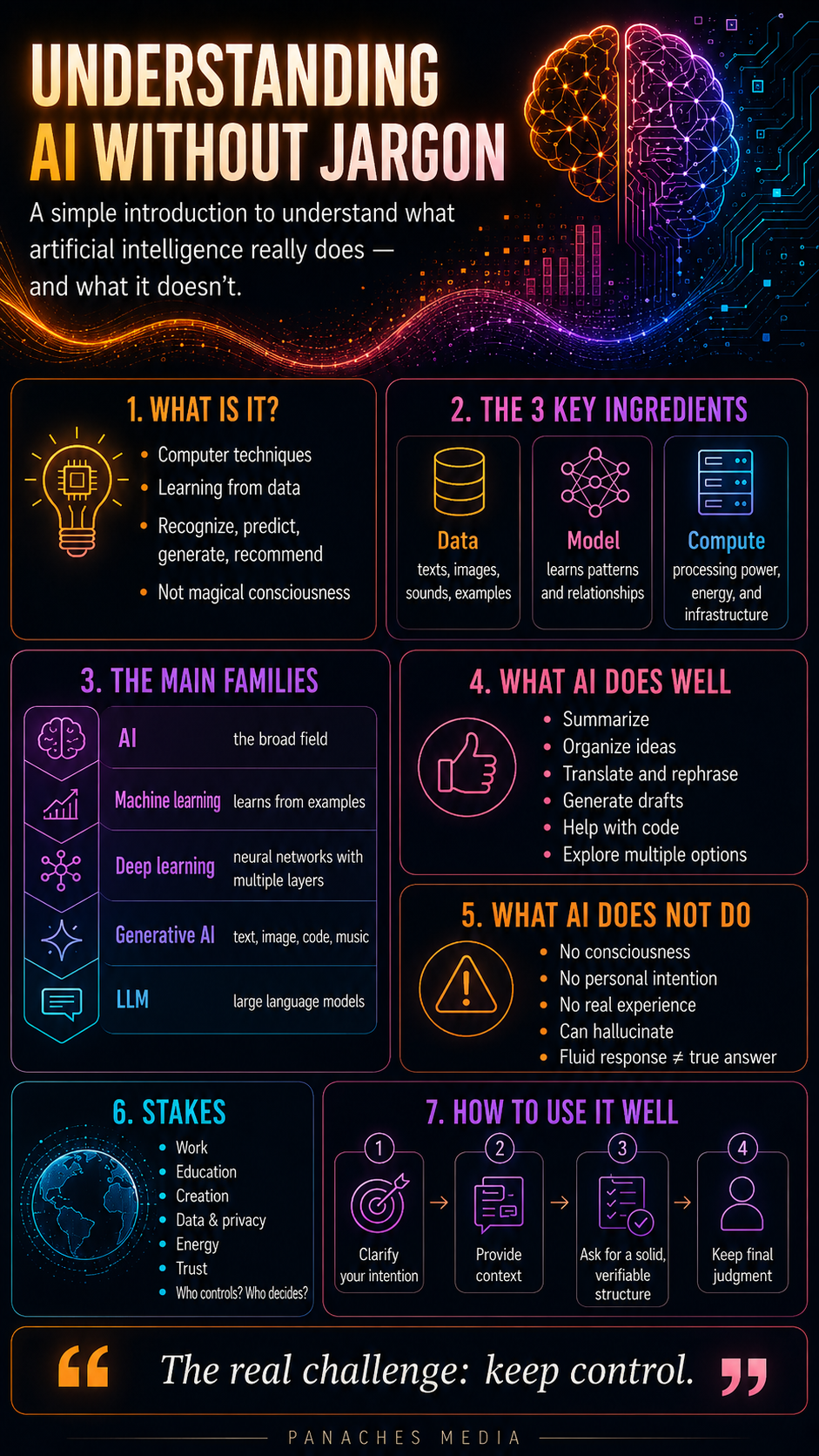
Why is everyone talking about artificial intelligence?
Some words become so large that they almost stop meaning anything.
Artificial intelligence is one of them.
We use it to talk about chatbots, image generators, translation tools, coding assistants, recommendation algorithms, search engines, robots, medical systems, sorting software, or models capable of writing a text in seconds.
The result is simple: everything seems to be AI.
And when everything is AI, nobody really knows what we are talking about anymore.
So let’s slow down.
Artificial intelligence is not a magical creature hidden inside a server. It is not a digital consciousness waiting for its moment while sipping virtual coffee.
It is a set of computer science techniques that allow machines to perform some tasks we used to associate with human intelligence: recognizing, classifying, predicting, translating, generating, recommending, discussing, and solving certain problems.
AI does not think like us.
But it can produce results that sometimes look like thinking.
And that is exactly where things become interesting.
A simple definition of AI
Artificial intelligence can be defined as a family of systems able to learn from data in order to perform complex tasks.
These tasks can be very different:
- recognizing a face or an object in an image;
- translating a text;
- recommending a video;
- summarizing a document;
- generating an illustration;
- writing code;
- detecting an anomaly;
- answering a question;
- organizing information;
- helping with a decision.
The common point?
These systems do not always follow a list of rules written one by one by a human.
They learn patterns.
They observe many examples, identify structures, build models, then use those models to produce an answer, a prediction, or an action.
In short:
AI learns patterns from data to produce useful results in a given context.
Less spectacular than a philosophical robot.
Much closer to reality.
Data, models, computing power: the three basic ingredients
To understand modern AI, we can start with three elements.
1. Data
AI learns from data: texts, images, sounds, videos, measurements, examples, histories, behaviors, documents.
Without data, there is no learning.
But data is never neutral. It can be incomplete, biased, outdated, poorly labeled, or too limited.
An AI trained on poor data can produce poor answers with great confidence.
A bit like a brilliant student who studied from false notes. The essay may sound good. It does not make it right.
2. The model
The model is the system that learns from the data.
It does not simply memorize every example. It transforms those examples into relationships, probabilities, associations, and parameters.
That is what allows it to recognize an image, generate a sentence, predict a sequence, or suggest an answer.
A model is therefore a kind of statistical map of the world it has been shown.
Not the world itself.
3. Computing power
Modern AI also requires a lot of computation.
Training large models requires powerful machines, specialized processors, large amounts of energy, and heavy technical infrastructure.
This is one reason why AI is also an economic, ecological, and political topic.
Behind an answer generated in two seconds, there may be years of research, thousands of machines, massive datasets, and very concrete industrial choices.
Machine learning, deep learning, generative AI: what is the difference?
AI vocabulary can feel like entering a machine room with the lights off.
So let’s simplify.
Artificial intelligence
This is the broad field.
It includes all techniques that aim to make machines perform tasks associated with human intelligence.
Machine learning
Machine learning is a branch of AI.
Instead of programming every rule by hand, we give examples to the system so it can learn patterns.
Simple example: instead of writing every rule that defines a cat, we show the model many images of cats and non-cats. It gradually learns to identify shapes, textures, ears, eyes, and contexts.
Deep learning
Deep learning is a subfield of machine learning.
It uses artificial neural networks made of many layers. These systems are especially powerful for complex tasks: images, voice, language, translation, recognition, and generation.
“Deep” does not mean the system thinks deeply.
It mostly means the network has many layers of processing.
Marketing poetry has its limits.
Generative AI
Generative AI refers to systems capable of producing new content: text, images, music, video, code, voices, ideas, outlines, summaries.
This is what made AI so visible in recent years.
Before that, many AI systems worked in the background: recommendation, ranking, detection, prediction.
With generative AI, AI speaks, writes, draws, composes, and codes.
It enters directly into our creative gestures.
And of course, that changes our relationship with tools.
LLMs: why can AI have conversations?
Large language models, often called LLMs, are models trained on huge amounts of text.
Their central task is simple to describe: predicting the most likely continuation of a text, based on context.
But at large scale, this ability creates powerful behaviors:
- answering questions;
- summarizing documents;
- reformulating ideas;
- translating;
- drafting text;
- explaining concepts;
- generating code;
- simulating dialogue;
- comparing options.
An LLM does not “understand” like a human.
It manipulates language with enormous statistical power.
But because much of human intelligence passes through language, its answers can create a strong impression of understanding.
That is useful.
Sometimes impressive.
And also risky when we forget that a fluent answer is not necessarily a true answer.
What AI is good at
AI is especially strong when it needs to detect patterns, process large amounts of information, or quickly generate proposals.
It can help to:
- summarize long texts;
- organize ideas;
- find article angles;
- generate examples;
- explain difficult concepts;
- analyze data;
- create visual references;
- assist with code;
- improve wording;
- translate;
- prepare outlines;
- automate repetitive tasks;
- detect anomalies;
- explore several options quickly.
In creation, it can become a sketching studio.
In development, a drafting and debugging assistant.
In writing, a reformulation partner.
In learning, a patient tutor.
But in every case, it remains a tool.
A powerful tool, yes.
But still a tool.
What AI does not really do
Current AI does not have consciousness.
It has no personal intention.
It does not know what it feels like to be sad, curious, tired, happy, worried, or inspired.
It can talk about those states. It can imitate them. It can recognize them in a text. It can respond to them with subtlety.
But it does not live them.
It does not understand the world through a body, a personal history, sensitive memory, or lived experience.
It can also be wrong.
And sometimes, it is wrong very well.
It can produce a clear, structured, convincing answer… that is false.
This is often called a hallucination: invented or incorrect information presented as if it were true.
That is why one simple rule remains essential:
The more important the decision, the more the AI answer must be checked.
Narrow AI, strong AI: where are we today?
The AI systems we use today are specialized systems.
They can be extremely good at specific tasks, but they do not possess general intelligence comparable to human intelligence.
An AI can outperform humans in a specific domain, generate text, recognize images, code certain functions, analyze documents.
But that does not make it a person.
So-called “strong AI”, able to understand and act with human-like or beyond-human general intelligence across all domains, remains theoretical and debated.
This does not mean current AI is weak in the ordinary sense.
It is already powerful.
But its power is not the power of consciousness.
It is the power of a trained, optimized, specialized system integrated into tools.
Why AI is also a social topic
Understanding AI is not only about technology.
It is also about work, education, creation, sovereignty, data, rights, energy, and trust.
Who owns the models?
Who controls the data?
Who checks the answers?
Who decides what should be automated?
Who benefits from productivity gains?
Who suffers from errors?
Who stays in control?
These questions are just as important as tool performance.
AI can be technically impressive and socially problematic.
It can save time, but also create dependency.
It can open creative possibilities, but also standardize production.
It can help people learn, but also encourage them to stop thinking for themselves.
So the real question is not only:
What can AI do?
But also:
What do we want to delegate to it?
A better way to use it
Using AI intelligently starts with a simple posture: do not ask it to think instead of you, use it to think better.
A few principles help.
1. Clarify your intention before prompting
Before writing a request, you need to know what you are looking for.
A summary?
A critique?
An outline?
A reformulation?
A list of ideas?
A verification?
A contradiction?
The clearer the intention, the more useful the tool becomes.
2. Give context
AI answers better when it knows the frame.
Who is the text for?
What tone should it use?
What constraints matter?
What platform is it for?
How detailed should the answer be?
What should it avoid?
Context turns a vague request into real direction.
3. Ask for a verifiable structure
Instead of asking “write me a good text”, you can ask for:
- an outline;
- assumptions;
- limits;
- examples;
- a checklist;
- a short version;
- a critical version;
- an actionable summary.
AI becomes more useful when the result can be reviewed, tested, compared, or corrected.
4. Keep final judgment
AI can suggest.
But the human must decide.
Responsibility does not disappear because a machine generated an answer.
It simply moves.
The real challenge: staying in control
Artificial intelligence is neither a magic wand nor an abstract monster.
It is a powerful, imperfect technology, already present in our tools and habits.
It can help us create, learn, organize, code, write, and explore.
It can also make us lazy, dependent, inattentive, or too confident in well-written answers.
Everything depends on how we integrate it into our gestures.
The real challenge is not to use AI everywhere.
The real challenge is to know when to use it, why to use it, how to verify it, and when to take the work back into our own hands.
Because in the end, understanding AI is not only about understanding a technology.
It is about learning how to remain human in a world increasingly assisted by machines.