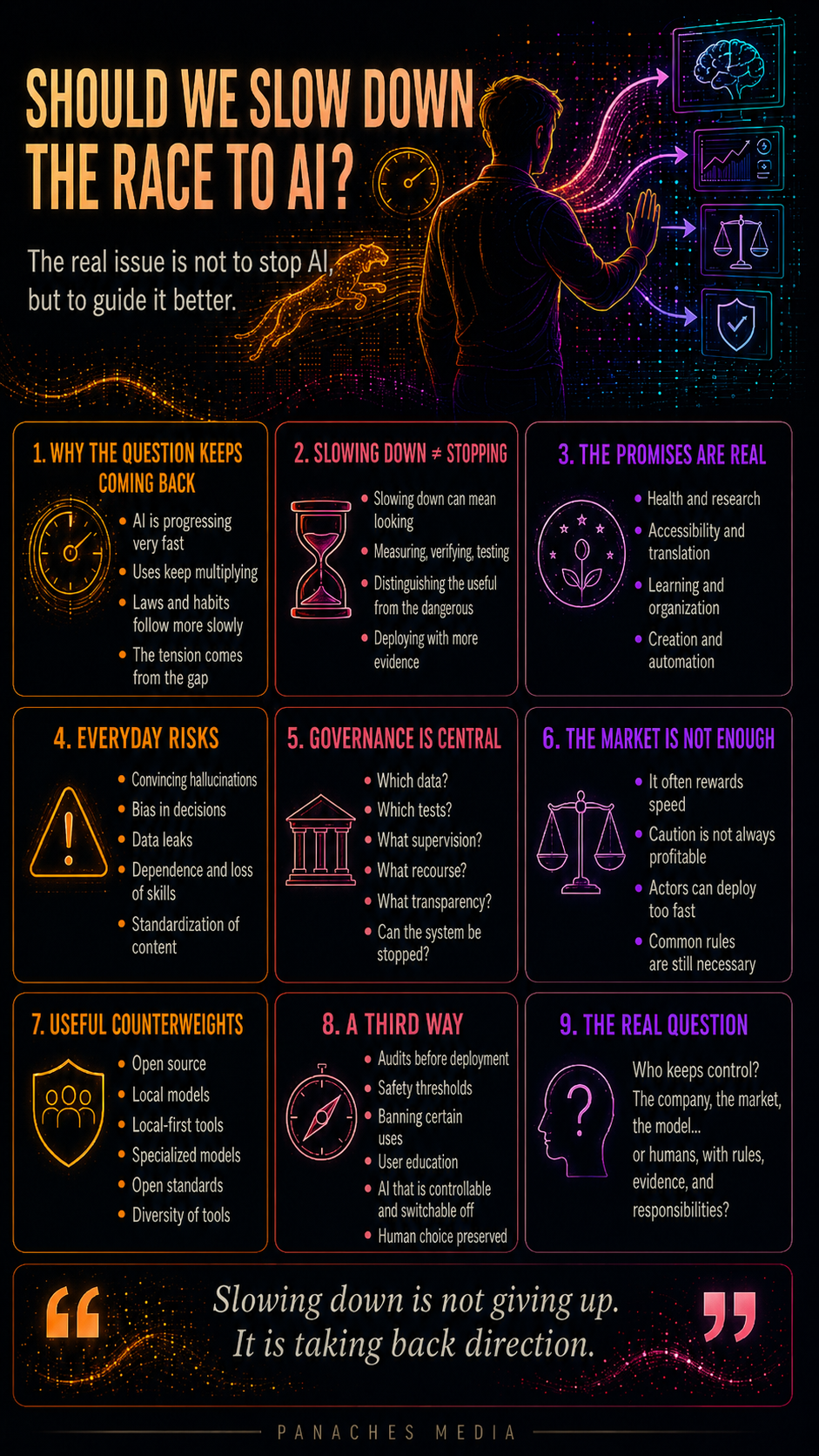
A technology moving faster than our habits
Artificial intelligence is not progressing like a simple software update.
It advances in waves.
A new model. A new ranking. A new agent. A new capability. A new tool promising to write, code, search, draw, summarize, decide, automate.
As soon as we understand one use case, another appears.
As soon as we learn how to ask a good question, a tool already offers to remove the need to ask it.
This speed is fascinating.
It creates the feeling of constant progress, of a future getting closer, of a world where every friction could be reduced by a machine that is faster, stronger, more contextual.
But this speed is also worrying.
Because our institutions, laws, companies, schools, work habits, and critical reflexes do not evolve at the same pace.
Technology accelerates.
Culture follows more slowly.
And between the two, there is a space of tension.
That is where the question appears:
Should we slow down the race toward artificial intelligence?
The word “slow down” makes people uncomfortable
Slow down is a difficult phrase to defend in an age obsessed with innovation.
We prefer to say:
accelerate, scale, optimize, deploy, automate, save time, gain an advantage.
Slow down almost sounds suspicious.
As if slowing down meant rejecting progress. As if setting limits meant being afraid. As if asking for evidence, testing, rules, or safety were the posture of an anxious old man staring at a connected toaster.
But slowing down does not necessarily mean stopping.
Slowing down can mean looking.
Understanding.
Measuring.
Verifying.
Distinguishing what is useful from what is dangerous.
Distinguishing what is impressive from what is reliable.
Distinguishing what can be tested in a lab from what can be deployed in real life.
So the real question is not:
Are you for or against AI?
That question is too poor.
The real question is:
At what speed do we want to deploy systems we do not yet fully understand?
The problem is not only power
When we talk about AI risks, we often think about very powerful models.
Those that reason better. Those that write code. Those that analyze documents. Those that manipulate tools. Those that can act as agents. Those that seem able to solve increasingly complex tasks.
Power matters.
But it is not the only issue.
A less spectacular system can already create risks if it is integrated too quickly into a sensitive context.
A decision-support tool can amplify bias. An assistant can produce a convincing error. A code generator can introduce a vulnerability. An HR tool can rank candidates unfairly. An educational system can change the relationship to learning. A medical chatbot can reassure at the wrong moment. An autonomous agent can act further than expected.
The risk does not come only from the model.
It comes from the meeting between:
- the model’s capability;
- the use context;
- the level of control;
- the data used;
- the people affected;
- the consequences of an error;
- the possibility of correcting afterwards.
A weak AI in a critical context can be more dangerous than a strong AI inside a well-supervised sandbox.
The promises are real
It would be easy to turn AI into nothing but danger.
That would be false.
AI can help detect diseases. Accelerate scientific research. Improve accessibility. Help translate. Summarize large volumes of documents. Support learning. Assist developers. Help creators. Automate repetitive tasks. Lower certain technical barriers. Give isolated people a tool for explanation, reformulation, or organization.
The promises are enormous.
And some are already concrete.
So the problem is not that AI is useless.
The problem is precisely that it is useful for many things.
When a technology becomes useful everywhere, it can also become risky everywhere.
The more a tool enters different domains, the more it touches lives, decisions, institutions, work habits, economic balances, and responsibilities.
That is not a reason to reject AI.
It is a reason to take it seriously.
Risks are not always spectacular
When we talk about AI risk, we sometimes imagine extreme scenarios.
An uncontrollable machine. Humanity surpassed. A super-system impossible to stop. A science-fiction film with blue light, red alarm, and someone typing “override” far too late.
These scenarios exist in debates.
But the most immediate risks are often less cinematic.
More ordinary.
More administrative.
More silent.
A bias in an automated decision. An error in a synthesis. An invented source. Excessive dependency at work. A weakening of learning. Increased surveillance. A data leak. Standardization of content. Loss of skill. Concentration of power in a few actors. More pressure on workers.
These risks do not always make headlines.
But they shape daily life.
And that is exactly why they matter.
A catastrophe does not always need to explode.
Sometimes it settles into procedures.
Hallucinations: an error that speaks well
One known problem of generative AI is its ability to produce false answers with confidence.
An invented piece of information. A citation that does not exist. A wrongly attributed source. A plausible but incorrect explanation. An overconfident diagnosis. A code function that seems logical but fails in a real case.
This is not only an error.
It is a well-phrased error.
And that is more dangerous than a visible mistake.
A hesitant answer invites verification.
An elegant answer invites belief.
In low-risk uses, this is not always serious.
An average title idea, a failed image, an awkward reformulation: we can fix it.
But in sensitive areas, hallucination changes nature.
Health. Law. Finance. Cybersecurity. Education. Public decision-making. Production code.
There, a false answer can have real consequences.
The problem is not only that AI can be wrong.
The problem is that it can be wrong with the tone of someone who knows.
Bias: the old world inside new machines
AI learns from data.
That data comes from the world.
And the world is not neutral.
It contains inequalities, blind spots, stereotypes, power structures, past decisions, old injustices, dominant representations.
If that data is used without care, AI can reproduce or amplify those biases.
It can rank differently. Recommend differently. Describe differently. Evaluate differently. Prioritize differently.
The danger is subtle.
Because an algorithmic decision can look objective.
It feels mathematical.
It comes out of a system.
It appears less personal.
But a decision produced by a machine can still carry the traces of the world that trained it.
So the problem is not only technical.
It is social.
Asking for “neutral AI” is not enough.
We must ask:
- what data?
- what limits?
- what tests?
- which populations are affected?
- what appeals?
- what transparency?
- what responsibility?
Without these questions, we risk putting old disorder into new tools.
With a cleaner interface, of course.
Chaos loves beautiful interfaces.
Governance is not decoration
AI governance can sound abstract.
A report word.
A committee word.
A word placed in a presentation with three arrows and a circular diagram.
And yet governance is central.
It answers very concrete questions:
Who can use the system? For what purpose? With what data? With what supervision? With what tests? With what limits? With what responsibilities? With what right to appeal? With what transparency? With what possibility of shutdown?
AI without governance is power without instructions.
Sometimes, that does not create a problem.
A personal creative tool, a draft, a local experiment: the risk remains limited.
But the more a system touches people, rights, decisions, professions, or infrastructure, the more governance becomes essential.
It should not arrive afterwards.
Not when the system is already everywhere.
Not when habits are already formed.
Not when the cost of withdrawal becomes too high.
Governance must accompany deployment.
Not run after it wearing a helmet that is too big.
Innovation without responsibility becomes a rush forward
Innovation is necessary.
But it is not a magic excuse.
We cannot answer every concern with:
Yes, but we need to innovate.
Of course we need to innovate.
But for what?
For whom?
At what cost?
With what protections?
With what side effects?
With what ability to correct?
An innovation can be technically brilliant and socially harmful.
It can solve one problem and create three.
It can increase productivity and degrade attention.
It can democratize a use and concentrate power.
It can help some users and weaken others.
Innovation is not automatically good.
It becomes useful when it meets responsibility.
Without that, it becomes a rush forward.
And a rush forward often looks like progress, until we realize nobody is really holding the wheel.
The market is not enough to regulate AI
Some believe the market will correct problems.
If a tool is bad, users will leave. If a model hallucinates, another will be better. If a company abuses, competition will sort it out. If a technology is dangerous, the public will refuse it.
Sometimes this is true.
But not always.
The market does not see everything.
It does not always protect the most vulnerable.
It often rewards speed, growth, massive use, attention capture, and cost reduction.
It does not automatically reward caution.
A company may have an incentive to deploy fast.
To announce louder.
To collect more.
To automate more.
To capture market share before rules arrive.
In a race, the one who slows down alone can be punished.
That is why governance cannot rely only on the individual goodwill of actors.
When everyone is running, traffic rules sometimes become necessary.
Otherwise, the fastest is simply the one willing to accept the most risk.
The problem of concentration
Developing the most powerful models requires enormous resources.
Data. Computing power. Researchers. Infrastructure. Capital. Market access. Distribution channels.
This favors concentration of power.
A few companies can become gateways to writing, search, creation, code, education, productivity, customer relations, and decision-making.
This is not only an economic problem.
It is a cultural one.
If a few models become the invisible filters of our texts, images, searches, and decisions, they influence how the world is represented.
Which content is highlighted? Which styles become dominant? Which viewpoints are normalized? Which languages are better served? Which cultures are less understood? Which uses become dependent on a platform?
Digital sovereignty is therefore not only about servers.
It is also about our ability to keep several paths.
Several tools.
Several models.
Several ways of thinking.
Open source, local-first, specialized models: necessary counterweights
Against concentration, there are counterweights.
Open source.
Local models.
Specialized models.
Local-first tools.
Open standards.
Public infrastructure.
Independent research.
Technical communities.
None of these elements solves the issue of risk alone.
An open-source model can also be misused.
A local model can also hallucinate.
A specialized tool can also reproduce bias.
But these approaches diversify the ecosystem.
They prevent all uses from depending on a few central gates.
They make it possible to audit, adapt, understand, experiment, and regain control.
The answer to AI should not only be:
bigger model, faster.
It can also be:
better use, better control, better transparency, better diversity of tools.
Sometimes, a smaller AI that is better placed, better understood, and better framed is worth more than a giant model used everywhere without distance.
Do we need a moratorium?
The question of a moratorium regularly returns.
Should certain developments be suspended? Should training of the most powerful models be limited? Should audits be required before deployment? Should international thresholds be created? Should common rules be established? Should certain uses be forbidden? Should the race between private actors be slowed?
The word is heavy.
It can be frightening.
It can seem unrealistic.
It also raises obvious difficulties: international coordination, controlling actors, geopolitical competition, the risk of moving research into less transparent areas.
But the question deserves to exist.
Because it forces us to say what we accept.
It forces us to distinguish experiments from mass deployment.
It reminds us that a very powerful technology should not move forward simply because it can.
A general and absolute moratorium would be difficult.
But targeted pauses, mandatory audits, safety thresholds, bans on certain uses in sensitive areas, transparency obligations, and shutdown mechanisms can be discussed seriously.
The debate should not be caricatured between:
accelerate without limits
and
stop everything.
There is a third path:
move forward, but with brakes, evidence, responsibilities, and forbidden zones.
Slowing certain uses to accelerate trust
Slowing down may seem contrary to innovation.
But sometimes, slowing down is precisely what allows better adoption.
A poorly deployed tool can create distrust.
A public error can break confidence.
A brutal automation can trigger rejection.
An opaque AI can feed fear.
By contrast, a slower but better explained deployment can create a stronger relationship.
Testing. Documenting. Training. Auditing. Correcting. Listening to users. Allowing appeal. Making limits visible. Giving choice.
All of this takes time.
But that time is not wasted.
It builds trust.
And in a technology as sensitive as AI, trust is not a marketing bonus.
It is a condition for sustainable use.
An imposed AI can be rejected.
An understood AI can be chosen.
The role of education
We cannot govern AI only through laws and audits.
People also need to be trained.
Understanding what AI is. Understanding what it cannot do. Understanding hallucinations. Understanding bias. Understanding data. Understanding limits. Understanding verification. Understanding acceptable uses. Understanding dependency risks.
AI education should not be reserved for engineers.
It concerns students, teachers, creators, journalists, entrepreneurs, independent workers, public officials, citizens.
From the moment a technology influences information, work, training, creation, and decision-making, it becomes a general culture topic.
Teaching AI is not only teaching how to prompt.
It is teaching how to judge.
And perhaps that is the central point.
In a world where machines answer better and better, humans must be trained to question better.
Users must keep a right to choose
Another question becomes essential: choice.
Can we refuse AI? Can we know when it is being used? Can we request a human alternative? Can we understand which data it relies on? Can we correct a decision? Can we disable a feature? Can we work without being forced to use an assistant? Can we keep our data locally?
Choice should not be a luxury.
It should become a principle.
Because an AI useful for one person can be intrusive for another.
A practical automation in one context can be dangerous in another.
An assistant that reassures one user can trap another in dependency.
The future should not be:
AI everywhere, by default, without discussion.
But rather:
AI available, understandable, controllable, disableable, proportionate.
That is not less modern.
It is more mature.
The right question: who stays in control?
In the end, all AI debates return to a simple question.
Who stays in control?
The company deploying it? The model suggesting? The user choosing? The regulator limiting? The community auditing? The market pushing? The state framing? The developer integrating? The creator signing?
There will not be a single answer.
But the question must remain visible.
If nobody knows who is in control, it often means control has already slipped somewhere between the model, the platform, the terms of service, and the “accept” button.
AI must remain a governable tool.
A system we can understand enough, limit, correct, contest, stop.
Not an opaque infrastructure we adapt to because it is already everywhere.
Modernity should not mean accepting everything faster.
It should mean choosing more clearly.
Slowing down is not giving up
Slowing down the AI race does not mean giving up on AI.
It can mean:
- slowing certain deployments;
- banning certain uses;
- auditing sensitive systems;
- requiring evidence of safety;
- making limits visible;
- training users;
- protecting data;
- diversifying models;
- supporting open alternatives;
- preserving human choice.
This is not a refusal of progress.
It is a way to prevent progress from becoming a force without direction.
The goal is not to break momentum.
The goal is to give it shape.
A powerful technology deserves better than a permanent race.
It deserves a culture.
Rules.
Responsibilities.
Spaces for debate.
Guardrails.
And above all, humans able to say:
Yes, here. No, not there. Not like this. Not without evidence. Not without appeal. Not without choice.
Moving forward without being carried away
Artificial intelligence will continue to progress.
It will enter more tools, more professions, more education, more decisions, more daily gestures.
So the question is not whether it will disappear.
It will not.
The question is how we want to live with it.
As passive users?
As fascinated consumers?
As constrained workers?
As poorly informed citizens?
Or as people capable of understanding, choosing, limiting, contesting, creating, deciding?
In this context, slowing down is not necessarily a brake.
It is a way of taking direction back.
A refusal to confuse speed with intelligence.
A reminder that every power requires responsibility.
AI can help us create, code, search, learn, organize, heal, understand.
But it must remain within a human frame.
Not because humans are perfect.
They are not.
We have fairly solid archives on that subject.
But because responsibility cannot be delegated to a machine.
In the end, the question “should we slow down the AI race?” hides another one:
Are we still capable of choosing the speed at which we transform the world?
And that question deserves more than a fast answer.