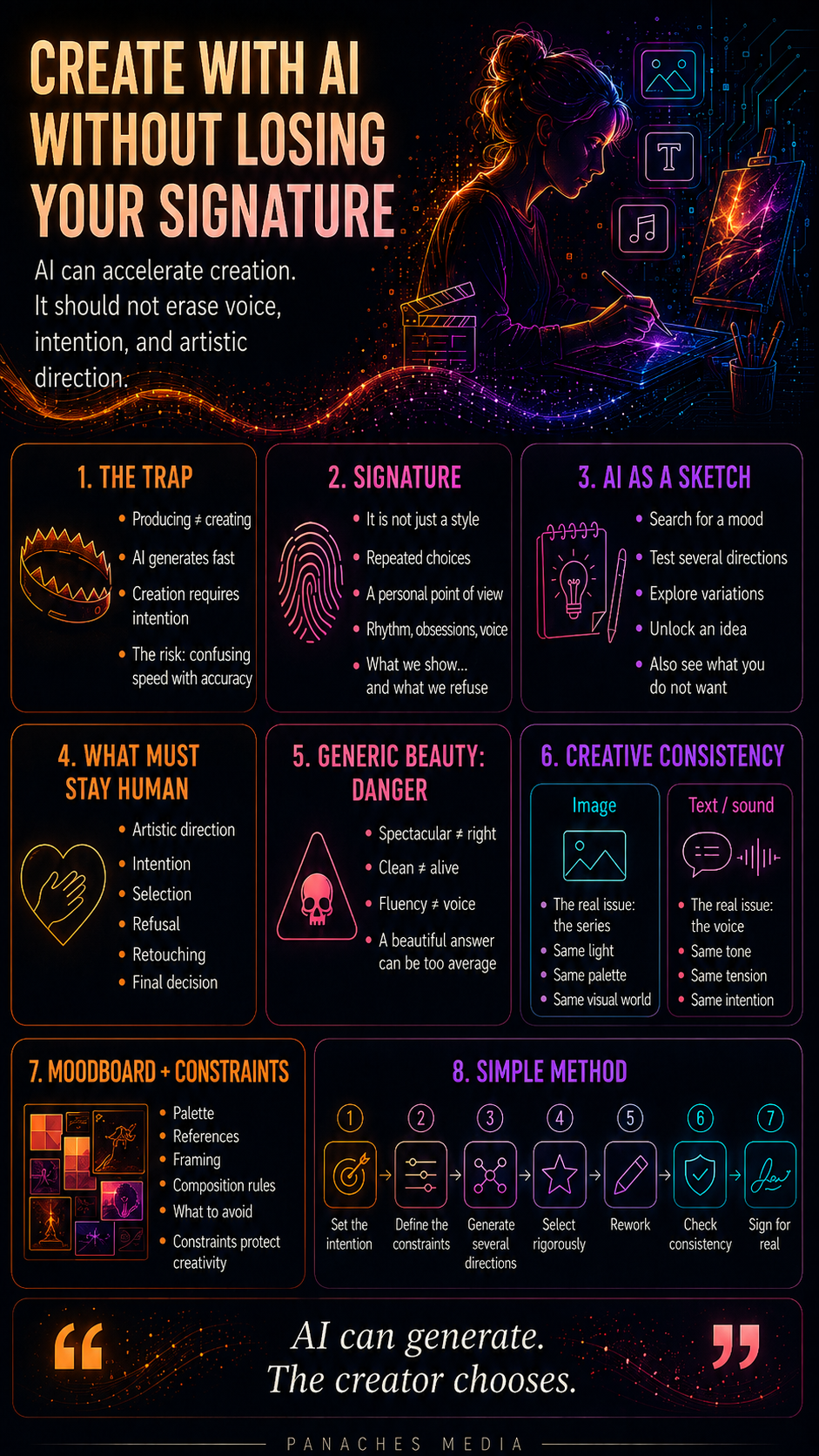
When AI enters the studio
For a long time, creating meant facing a material.
A blank page. A canvas. A guitar. A notebook. An editing software. A camera. A game engine. A text editor. A slightly chaotic moodboard with too many images, three beautiful colors, and an idea still refusing to introduce itself properly.
Then generative AI entered the studio.
It can write. Draw. Compose. Reformulate. Imagine. Summarize. Prototype. Decline. Correct. Suggest.
It turns a sentence into an image, a note into an outline, a style into variations, a vague idea into a first path.
For creators, this is enormous.
But it is also destabilizing.
Because AI does not only touch productivity.
It touches something more intimate: the way an idea becomes a form.
The trap: confusing production with creation
AI produces very well.
It can generate ten images in a few seconds. Suggest twenty titles. Write a scene. Create a musical atmosphere. Imagine a palette. Rewrite a text. Give graphic directions. Decline an idea into several styles.
But producing is not creating.
Producing means making a form appear.
Creating means choosing why that form exists.
The difference may seem subtle.
It is enormous.
AI can fill space.
But it does not naturally know what matters to you.
It does not always know your history, your obsessions, your references, your doubts, your contradictions, your relationship to the world, your way of looking at a light, a sentence, a face, a silence.
It can imitate a style.
But a signature is not just a style.
A signature is an intention that returns.
A way of organizing perception.
A repeated choice.
A sensitivity that crosses forms.
A signature is not a visual effect
We often talk about style as if it were a surface.
Colors. Typography. Linework. Texture. Atmosphere. Framing. A type of sentence.
All of that matters.
But a creator’s signature goes further.
It can be recognized in:
- what they choose to show;
- what they refuse;
- what they repeat;
- what they search for;
- what obsesses them;
- their rhythm;
- their way of connecting things;
- the way they simplify or complexify;
- their relationship to detail;
- their relationship to silence;
- their relationship to the world.
A creator can change tools, media, formats, techniques.
And yet, something remains.
That is the signature.
AI can help explore that signature.
But it can also dilute it if it pushes every idea toward an average aesthetic: shiny, clean, already seen.
The danger is not that AI makes something ugly.
The danger is that it makes something “good” without necessity.
Generic beauty is a real danger
AI knows how to produce seductive things.
A spectacular image. A fluid text. A clean poster. A logo that looks like a logo. A concept that seems interesting. A piece of music that immediately sounds like something.
The problem is that seduction can put judgment to sleep.
We look at an image and think:
It is beautiful.
But the real question should be:
Is it right?
Right for the project. Right for the audience. Right for the message. Right for the direction. Right for the person signing it.
A creation can be less spectacular and much more accurate.
An imperfect sketch can contain more truth than a perfectly polished generated image.
A fragile sentence can have more voice than a flawless paragraph.
A clumsy draft can reveal a direction that an overly clean version would have erased.
With AI, we must learn not to be hypnotized by apparent quality.
Clean is not always alive.
Spectacular is not always necessary.
Beautiful is not always true.
AI as a sketch accelerator
One of the best creative uses of AI is sketching.
Not the final work.
The sketch.
AI can help bring forms out quickly:
- searching for an atmosphere;
- testing several compositions;
- generating variations;
- exploring a palette;
- finding visual references;
- imagining titles;
- unblocking a scene;
- turning an abstract idea into a concrete path;
- suggesting a structure;
- producing first material to criticize.
In this role, it is very useful.
It helps us see.
And sometimes, seeing something helps us understand what we do not want.
This matters.
A failed generation can be useful if it clarifies the intention.
We can look at a proposal and say:
No, not that. Too cold. Too smooth. Too advertising-like. Not human enough. Too futuristic. Too expected. It lacks tension. It lacks silence. It lacks a flaw.
That refusal is creative.
AI proposes.
The creator refines.
Art direction remains human
Creating with AI requires direction.
Without direction, the tool produces random statistics, styles, associations, seductive images, plausible texts.
With direction, it becomes an assistant.
Art direction can include:
- an intention;
- an emotion;
- a palette;
- a rhythm;
- references;
- an audience;
- a constraint;
- a symbolism;
- a composition rule;
- something to avoid;
- a central tension.
For example, asking:
Generate an illustration about AI.
will often give a generic image: glowing brain, blue robot, neural network, cybernetic face staring into eternity in 4K.
Asking:
Create a sober illustration about a person regaining control of their attention in front of several luminous paths generated by AI, editorial atmosphere, human, calm, no humanoid robot, no cyberpunk clichés.
already changes a lot.
AI does not invent the direction by itself.
It follows it more or less well.
And the clearer the direction, the more the creator stays in control.
Constraints protect creativity
We often think creating means having total freedom.
In reality, many strong creations are born from constraints.
A limited palette. A precise format. An imposed length. A given material. An editorial angle. A silence to respect. A constant typography. A composition rule. A real audience.
With AI, constraints become even more important.
Because without constraints, the tool can go everywhere.
And everywhere often means nowhere.
To keep coherence, we can define:
- a color palette;
- a composition style;
- visual density;
- an editorial tone;
- forbidden words;
- clichés to avoid;
- a target length;
- a repeatable structure;
- a type of conclusion;
- a relationship between image and text.
Constraints do not necessarily limit.
They give shape to the playground.
They tell AI:
You can explore, but inside this world.
And for a creative project, it is often this world that matters.
AI can help you find your voice
AI is not only a risk of uniformity.
It can also help you hear your own voice better.
As long as you do not only ask it:
Write instead of me.
But rather:
Help me understand what I am trying to say.
It can help to:
- reformulate a text that is too blurry;
- suggest several tones;
- compare two versions;
- spot strong sentences;
- detect repetitions;
- summarize the intention of a draft;
- identify what sounds generic;
- suggest a more direct version;
- suggest a more sensitive version;
- show what is missing.
There, AI becomes a mirror.
Not a replacement.
It does not create the voice.
Sometimes it helps us hear it by contrast.
We can read a generated version and immediately feel:
This is not me.
And that reaction is precious.
Because it indicates something.
It shows where the real voice resists.
But it can also smooth out what makes the work strong
The opposite danger exists.
By repeatedly asking AI to improve, it can make a text too clean.
It can correct the rough edges. Remove the breaks. Make the tone more consensual. Round off a sentence that was supposed to sting. Clarify an ambiguity that was meant to remain open. Make acceptable something that was supposed to disturb.
But a signature often contains irregularities.
A particular rhythm. A way of cutting. A discreet humor. A tension. An obsession. A recurring word. A strangeness that lets the text breathe.
Not everything should be optimized.
Not everything should be polished.
Not everything should become fluid.
Sometimes, the strength of a creation lies precisely in what catches a little.
AI tends to like smooth surfaces.
The creator must sometimes keep the rough edges.
Creating an image with AI: the real issue is the series
A single AI image can impress.
But for a project, a brand, a media, a narrative, or an art direction, the real issue is often coherence.
A beautiful image is not enough.
You need to be able to produce a family of images that seem to belong to the same world.
Same kind of light. Same density. Same relationship to colors. Same level of detail. Same atmosphere. Same symbolic logic. Same visual breathing.
This is where the creative work truly begins.
Not in the first “wow”.
But in the ability to build continuity.
For that, you need to document:
- prompts that work;
- words to avoid;
- useful framings;
- the palette;
- references;
- frequent mistakes;
- composition rules;
- required formats;
- acceptable variations.
Creating with AI is not only generating.
It is building a grammar.
Creating a text with AI: the real issue is voice
For text, the trap is similar.
AI can write a correct paragraph very quickly.
But a useful text is not only measured by correctness.
It needs a voice.
A tension.
A reason to exist.
It must know where it is going.
It must respect the reader.
It must carry a point of view.
A generated text can be clear and empty.
It can explain without transmitting. Inform without touching. Structure without engaging. Fill without saying.
To avoid that, we need to give AI a more precise mission than “write”.
For example:
- clarify this passage without losing its warmth;
- suggest a more direct version, but keep the human tone;
- identify generic sentences;
- show where the text becomes too academic;
- suggest three more embodied openings;
- keep the strong images, cut the repetitions;
- do not turn the text into corporate communication.
Again, the creator directs.
AI helps work the material.
But the final eye remains human.
Creating music with AI: atmosphere is not enough
Generative music also opens enormous possibilities.
It can produce atmospheres, textures, loops, inspiration tracks, complete pieces.
But once again, producing an atmosphere is not enough.
Music useful to a project must have a function.
It can:
- accompany a video;
- install an atmosphere;
- support a narrative;
- give a sound identity;
- create a work rhythm;
- inspire a scene;
- build a content series.
So the question is not only:
Does the track sound good?
But:
What does it do inside the whole?
A piece can be pleasant but too present.
Beautiful but incoherent.
Effective alone, but bad with the image.
Creating with sound AI therefore requires the same discipline: intention, selection, coherence, real use.
AI can generate sound.
But it does not decide silence.
And sometimes, silence is the best artistic decision.
The moodboard becomes central
The faster tools generate, the more important it becomes to know how to look.
The moodboard becomes essential again.
A moodboard is not only a collection of pretty images.
It builds a sensitive direction.
It allows us to say:
- this is the light;
- this is the tension;
- these are the materials;
- these are the colors;
- these are the references;
- this is what I want to avoid;
- this is the world the project must live in.
With AI, the moodboard almost becomes a safeguard.
It prevents the tool from going in every direction.
It reminds us of coherence.
It makes intention visible.
It allows us to compare a generation with an already established direction.
The question becomes:
Does this proposal belong to the world of the project?
If not, it may be beautiful.
But it is not right.
Do not confuse inspiration with substitution
Using AI for inspiration can be very useful.
But we must be careful not to replace research too quickly.
Looking at works. Reading. Listening. Observing. Drawing. Walking. Photographing. Taking notes. Making mistakes. Accumulating references. Letting an idea rest.
All of this feeds creation.
If AI becomes the only source of images, sentences, music, or references, the creative world can shrink.
We end up looking at summaries of summaries.
Digested styles.
Average forms.
Recycled imaginations.
AI can enrich research.
It should not replace contact with works, places, materials, people, books, sounds, accidents.
Creation needs the world.
Not only models.
The prompt is not the creation
The prompt matters.
But we should not give it a mystical role.
A prompt is not a work.
It is a command, a direction, a working hypothesis.
It can be precise, poetic, technical, long, short, structured.
But creation is not limited to the prompt.
It includes:
- intention;
- selection;
- refusal;
- iteration;
- editing;
- montage;
- composition;
- context;
- use;
- coherence;
- signature.
The real work often begins after generation.
When we must choose.
Correct.
Combine.
Discard.
Return to meaning.
A good prompt can open a door.
But the creator decides whether to enter.
Or burn the door.
Depending on mood and deadline.
A simple method for creating with AI
To stay in control, we can follow a simple method.
Set the intention
Before generating, write what you are looking for.
Not only the format.
The emotion. The message. The function. The audience. The context. The direction.
Define the constraints
Palette, tone, style, length, level of detail, references, forbidden elements, final format.
Constraints prevent dispersion.
Generate several paths
Do not stop at the first proposal.
Ask for variations.
Compare.
Notice what returns.
Select harshly
Keep little.
Reject a lot.
Do not confuse quantity with quality.
Rework
Modify, cut, recombine, retouch, rewrite, mix with manual work.
Generation is a step.
Not necessarily the end.
Check coherence
Compare with the initial direction.
Does it serve the project?
Does it respect the signature?
Does it bring something?
Truly sign
Publish only what you can stand behind.
Not because AI produced it.
Because you chose it.
What AI reveals about the creator
AI does not only replace gestures.
It also reveals our relationship to creation.
If we do not know what we want, it fills the void.
If we have no criteria, it proposes its own.
If we only search for spectacle, it will give spectacle.
If we want to go too fast, it may help us produce something hollow faster.
But the opposite is also true.
If we arrive with a strong intention, it becomes interesting.
It allows us to test. Expand. Compare. See differently. Bring an idea out of the fog. Turn an intuition into material.
AI does not remove the need for a point of view.
It makes it more visible.
Facing a machine that can produce almost anything, the real question becomes:
What deserves to be kept?
And that question is deeply creative.
Keeping your signature in a generative world
We are entering a time where producing forms becomes easier.
Texts. Images. Sounds. Videos. Interfaces. Ideas. Infinite variations.
This can open magnificent possibilities.
But it can also create an ocean of correct, fast, interchangeable content.
In that ocean, signature becomes even more important.
Not as an ego mark.
As a compass.
It says:
This is what I am searching for. This is what I refuse. This is how I look. This is what I want to transmit.
Creating with AI should not mean disappearing behind the tool.
It should mean using the tool to better reveal what truly belongs to us.
The machine can generate.
But the creator chooses.
The machine can suggest.
But the creator connects.
The machine can produce forms.
But the creator gives necessity.
And perhaps this is the real challenge:
not creating less humanly because machines create faster,
but creating with more consciousness,
more direction,
more perception,
more signature.