Behind every French manga edition lies a publisher’s decision
When a French reader opens One Piece, Naruto, Fullmetal Alchemist, My Hero Academia or Chainsaw Man, they usually think first of the mangaka and the Japanese publisher that originally produced the series. Yet between the work’s first publication in Japan and the volume available in a French bookstore, another actor plays an essential role: the French-language publisher.
It is the publisher who selects the works it wants to release, negotiates the rights, organizes translation, adapts graphic elements, prepares the volumes, defines the commercial positioning and sometimes supports a series for several decades.
French publishers are therefore not simply distributors of already completed Japanese manga. They directly influence how these works are discovered, understood and preserved in France.
This story truly begins in the early 1990s. At the time, nothing guaranteed that manga could become a major part of French publishing. Yet a handful of companies took the risk of importing works whose format, rhythm and visual codes were still largely unfamiliar to the general public.
Three decades later, the landscape has changed considerably. Some pioneering brands still exist, others have merged or changed ownership, and new publishers have built identities of their own.
Publishing manga is not simply a matter of buying a Japanese license. Every publisher builds a catalogue, an audience and a particular way of presenting manga in France.
Understanding these companies therefore changes the way we look at bookstore shelves.
Glénat: opening the door to mass-market manga
In the history of manga in France, Glénat occupies a particular place.
The company, founded in 1969 by Jacques Glénat around comics publishing, dates its major Japanese turning point to 1989, when its founder returned from a trip to Tokyo carrying manga. From 1991 onward, the publisher began releasing manga in France, first through newsstands and then through bookstores.
Akira played a pioneering role in this history. Katsuhiro Otomo’s work demonstrated that manga could deliver ambitious, spectacular science fiction aimed at a much broader audience than the children’s entertainment often associated with Japanese animation at the time.
But Dragon Ball truly changed the scale.
The success of Akira Toriyama’s series helped transform an editorial curiosity into a genuine bookstore phenomenon. Readers who already knew Son Goku from television could now follow his story in collected volumes, keep them and gradually discover how printed manga worked.
Glénat later continued this strategy with titles capable of spanning generations. One Piece and Bleach in turn became pillars of its French catalogue, alongside many other shōnen, seinen and heritage titles.
Glénat’s historical role therefore goes beyond simply being one of the oldest players.
The company helped demonstrate that France could support a lasting mass market for manga, rather than just a temporary trend.
Tonkam and Kana: building a genuine manga culture
Glénat was not alone in breaking new ground.
In the early 1990s, Tonkam emerged from one of France’s first specialist stores devoted to manga and Japanese imports. The publishing house was created during the first half of the decade and began releasing works such as Video Girl Ai from 1994 onward.
Tonkam quickly developed an identity different from the major television-driven successes. The publisher introduced French readers to works by CLAMP, supported JoJo’s Bizarre Adventure, published Vagabond and explored genres that were still barely represented in France. In doing so, it helped broaden the very idea of what manga could be for French readers.
Tonkam also helped bring dedicated readers closer to Japanese publishing culture: lesser-known creators, works aimed at specific audiences, new genres and a stronger emphasis on the original cultural context.
A few years later, Kana, founded in 1996 by Yves Schlirf within Dargaud-Lombard, became another major force in the market.
Its catalogue accompanied a new stage in manga’s mainstream expansion through series such as Naruto, Death Note, Hunter × Hunter, Yu-Gi-Oh! and Detective Conan. Kana also developed collections that helped distinguish between different audiences and editorial approaches.
The publisher places particular importance on preserving original works: reading direction, format, pagination and the treatment of sound effects are among the elements it considers essential to transmitting an author’s work faithfully.
This marked an important shift.
In the earliest years, manga sometimes had to be adapted to French habits. By the late 1990s and early 2000s, publishers could instead make respect for the Japanese format an editorial selling point.
The 2000s: new publishers change the balance
The French manga market truly expanded when new companies began building catalogues strong enough to compete with the pioneers.
Pika Édition, founded in 2000, quickly became one of these major players.
Its catalogue brought together highly varied series: GTO, Cardcaptor Sakura, Fairy Tail, Attack on Titan, Witch Hat Atelier and Blue Lock, among many others. This diversity reflected the market’s evolution: publishers no longer had to rely on a single major phenomenon in order to attract readers.
Pika also gradually developed activities beyond simply acquiring Japanese licenses. Since 2006, the company has published Dreamland by Reno Lemaire, a French series strongly influenced by manga. It later acquired nobi nobi! in 2016 to strengthen its children’s publishing, then launched Pika Wavetoon in 2024, devoted to print editions of Korean webtoons.
The catalogue therefore reflects a much broader Asian and graphic publishing landscape.
Ki-oon: building an identity rather than an enormous catalogue
Founded in 2003, Ki-oon chose a different path.
The company initially developed around a carefully selected range of Japanese licenses, with a strong presence of fantasy, thrillers and supernatural works. Series such as My Hero Academia, Jujutsu Kaisen and The Apothecary Diaries later gave the publisher major visibility.
But Ki-oon no longer limits itself to purchasing rights. Since the 2010s, it has also developed original creation, including projects involving French and Japanese creators working directly with the publisher.
This strategy illustrates a new level of maturity in the French market: a manga publisher is no longer necessarily limited to waiting for a work to already exist in Japan.
It can also become a producer of new works.
Kurokawa: entering the market with powerful licenses
When Editis launched Kurokawa in 2005, the French market was already far more competitive than it had been a decade earlier.
The publisher nevertheless found its place quickly.
Its first major phenomenon was Fullmetal Alchemist, which played an important role in establishing the label. The catalogue later welcomed series capable of reaching very different audiences: Ippo, Pokémon Adventures, Vinland Saga, One-Punch Man, Spy × Family and Oshi no Ko.
This diversity reflects a fundamental change in the profession.
In the early 1990s, publishing manga still largely meant introducing manga itself to French readers.
By the 2000s, that stage had been completed. Publishers now had to convince readers to choose their series from an increasingly crowded market.
The competition was no longer simply about cultural acceptance.
It was about licenses.
Kazé: when manga and animation begin to converge
Kazé occupied a particular position because its history began with Japanese animation.
Founded in 1994, the brand helped develop the French anime home-video market before gradually expanding into manga publishing. This close relationship between print and animation became increasingly significant as the two markets moved closer together.
Its manga catalogue included titles such as Black Clover, The Promised Neverland, Mashle and Chainsaw Man.
By the 2010s, the ability to connect manga, anime and Japanese pop culture had become increasingly strategic. A series could be discovered through streaming, then purchased in bookstores and later extended through films, physical media or merchandise.
Kazé itself eventually became an example of consolidation within the industry. After several changes in ownership, the brand was integrated into the Crunchyroll ecosystem and moved under that name in 2022.
The rebranding did not mean that Kazé’s historical catalogue simply disappeared. Manga previously associated with the Kazé name continued to be published within the Crunchyroll ecosystem.
What it did show, however, was how much the industry had changed: a French brand historically connected to anime and manga had become part of a global company devoted to anime distribution and Japanese pop culture.
Delcourt, Tonkam and Akata: a history of crossings and restructurings
The story of Delcourt / Tonkam / Akata almost summarizes the transformation of French manga publishing by itself.
In 2001, Akata, created notably around Dominique Véret, took charge of the editorial direction of Delcourt’s manga collection. This collaboration led to the publication of series such as Nana, Fruits Basket, Switch Girl!! and Shamo.
Akata brought a particularly recognizable editorial approach, with strong attention to manga aimed at female readers, unusual works and social themes.
At the same time, Delcourt acquired Tonkam in 2005. The group’s manga activities continued for a period under several different identities before being brought together: in 2016, Delcourt Mangas and Tonkam merged to become Delcourt/Tonkam.
Akata followed another path.
The company became independent in 2013 and developed its own catalogue, often selecting works for their social dimension, female characters or ability to explore subjects less commonly represented. In 2022, Akata joined the Albin Michel group while retaining its editorial identity.
Meanwhile, Groupe Delcourt continued to evolve. After Tonkam and Soleil, it developed several brands and eventually joined Editis in January 2025.
These trajectories show why speaking simply about “manga publishers” can be misleading.
Behind the logos printed on covers are publishing houses, collections, imprints and corporate groups whose boundaries continuously evolve.
2014: a particularly revealing snapshot of the market
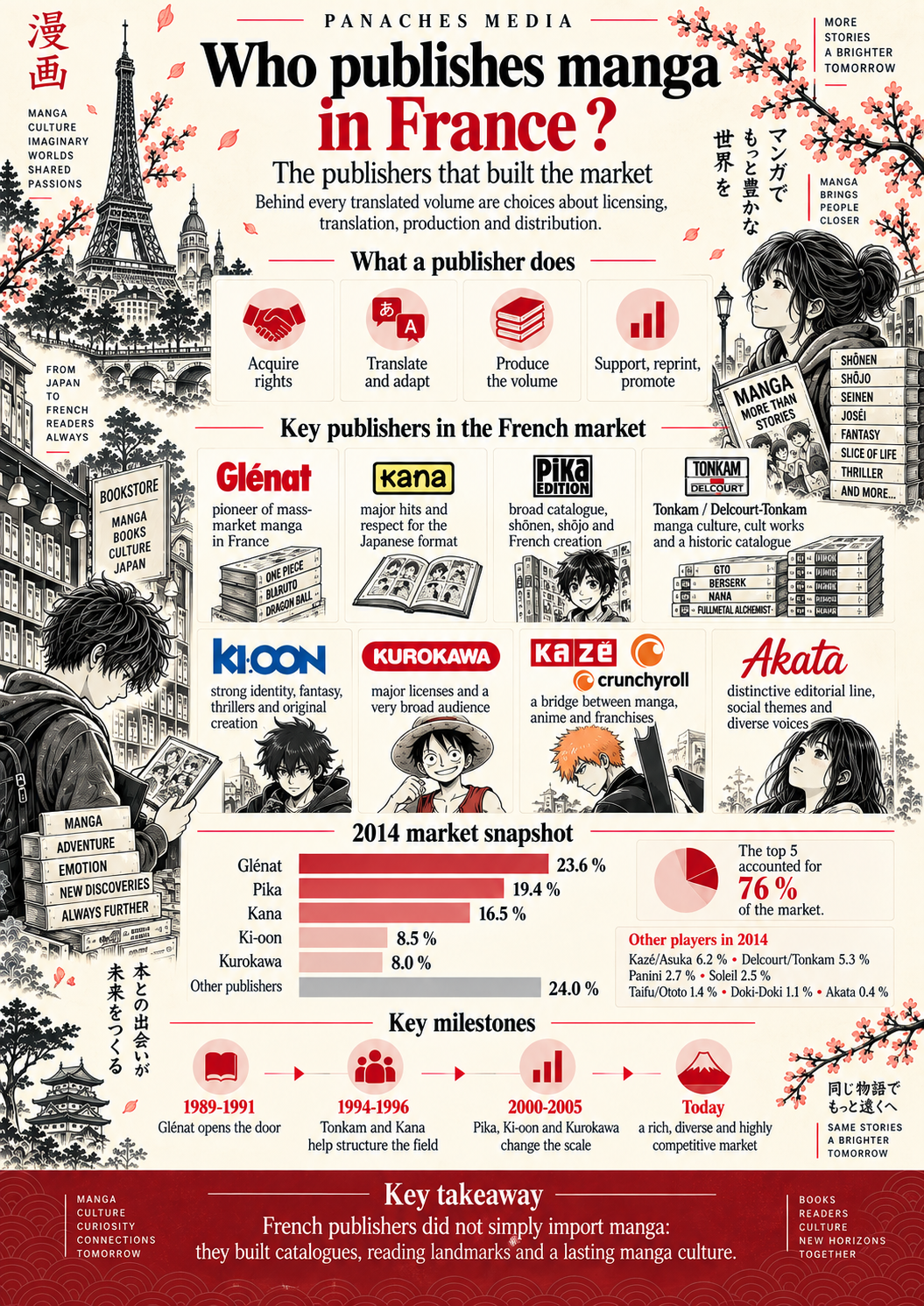
The French landscape can be observed through an interesting historical snapshot: the market shares attributed to the leading publishers in 2014.
These figures obviously do not represent the market today. Some brands have merged, changed groups or disappeared under their former names. But they show how strongly the sector was already structured around a handful of major players.
| Publisher in 2014 | Market share |
|---|---|
| Glénat | 23.6% |
| Pika | 19.4% |
| Kana | 16.5% |
| Ki-oon | 8.5% |
| Kurokawa | 8% |
| Kazé Manga / Asuka | 6.2% |
| Delcourt / Tonkam | 5.3% |
| Panini | 2.7% |
| Soleil Manga | 2.5% |
| Taifu Comics / Ototo | 1.4% |
| Doki-Doki | 1.1% |
| Casterman / Sakka | 0.9% |
| Komikku | 0.5% |
| Akata | 0.4% |
One figure stands out immediately: Glénat, Pika and Kana alone accounted for 59.5% of the market.
Adding Ki-oon and Kurokawa brings the five leading publishers to exactly 76%.
The French manga market was therefore already highly concentrated at the time, but it was not closed. Several smaller publishers used precisely their size to offer different catalogues, explore niches or take risks that larger companies might not necessarily find worthwhile.
This coexistence between major players and specialist publishers remains one of the important characteristics of the sector.
Not every publisher is looking for the same manga
Looking only at market share could create the impression that publishers differ mainly in size.
Their true distinction lies in their catalogues.
A publisher selects works according to its history, its audience, its relationships with Japanese companies and the personality of its editorial team. Some focus heavily on major shōnen titles capable of selling millions of copies. Others emphasize heritage, auteur works, shōjo, socially engaged manga or original creation.
A few broad tendencies help illustrate these identities:
| Publisher | Some catalogue markers |
|---|---|
| Glénat | Major historical series, major shōnen titles, heritage editions |
| Kana | Very broad catalogue, major mainstream successes, diverse audiences |
| Pika | Blockbusters, shōjo, French creation, children’s books and now webtoons |
| Ki-oon | Strong selection, fantasy, thrillers, major recent phenomena, original creation |
| Kurokawa | Major mainstream licenses, accessible shōnen and seinen |
| Crunchyroll / former Kazé | Strong connection between manga, anime and Japanese franchises |
| Delcourt/Tonkam | Large historical catalogue, cult works and varied genres |
| Akata | Manga aimed at female readers, social themes, Asian heritage and distinctive editorial choices |
These categories are obviously not absolute rules. Catalogues constantly evolve and every publisher releases works that fall outside these general tendencies.
But they explain why the publisher’s name can become a genuine reference point for readers.
Some readers do not only follow creators.
They also learn to trust an editorial line.
Acquiring a license: competition the reader rarely sees
Behind every announcement of a new series lies work that readers rarely witness.
A French publisher must first convince the Japanese rights holder to entrust it with the work.
Negotiations can concern the price of the license, the territories involved, the length of the agreement, publication conditions, print runs, digital editions or possible special editions.
For an unknown series, the gamble can be significant: nobody truly knows whether French readers will respond.
Conversely, when a manga is already a major success in Japan or benefits from a highly anticipated anime adaptation, several companies may wish to acquire the same license. Market knowledge, relationships built with Japanese publishers and the ability to present a convincing publishing project then become essential.
The best catalogue is therefore not necessarily the one with the greatest number of licenses.
It also depends on the ability to identify the right work at the right moment for the right audience.
Translating manga already means editing it
Once the rights have been secured, another form of work begins.
Dialogue must be translated, wordplay adapted, cultural references managed, decisions made about Japanese honorifics, text fitted back into speech bubbles and sound effects handled in a coherent way.
The French cover must also be prepared, the book manufactured, its price set and distribution organized for bookstores.
Two publishers could theoretically release the same work and produce two different reading experiences depending on their translation and production decisions.
That is why the history of French manga publishers cannot be reduced to a list of famous licenses.
Their work directly influences the way readers encounter the original work.
The now almost universal preservation of right-to-left reading in France, for example, is the result of several decades of shared learning between publishers and readers.
Reprinting, reissuing and preserving manga
A publisher’s work does not end with the release of volume one.
A series then has to remain available.
When sales are strong enough, volumes are reprinted. When an older title attracts renewed interest, a publisher may offer a new edition: larger format, revised translation, restored colour pages, double volumes or box sets.
These reissues have become particularly visible as the French market has matured.
Readers who discovered a manga twenty years ago may want to experience it again in an edition closer to the original. A new generation may also encounter a work whose first French edition has become difficult to find.
The publisher then becomes a guardian of manga heritage as well.
Conversely, a license can expire and certain volumes may go out of print. Kana, for example, explains that despite its desire to keep works available as long as possible, some series can no longer be reprinted when editorial conditions no longer allow it.
The manga shelf is therefore never completely fixed.
Some series arrive.
Others disappear.
Some return twenty years later in a new form.
A market that has become much larger — and much more complex
In the early 1990s, a few publishers still had to convince French readers that manga deserved a place in bookstores.
Today, the problem is almost the opposite.
The amount of available material is enormous.
Historical publishers compete alongside newer houses, major groups operate several imprints, webtoons are gradually entering manga sections, French creation is developing and heritage editions are becoming increasingly prominent.
In this environment, the real strength of the French market lies less in the sheer number of manga available than in the diversity of editorial strategies.
Glénat helped open the market.
Tonkam helped build a culture of dedicated enthusiasts.
Kana accompanied manga’s mass democratization.
Pika developed a broad catalogue while also investing in French creation.
Ki-oon showed that a newer publisher could become a major player through a strong identity.
Kurokawa built its catalogue around licenses capable of reaching very broad audiences.
Kazé and later Crunchyroll brought manga and animation increasingly close together.
Delcourt/Tonkam carries several decades of publishing history, while Akata demonstrates that a publisher can also exist through highly focused choices and a genuine cultural vision.
None of these strategies alone defines French manga publishing.
Together, they explain how France moved from a handful of experiments in the early 1990s to one of the most developed manga markets in the world.
French publishers did not merely import manga. By selecting, translating, adapting, reissuing and defending particular works, they shaped the way several generations of French readers discovered manga.
And this history leads naturally to another question: among the thousands of series published over the decades, which ones have achieved truly exceptional circulation figures?
After looking at the companies that built the market, the next step is therefore to examine the best-selling manga of all time — and, more importantly, what those numbers really mean.
Main sources
To explore this history further: Glénat for the arrival of its first manga in France; Kana, Pika Édition, Ki-oon, Kurokawa, Akata and Groupe Delcourt for their histories and editorial positioning; Crunchyroll for the integration of Kazé under its brand; and historical French market data showing the distribution of market share among leading manga publishers in the mid-2010s.