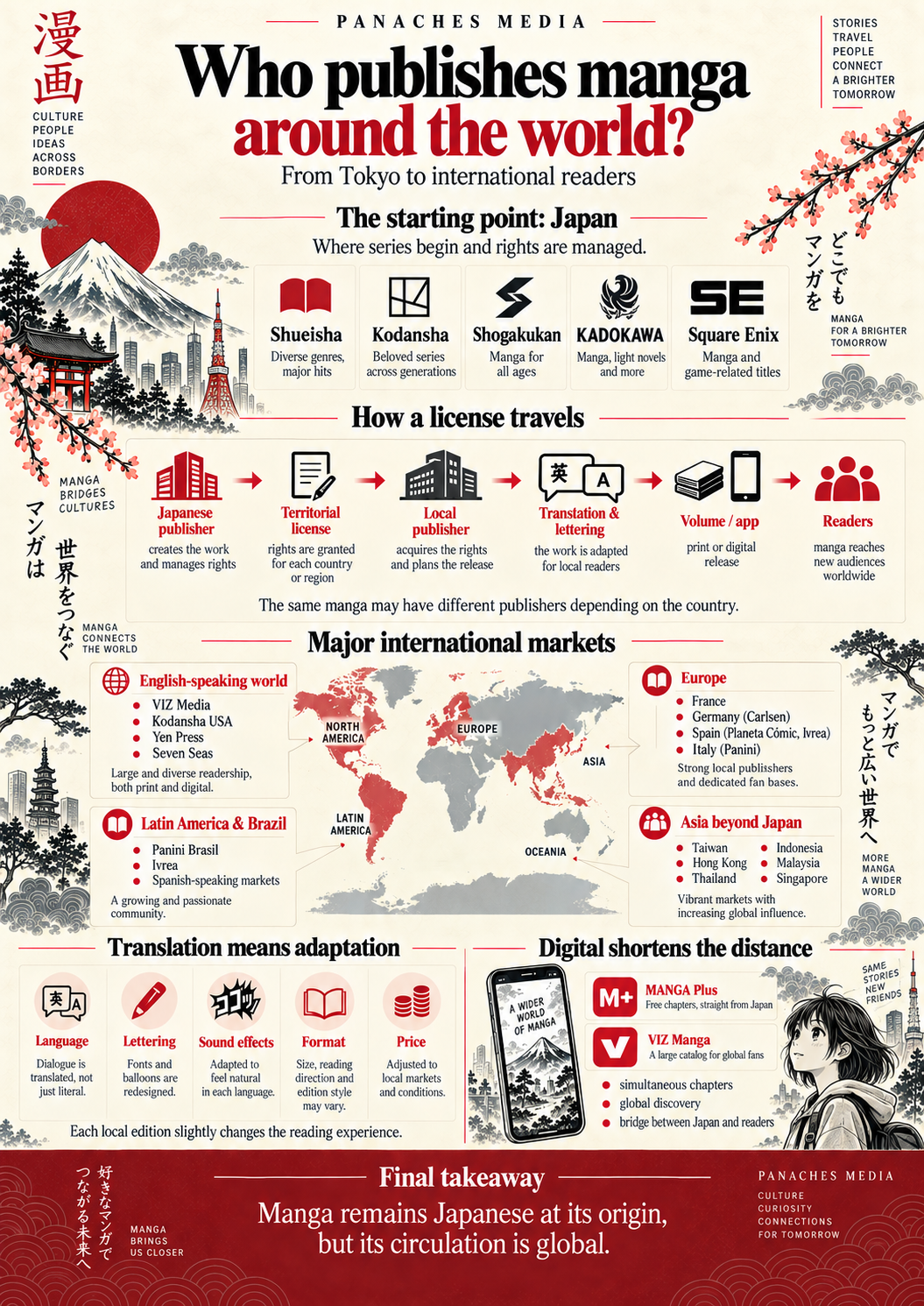
A Japanese manga can have several editorial lives
A manga generally begins its journey in Japan, but its publishing life has long since stopped at the borders of the archipelago.
A series can be developed with an editorial team in Tokyo, serialized in a Japanese magazine or app, published in collected volumes, and then entrusted to different partners depending on the language and territory. The same title may then be translated into English, French, German, Spanish, Portuguese, Italian, Thai or Indonesian, with schedules and editions that do not always look alike.
Behind a global success therefore lies an entire network.
The mangaka and the Japanese publisher form the starting point, but international rights managers, foreign publishing houses, translators, letterers, printers, distributors, booksellers and now digital platforms capable of reaching several countries directly all become involved.
Manga was born in Japan, but its publishing ecosystem has become global. The same work can now follow several parallel paths depending on territory, language and medium.
Understanding this circulation also helps move beyond a misleading idea: there is no single “international manga market”.
There are many interconnected markets.
It still largely begins in Japan
Even when a manga becomes a global phenomenon, its original editorial centre generally remains Japanese.
Groups such as Shueisha, Kodansha, Shogakukan, KADOKAWA, Square Enix, Hakusensha and Akita Shoten support creators, organize serialization and manage the rights to works published in their catalogues.
Their role is no longer limited to selling books in Japan.
They also have to organize the international circulation of their intellectual properties.
Shueisha, for example, states that its manga are translated and published in more than 80 countries and regions. The company relies on foreign partners, on VIZ Media for part of the English-language market and on its own digital service, MANGA Plus.
KADOKAWA follows a comparable strategy on an even broader scale: the group develops translations, local editions, e-books, animation, games and works produced abroad through companies established in North America, Taiwan, Hong Kong, China, Thailand and Malaysia, among other territories.
Manga has therefore become part of a much wider international strategy.
A series is no longer viewed only as a succession of volumes.
It can become a global intellectual property, capable of moving between books, digital platforms, animation, video games and merchandise.
A license does not automatically grant access to the whole world
When a foreign publisher wants to release a Japanese series, it generally does not become the owner of the work.
It acquires publication rights defined by contract.
That contract may specify a language, a territory, a duration, particular formats and various commercial conditions. Print and digital rights may be handled together or separately, and arrangements vary according to the work and the partners involved.
This explains why the same manga can belong to completely different publishers from one country to another.
The French publisher of a series is not necessarily its German publisher.
The Spanish publisher may differ from the one distributing the work in Latin America.
The English edition itself may be sold across several territories under the same agreement.
The path therefore looks less like one huge global chain and more like a set of branches starting from the same Japanese rights holder.
Japanese publisher → territorial license → local publisher → translation → production → distribution → readers
This structure makes it possible to adapt a work to the realities of each market.
But it can also create major differences in release dates, formats, prices and availability.
The English-language world: a market capable of spanning several continents
English occupies a particular position.
A single edition can potentially reach the United States, Canada, the United Kingdom, Ireland, Australia or New Zealand, even though actual rights and availability still depend on the relevant contracts.
VIZ Media is one of the most important players in this space.
Active in manga for several decades, the company has direct ties with Shueisha and Shogakukan and publishes many major Japanese series for English-language readers. It is also developing VIZ Manga and VIZ Originals, showing that its activity is no longer limited to localizing Japanese works.
Other companies occupy complementary positions.
Kodansha directly publishes a significant part of its catalogue in English. Yen Press, which became a joint venture between KADOKAWA and Hachette Book Group in 2016, publishes manga, light novels, original works and Korean titles. Seven Seas has also established itself with a catalogue combining manga, light novels, danmei, manhwa and webtoons.
This diversity reflects a fundamental shift.
The English-language market is no longer simply a place where Japan’s biggest hits are translated.
It is itself becoming a space for production, experimentation and international circulation of comics influenced by manga.
Europe is not a single market
From Japan, Europe can appear to form one large neighbouring territory.
For a publisher, the reality is far more fragmented.
Each language has its own history, bookstore networks, reading habits, pricing structures and publishing houses.
France developed its ecosystem around Glénat, Kana, Pika, Ki-oon, Kurokawa, Delcourt/Tonkam and several other companies.
But only a few hundred kilometres away, the landscape changes completely.
Germany: another history of European manga
In Germany, Carlsen plays an important historical role.
The publisher released Akira as early as 1991, then reached a decisive milestone in 1997 with Dragon Ball, published in the Japanese reading direction. Its success helped establish manga permanently in the country.
The German market then developed its own collections, magazines, local creators and specialist imprints.
Carlsen today publishes Japanese manga, webtoons and works by German mangaka.
What may resemble the French history of manga is therefore only one variation.
Each European country has built its own chronology of adoption.
Spain, Italy and Southern Europe: the same manga, different ecosystems
Spain also has a long comics tradition and a particularly developed manga market.
Publishers such as Planeta Cómic, Ivrea and Panini now operate major catalogues there.
Planeta notes that its comics activity dates back to the 1980s and that the Spanish manga boom developed particularly strongly during the 1990s, alongside the massive arrival of Japanese animation.
The publisher no longer simply imports works. With Planeta Manga, it also develops works by local creators, some of which are later exported to other territories.
Here again, we see an evolution that has appeared elsewhere:
the flow no longer moves only from Japan to the rest of the world.
A European publisher can now release a manga-influenced local work and then sell its rights abroad.
Italy also has a long-established market in which Panini and other publishers have built substantial Japanese catalogues.
European readers may therefore read the same major series through completely different publishing ecosystems.
The same language does not mean the same market
Spanish illustrates this reality particularly well.
Publishing a work in Spain does not automatically mean publishing it in the same way in Mexico, Argentina, Chile or the rest of Latin America.
Language variation is only part of the issue.
Prices, currencies, distribution networks, bookstore formats and territorial agreements may also differ.
That is why some publishers develop editions adapted for several regions while others work at the scale of a single country or a defined group of territories.
Ivrea, for example, has a long presence in Spanish-language manga publishing and develops catalogues combining shōnen, seinen, shōjo, BL, yuri, manhwa and webtoons.
Manga therefore circulates through a shared language, but it continues to encounter different local publishing cultures.
Brazil: translating manga into Portuguese and building its own market
Brazil provides another essential example for understanding the globalization of manga.
Portuguese creates a publishing space distinct from Spanish-speaking Latin America.
Panini Brasil, notably through Planet Mangá, now operates a broad catalogue ranging from classics such as Dragon Ball and Naruto to contemporary series such as One Piece, Demon Slayer, Jujutsu Kaisen and Chainsaw Man.
But again, the job is not simply to replace Japanese with Portuguese.
Publishers must take into account book prices, purchasing power, preferred formats, publication frequency, distribution across a vast territory and Brazilian reading habits.
A global license therefore becomes a local publishing product.
Asia beyond Japan: a major region often overlooked in the West
Discussing the internationalization of manga only through Europe and the Americas would give a very incomplete picture.
Manga has circulated across Asia for a long time.
Taiwan, Hong Kong, Thailand, Indonesia, Malaysia, Singapore and many other territories have their own publishers, translations and reader communities.
Geographical proximity does not mean the process is automatic.
Each market has its own regulations, languages, platforms and comics traditions.
Major Japanese groups understand this perfectly.
KADOKAWA, for example, operates companies and partnerships in several Asian territories and explains that it adapts its platforms and activities to the characteristics of each country.
The international model is therefore not simply:
Japan → the West
It increasingly resembles:
Japan ↔ Asia ↔ Europe ↔ the Americas ↔ global platforms
with more and more circulation between these spaces.
Translation never means simply replacing words
When a license crosses a border, another transformation begins.
The translator must reproduce dialogue, humour and levels of speech. The editorial team must decide how to handle honorifics, cultural references, wordplay and sound effects.
Lettering has to fit the speech bubbles and artwork.
The cover may remain almost identical to the Japanese design or be slightly adapted for the local market.
The book format may change.
Paper quality may vary.
So may the price.
Even two editions of a manga published in the same language can therefore differ.
This localization does not necessarily mean betraying the work.
The challenge is rather to find the balance between fidelity to the original manga and accessibility for the local reader.
That is precisely why the foreign publisher continues to play a genuine cultural role.
Major international publishers no longer only translate
For a long time, the logic seemed simple: Japan created manga and foreign publishers translated them.
That boundary is becoming less clear.
VIZ now develops VIZ Originals, featuring works created by authors outside Japan. Yen Press also publishes original creations and created Ize Press for Korean content.
Carlsen supports German mangaka.
Planeta develops works by Spanish creators influenced by manga.
Publishers in other regions are following similar strategies.
The international catalogue is therefore increasingly made up of three broad families that are beginning to overlap:
| Origin | Circulation |
|---|---|
| Licensed Japanese manga | Translated and published locally |
| Local manga-influenced creation | Published directly in its home market |
| International creation exported abroad | Licensed to other territories |
Manga remains a cultural product deeply rooted in Japan.
But the ecosystem built around it is no longer exclusively Japanese.
Digital platforms are beginning to bypass some borders
A new actor has now joined this network of local publishers: the direct international platform.
MANGA Plus is the clearest example.
Shueisha can now make selected chapters available to international readers at the same time as their Japanese release, without necessarily waiting for a physical edition from every local partner.
VIZ also offers simultaneous digital chapter publication with Japan in certain English-language markets.
This does not eliminate local publishers.
A reader can discover a series digitally and later buy the physical edition from the publisher in their own country.
The two circuits can work together:
Japanese publication → global platform → discovery
then
local license → translation → volume → bookstore → collection
Digital distribution therefore shortens the distance between Tokyo and the reader.
But physical books still often pass through a genuine territorial ecosystem.
A world of rights, languages and release schedules
This structure also explains a frustration familiar to many readers.
Why is a series available in one country but not the next?
Why does an English translation already have fifteen volumes when another language has only eight?
Why is a manga available digitally but not yet in bookstores?
Because markets do not move at the same pace.
Each license has its own schedule.
Each publisher must translate, produce and finance its releases.
A series that performs very well in one country may appear too risky in another.
Some works are strong enough to be licensed almost everywhere.
Others reach only a handful of territories.
The globalization of manga therefore does not mean that all readers around the world have access to the same catalogue.
It means that more works can circulate through more routes.
From local publishers to global networks
In just a few decades, manga has moved from a cultural product aimed primarily at the Japanese market to one of the most international forms of comics.
This transformation depends on an unusual combination.
Major Japanese publishers remain essential.
Local publishers continue to translate, produce and promote works.
International groups connect several territories.
Digital platforms can sometimes enable near-simultaneous release.
And creators themselves can now come from countries that historically had no direct connection to the Japanese industry.
The path of a contemporary manga can therefore look like this:
mangaka → Japanese publisher → international rights management → publishers and platforms → translators → bookstores and apps → readers around the world
But it can also be much shorter.
mangaka → Japanese platform → international reader
Or even begin elsewhere:
European, American or Asian creator → local publisher → success → international licenses
The model is becoming less linear.
And that is precisely what makes it global.
Manga remains Japanese through its history and the heart of its industry, but its circulation now belongs to an international network of languages, publishers, platforms and readers.
After looking at how these works travel around the world, another question becomes unavoidable: which ones have travelled the furthest?
The next chapter will therefore take us toward the best-selling manga of all time — and, above all, what their hundreds of millions of copies really tell us about success.
Main sources
To explore this international circulation further: Shueisha for the global exploitation of its manga and its international partnerships; KADOKAWA for its worldwide network and media-mix strategy; VIZ Media for English-language publishing and original creations; Yen Press for its international activity and ties to KADOKAWA and Hachette; Carlsen for the historical development of manga in Germany; Planeta Cómic and Ivrea for the Spanish-speaking world; Panini Brasil for the Brazilian market; and MANGA Plus by SHUEISHA for simultaneous international digital publication.