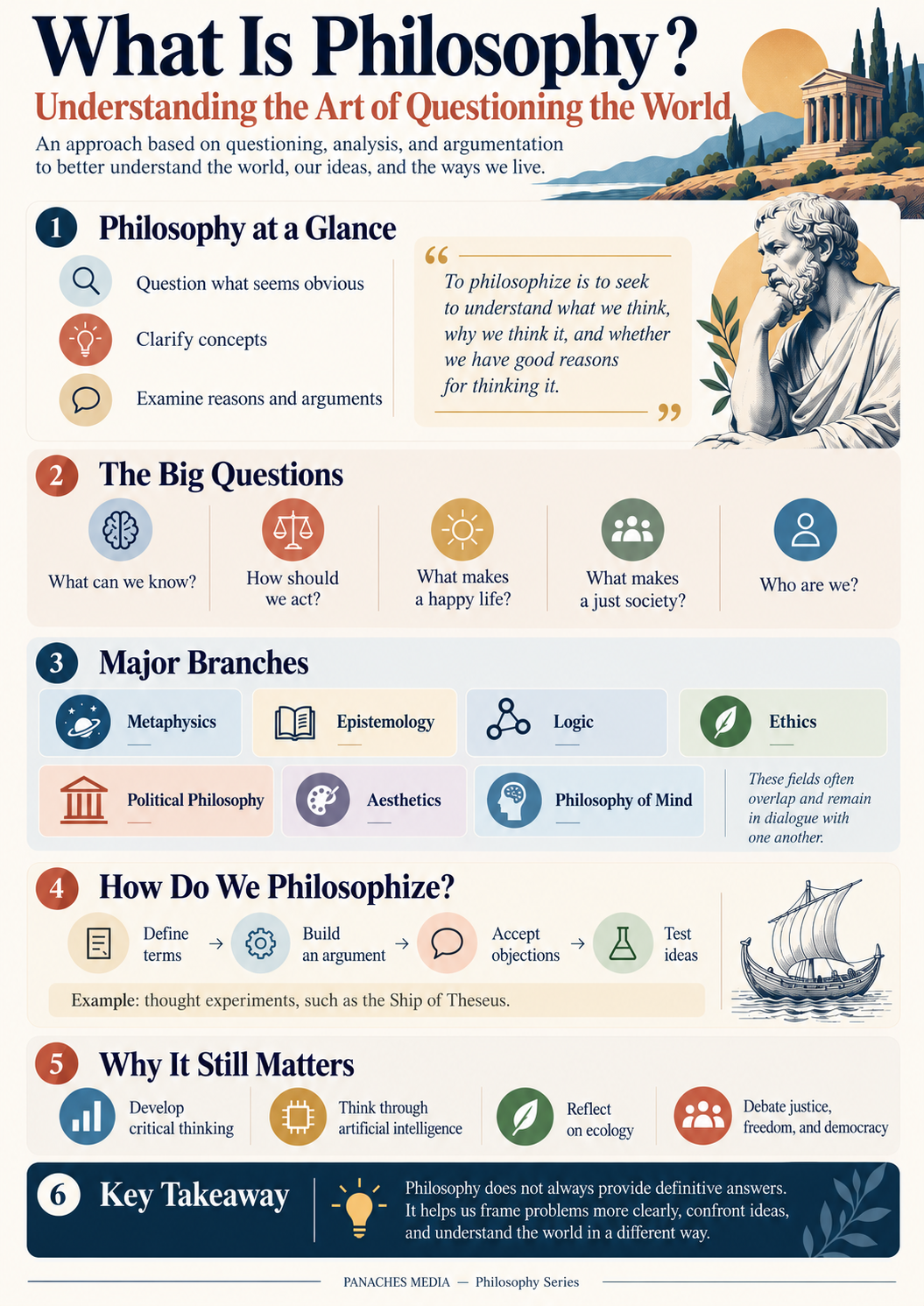
Why do we exist? What makes a happy life? Are we truly free to make our own choices? Some questions seem to have accompanied humanity since the beginning of recorded history. They cross centuries, cultures, and civilizations without ever receiving a universally accepted answer. Philosophy finds its place precisely within this search, somewhere between curiosity, doubt, and the desire to understand.
Philosophy Begins When Certainties Become Questions
We sometimes engage in philosophy without even realizing it.
A conversation with friends about justice, a question about the meaning of work, a disagreement over freedom of expression, or a personal reflection on happiness can all lead us into philosophical territory.
Consider a seemingly simple idea: everyone should be free to do whatever they want.
Most people might readily agree with this statement. But what happens when one person's freedom interferes with another's? Should certain freedoms then be restricted? And who has the legitimate authority to decide where those limits should lie?
A statement that initially seemed obvious suddenly becomes far more complicated.
Philosophical inquiry often begins with this shift. Where we thought we already had an answer, a new question emerges. We must define the words we use, examine our arguments, and consider situations we had previously overlooked.
This attitude does not mean systematically challenging everything around us. Rather, it encourages us not to accept an idea simply because it feels familiar, reassuring, or widely shared.
One of philosophy's central ambitions: to understand what we think, why we think it, and whether we have good reasons for thinking it.
Philosophy is therefore not merely an academic discipline reserved for specialists. It is also an intellectual activity grounded in questioning, analysis, and argumentation, through which we examine the world, our experiences, and the principles that guide our lives.
But what distinguishes this approach from an ordinary opinion or an everyday conversation?
What Does the Word "Philosophy" Actually Mean?
The word philosophy comes from the ancient Greek philosophía, commonly translated as "love of wisdom." It combines the idea of love or affection (philein) with wisdom (sophía).
This origin is particularly revealing.
A philosopher is not necessarily someone who possesses wisdom. Above all, a philosopher is someone who seeks it. Philosophy therefore does not describe a completed body of knowledge, but an aspiration to understand and develop sound judgment.
From Early Questions to Ancient Greek Philosophy
In ancient Greece, this search took many different forms.
Some thinkers investigated the nature and organization of the cosmos. Others explored mathematics, language, human conduct, or the principles governing political communities.
Among these figures, Socrates (c. 469–399 BCE) represents one of the most celebrated approaches to philosophical inquiry.
He left no known philosophical writings of his own, but Plato's dialogues, Xenophon's works, and other surviving accounts offer insights into how he questioned his contemporaries.
Rather than simply presenting a doctrine, the Socrates portrayed in several of Plato's dialogues asks his interlocutors to explain what they mean by courage, justice, virtue, or knowledge.
Someone claims to know what courage is? Socrates asks for a definition. He then examines situations that seem to contradict it.
One answer leads to another. Certainties become less secure, but the discussion grows more precise.
This approach, commonly associated with the Socratic method, involves several steps:
- Questioning a statement that initially seems self-evident.
- Asking for a precise definition of the terms being used.
- Examining the consequences of that definition.
- Introducing objections or counterexamples to test its consistency.
- Reconsidering the original position, even if the question ultimately remains unresolved.
Dialogue does not necessarily produce a definitive answer. It may instead reveal that we understand a subject less thoroughly than we assumed.
Recognizing the limits of our knowledge can therefore become the starting point for a more rigorous understanding.
Yet this Greek conception, however influential in the history of Western philosophy, is not the only way of approaching philosophical questions.
A Universal Search, Multiple Traditions
The word "philosophy" has Greek origins, but philosophical questions did not emerge in just one part of the world.
Long before philosophy became an academic discipline in the modern sense, different civilizations were developing sophisticated reflections on knowledge, morality, existence, and the organization of societies.
Different Ways of Understanding the World
In India, traditions associated with the Upanishads, followed by Hindu, Buddhist, and Jain philosophical schools, explored questions concerning the self, reality, suffering, knowledge, and liberation. Their answers differ profoundly, sometimes even in how they conceive of individual existence.
In China, Confucius placed considerable importance on education, moral conduct, and harmonious human relationships. Other traditions, particularly those associated with Laozi and Zhuangzi, questioned our relationship with nature, social conventions, and the order of the world.
The intellectual traditions of the Arab-Islamic world also produced major philosophical works. Thinkers such as Avicenna and Averroes developed original reflections on being, knowledge, the intellect, and the relationship between reason and revelation, while helping transmit and transform ancient philosophical traditions.
African philosophies, in their diversity, examine such questions as personhood, community, knowledge, tradition, and the foundations of morality. They include ancient forms of thought as well as contemporary debates concerning identity, history, and the decolonization of knowledge.
The philosophical traditions of the Americas, particularly those of Indigenous peoples, also offer diverse understandings of the relationships between human beings, other living creatures, communities, and the natural world.
These traditions are not simply chapters within a single universal doctrine. They have their own languages, concepts, methods, and disagreements.
Some emphasize written argumentation, while others attach great importance to dialogue, oral transmission, meditation, or practices of living. Many combine several of these approaches.
Key point: the history of philosophy cannot be reduced to a succession of European thinkers. It encompasses a plurality of intellectual traditions, sometimes developing independently and sometimes connected through exchanges, translations, and mutual influences.
This diversity also invites us to broaden our understanding of what it means to think.
The Fundamental Questions of Philosophy
Philosophy covers an exceptionally broad field of inquiry. It can explore an individual's decision just as readily as the nature of the universe, the functioning of language, or the foundations of society.
Throughout its history, several major families of questions have gradually emerged.
What Can We Know?
Every day, we rely on our senses, our memory, the information we receive, and the reasoning we construct.
But are these sources of knowledge always reliable?
Our perceptions can deceive us. Our memories become distorted. Information can sound convincing while being entirely false.
Philosophy therefore examines the conditions that allow us to distinguish knowledge from mere belief.
- How can we justify a claim?
- Are there truths that exist independently of our opinions?
- Can we know anything with absolute certainty?
- What are the limits of our understanding of reality?
These questions belong primarily to epistemology, the branch of philosophy concerned with the nature, foundations, and limits of knowledge.
They are particularly important in a world where we constantly encounter information that may be contradictory, incomplete, or difficult to verify.
How Should We Act?
We regularly encounter situations in which several values come into conflict.
Is telling the truth always preferable, even when it might hurt someone? Can a harmful action be justified if it prevents a greater harm? Are we responsible for consequences we could not have anticipated?
These questions belong to ethics, or moral philosophy.
Different approaches attempt to answer them:
- Consequentialist ethics evaluates actions primarily in terms of their outcomes.
- Duty-based ethics places particular importance on the principles and obligations that guide our decisions.
- Virtue ethics focuses on the moral qualities we seek to cultivate, such as courage, practical wisdom, or generosity.
Each of these approaches encompasses theories that may themselves differ or even conflict.
They can lead to different conclusions when faced with the same situation. Moral philosophy is therefore not simply about mechanically separating right from wrong: it seeks to understand the reasons upon which our moral judgments can be justified.
What Makes a Happy Life?
Happiness appears to be a universal aspiration, yet it remains difficult to define.
Is it connected to pleasure, achievement, human relationships, inner peace, or the feeling that our existence has meaning?
Someone may obtain everything they once desired and remain dissatisfied. Another person may face considerable difficulties while still believing that their life is meaningful and worth living.
Since antiquity, philosophers have developed different conceptions of happiness.
| Philosopher or tradition | A central idea |
|---|---|
| Aristotle | Human flourishing involves cultivating virtues and developing human capacities. |
| Epicurus | A happy life requires understanding our desires, nurturing friendship, and seeking freedom from unnecessary disturbances. |
| Stoicism | Happiness involves working on our judgments and distinguishing what depends on us from what lies partly or entirely beyond our control. |
| Utilitarianism | Happiness and well-being play a central role in evaluating the morality of actions and their consequences. |
These conceptions are not interchangeable. On the contrary, they reveal how a question as familiar as happiness can involve profoundly different visions of human existence.
What Makes a Society Just?
Philosophy does not concern itself solely with people's inner lives.
It also examines institutions, laws, authority, and relationships of power.
Why should we obey certain rules? What makes a government legitimate? Should a just society guarantee the same rights to everyone, or should it also seek to reduce material inequalities?
Are freedom and equality always compatible?
Political philosophy explores these tensions and attempts to understand the principles upon which a society can legitimately be organized.
Thinkers as different as Plato, Aristotle, Hobbes, Locke, Rousseau, Marx, and Hannah Arendt have addressed these questions in distinct historical contexts, sometimes pursuing radically opposing objectives.
These debates remain central to contemporary discussions about democracy, education, social justice, and fundamental rights.
Who Are We, and What Is Our Place in the World?
Other questions lead us toward even more fundamental problems.
What makes us the same person over time when our bodies, memories, and convictions continually change? Can consciousness be fully explained through the functioning of the brain? Are our decisions free, or are they determined by causes beyond our awareness?
And, more generally, what does it mean to exist?
These questions run through metaphysics, the philosophy of mind, and philosophical reflections on the human condition.
They do not always appear in our daily lives in such abstract terms. Yet they emerge whenever we reflect on our identity, our relationship with time, or the prospect of our own mortality.
The Main Branches of Philosophy
These questions have gradually contributed to the development of different fields of study. Their boundaries are not always clearly defined: a single problem may involve several philosophical disciplines.
The following table provides an overview of their main concerns.
| Field | What it studies | Example question |
|---|---|---|
| Metaphysics | Reality, existence, and the fundamental principles of being. | What actually exists? |
| Epistemology | The conditions, sources, and limits of knowledge. | How can we distinguish knowledge from belief? |
| Logic | The structures of reasoning and the conditions under which arguments are valid. | What makes an argument logically valid? |
| Ethics | Morality, values, duties, and the principles governing action. | How should we act? |
| Political philosophy | Power, justice, rights, and the organization of societies. | What makes political authority legitimate? |
| Aesthetics | Art, beauty, aesthetic experience, and creativity. | What makes something a work of art? |
| Philosophy of mind | Consciousness, thought, mental states, and their relationship with the body. | What is consciousness? |
| Philosophy of science | The methods, concepts, and foundations of scientific knowledge. | What makes a theory scientific? |
This classification helps us understand the discipline, but these fields should not be imagined as isolated territories.
A discussion about artificial intelligence, for example, may involve the philosophy of mind, ethics, logic, and political philosophy simultaneously.
Similarly, questions about art may intersect with knowledge, language, or society.
Philosophy is less a collection of separate specialties than a network of inquiries whose problems constantly intersect.
Philosophizing Is More Than Having an Opinion
Everyone has opinions. We have preferences, convictions, and intuitions about what seems true, fair, or desirable.
Philosophy does not require us to abandon these positions. It asks us to examine them.
From Statements to Reasoning
Imagine two people discussing justice.
First position: "A just society should treat everyone in exactly the same way."
Second position: "A just society should provide greater support to those facing the greatest difficulties."
The disagreement seems obvious.
Yet before deciding who is right, several questions arise.
Does treating everyone identically really guarantee equal opportunities? Is giving more assistance to some people unfair to others? Are we discussing equality of rights, resources, or opportunities?
The discussion becomes philosophical when the participants stop merely defending their preferences and begin examining the principles underlying their positions.
This approach involves three complementary requirements:
- Clarifying concepts. Words such as freedom, justice, and truth can carry different meanings. An apparent disagreement may sometimes arise because people are not discussing exactly the same thing.
- Constructing arguments. Claiming that a decision is just is not enough: we must also explain why it should be considered just.
- Accepting objections. Philosophical reasoning must be open to discussion, counterexamples, and, when necessary, revision.
This is a crucial distinction between trying to persuade someone at all costs and genuinely trying to understand.
An argument can be persuasive without being sound. A conclusion can be true even when the reasons offered in its defense are poor. And two people may share the same value while disagreeing about how it should be put into practice.
Philosophy teaches us to distinguish these situations.
Thought Experiments: Testing Ideas Through Imagination
Philosophers use many different methods: dialogue, conceptual analysis, logic, comparison of theories, and the construction of arguments.
Among their most intriguing tools are thought experiments, which involve imagining a particular situation in order to test an idea or principle.
The Ship of Theseus provides a famous example.
The Ship of Theseus paradox
Imagine a ship whose wooden planks are gradually replaced as they wear out.
After several years, none of its original parts remain. Yet the ship retains its shape, name, and purpose.
Is it still the same ship?
And if someone collected the discarded planks and used them to reconstruct a second vessel, which of the two would be the original Ship of Theseus?
Behind this seemingly simple story lies a profound question about identity and the persistence of things over time.
The same question can apply to human beings: if our bodies and personalities continually change, what makes us the same person throughout our lives?
The purpose of such experiments is not necessarily to produce a single answer. Instead, they reveal difficulties that our ordinary intuitions might otherwise fail to notice.
Philosophy, Science, and Religion: What Are the Differences?
Philosophy has long maintained complex relationships with both science and religion.
For much of history, the boundaries between different forms of knowledge were not organized as they are today. Thinkers whom we now describe as philosophers also investigated mathematics, medicine, astronomy, and the natural world.
As modern scientific disciplines developed, many fields gradually established their own methods and institutions.
Philosophy and Science
The sciences seek to understand and explain phenomena through models, reasoning, observation, and, where possible, experimentation.
Philosophy can examine the foundations of these methods, the concepts they employ, and the implications of scientific conclusions.
Consider an example: neuroscience can investigate the brain mechanisms involved in decision-making. But the question of what these mechanisms imply for our understanding of freedom and responsibility also remains philosophical.
The two approaches can therefore complement each other.
| Scientific investigation | Related philosophical question |
|---|---|
| Studying the brain mechanisms of consciousness. | What is subjective experience? |
| Describing physical laws and natural phenomena. | What do these laws tell us about causation and reality? |
| Analyzing how technology influences human behavior. | Which uses of this technology are morally acceptable? |
| Observing the evolution of living organisms. | What moral obligations do we have toward other species? |
This distinction does not mean that science produces facts while philosophy merely expresses opinions.
Philosophy also seeks rigor, consistency, and rational justification. Some of its branches maintain particularly close relationships with logic, mathematics, and experimental science.
Philosophy and Religion
The relationship between philosophy and religion is equally diverse.
Religious traditions may offer teachings about the meaning of existence, morality, suffering, or humanity's place in the world.
Philosophy can examine these teachings, assess their arguments, question their foundations, or develop perspectives independent of religious belief.
Many philosophers have attempted to reconcile faith and reason. Others have defended skeptical, agnostic, or atheistic positions.
It would therefore be misleading to portray philosophy as necessarily opposed to religion, just as it would be inaccurate to reduce it to the justification of existing beliefs.
An important distinction: philosophical inquiry is not defined simply by the subjects it addresses, but by how it examines concepts, evaluates arguments, and seeks to justify its conclusions.
Is Philosophy a Body of Knowledge or a Way of Life?
Today, we tend to associate philosophy with books, universities, and elaborate intellectual systems.
This theoretical dimension is essential, but it does not represent the whole of its history.
For many ancient schools, philosophizing also meant learning how to live.
Epicureans examined how to distinguish desires that genuinely contribute to our well-being from those that perpetuate dissatisfaction.
Stoics sought to cultivate an inner disposition that would help them face events with discernment, without abandoning their moral responsibilities.
Other traditions placed particular emphasis on meditation, self-discipline, education, or relationships with others.
In these approaches, philosophical ideas are not separated from everyday existence. They are expected to transform how we act, judge, and conduct ourselves.
Thinking, but Also Putting Ideas into Practice
This ambition does not mean that philosophy promises happiness to anyone who learns its principles. Nor does it offer a universal formula for solving every difficulty.
Philosophers themselves disagree profoundly about what constitutes a successful life.
Yet one question remains:
What is the point of understanding the world if that understanding never changes the way we live in it?
This tension between knowledge and practice runs through much of philosophical history.
It also helps explain why some philosophical works take the form of dialogues, letters, meditations, or personal essays rather than purely theoretical treatises.
Seneca's Letters to Lucilius, Marcus Aurelius' Meditations, and Montaigne's Essays each illustrate, in their own way, how reflection can become a personal exercise.
Philosophy can be a highly specialized field of research. It can also nourish personal reflection on our existence. These two dimensions are not mutually exclusive.
Why Does Philosophy Still Matter Today?
In an age of scientific progress, rapidly evolving technologies, and an almost constant flow of information, philosophy might seem like a discipline belonging to another era.
Yet new discoveries and technologies regularly raise questions that cannot be answered simply by measuring their technical performance.
Artificial Intelligence: Can Something Think Without Being Human?
Artificial intelligence offers a particularly relevant example.
We can measure a system's performance, observe its behavior, and study the methods used to develop it.
But several questions remain:
- Consciousness: does a system capable of producing complex reasoning necessarily possess subjective experience?
- Responsibility: who should be held accountable for the consequences of decisions made with the assistance of artificial intelligence?
- Freedom: how can we preserve human autonomy when technologies can influence our behavior?
- Creativity: what role should intention and human experience play when machines generate images, texts, or musical compositions?
These questions involve moral philosophy, philosophy of mind, political philosophy, and aesthetics.
They demonstrate how very old philosophical problems can take on entirely new forms as technology evolves.
Ecology: What Responsibilities Do We Have Toward the Living World?
Environmental challenges raise similarly difficult questions.
What obligations do we have toward future generations? Should nature have value independently of the benefits it provides to human beings? How should the efforts required to address ecological crises be distributed fairly?
Science can clarify the consequences of our actions, measure changes in ecosystems, and evaluate different scenarios.
But collective decisions also require reflection on the values, responsibilities, and principles of justice we wish to uphold.
Environmental philosophy contributes precisely to these debates.
Information and Critical Thinking: How Can We Distinguish Truth from Plausibility?
Philosophy also plays a role in our relationship with information.
When a claim goes viral, its popularity is not evidence of its truth. When an argument provokes strong emotions, that does not guarantee its validity. And when a respected public figure defends an idea, their authority does not eliminate the need to examine their reasoning.
Developing critical thinking does not mean automatically suspecting everyone of dishonesty.
It involves learning to:
- Identify sources and assess their reliability.
- Distinguish facts from interpretations, without assuming that interpretations are necessarily worthless.
- Recognize reasoning errors and contradictions.
- Compare different arguments before forming a judgment.
- Revise our convictions when new information or stronger arguments justify doing so.
These abilities remain valuable in personal life, at work, in artistic creation, and in democratic discussions.
They do not guarantee that we will always make the right decisions. They can, however, help us make more thoughtful ones.
Do You Have to Be a Philosopher to Philosophize?
You do not need to have read all of Plato, Kant, or Nietzsche to begin exploring philosophy.
A genuine question can be an excellent starting point.
Why does this situation seem unfair to me? What supports this belief? Why can two reasonable people defend opposing positions? What would make me change my mind?
Such questions are no substitute for studying philosophical works, but they help us understand why those works matter.
Reading philosophers means discovering how other people have confronted intellectual difficulties similar to our own, sometimes within very different historical and cultural contexts.
It also means encountering ideas that challenge our habitual ways of thinking.
A Few Starting Points for Philosophical Reading
There is no single path into philosophy. Some relatively short texts, however, offer opportunities to explore different approaches to reflection.
| Work | Author | What it explores |
|---|---|---|
| Apology | Plato | Questioning, the pursuit of truth, and the philosopher's responsibility. |
| Letter to Menoeceus | Epicurus | Happiness, desire, pleasure, and the fear of death. |
| Discourses | Epictetus, recorded by Arrian | Judgment, inner freedom, and the conduct of life. |
| Essays (selected passages) | Michel de Montaigne | Personal experience, doubt, and the diversity of human behavior. |
| Discourse on the Method | René Descartes | The pursuit of knowledge and the systematic examination of beliefs. |
| Existentialism Is a Humanism | Jean-Paul Sartre | Freedom, responsibility, and the human condition. |
These texts vary in difficulty, and their historical contexts should always be considered.
A philosophical work can be demanding. Some texts require familiarity with specialized vocabulary, historical references, and the debates to which they respond. But there is no need to begin with the most difficult books.
The goal is not to accumulate famous quotations or memorize the positions of countless thinkers.
Understanding an argument, identifying a difficulty, or discovering a new way of approaching a problem already represents progress.
Philosophy takes time, curiosity, and sometimes considerable patience. It can also offer a distinctive intellectual pleasure: discovering an entirely new perspective on a familiar question.
Thinking for Ourselves, Without Thinking Alone
Philosophy has one characteristic that may seem surprising: after centuries of reflection, many of its greatest questions remain open.
Philosophers have not arrived at universally accepted definitions of justice, happiness, consciousness, or freedom.
That does not mean their investigations have been pointless.
Over time, arguments have become more refined, contradictions have been exposed, new concepts have emerged, and previously neglected perspectives have enriched the debate.
Philosophy also progresses in this way: by learning to formulate problems more precisely, distinguishing ideas that once seemed inseparable, and discovering the sometimes unexpected consequences of particular beliefs.
It invites us to think for ourselves, but certainly not to think alone.
Our reasoning develops through encounters with others, through reading, dialogue, and the confrontation of different perspectives. A thoughtful objection can teach us more than immediate agreement.
We do not need to doubt everything, at every moment, to adopt this attitude. Sometimes, it is enough to accept that an apparent certainty deserves closer examination.
A conversation about happiness, a question about justice, or a disagreement concerning freedom can then become the beginning of genuine philosophical reflection.
Philosophy does not promise a world without uncertainty. It offers ways to understand uncertainty, discuss it, and learn to live with some of its forms.
The essential idea: the richness of philosophy lies not only in the answers it offers, but also in its ability to reveal questions we had never thought to ask.
And perhaps that is where the philosophical adventure truly begins: when we stop taking the world for granted and start trying to understand it differently.
Sources and References
General Resources
- Wikipedia — Philosophy — General overview of the discipline, its methods, and its traditions.
- Wikipedia — Western Philosophy — Historical background on Western philosophical traditions.
- OpenStax — Introduction to Philosophy: What Is Philosophy? — University-level introduction to the definitions, history, and different practices of philosophy.
Encyclopedias and Academic Resources
- Stanford Encyclopedia of Philosophy — Socrates — Study of the historical figure of Socrates, the surviving sources, and his philosophical methods.
- Stanford Encyclopedia of Philosophy — Thought Experiments — Examination of thought experiments and their role in philosophical inquiry.
- Internet Encyclopedia of Philosophy — Academic encyclopedia covering major philosophical traditions, thinkers, and concepts.
- UNESCO — World Philosophy Day — Reflections on philosophy's role in intercultural dialogue and contemporary challenges.