Programming language rankings always feel like a small spectacle.
Python rises. Rust surprises. JavaScript remains everywhere. C, C++ and Java politely refuse to die.
And there we are, staring at the podium, wondering:
“So… which programming language should I learn now?”
It is a fair question. But it often comes too early.
Because a programming language is not a religion, a football team, or a badge of personal value. It is a tool. Sometimes a beautiful one. Sometimes a powerful one. Sometimes a very moody one. But still a tool.
And in 2026, the real challenge of code is no longer just knowing whether Python is ahead of Rust, or whether JavaScript deserves a higher place in the rankings.
The real challenge lies elsewhere: turning an idea into software that is useful, reliable, maintainable, secure, and truly adapted to the people who will use it.
The ranking that catches the eye
The TIOBE Index measures the popularity of programming languages through public signals: search engines, courses, vendors, engineers and online content.
It is not a ranking of the “best” language. It is not a measurement of how many lines of code are written around the world either.
It is more like a snapshot of visibility.
And that snapshot is still interesting.
Python dominates. C remains very high. C++ and Java resist. C# continues to hold a solid place in professional environments. JavaScript, despite being everywhere on the web, is not always as high as one might expect. Rust, meanwhile, keeps attracting attention, especially for its promises around performance and memory safety.
But a general ranking can easily mislead.
It gives a temperature. Not a full diagnosis.
Python dominates, but it does not replace everything
Python has become one of the major languages of our time.
It is readable. Accessible. Versatile. Widely used in artificial intelligence, data, automation, scripting, education, backend development and internal tools.
For learning to code, building quick prototypes or automating tasks, Python is often an excellent entry point.
But its dominance does not mean it replaces everything.
You do not choose Python for every project as if it were a magical Swiss army knife capable of opening every door in the digital world. Even a Swiss army knife looks ridiculous when you need to build a bridge.
For a modern web interface, JavaScript or TypeScript remain central. For some embedded systems, C and C++ still matter deeply. For enterprise applications, Java and C# remain very present. For performance, reliability or memory safety, Rust is becoming increasingly attractive.
So the right question is not:
“Which language is number one?”
It is rather:
“What problem am I trying to solve, in what context, with what constraints?”
JavaScript is everywhere, even when rankings do not fully show it
JavaScript is an interesting case.
In some rankings, it may look less spectacular than Python, C or C++. And yet, in practice, it remains one of the most present languages in everyday digital life.
Wherever there is interactive web, JavaScript is rarely far away.
Interfaces. Web applications. Front-end frameworks. Node.js on the server side. Build tools. Entire ecosystems around React, Vue, Angular, Svelte, Next.js and other modern joys capable of turning a simple button into a philosophical construction site.
JavaScript is not just a language. It is a whole layer of the contemporary web.
And this is exactly why rankings need to be read carefully: a language may look less spectacular in a general index while being absolutely essential in a specific field.
Rust is rising because it answers a modern concern
Rust attracts attention because it responds to a very current tension: how do we write performant software without sacrificing safety?
Its promise is strong: better memory management, high performance, robustness, serious tooling.
But Rust also requires real investment. It is not always the easiest language to learn. Its strictness is a strength, but also a barrier to entry.
That is probably why it fascinates so many developers.
Rust says something about our time: we want software that is faster, more reliable and safer. But we also want to keep development manageable.
The problem, of course, is that software rarely gives us all three at once without negotiation.
Software development is not just coding
The most common trap, when talking about languages, is reducing development to writing code.
But developing software is not simply producing files full of instructions.
It means understanding a need. Clarifying a use case. Designing an architecture. Choosing tools. Writing code. Testing. Fixing. Documenting. Deploying. Maintaining. Listening to feedback. Revisiting decisions. Accepting that reality sometimes laughs very loudly at the original plan.
A language is part of that process, yes. But it is only part of the story.
A good Python project can become fragile if its architecture is unclear. A Rust project can be robust but too complex for the team that has to maintain it. A JavaScript project can be quick to launch but difficult to stabilize if the ecosystem goes in every direction. A C++ project can be extremely performant, but expensive to evolve.
The language matters. But method matters just as much.
Sometimes more.
Technical debt: the invisible cost of “we’ll fix it later”
There is a dangerous sentence in software development:
“We’ll fix it later.”
It sounds reasonable. It looks pragmatic. It helps move forward.
And sometimes, it is exactly what needs to be done.
But when that sentence becomes a habit, it creates technical debt.
Technical debt is the future cost of present shortcuts. A choice made too quickly. A shaky architecture. A forgotten test. Duplicated logic. Missing documentation. Security postponed. A “temporary” fix celebrating its third birthday in production.
The issue is not making compromises. Every real project requires them.
The issue is no longer knowing where they are.
A popular language can speed up a project. But it does not automatically protect it from poor decisions. Python will not save a confused architecture. Rust will not save a poorly conceived product. TypeScript will not save a useless interface.
Real professionalism often begins here: knowing which compromises you accept, and which ones you refuse to let rot in the dark.
Good software also protects its users
There is another dimension that is too often missing from discussions about programming languages: responsibility.
Software does not only manipulate functions. Sometimes it manipulates data, traces, habits, documents, preferences and identities.
As soon as a tool collects, stores, transmits or analyzes information, it enters a more sensitive area.
The question is no longer only:
“Does it work?”
But also:
“What does it ask from the user?” “What does it keep?” “Where is the data?” “Who can access it?” “For how long?” “Is it clear?” “Is it necessary?”
This is where security, data minimization, GDPR and privacy protection become design topics, not legal decorations glued on at the end.
Good software is not only fast. It is also clear in its intentions.
It does not take more than it needs. It does not bury users under opaque choices. It does not treat trust as a secondary variable.
In 2026, developing software also means this: building tools that respect the people who use them.
AI changes the developer’s gesture
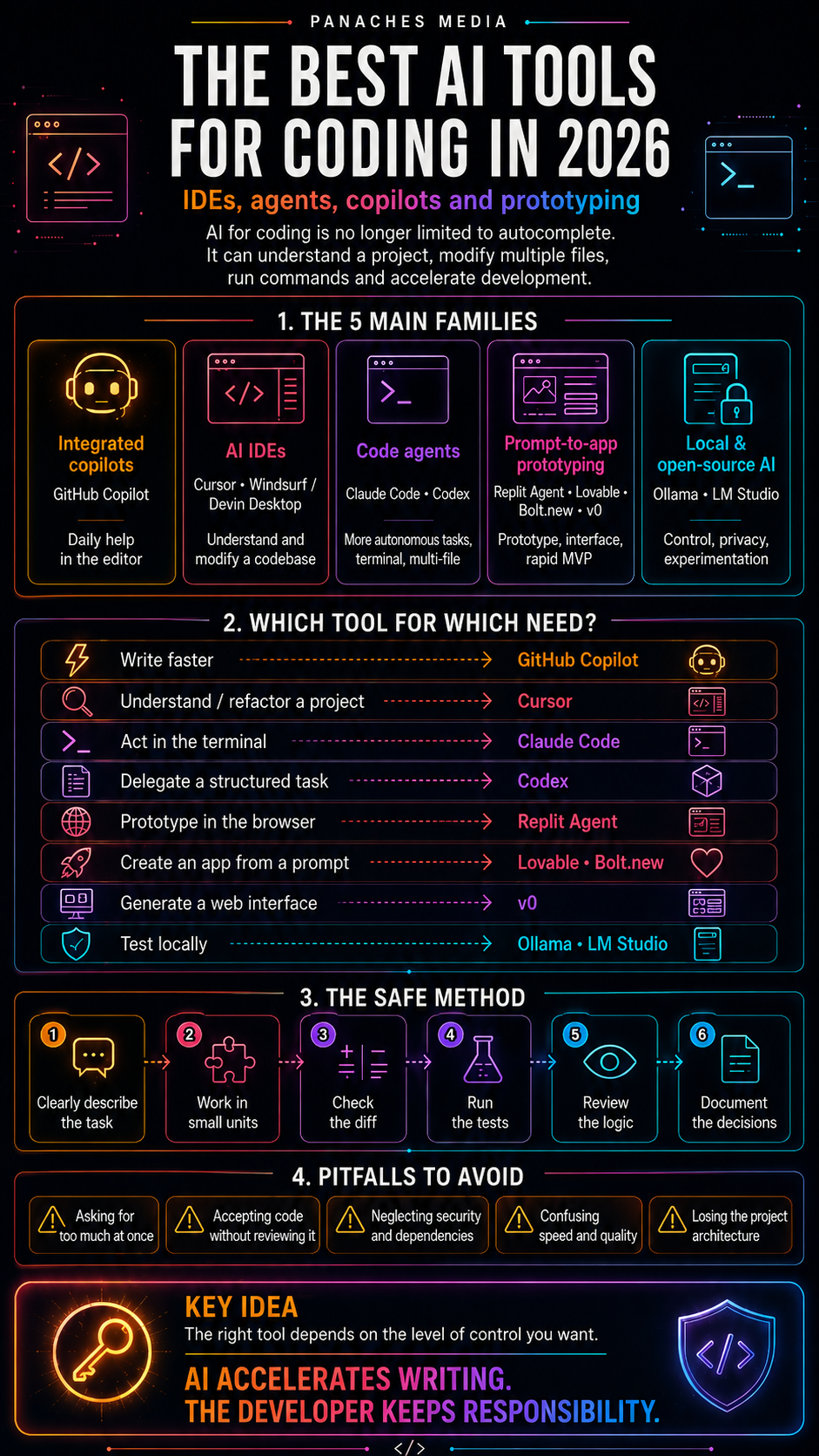
The arrival of AI assistants is changing the way we code.
They can generate functions faster. Explore solutions. Translate code. Write tests. Document. Refactor. Explain. Suggest a direction in seconds.
But this acceleration does not remove human judgment.
It makes it more important.
When an AI writes code, someone still needs to know what was asked. What was produced. What was modified. What was tested. What was not tested. What could break.
The developer becomes less only a script writer, and more a pilot: formulating, checking, arbitrating, integrating, securing, documenting.
AI can reduce friction. It can also produce chaos very quickly, with a truly impressive confidence in its own nonsense. Which is almost touching, until it reaches production.
So the future of software development is not “AI replaces developers”.
It looks more like this:
Tools write faster. Humans need to understand better.
The future of code is a future of environments
This may be the most important point.
We often talk about languages as if they existed alone. But in reality, developers never work only inside a syntax.
They work with:
- a browser;
- documentation;
- an editor;
- a terminal;
- files;
- tests;
- tickets;
- notes;
- screenshots;
- databases;
- resources;
- AI models;
- human exchanges;
- production constraints.
Code is only one center among many in a much larger workspace.
This is also where environments like Panaches naturally find their place: not as one more language, and not as a replacement for specialized tools, but as a creative workspace able to connect web navigation, resources, notes, code, documents, local AI, media and projects.
Because a developer, a creator or a curious mind does not think in isolated tabs. They think in links.
An idea found on the web can become a note. A note can become a piece of code. A piece of code can become a prototype. A prototype can require documentation. Documentation can become an article. An article can become a shared resource.
Modern work is rarely linear.
It looks more like a constellation.
So, which language should you learn?
The short answer would be: it depends.
The useful answer is closer to this:
- to discover programming: Python is an excellent choice;
- to understand the web: HTML, CSS, JavaScript and then TypeScript quickly become essential;
- for data, automation or AI: Python remains very strong;
- for modern web interfaces: JavaScript and TypeScript are unavoidable;
- for enterprise environments: Java and C# remain solid choices;
- for performance, systems or embedded development: C, C++ and Rust deserve attention;
- for serious learning: the best language is also the one with which you will actually build something.
Because learning a language without a project is like buying tools without ever entering the workshop.
It reassures. It shines a little. But it does not build anything.
Conclusion: a language is a door, not the house
Rankings like TIOBE are useful. They give signals. They show trends. They remind us that ecosystems evolve.
But they should not become our only compass.
Python dominates, yes. Rust is rising, yes. JavaScript remains everywhere, obviously. C, C++, Java and C# continue to support a huge part of the software world.
But the real challenge of code in 2026 is not choosing a winner.
The real challenge is learning how to build.
To build with method. With perspective. With responsibility. With the right tools. With real attention to users. With the ability to connect languages, documents, resources, tests, ideas, constraints and use cases.
A language can open a door.
But software is built across the whole house.
And sometimes even in the attic, where that old final_v2_backup_OK_bis.py file is still waiting because nobody dares to delete it.