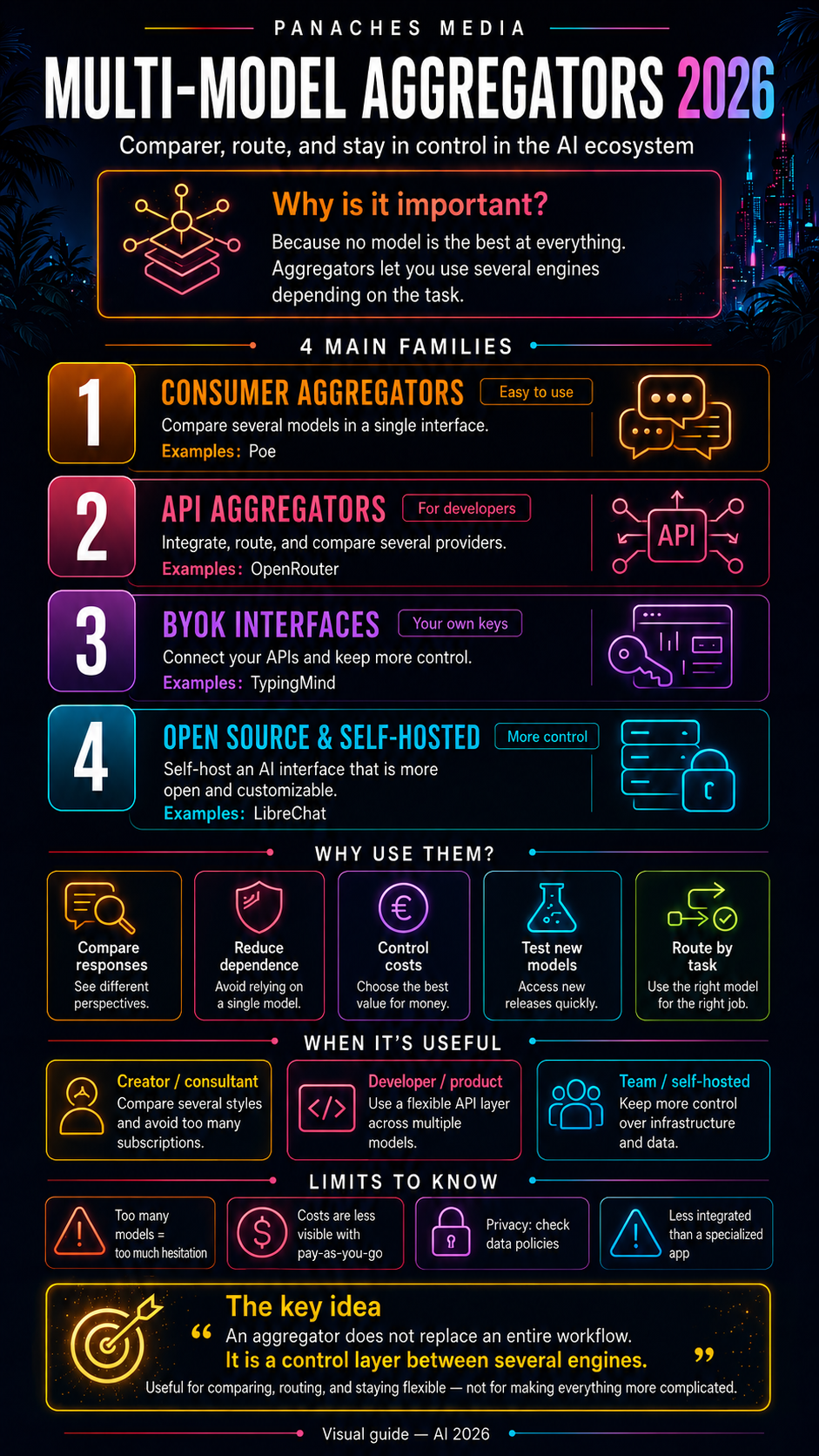
Why multi-model aggregators are becoming important
For a long time, using AI mostly meant choosing one main application.
ChatGPT for writing and thinking. Claude for long-form text and reasoning. Gemini for the Google ecosystem. Copilot for Microsoft. Midjourney for images. Perplexity for research. Cursor or GitHub Copilot for code.
But in 2026, this logic is becoming less simple.
Models evolve quickly. Prices change. Context windows expand. Tools gain new features. One model may be excellent for writing, but weaker for coding. Another may be faster, but less precise. Another may cost less, but feel less comfortable inside a consumer-facing interface.
As a result, many users no longer want to depend on a single model or a single application.
This is where multi-model aggregators come in.
Their promise is simple: allow people to use several AI models from one interface, or through one technical layer.
Instead of asking, “Which AI should I choose once and for all?”, we can begin asking:
Which model is the best fit for this specific task?
That is an important shift.
What is a multi-model aggregator?
A multi-model aggregator is a platform that gives access to several AI models or providers from one place.
It can take different forms.
It can be a chat application where users choose between GPT, Claude, Gemini, Llama, Mistral, DeepSeek, or other models.
It can be an API layer that lets a developer integrate several providers into one application without rewriting the entire architecture.
It can be an advanced interface where users connect their own API keys.
It can also be an open-source self-hosted platform for people who want more control over their data and their models.
The central idea stays the same: users are no longer locked into one engine.
An AI model is an engine. An AI application is a ready-to-use tool. A multi-model aggregator is a navigation layer between several engines. An AI agent can use those engines to act inside a workflow.
This distinction helps avoid a lot of confusion.
An aggregator is not necessarily “better” than an official application. It simply plays a different role.
Why not just use ChatGPT, Claude, or Gemini?
For many users, one official application is more than enough.
ChatGPT, Claude, Gemini, Copilot, or Perplexity already offer powerful, integrated, and easy-to-use experiences. They handle the interface, files, memory, search, projects, and sometimes images, voice, or tools.
But the more regular the usage becomes, the more some limits start to appear.
The first limit is specialization. No model is the best at everything. One model may produce better prose. Another may handle code better. Another may be faster for simple tasks. Another may be cheaper for large volumes.
The second limit is cost. Stacking subscriptions across several applications can become expensive, especially if some tools are only used occasionally.
The third limit is dependency. Relying on one provider means accepting its choices: pricing, availability, interface, limits, data policies, and model changes.
The fourth limit is comparison. When a response matters, it can be useful to compare several models. Not because one of them magically holds the truth, but because comparison helps reveal blind spots, test phrasing, validate a decision, or improve a result.
An aggregator responds to these limits by offering more flexibility.
The main families of aggregators
Not all aggregators are built for the same audience.
We can classify them into four major families.
1. Consumer aggregators
These look like classic chat applications, but they provide access to several models through the same interface.
Their main strength is simplicity.
Users can chat with different models, test different response styles, create specialized bots, or quickly compare outputs.
Poe is one of the best-known examples in this category. It allows users to explore many models and bots from one unified space, with a very accessible experience for non-technical users.
This type of tool is well suited to people who want to test several AI systems without managing APIs directly.
2. API aggregators for developers
Here, the main user is not necessarily someone chatting with a bot. It is a developer, a technical team, or a software product.
OpenRouter is representative of this family.
Its role is to provide a unified API layer for accessing many models. This makes it possible to test several providers, switch models more easily, plan fallback mechanisms, or optimize costs depending on the request.
For a developer, this kind of aggregator can become a strategic building block.
Instead of designing an application around one provider, the architecture becomes more flexible.
3. BYOK interfaces
BYOK means “bring your own key.”
In this model, the interface does not necessarily sell one big all-in-one subscription. Instead, it lets users connect their own OpenAI, Anthropic, Google, Mistral, OpenRouter, or other API keys.
TypingMind belongs to this family.
This model is attractive for advanced users who want a comfortable interface, but prefer to pay directly for API usage or keep tighter control over the providers they use.
This approach is often appreciated by freelancers, developers, consultants, and heavy users.
4. Open-source and self-hosted platforms
The last family is for users who want more control.
LibreChat is a good example: an open-source interface that allows several AI providers to be brought together inside a customizable environment, potentially self-hosted.
This approach requires more setup than a consumer application, but it offers more freedom.
It can be attractive for:
- developers;
- technical teams;
- organizations that want to control their infrastructure;
- users who care about privacy;
- people who want to avoid strong lock-in to a single platform.
This logic is much closer to self-hosted and controlled AI.
Poe: the accessible aggregator
Poe is often the easiest entry point into the world of multi-model aggregators.
Its main value lies in making access to several models very easy. Users can talk to different assistants, explore specialized bots, test several models, and switch between use cases without heavy technical setup.
For a content creator, Poe can be used to compare phrasing, test writing styles, generate ideas, contrast several answers, or explore creative models.
For a curious user, it is a practical way to discover the ecosystem without opening ten separate accounts.
But Poe remains a usage platform. It is not necessarily designed to replace a specialized professional workflow for code, design, video, or document management.
Its real value is discovery, comparison, and simple multi-model usage.
OpenRouter: the strategic layer for developers
OpenRouter plays a different role.
It should not be seen only as a chat application. Its main value is on the API side.
For a developer, an agency, a startup, or a software product, the problem is not just choosing one model today. The problem is being able to evolve tomorrow.
What happens if one model becomes too expensive? If another becomes better for code? If a provider goes down? If a client wants to avoid certain providers? If a simple task can be sent to a cheaper model?
A layer such as OpenRouter makes it possible to think of AI as a more flexible system.
You can test several models, route some requests, compare costs, manage alternatives, and reduce dependency on a single actor.
For applications that integrate AI, this is a very important logic.
The aggregator becomes an architectural building block.
TypingMind: the advanced interface for heavy users
TypingMind responds to a different need: having a powerful, customizable chat interface while keeping control of your API keys.
This kind of tool works well for users who already know they use AI a lot, but do not necessarily want to depend on one fixed subscription imposed by a platform.
The BYOK approach lets users connect different providers and manage model access themselves.
The benefit is twofold.
On one side, the user gets a more comfortable interface than basic API consoles. On the other, the user keeps a more modular setup: models can change, providers can evolve, and costs can be monitored more directly.
It is not necessarily the easiest option for a beginner, but it is an interesting solution for advanced profiles.
LibreChat: the open-source and controllable option
LibreChat is aimed at yet another audience.
Its main value lies in openness and control. Where Poe offers a ready-to-use experience, and OpenRouter provides an API layer, LibreChat makes it possible to set up a more customizable unified interface.
It is an interesting option for people who want to stay in control of their environment.
It can be relevant in situations where people want to:
- self-host their interface;
- connect several providers;
- avoid strong lock-in;
- adapt the experience for a team;
- experiment with different models;
- keep an open-source logic.
In return, it requires more technical skills than a consumer application.
It is the classic trade-off: more control, but more responsibility.
The advantages of multi-model aggregators
Aggregators offer several benefits.
The first is comparison. Being able to send the same request to several models makes it easier to spot differences in style, precision, creativity, caution, synthesis, or code quality.
The second is flexibility. You can use a powerful model for a complex task, then switch to a faster or cheaper one for a simple task.
The third is reduced dependency. If everything depends on one provider, every pricing, policy, or quality change directly affects your workflow.
The fourth is cost control. Advanced users can choose more precisely which model to use depending on the value of the task.
The fifth is experimentation. Aggregators are often good places to test emerging models without having to rebuild your whole organization.
The sixth is continuity. In some cases, if one model becomes unavailable or less relevant, it is easier to move to another.
These advantages are real, but they do not mean aggregators are always the best choice.
The limitations to keep in mind
An aggregator can also add complexity.
The first limitation is confusion. Having access to too many models can recreate the original problem: too much time spent choosing instead of working.
The second limitation is integration quality. An official application can sometimes offer a better experience with its own models: memory, files, projects, tools, search, voice, images, or native features.
The third limitation is privacy. Depending on the platform, data may pass through several layers: the interface, the aggregator, and then the model provider. That means data policies need to be checked carefully, especially for sensitive uses.
The fourth limitation is cost management. Pay-as-you-go can be attractive, but it requires more discipline. Without tracking, costs can become less visible than with a fixed subscription.
The fifth limitation is stability. Some models change, disappear, get renamed, limited, or replaced. A workflow that depends too heavily on one specific model can be fragile.
The sixth limitation is responsibility. The more you rely on a flexible technical layer, the more you need to understand what is happening: which model is responding, at what cost, with what limitations, and under what data conditions.
So an aggregator is not a magic solution. It is a control tool.
When should you use an aggregator?
An aggregator becomes useful in several situations.
It is useful if you regularly compare several models. It is useful if you want to avoid stacking subscriptions. It is useful if you are building an AI application. It is useful if you want to test new models quickly. It is useful if you need a flexible API logic. It is useful if you want more control through your own keys. It is useful if you want to self-host an AI interface.
By contrast, it is not essential if your AI usage is simple and occasional.
For many users, one well-mastered main application remains more effective than a dashboard full of models.
The right criterion is simple:
Does the aggregator simplify my workflow, or does it add another layer to manage?
If it reduces friction, it is useful. If it adds hesitation, it is probably too early.
Aggregator or specialized application?
This is an important question.
An aggregator lets you choose between several models. A specialized application offers a complete workflow for a specific use case.
For example, if you want to compare several model answers, an aggregator can be very useful. But to create an infographic, Canva or another design tool will usually be more effective. To work on a codebase, Cursor, Claude Code, or Codex may provide a more direct integration. To analyze your own documents, NotebookLM or a project-based document system may be more comfortable.
So the two should not be opposed.
A good stack can include:
- one main application;
- one specialized professional tool;
- one aggregator for comparison or routing;
- optionally, one local or open-source solution.
The aggregator then becomes one building block in the system, not the whole system.
How to choose your aggregator
The choice depends on your profile.
For a curious or creative user, a platform like Poe may be enough. It makes it possible to explore several models without going too technical.
For a developer or an application, OpenRouter is more relevant because API logic, routing, and access to many models become central.
For an advanced user who wants a comfortable interface with their own keys, TypingMind can be interesting.
For a technical profile, a team, or someone attached to self-hosted solutions, LibreChat is a more controllable option.
So the question is not, “Which is the best aggregator?”
The real question is:
Do I need a simple interface, an API layer, a BYOK workspace, or an open-source solution?
That is what should guide the choice.
The role of aggregators in a minimal AI stack
In a minimal AI stack, an aggregator should not be added automatically.
It needs a clear role.
It can be used to compare models on important tasks. It can be used to access models you do not use often enough to justify a dedicated subscription. It can be used to connect an application or internal tool to several providers. It can be used to avoid lock-in to one ecosystem. It can be used to experiment without rebuilding your whole workflow.
But it should not become an excuse to test everything all the time.
A minimal stack stays minimal only if each building block has a purpose.
An aggregator is useful when it becomes a control station. It becomes useless when it turns into an endless catalog.
Inside Panaches
Panaches is not meant to be only a list of AI tools or a model aggregator.
Its logic is different: bringing creative work together inside one local and coherent workspace.
But multi-model aggregators still offer an important lesson for Panaches: the future will probably not depend on one single model. Users will need flexibility, control, and workflows that can evolve.
A creative project may require several kinds of intelligence: writing, research, image generation, code, organization, document analysis, translation, synthesis. It would be risky to assume that one single engine will always answer all those needs.
The real challenge is therefore to build an environment where AI remains a working layer, not a rigid dependency.
In a workspace like Panaches, users should be able to organize their ideas, files, media, notes, code, and content without being trapped in one tool or one service.
Multi-model aggregators point toward one direction: more modularity, more choice, more control.
But the real goal stays the same: working better.
Conclusion: the aggregator is not the answer to everything, but it changes the logic
Multi-model aggregators are becoming important because the AI market has become too broad to be summarized by one single application.
They make it possible to compare, test, route, optimize, and avoid depending too heavily on one unique provider.
But they do not always replace specialized applications.
Poe helps you explore. OpenRouter helps you integrate. TypingMind helps you manage your own keys. LibreChat helps you stay in control.
Their true value is not adding even more AI to your daily work.
Their true value is helping you choose the right engine at the right moment.
In 2026, it is no longer only the intelligence of the model that matters. It is also the way it is integrated into a clear, durable, and controlled workflow.
FAQ
What is a multi-model aggregator?
A multi-model aggregator is a platform that allows users to access several artificial intelligence models from one interface or one API.
What is the difference between an aggregator and an AI application?
An AI application is designed for a specific use case, such as writing, coding, searching, or creating visuals. An aggregator is mainly used to access several models, compare them, or route requests according to need.
Do Poe, OpenRouter, TypingMind, and LibreChat serve the same purpose?
No. Poe is more oriented toward consumer use and bots. OpenRouter is mainly useful for API and development. TypingMind targets advanced users with their own API keys. LibreChat is more suited to users who want an open-source and controllable solution.
Can an aggregator save money?
Sometimes, yes. It can help avoid some subscriptions or make pay-as-you-go usage possible. But it can also make costs less visible if consumption is not tracked carefully.
Do aggregators replace ChatGPT, Claude, or Gemini?
Not necessarily. Official applications often remain simpler and better integrated. An aggregator is mainly useful if you want to compare several models, use a flexible API, or avoid depending on one provider.
Do you need an aggregator in a minimal AI stack?
Not always. It becomes useful if you need flexibility, comparison, API access, cost control, or access to several models. Otherwise, one main assistant and a few specialized tools may be enough.