How does an idea scribbled in a notebook become a manga that someone can hold in their hands, scroll through on a screen and wait for every week with slightly unreasonable impatience?
At the beginning, there is sometimes only an image.
A character standing in the rain.
A city suspended in the sky.
A fighter unable to use her own power.
A sentence that refuses to leave its author’s mind.
Then this image begins to attract other elements.
A story.
A world.
Characters.
Pages.
Panels.
Dialogue.
Black lines, screentones, silences and that very precise moment when the reader turns the page to discover what the author had carefully hidden just behind it.
Creating a manga is therefore not simply a matter of knowing how to draw.
It requires imagining, researching, structuring, breaking down, staging, correcting, producing, publishing and beginning again.
This chain of work has a name:
The manga production pipeline.
It follows a logic similar to other visual productions: prepare the story, construct the pages, finalise the artwork and then distribute the work.
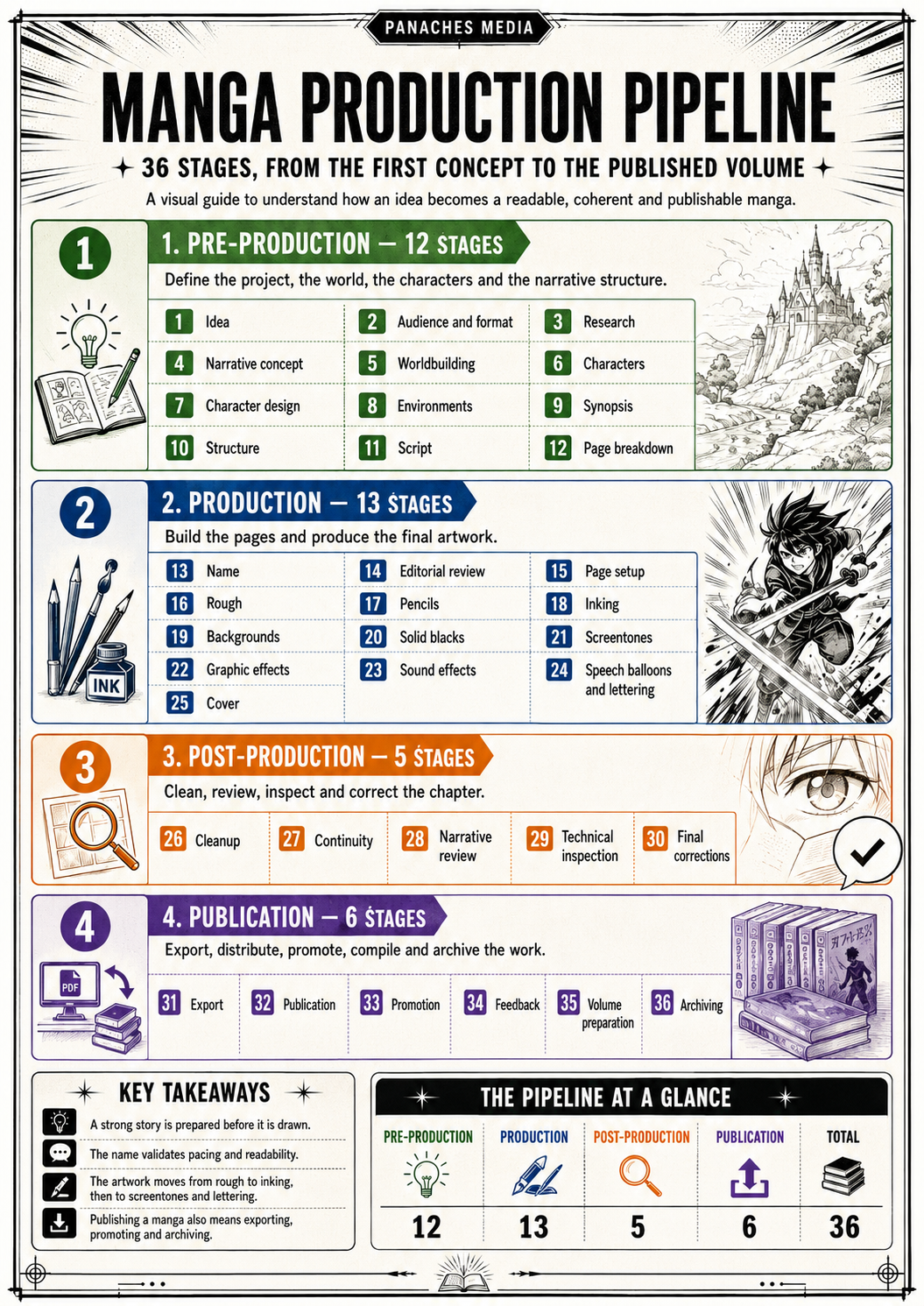
In its most complete form, the pipeline examined here contains 36 stages.
Some will be handled by a single person.
Others may be distributed between a mangaka, a writer, an editor, background assistants, screentone assistants, a letterer or a publishing team.
The number of people changes.
The central question remains the same:
How can an idea be transformed into readable, coherent and publishable pages without losing the story along the way?
The manga pipeline at a glance
| Phase | Stages | Primary objective |
|---|---|---|
| Pre-production | 12 | Define the project, world, characters and narrative structure |
| Production | 13 | Construct the pages and produce the finished artwork |
| Post-production | 5 | Clean, proofread, inspect and correct the chapter |
| Publication | 6 | Export, distribute, promote, compile and archive the work |
| Total | 36 | Transform an idea into a published and reusable manga |
Pre-production
Idea → Audience and format → Research → Narrative concept → Worldbuilding → Characters → Character design → Environments → Synopsis → Structure → Script → Page breakdown
Production
Name → Editorial review → Final page setup → Rough → Pencils → Inking → Backgrounds → Solid blacks → Screentones → Graphic effects → Sound effects → Speech balloons and lettering → Cover
Post-production
Cleanup → Continuity → Narrative review → Technical inspection → Final corrections
Publication
Export → Publication → Promotion → Feedback → Volume preparation → Archiving
This organisation represents a complete and professional version of the process. In an independent project, several stages may be combined. In a studio or editorial production, they may instead be divided between different professions.
First phase: pre-production
Pre-production is the invisible part of manga creation.
The reader will not directly see the research, plans, character sheets or abandoned versions of the synopsis.
They will nevertheless see their consequences on every page.
A scene that is easy to understand.
A coherent character.
A world that seems to exist beyond the panels.
A revelation prepared several chapters earlier.
Conversely, weak pre-production often reappears later in the form of irregular pacing, poorly defined powers, a character whose motivations change according to the chapter’s needs or a background whose door mysteriously moves from one wall to another.
Pre-production therefore determines what the manga should become before dozens of hours are spent drawing what it should not be.
1. Idea — Finding the starting point
Everything begins with an idea clear enough to create a direction.
It may take the form of a narrative concept:
An apprentice cartographer discovers that the territories she draws actually appear during the night.
It may come from a character, an atmosphere, a conflict or a rule of the world.
The important thing is not that it already contains the entire manga.
It must provide a promise.
The idea notably defines:
- the main concept;
- the theme;
- the genre;
- the dominant emotion;
- the work’s distinctive element;
- the promise made to the reader.
A good idea can generally be summarised in one or two sentences.
This limitation does not impoverish the project.
It simply forces the creator to identify its core.
The main risk
Confusing the idea with an accumulation of elements.
An amnesiac hero, twelve kingdoms, nine magic systems, a cosmic war and mechanical dragons do not yet constitute a story.
They are materials.
The idea explains what connects them.
2. Audience and format — Knowing who and what you are creating for
A manga does not exist in a vacuum.
It is intended for a readership and must be published in a specific format.
These two elements have a profound influence on storytelling.
A forty-page one-shot is not constructed like a series planned to continue for several dozen volumes.
Vertical reading designed for a phone is not broken down in exactly the same way as a printed double-page spread.
You need to determine:
- the intended readership;
- the age group;
- the editorial positioning;
- the type of publication;
- the length of the project;
- the reading medium;
- the publication schedule.
The project may therefore take the form of:
- a children’s manga;
- a shōnen;
- a shōjo;
- a seinen;
- a josei;
- a kodomo;
- a one-shot;
- a short series;
- a long series;
- a print publication;
- a digital publication;
- a vertically scrolling format.
Why is this choice made so early?
Because the format affects:
- chapter length;
- pacing;
- the level of violence depicted;
- the complexity of the themes;
- text size;
- page composition;
- the frequency of cliffhangers.
The format is not merely the container for the story.
It becomes part of its mechanics.
3. Research and documentation — Giving the world weight
Research gathers the information needed to construct a believable world.
Even a fantasy work needs coherence.
A character may cast spells and travel between dimensions.
But when they use armour, practise a profession, inhabit an architectural style or handle an object inspired by a real period, a little research will make the whole work more convincing.
Documentation may concern:
- locations;
- historical periods;
- clothing;
- architecture;
- objects;
- professions;
- cultures;
- technologies;
- anatomy;
- movement;
- historical documents.
Research is not only useful for avoiding mistakes.
It provides details that imagination alone might not have invented.
A particular way of holding a tool.
The shape of a window.
A ritual.
A professional posture.
A material used in a specific region.
These details may occupy only a small part of a panel.
Yet they give the world the impression that it existed before the reader arrived.
The main risk
Turning research into a refuge.
It is possible to spend several months documenting a world without writing the first scene.
Documentation should nourish creation.
It should not become a highly educated way of postponing it.
4. Narrative concept — Establishing the foundations of the story
The narrative concept transforms the idea into conflict.
It is no longer enough to know that the world is interesting.
You need to determine what will happen within it.
The foundations generally include:
- a protagonist;
- an objective;
- a primary obstacle;
- a conflict;
- stakes;
- a world;
- a tone;
- a possible ending.
This stage can be summarised through one central question:
How far is the character prepared to go to achieve their objective?
This question sets the hero in motion.
It also forces the author to consider the price of change.
A character does not become interesting merely because they possess a rare ability.
They become interesting when this ability conflicts with what they want, what they fear or what they still refuse to understand.
5. Worldbuilding — Constructing the rules of the world
Worldbuilding develops the framework within which the story can function.
It may include:
- geography;
- societies;
- institutions;
- powers;
- technologies;
- beliefs;
- the economy;
- chronology;
- relationships between groups;
- the limits of the world.
Limits are especially important.
A power without limits often reduces conflict.
A technology capable of solving every problem gradually removes the story’s obstacles.
The world must therefore possess rules clear enough for the characters’ decisions to have consequences.
The right question
Does the worldbuilding serve the story?
A political system can explain why two characters are enemies.
A belief may influence a sacrifice.
Geography can make a journey dangerous.
A magical rule can force the hero to choose.
Worldbuilding becomes a problem when it requires the reader to memorise an encyclopaedia before they have a reason to care about anyone.
The world is a stage.
It should not smother those trying to live within it.
6. Character creation — Constructing the human forces of the story
Characters give the conflict a face.
This stage develops the protagonists, antagonists and supporting roles.
For each character, you can define:
- their identity;
- their appearance;
- their personality;
- their past;
- their motivations;
- their strengths;
- their flaws;
- their relationships;
- their narrative development.
A character cannot be reduced to a list of traits.
“Brave, funny and loyal” does not yet explain how they will react when forced to choose between protecting a friend and completing their mission.
Traits gain meaning through decisions.
Graphic research may include:
- expressions;
- poses;
- clothing;
- hairstyles;
- accessories;
- rotations;
- height differences;
- visual relationships between silhouettes.
This stage already connects storytelling with drawing.
Character begins to enter the body.
7. Character design — Translating personality into visual language
Character design transforms narrative information into shapes, lines and contrasts.
The reader should be able to recognise a character quickly, even in the middle of a complex scene.
An effective design often relies on:
- an identifiable silhouette;
- dominant shapes;
- a coherent outfit;
- characteristic expressions;
- a few memorable details;
- a clear relationship between appearance and personality.
A stable and rigid character may be constructed using straight shapes.
An unpredictable character may receive a more unbalanced silhouette.
An excessively clean costume may reveal a need for control.
A worn accessory may suggest a story that the dialogue has not yet explained.
The model sheet
A model sheet gathers the essential visual information:
- front view;
- profile;
- rear view;
- expressions;
- proportions;
- clothing;
- accessories;
- recurring details.
It helps maintain consistency from one page to another and makes the assistants’ work easier.
Without a reference, a complex hairstyle sometimes ends up developing its own narrative evolution.
8. Environment design — Giving the story a geography
Backgrounds are not only there to fill empty space.
They determine where characters can move, hide, meet or fight.
Important locations need to be defined:
- houses;
- bedrooms;
- schools;
- streets;
- buildings;
- landscapes;
- vehicles;
- recurring locations;
- important objects.
Simple plans can indicate:
- the position of doors;
- the location of furniture;
- circulation routes;
- possible viewpoints;
- distances between elements.
This preparation prevents a character from crossing a room whose dimensions change from one panel to another.
It also makes future framing easier.
A good background is not merely attractive.
It can be used by the staging.
9. Synopsis — Observing the story as a whole
The synopsis summarises the entire story or a major narrative arc.
It presents:
- the starting point;
- the main events;
- the twists;
- the climax;
- the conclusion.
This stage forces the author to look at the story from a distance.
Every scene may seem interesting when viewed on its own.
The synopsis checks whether they genuinely construct a progression.
The synopsis answers several questions
- Where does the character begin?
- What do they want?
- What prevents them from moving forward?
- Which revelations transform their understanding?
- What final choice must they make?
- In what state do they end the story?
The synopsis is not a prison.
It is a map.
The route may change.
It is still useful to know which region you are trying to reach.
10. Narrative structure — Transforming the story into architecture
Structure divides the story into units that are easier to organise.
The manga may be divided into:
- narrative arcs;
- acts;
- chapters;
- sequences;
- scenes.
For each arc, you define:
- the conflict;
- the objective;
- the revelations;
- the characters’ development;
- the resolution.
This organisation makes it possible to control progression.
An arc can resolve one problem while opening a broader question.
A chapter can provide information without interrupting the momentum of the story.
A scene can possess its own objective while contributing to the character’s overall transformation.
The main risk
Constructing a succession of episodes that accumulate no consequences.
The reader can accept detours.
They must feel that something is moving forward.
11. Chapter script — Defining precisely what happens
The chapter script develops the scenes, actions and dialogue.
It may take the form of a conventional text or a page-by-page breakdown.
It notably specifies:
- the scenes;
- the actions;
- the dialogue;
- the reactions;
- the transitions;
- the information revealed;
- the final cliffhanger.
At this stage, the author checks the function of each sequence.
A scene may:
- provide information;
- deepen a relationship;
- trigger a conflict;
- prepare a revelation;
- modify an objective;
- create breathing space;
- resolve a tension.
When a scene accomplishes nothing, it can sometimes be removed.
Which is excellent news for the drawing schedule.
12. Page breakdown — Distributing the story across the pages
The breakdown distributes the script within the space of the manga.
For each page, you need to determine:
- the number of panels;
- the action;
- the characters present;
- the dialogue;
- the framing;
- the rhythm;
- the turning point leading to the next page.
The breakdown directly controls reading speed.
A page made from many small panels can slow the action or create a feeling of detailed observation.
A large panel can suspend time.
A double-page spread can reveal a location, a monster, an event or an emotion that the story has been preparing for several pages.
The page turn
The moment when the reader turns the page is a narrative tool.
It can hide information.
Create anticipation.
Prepare a revelation.
Paper possesses its own form of editing.
Even while motionless, it knows how to make a second last.
Second phase: production
Pre-production has constructed the project’s logic.
Production must now manufacture the pages.
This is where narrative decisions meet the reality of drawing.
The characters must fit inside the panels.
The dialogue must fit inside the balloons.
The backgrounds must respect perspective.
The inking must preserve the energy of the rough.
The screentones must enrich the page without suffocating it.
Each stage brings the chapter closer to its finished form.
It also makes changes more expensive.
Moving a panel in the name takes a few minutes.
Redrawing three inked pages requires a much more intimate relationship with coffee.
13. Name — The manga storyboard
The name is the rough version of the chapter.
It indicates:
- page composition;
- panel positions;
- framing;
- characters;
- speech balloons;
- dialogue;
- effects;
- transitions.
The drawings can be extremely simple.
A head can become a circle.
A character, a few lines.
A background, a rectangle accompanied by a note.
The objective is not to demonstrate the final graphic quality.
It is to check whether the chapter reads correctly.
The name tests:
- the reading order;
- pacing;
- comprehension;
- changes in viewpoint;
- revelations;
- the position of dialogue;
- the relationship between text and image.
It is one of the most important stages in the pipeline.
A beautifully drawn manga can still be difficult to read.
The name protects the storytelling before the beauty of the line has an opportunity to conceal its weaknesses.
14. Editorial review — Correcting before production
The name is reviewed by the author, a collaborator or the editor.
Corrections may concern:
- comprehension;
- pacing;
- dialogue;
- unnecessary length;
- inconsistencies;
- staging;
- characterisation;
- emotional impact;
- the chapter ending.
This approval makes it possible to identify problems while the pages are still easy to modify.
A scene can be moved.
A panel removed.
A line of dialogue shortened.
A cliffhanger strengthened.
It is better to move a panel now than to redraw three finished pages.
Rough paper is much less likely to take offence.
15. Final page setup — Preparing the working document
Once the name has been approved, the final document is prepared.
You need to define:
- the dimensions;
- the resolution;
- the margins;
- the bleed;
- the safe area;
- the panels;
- the gutters;
- the double-page spreads.
This stage depends on the medium.
A print publication must respect the printer’s requirements.
A digital platform may request a specific size or format.
Vertical reading requires a different organisation of space.
Why should the file be prepared correctly?
Because a page can be graphically successful and still become unusable when:
- text is too close to the trim;
- an essential element extends beyond the safe area;
- the resolution is insufficient;
- a double-page spread is misaligned;
- the margins do not correspond to the final format.
Technique is not the most poetic part of manga creation.
It nevertheless has a remarkable ability to destroy the result when ignored.
16. Rough — Constructing shapes and movement
The rough is a preparatory drawing more precise than the name.
It defines:
- anatomy;
- poses;
- expressions;
- perspective;
- volumes;
- framing;
- backgrounds;
- movement.
It is the graphic foundation of the page.
The rough must resolve the main masses before the drawing becomes lost in detail.
It helps verify:
- whether the characters occupy the space correctly;
- whether the poses remain readable;
- whether the perspective works;
- whether the characters’ gazes guide the reader;
- whether the action possesses enough energy;
- whether the expressions correspond to the scene.
The rough generally retains a great deal of freedom.
It searches for movement.
The final line will later ask it to behave properly.
17. Pencils — Refining the drawing
The pencil stage develops the rough into a clean and detailed version.
It refines:
- faces;
- hands;
- clothing;
- accessories;
- hair;
- background elements;
- movement lines;
- the details required for inking.
In a digital workflow, the rough and pencils can be placed on several layers.
This makes it possible to correct, move or reduce certain elements without rebuilding the entire page.
The main risk
Cleaning the drawing so much that it loses its energy.
The rough may contain a lively movement that the pencil stage gradually transforms into a rigid pose.
The objective is not merely to make the line clean.
The intention must be preserved.
18. Inking — Creating the final lines
Inking produces the final lines of the page.
It organises:
- line thickness;
- contours;
- visual hierarchy;
- details;
- shadows;
- depth;
- readability.
Not every line should possess the same importance.
A nearby contour may be thicker.
A distant background can use finer lines.
An expression may receive a more nervous treatment.
A metallic object can be described with different lines from a soft piece of clothing.
Inking does not merely copy the pencils
It interprets them.
It decides which lines should remain.
Which can disappear.
Where weight should be added.
Where white space should be allowed to breathe.
Inking is often the stage when the drawing genuinely begins to resemble the final manga.
It is also the stage when a hesitant line can become extremely visible.
Black possesses very little patience for indecision.
19. Backgrounds — Constructing the finished environments
Backgrounds give the scenes their final space.
They may include:
- architecture;
- landscapes;
- furniture;
- streets;
- vegetation;
- objects;
- vehicles;
- atmospheric elements.
They may be drawn:
- by hand;
- using perspective rulers;
- from 3D models;
- with material libraries;
- with the help of specialised assistants.
The background must fulfil several functions
It establishes the location of the action.
It creates an atmosphere.
It communicates distance.
It recalls the period or culture.
It can also reveal something about the characters.
An orderly, empty or object-filled room does not express the same personality.
The main risk
Treating the background as a simple technical demonstration.
An extremely detailed building can slow the reading experience when the reader no longer understands where to look.
The background must support the panel.
It should not attempt to become the protagonist of every page.
20. Solid blacks — Structuring the page with dark masses
Solid blacks strengthen the composition.
They make it possible to:
- reinforce silhouettes;
- create contrast;
- direct the eye;
- separate planes;
- establish an atmosphere;
- structure the page.
In a black-and-white manga, black is not merely a colour.
It is a visual weight.
A large dark mass can attract the eye, create a threat, close a composition or add depth.
Black can also represent silence, absence or rupture.
The main risk
Distributing blacks without an overall vision.
Each panel may work independently while unbalancing the entire page.
It is therefore useful to observe the artwork as a thumbnail.
The reader does not only discover a succession of panels.
They also perceive a complete composition.
21. Screentones — Creating values and materials
Screentones represent:
- greys;
- shadows;
- textures;
- clothing;
- skin;
- the sky;
- atmosphere;
- depth;
- light.
They enrich surfaces without using colour.
A light screentone can suggest skin or a gentle atmosphere.
A dense screentone can weigh down a sky or increase tension.
Consistency is essential
A material should retain a similar treatment between panels.
A light source should produce understandable values.
Screentones should not blur faces or make small text difficult to read.
The main risk
Adding screentones because an area appears empty.
White is not necessarily an absence.
It may be a pause.
A page filled with textures can appear highly worked while becoming more difficult to navigate.
22. Graphic effects — Giving the action energy
Graphic effects strengthen movement or emotion.
They may include:
- speed lines;
- impacts;
- flashes;
- smoke;
- dust;
- light;
- rain;
- energy;
- distortions;
- emotional backgrounds.
These effects are an integral part of manga language.
They do not always attempt to represent the world literally.
A black background behind a face can communicate fear.
Converging lines can focus attention.
A distortion can exaggerate a shock or comic reaction.
The essential question
What should the reader feel?
The effect should amplify that sensation.
When added through habit, it can transform a clear action into a graphic storm.
Energy is not the number of lines.
It is the precision with which they guide the eye.
23. Sound effects — Giving sound a visible form
Sound effects represent:
- impacts;
- movement;
- explosions;
- ambient sounds;
- silences;
- sensations;
- internal reactions.
In manga, sound becomes a graphic object.
The shape, size and orientation of the letters contribute to the staging.
A heavy, angular sound effect does not create the same sensation as a thin, trembling word.
The text can blend into the background.
Cross a panel.
Follow the movement.
Break beneath an impact.
Silence can also be represented
The absence of a sound effect after several very loud pages can become powerful.
Manga has no real soundtrack.
It therefore uses space and contrast to make us hear something that does not exist.
24. Speech balloons and lettering — Organising voices on the page
Speech balloons and lettering finalise:
- dialogue;
- thoughts;
- narration;
- shouts;
- whispers;
- off-panel text;
- notes;
- certain sound effects.
You need to check:
- the reading order;
- text size;
- the internal spacing;
- the direction of the balloon tails;
- typographic consistency;
- the relationship between text and drawing.
A poorly positioned balloon can force the reader to read the dialogue in the wrong order.
Text that is too long can crush the drawing.
A font that is too small can make the chapter painful to read.
Lettering is a form of staging
A shout is not presented like a thought.
A whisper does not have the same form as an official announcement.
The text is part of the image.
It is not merely placed on top once everything else has been completed.
25. Cover and illustrations — Presenting the work
This stage produces the elements that represent the chapter or volume:
- the cover;
- an opening illustration;
- the title page;
- a promotional image;
- the back cover;
- bonus illustrations.
The cover must quickly communicate:
- the genre;
- the atmosphere;
- the important characters;
- the visual promise;
- the manga’s identity.
It does not necessarily summarise the entire story.
It creates an invitation.
A successful cover does not say everything.
It makes people want to open it.
Third phase: post-production
The pages are almost finished.
“Almost” is a particularly dangerous word in production.
It may still conceal:
- a forgotten speech balloon;
- an inconsistent costume;
- a broken screentone;
- text placed too close to the trim;
- a page in the wrong order;
- a character who mysteriously changes dominant hand.
Post-production checks that the chapter is readable, coherent and technically publishable.
26. Cleanup — Removing unwanted elements
Cleanup removes:
- construction lines;
- overspill;
- dust;
- stray pixels;
- screentone errors;
- incorrect intersections;
- elements extending beyond panels.
The page should become clean without losing the drawing’s energy.
Insufficient cleanup leaves defects behind.
Overly aggressive cleanup can make the lines appear artificial or erase expressive details.
The aim is not to transform the page into a sterile surface.
It is to remove what has no reason to remain.
27. Continuity control — Making sure the world does not change by accident
Continuity control compares the pages and panels.
It notably checks:
- clothing;
- injuries;
- accessories;
- character orientation;
- the position of objects;
- the time of day;
- the level of light;
- the condition of the backgrounds;
- the direction of movement.
This stage prevents a character from mysteriously losing a jacket, a scar or sometimes an entire door between two panels.
Why do these mistakes appear?
Because pages are not always drawn in order.
Because a scene may take several days.
Because a background is sometimes reproduced from memory.
Because the human mind is capable of imagining entire worlds while forgetting which side of the table held a cup.
28. Narrative review — Reading like a reader
The author rereads the chapter while attempting to leave their position as creator for a moment.
They check:
- fluidity;
- comprehension;
- pacing;
- emotion;
- transitions;
- dialogue;
- repetition;
- mistakes;
- the cliffhanger.
Reading the pages as thumbnails also makes it possible to observe their overall balance.
Reading without stopping over the details reveals the rhythm.
Reading aloud helps identify dialogue that is too long or artificial.
The difficulty
The author already knows every intention.
They may understand a scene because they know what it was supposed to show.
The reader does not possess that information.
The review must therefore examine what is genuinely present on the page, not only what existed in the mind of the person who drew it.
29. Technical inspection — Checking the files
Before publication, you need to inspect:
- the resolution;
- the dimensions;
- the greyscale levels;
- the colour mode;
- the margins;
- the bleed;
- the compression;
- the page order;
- the text quality;
- the file size.
The requirements depend on the printer or platform.
A version intended for print may require a different format from a web publication.
A file intended for a phone may need different compression.
Technical inspection ensures that the work can leave the software without losing quality or readability.
30. Final corrections — Applying the last modifications
The final corrections may include:
- drawing retouches;
- dialogue corrections;
- replacement panels;
- contrast adjustments;
- screentone corrections;
- lettering changes;
- page harmonisation.
At this stage, necessary corrections must be distinguished from endless changes.
A spelling mistake should be corrected.
An important inconsistency should as well.
But redrawing a face for the twelfth time because it could be “slightly better” may prevent the chapter from ever being completed.
A published work can meet readers.
A work that is corrected forever mainly encounters new file versions.
Fourth phase: publication
The manga is graphically complete.
It must now find its destination.
Publication is not only the moment when the file becomes visible.
It also includes adaptation to different media, promotion, observation of feedback, volume preparation and preservation of the project.
Creation produces pages.
Publication constructs their circulation.
31. Export — Preparing the different versions
The files are adapted to their destination:
- print;
- web publication;
- a reading platform;
- a mobile application;
- a social network;
- PDF;
- vertical format.
A single chapter may require several exports.
You need to check:
- the resolution;
- compression;
- size;
- page order;
- colour space;
- the presence or absence of bleed;
- text quality;
- compatibility with the platform.
Export is not a simple button.
It is the translation of the project into a format that another person can use.
32. Chapter publication — Making the work available
The chapter may be distributed through:
- a magazine;
- a digital platform;
- a personal website;
- a social network;
- crowdfunding;
- self-publishing;
- a traditional publisher.
Publication may be occasional or follow a regular schedule.
The schedule influences production
Weekly, monthly and irregular publication do not require the same organisation.
You need to consider:
- creation time;
- correction periods;
- promotion;
- the amount of completed work held in reserve;
- the author’s health;
- the realistic ability to maintain the schedule.
An ambitious schedule can create momentum.
An impossible schedule quickly transforms every chapter into a race against the previous one.
33. Promotion — Bringing the manga and its readers together
Promotion may use:
- excerpts;
- trailers;
- illustrations;
- social posts;
- behind-the-scenes content;
- character sheets;
- events;
- conventions;
- newsletters.
It does not necessarily begin after the manga has been completed.
It can accompany the entire creation process.
Sharing a character design, an inking stage or an extract from the name can gradually build a relationship with future readers.
Promotion must not replace the project
It should make the work visible.
It should not consume all the energy required to produce it.
The best social-media schedule in the world cannot publish a chapter that does not exist.
34. Reader feedback — Observing without abandoning the author’s vision
After publication, reactions may provide information about:
- comprehension;
- popular characters;
- memorable scenes;
- pacing problems;
- recurring questions;
- interest in what comes next.
This feedback may guide certain adjustments.
It should not replace the author’s vision.
Not all feedback has the same value
An isolated comment may reveal a personal preference.
A misunderstanding repeated by many readers may indicate a genuine storytelling problem.
You therefore need to observe patterns without transforming every reaction into an order to rewrite the story.
Listening to the reader does not mean handing them the script with a red pen.
35. Volume preparation — Compiling the chapters
Several chapters may be assembled into a volume.
This stage may include:
- additional corrections;
- graphic harmonisation;
- a new cover;
- a contents page;
- bonus pages;
- illustrations;
- character introductions;
- an afterword;
- legal notices.
Reading the work as a volume sometimes reveals problems that were invisible during chapter-by-chapter publication.
A repetition may become more obvious.
A transition between two chapters may feel too abrupt.
The earliest drawings may differ greatly from the latest ones.
Volume preparation makes it possible to unify the whole.
It transforms a succession of publications into a coherent editorial object.
36. Archiving — Preserving the project for the future
Archiving gathers:
- source files;
- finished pages;
- fonts;
- screentones;
- 3D models;
- references;
- scripts;
- corrected versions;
- exports;
- editorial documents.
Good archiving makes it easier to produce:
- reprints;
- translations;
- corrections;
- adaptations;
- future volumes;
- new editions.
A clear organisation can specify:
- the project name;
- the chapter number;
- the page number;
- the version;
- the language;
- the file type;
- the approval status.
Archiving rarely resembles the most exciting part of creation.
It suddenly becomes fascinating when a platform requests a new version of a chapter produced three years earlier.
The manga pipeline is not perfectly linear
Presenting the 36 stages in a precise order helps explain the process.
In reality, some stages overlap.
A character design may evolve during the name.
A background may be simplified after the rough.
A review may require a line of dialogue to be rewritten.
A printing constraint may impose a new layout.
Feedback from an editor may send a chapter back to the script or page breakdown.
The pipeline therefore functions as a set of controlled loops.
Example
The name reveals that a scene lacks space.
The page breakdown is modified.
The layout changes.
The rough shows that the background is still too complex.
The environment design is simplified.
The scene then returns to the pencil stage.
Going backwards is not a failure.
It becomes a problem only when no one knows:
- which version has been approved;
- which file should be used;
- which pages depend on the modification;
- who must approve the correction;
- whether the old version can be deleted.
The pipeline does not eliminate corrections.
It makes them understandable.
Example of a character moving through the pipeline
Let us take a main heroine.
During pre-production
- her role is defined within the narrative concept;
- her past and motivations are written;
- her place within the arcs is determined;
- her appearance is explored;
- her silhouette is approved;
- her clothing and expressions are documented.
During production
- she appears in the name;
- her poses are developed in the rough;
- her face and clothing are refined during the pencil stage;
- her final lines are drawn during inking;
- her solid blacks and screentones are added;
- her movements receive graphic effects;
- her words are placed inside speech balloons.
During post-production
- her details are cleaned;
- her clothing and injuries are checked;
- her dialogue is reviewed;
- her contrasts are harmonised;
- her pages are prepared for export.
During publication
- she may appear on the cover;
- be presented on a promotional character sheet;
- receive a bonus illustration;
- be included in the volume presentation;
- be preserved in the project’s graphic archives.
The character is therefore not created during a single stage.
She is constructed throughout the pipeline.
Storytelling gives her a role.
Design gives her an appearance.
Drawing gives her a presence.
Publication finally allows her to meet the reader.
The professions behind the manga pipeline
| Area | Associated professions or functions |
|---|---|
| Concept and story | Mangaka, author, writer |
| Editorial development | Editor, editorial manager |
| Character design | Mangaka, character designer |
| Page breakdown and name | Mangaka, storyboard artist |
| Rough and pencils | Mangaka, artist |
| Inking | Mangaka, inking assistant |
| Backgrounds | Background assistant, background artist |
| Screentones and solid blacks | Screentone assistant, graphic assistant |
| Lettering | Letterer, editorial designer |
| Proofreading | Author, editor, proofreader |
| Cover | Mangaka, illustrator, graphic designer |
| Export and publication | Editor, printer, digital-publication manager |
| Promotion | Author, editor, community manager |
| Archiving | Author, studio, editorial team |
On an independent project, one person may handle almost all of these functions.
Within a team, tasks can be distributed according to specialities.
The pipeline must remain readable in both situations.
A solo creator does not need organisation any less.
They simply need to avoid scheduling a meeting with themselves every time they change layers.
How can this pipeline be simplified for an independent manga?
The 36 stages describe a complete version.
They do not all need to become separate departments.
Simplified pre-production
Idea → documentation → characters → synopsis → script → page breakdown
Simplified visual planning
Name → review → page setup
Simplified graphic production
Rough → pencils → inking → backgrounds → blacks → screentones → effects
Simplified finalisation
Balloons → lettering → cleanup → review → corrections
Simplified publication
Export → distribution → promotion → archiving
Several tasks can be combined:
- worldbuilding with research;
- character creation with character design;
- the rough with the pencil stage;
- solid blacks with screentones;
- graphic effects with sound effects;
- narrative review with final corrections;
- publication with promotion.
The objective is not to imitate a studio artificially.
The objective is to preserve the essential questions:
- Is the story clear?
- Is the chapter broken down effectively?
- Has the name been approved?
- Is the page readable?
- Are the files technically correct?
- Which version is the reference?
- What needs to be published and archived?
A short pipeline that is actually followed is better than an enormous pipeline used only to decorate a Notion board.
Common mistakes in a manga pipeline
Beginning the pages before structuring the story
Drawing quickly creates an impression of progress.
But producing twenty pages of a story that does not yet know where it is going remains a very artistic way of creating additional work.
Skipping the name
Without a name, breakdown and pacing problems appear when the drawings are already advanced.
Placing too much text inside the panels
A manga is not a novel placed inside rectangles.
The drawing must participate in the storytelling.
Adding detail before approving the composition
A panel should work with simple forms before receiving complex backgrounds.
Neglecting the speech balloons while drawing
Adding text at the end can cover faces or force the composition to be rebuilt.
Using screentones without hierarchy
More texture does not necessarily mean greater depth.
It may simply produce more grey.
Modifying a character without updating their references
A new hairstyle, accessory or injury needs to be reflected in the following pages.
Waiting until publication to inspect the files
The last minute is a poor time to discover that a chapter has the resolution of a postage stamp.
Failing to archive
The file chapter12_final_final_reallyfinal is not a preservation strategy.
The pipeline transforms an idea into a reading experience
Creating a manga may appear to be one enormous task:
making a manga.
In reality, this task is too large to confront directly.
First, the idea needs to be defined.
Then the audience understood.
The world documented.
The characters constructed.
The synopsis written.
The arcs structured.
The chapter scripted.
The pages broken down.
The name created.
Approved.
Drawn.
Inked.
The backgrounds, blacks, screentones and effects added.
The words placed.
Reviewed.
Corrected.
Exported.
Published.
Archived.
The pipeline does not make the work easy.
It makes it possible to move through it.
Each stage temporarily reduces the size of the problem.
Today, the entire manga does not need to be finished.
The synopsis needs to be resolved.
Then the name.
Then this page.
Then this panel.
The idea gives it a direction.
The narrative concept gives it a conflict.
Worldbuilding gives it rules.
The characters give it a presence.
The script gives it actions.
The page breakdown gives it rhythm.
The name gives it a form.
The rough gives it movement.
The inking gives it a line.
The blacks give it weight.
The screentones give it values.
The effects give it energy.
The balloons give it a voice.
The review gives it clarity.
The export gives it a format.
Publication gives it readers.
And archiving gives it a memory.
The manga production pipeline is therefore not merely a technical organisation.
It is the path through which an idea learns to become a page.
Then a chapter.
Then a work.