Before the drawing, a lot of the manga already exists
When we open a finished volume, everything seems perfectly in place. Characters naturally occupy their panels, dialogue fits into speech bubbles, backgrounds extend the world and every page appears to lead effortlessly into the next.
That fluidity is deceptive.
Before reaching the reader, a chapter may have been discussed, broken down, rewritten, redrawn and corrected several times. A scene that looks obvious in the final volume may have started as a few barely recognizable lines on a storyboard.
Manga production does not follow one absolutely identical method for every creator. A weekly series, a monthly manga and a work published directly on a digital platform do not impose the same pace or organization. Some mangaka work alone, others with several assistants; some still draw largely on paper, while others produce almost everything digitally.
Yet behind these differences lies the same basic principle:
A manga page is not simply drawn. It is gradually built, tested and corrected until it becomes clear and effective enough to publish.
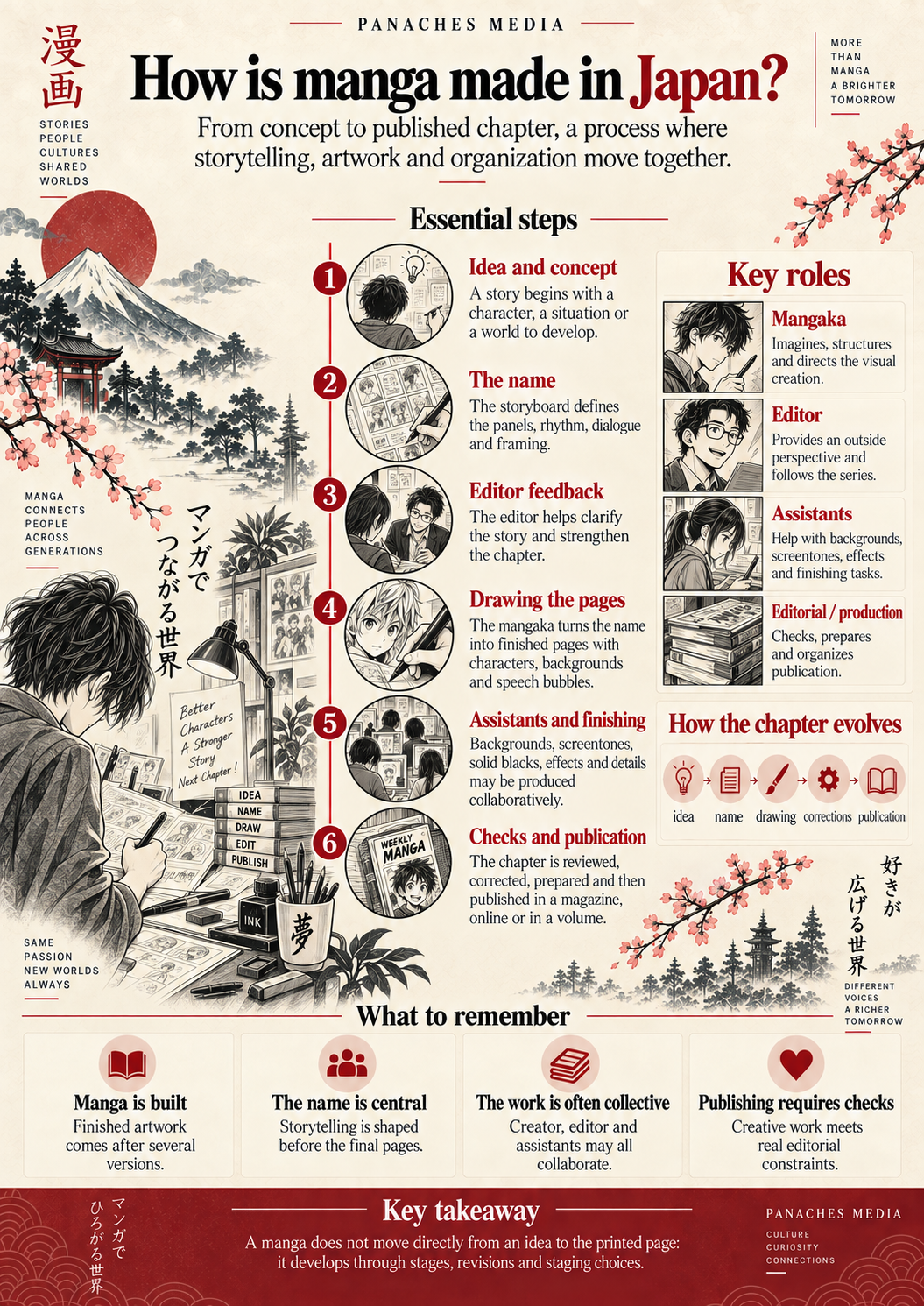
In broad terms, the process looks like this:
idea → development → name → editorial discussion → drawing → finishing → checks → publication
The part visible to readers — the finished artwork — therefore comes relatively late.
From the idea to the name: building the chapter before finishing it
A new story can begin with a character, a conflict, an image, a world or simply a situation the creator finds strong enough to explore.
At this stage, the main question is not yet whether the backgrounds will look beautiful or whether the linework will be perfectly controlled. First, the creator has to determine whether the idea works as a story.
Who is the main character? What do they want? What prevents them from moving forward? Why tell this story rather than another? And above all: what will make the reader want to turn the page?
In professional Japanese publishing, these questions may be discussed very early with an editor in charge, commonly called a tantō. The editor follows the creator and provides an initial outside perspective on the project.
Their role is not simply to correct mistakes once the pages are finished. Editorial work can begin during the construction of the concept itself and continue throughout the entire series.
The name, the skeleton of the future chapter
Before the finished pages comes one of the most important stages: the name.
The term refers to the manga storyboard. Visually, it can be extremely simple: characters drawn with only a few lines, backgrounds barely indicated, and movements reduced to an arrow or short note.
And yet, almost all of the storytelling is already there.
| In the name | What is being built |
|---|---|
| Panel layout | Size, number and organization of panels |
| Pagination | Distribution of the story across the available pages |
| Framing | What the reader will see and in what order |
| Dialogue | Content of conversations and approximate placement of speech bubbles |
| Rhythm | Action, pause, reveal, silence and transition |
| End of the chapter | The impression left on the reader and the desire to continue |
The name mainly makes it possible to experiment without immediately paying the cost of finished artwork.
Does a reveal happen too early? A few panels can be moved. Does a conversation take five pages when it only deserves three? It can be tightened. Does the end of the chapter lack impact? The entire page structure can still be reworked.
In other words, the rough draft is not what comes before the real work: it is where a large part of the real storytelling work happens.
This is also where some of the decisions discussed in our previous article on manga’s visual language begin to take shape. A spectacular full-page image, the silence before a reveal or a sequence of close-ups are not necessarily added at the last minute: they may already be planned in this first structure.
Mangaka and editor: two perspectives on the same story
Once the name is developed enough, the creator may submit it to the editor in charge.
This relationship is often caricatured in both directions. Sometimes the editor is imagined as someone who dictates the story; elsewhere, as little more than an intermediary who collects the pages.
The reality varies much more.
The creator holds the vision of the world and knows what they want to tell. The editor mainly brings a different perspective: that of someone who can ask what the reader will actually understand from the information available on the page.
A motivation may seem obvious to the creator because they already know the whole story, but remain unclear in the chapter. A scene they love may slow the pacing. Conversely, a detail they consider ordinary may be exactly what gives the protagonist personality.
Discussions can therefore concern both storytelling and staging:
- a character’s motivation;
- the order of a reveal;
- the length of a sequence;
- the clarity of a fight;
- the rhythm of a conversation;
- the final page of the chapter.
Of course, not everything is constantly reworked. Some collaborations are highly interventionist, while others are much lighter.
But this stage mainly shows that professional manga creation is often a dialogue rather than an entirely solitary path.
For Demon Slayer: Kimetsu no Yaiba, editor Tatsuhiko Katayama has for example described working with Koyoharu Gotouge on the series’ early proposals and on Tanjiro’s characterization. Interviews about My Hero Academia likewise show that developing the launch required particularly extensive work before the foundations of the series were considered strong enough.
The time spent here may remain invisible.
Yet it can prevent several days from being spent finishing a scene that should have been corrected at the storyboard stage.
From the name to the page: telling the story a second time
When the chapter’s structure is solid enough, another phase begins: transforming those rough drawings into actual pages.
The mangaka revisits every panel and gives it its final form. Characters gain precise expressions, backgrounds appear, perspectives are constructed and details gradually fall into place.
But it is not simply a matter of “redrawing the rough version more beautifully”.
A standalone illustration and a manga panel do not follow exactly the same rules.
An image can be beautiful on its own and still slow down the reading experience. An extremely detailed background can draw the eye away from the real focus of the scene. Conversely, a deliberately simple panel can be perfect if it immediately guides the reader toward the next one.
Characters, framing and speech bubbles work together
The finished drawing must preserve the movement imagined in the name while giving it greater precision.
A pose can define the violence of a blow. A close-up can reveal hesitation. A few extra centimeters between two characters can increase the emotional distance between them.
Even speech bubbles are part of this staging.
They take up space and influence the path of the eye. Dense dialogue has to be anticipated so that it does not cover the artwork or force the reader to backtrack. Conversely, a very short line may allow much more of the panel to breathe.
Drawing, text and layout are therefore not three independent layers added one after another.
They have to work together.
Paper, tablet or a combination of both?
The profession has long been associated with a very recognizable set of tools: pencil, dip pen, black ink, rulers, drawing paper and sheets of screentone.
Those tools still exist.
But contemporary studios may also work with tablets and software such as Clip Studio Paint, which directly integrate panels, speech bubbles, perspective tools, screentones, effect lines and drawing tools.
Between the two approaches are many hybrid methods. A creator may draw characters on paper and add screentones digitally, or prepare the name on a tablet before inking certain pages by hand.
The move to digital mainly changes how certain tasks are carried out, not the questions the creator must answer.
Software can generate accurate perspective.
It cannot know whether that perspective improves the scene.
It can move a panel in seconds.
It cannot know whether the new rhythm is better.
Technology therefore speeds up certain operations, but the storytelling choice remains human.
The studio: when several people contribute to the same chapter
Not every manga is produced by a large team.
But when a series has to deliver a substantial number of pages regularly, the mangaka may work with one or more assistants.
Their role is often misunderstood. They are not simply there to “finish the drawings” after the creator.
Depending on the studio, assistants may have very precise responsibilities: urban backgrounds, vegetation, complex buildings, vehicles, solid blacks, screentones, speed lines or different finishing stages.
Work can therefore be distributed according to individual skills.
Mangaka main characters, staging, storytelling choices and overall visual coherence. Assistants certain backgrounds, textures, effects and production tasks defined by the studio.The boundary is obviously not identical everywhere. Some creators delegate a great deal, others very little.
Assistant recruitment notices published by Japanese editorial departments give a concrete sense of this variety: one listing may look for someone particularly skilled at backgrounds, another may require precise knowledge of Clip Studio, while another studio may favor traditional finishing techniques.
When the schedule changes the organization
This division of labor becomes especially meaningful when a series is published weekly.
A new chapter has to be prepared while the previous one has barely been completed. The next name may already be progressing while assistants finish certain elements of the current chapter.
It would nevertheless be misleading to imagine one universal weekly schedule. Timelines vary according to magazines, creators and working methods. A monthly series may devote more time to certain pages, while a digital work may follow a completely different rhythm.
But one constraint remains: creation has to meet a deadline.
This is where one of the least romantic dimensions of the profession appears. An excellent idea requiring three weeks of drawing is not always compatible with a chapter expected within a few days.
The process must therefore constantly balance ambition, readability and the time actually available.
Inking, screentones and effects: giving the page its final texture
Once characters and backgrounds have been constructed, the page still needs to acquire its visual balance.
Inking clarifies forms and establishes line hierarchy. Solid blacks create contrast. Screentones provide different shades of gray, shadows and textures. Speed lines can emphasize movement or tension, while sound effects sometimes become part of the artwork itself.
This stage may appear mainly graphic.
Yet it is still part of the storytelling.
A very dark panel following several light pages can signal a rupture. A delicate screentone can soften an exchange. A background that suddenly disappears can emotionally isolate a character.
Finishing therefore does not mean adding effects until the page looks “more like manga”.
It should reinforce the intention of the scene.
The more a visual effect attracts attention, the stronger the reason for using it should be.
This is also where studio coherence becomes particularly important. If several assistants are involved, the elements they produce must remain compatible with the mangaka’s drawing and with the rest of the chapter.
The reader should not feel as though a street, a character and an effect belong to three different works.
Correcting, checking, publishing
When the pages appear finished, the chapter is not necessarily ready to reach the reader.
The editorial team must receive the manuscript, check the graphic and textual elements, prepare the files and carry out final controls before approval.
A dialogue error may need correction. A continuity detail may cause a problem. A page may contain a technical issue or an element placed too close to an area that will be trimmed during printing.
These corrections may seem tiny compared with drawing an entire chapter, but they are part of the production process.
And after the first publication?
A chapter published in a magazine or on a digital platform is not necessarily fixed forever.
When it is later included in a tankōbon, several chapters are collected into one volume. Some pages may then be corrected or slightly revised, mistakes removed and additional material added depending on the series.
The same chapter can therefore exist in several forms:
first name → drawn version → published version → corrected volume version
This progression is interesting because it reminds us that a published work does not instantly appear in its final form.
It also has its own production history.
From the first sketch to the finished chapter
If we summarize the process, making manga almost looks simple:
idea → name → approval → drawing → assistants → finishing → corrections → publication
But that line hides the most important part: the many returns and revisions.
A scene may go back to the storyboard after being drawn. A problem discovered in one panel may require changes to the entire page. An editor’s comment may trigger a new version of the chapter. A background that is technically too ambitious may force the team to find another solution.
Creation therefore moves forward less like an assembly line than a succession of increasingly refined versions.
Who actually takes part?
| Role | Main responsibility |
|---|---|
| Mangaka | Imagines, writes, structures and directs the visual creation |
| Editor in charge | Follows the project, discusses it with the creator and provides an outside perspective |
| Assistants | Contribute to certain graphic and technical tasks |
| Editorial / production team | Prepares, checks and organizes publication |
Depending on the work, a single person may handle many more stages, or the team may instead be larger.
What matters is not finding one universal model, but understanding that the printed page is only the final visible layer of the process.
Behind twenty pages may lie several versions of the chapter, hours of discussion, backgrounds produced by an assistant, invisible corrections and sometimes choices made simply because a deadline is approaching.
A mangaka’s skill therefore does not consist only in knowing how to draw.
They also have to imagine, structure, choose, cut, correct, coordinate and start again.
It is precisely this combination of artistic creation and production constraints that makes manga production so distinctive.
Once the manuscript is finished, however, the work changes scale again. The chapter joins a magazine or platform, episodes are collected into volumes, readers react and some works begin to move toward animation, video games or international markets.
After looking at how manga is made, the next step is therefore to examine the machinery that allows it to exist over time: the manga industry.
Main sources
To explore this process further: Shueisha for the organization of manga editorial departments and the role of editors in charge; MANGA Plus for interviews about the production of series such as Demon Slayer: Kimetsu no Yaiba and My Hero Academia; assistant recruitment notices published by Weekly Shōnen Jump for the practical organization of manga studios; and Clip Studio Paint / Celsys for contemporary production, screentone and page-layout tools.