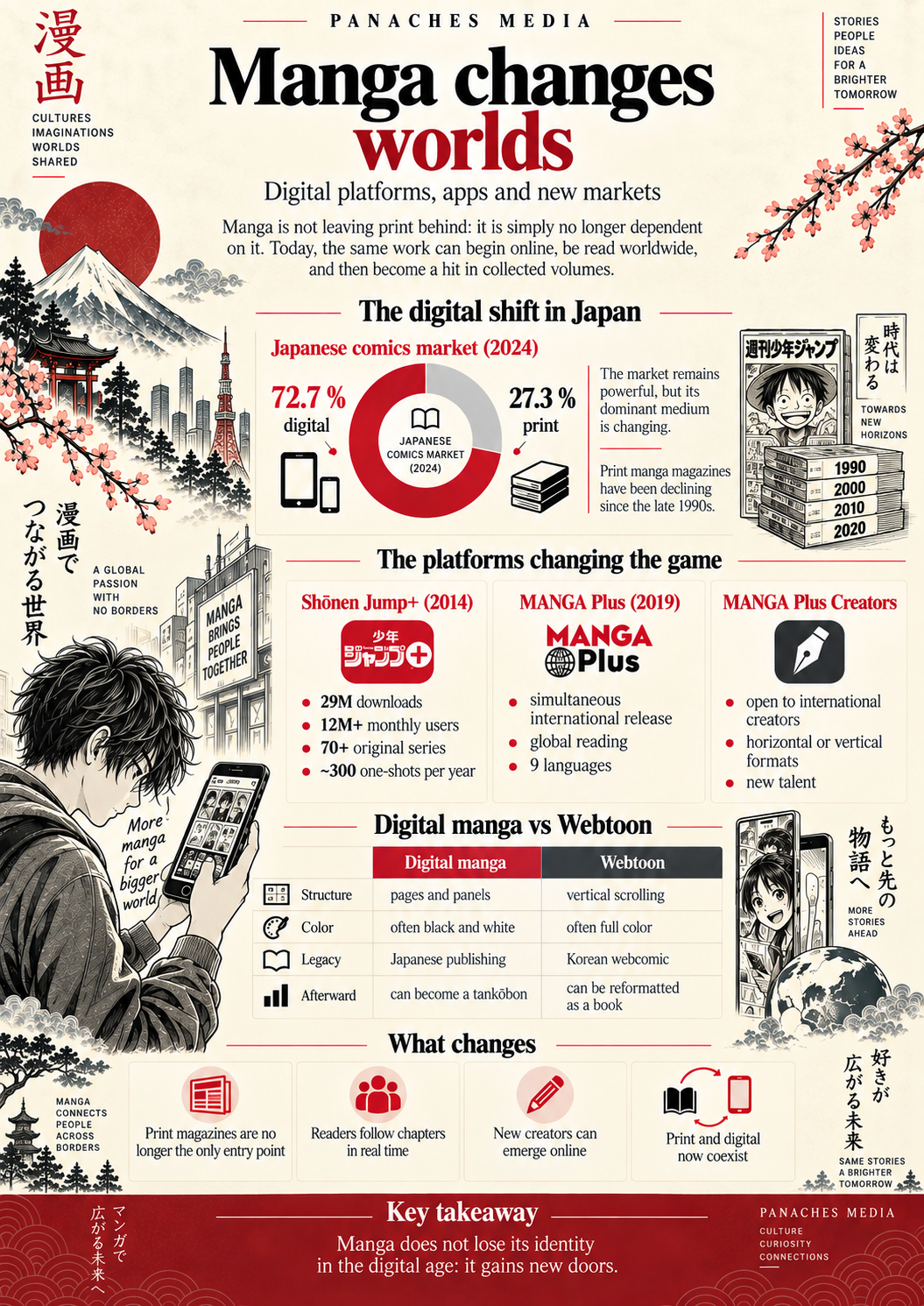
Manga is not leaving print behind: it is simply no longer dependent on it
For decades, the path of manga appeared relatively stable. A series found a place in a magazine, was published chapter by chapter, collected into tankōbon, then translated, exported and sometimes adapted into anime.
That model still exists.
But it is no longer the only one.
Smartphones, reading apps and digital platforms have profoundly changed how manga is published, discovered and distributed. A series can now begin directly online, find an audience without passing through a print magazine, be read in Japan and abroad at the same time, and later become a bookstore success after first existing on a screen.
This does not mean that print is disappearing. Collected volumes remain essential, major publishing houses still play a central role, and bookstores continue to give works a lasting physical presence.
The real transformation lies elsewhere: the print magazine is no longer the only gateway into serialization.
Contemporary manga now moves between print, apps, international platforms and online communities. The same work can pass from one to another without following the traditional route in the same order.
This evolution changes reading habits.
It also changes creation, publishing and even the definition of what we call “manga”.
The digital shift is already a reality
The change is particularly visible in Japan.
The manga market remains extremely strong, but its growth now relies heavily on digital distribution. According to the Research Institute for Publications, the comics market exceeded 700 billion yen in 2024, reaching a new record. The breakdown is even more revealing: 72.7% of the market came from digital manga, compared with 27.3% for print.
The paradox is important.
Manga itself is not declining.
Its dominant medium is changing.
Print manga magazines, on the other hand, face a more difficult situation. The Institute notes that the manga magazine market has been shrinking since the second half of the 1990s, while apps and web-born series have gradually become more important as serialization spaces.
The historical model has therefore not disappeared, but its centre of gravity has shifted.
In the 1990s, discovering a new series often meant buying a magazine containing dozens of chapters. Today, a reader can open an app, select only the titles they care about, receive a notification when a new episode is released and immediately begin another recommended work.
The experience is no longer the same.
The magazine offered a catalogue imposed on the reader.
The app gradually builds a catalogue around the reader’s own habits.
Shōnen Jump+: when the magazine becomes an app
Shueisha provides one of the clearest examples of this transformation.
In September 2014, the publisher launched Shōnen Jump+, a digital manga app and platform. The goal was not simply to reproduce Weekly Shōnen Jump on a screen, but to create a real editorial space capable of hosting its own original series.
At first, the experiment was far from guaranteed to succeed. Shueisha has explained that it was difficult to convince creators to produce works specifically for smartphones, and that the team behind the service initially consisted of only a small number of editors.
Ten years later, the landscape looks completely different.
For the tenth anniversary of Jump+ in 2024, Shueisha announced 29 million downloads, more than 12 million monthly users across the app and browser, over 70 original series updated regularly and around 300 new one-shots published each year.
Most importantly, the platform proved that a digital manga could move far beyond the screen.
Series originating on Jump+ have later been published in collected volumes, adapted into animation and distributed internationally. Digital publication is therefore no longer necessarily a secondary edition that comes after print.
It can become the place where the work begins.
The one-shot has also found a new role
Digital publishing also makes short-form work easier to release.
In a print magazine, every page is a limited resource. An app can much more easily host experiments, standalone stories or creators who are not yet established.
The one-shot therefore becomes an editorial laboratory.
A story can be published, circulate rapidly, attract reader attention and allow editors to identify new talent or new ideas. Some will remain isolated experiments; others may become the starting point for a series.
The web does not eliminate editorial selection.
It multiplies the places where that selection can begin.
MANGA Plus: publishing in Japan and being read worldwide
The transformation becomes even more important when digital publishing meets international distribution.
For a long time, foreign readers were necessarily months or even years behind readers in Japan. They had to wait for a work to be licensed, translated and published in their country.
The internet gradually made that delay less acceptable.
Shueisha launched MANGA Plus by SHUEISHA in January 2019 around a simple but structurally important idea: readers around the world could officially access selected new chapters at the same time as their Japanese publication.
The service is presented around three core ideas: reading in many territories, accessing works in several languages and discovering new chapters as they are released in Japan.
This fundamentally changes the cultural circulation of manga.
A French, Spanish, Brazilian or Indonesian reader is no longer necessarily a late observer of a phenomenon. They can follow a series while it is still being built.
By 2024, Shueisha stated that MANGA Plus was providing simultaneous translations in nine languages and distributing works from several of the group’s editorial departments, including Weekly Shōnen Jump, Shōnen Jump+, Jump Square and Weekly Young Jump.
The boundary between a “Japanese release” and an “international release” is beginning to shrink.
From anime simulcast to manga simulpub
Animation had already accustomed audiences to following certain series almost at the same time in Japan and abroad.
Manga is gradually adopting a comparable model.
A chapter becomes a global event.
Discussions, theories, reactions and recommendations emerge almost simultaneously in several languages. A work no longer necessarily builds a Japanese community before finding an international audience: both can now grow together.
Simultaneous publication also addresses another issue: providing a legal alternative to unauthorized scan circulation, which was long encouraged by the delay between Japanese and foreign release schedules.
Distribution speed therefore becomes part of the publishing model itself.
The web is also changing how people become mangaka
Digital platforms are not only changing the path followed by works already selected by a major publisher.
They are also changing access to creation.
A creator can now publish pages on a personal website, through social media, inside a specialist community or on an open platform. A work can begin as a personal project, gradually find an audience and later attract the attention of an editorial team.
This was much harder when publication depended almost entirely on a handful of magazines with a limited number of pages.
Major publishers themselves have begun adapting to this change.
MANGA Plus Creators by SHUEISHA, for example, allows creators to submit their manga directly to a platform available worldwide. The service accepts different reading directions — horizontal or vertical — and organizes monthly awards that can lead some works toward publication on MANGA Plus.
One detail is particularly revealing: the platform does not require the creator to be Japanese.
Nor does it require the work to look exactly like a manga published twenty years ago in Weekly Shōnen Jump.
What increasingly matters is the ability to tell stories using manga language and to find an audience.
The term “mangaka” remains culturally strongly associated with Japan, but the visual and narrative practices of manga now circulate far beyond the country’s borders.
“Global manga”: when the style travels without a passport
For several years, the expression global manga has been used rather loosely to describe comics created outside Japan but strongly influenced by manga in their drawing, paneling, storytelling or publishing formats.
It is not an editorial category as clear as shōnen or seinen.
And the boundary quickly becomes subjective.
If a French creator draws in black and white, uses right-to-left reading and is influenced by Dragon Ball, are they automatically making manga? Is an American work with Japanese-style paneling but published in a large Western format still manga? Should we look at the country, the style, the publisher or the way the creator describes their own work?
There is no universal answer.
But the fact that these questions even exist shows how much manga has become an international language.
Influence no longer moves in only one direction either. European, American, Chinese, Korean and other creators use codes inherited from manga, while Japanese artists themselves now work in an environment shaped by global cinema, video games, digital illustration and internet culture.
Manga remains deeply connected to Japan.
But culturally, it is no longer confined within Japanese borders.
Manga and webtoon: two worlds beginning to touch
Digital publishing has also brought manga closer to another model that has become impossible to ignore: the webtoon.
Developed especially in South Korea, webtoons were designed for online reading and later for smartphones. Where traditional manga generally retains a page-based logic, webtoons often rely on continuous vertical scrolling.
That difference directly influences storytelling.
| Digital manga | Webtoon |
|---|---|
| Often keeps a page-and-panel structure | Primarily read through vertical scrolling |
| Black and white remains common | Colour is much more common |
| Strongly inherits the Japanese publishing model | Inherits Korean webcomic and smartphone culture |
| Can later be printed as tankōbon | Can be reformatted for print editions |
| Horizontal or page-by-page reading remains common | Rhythm is built through vertical spacing between images |
This distinction is still useful.
But it is becoming less rigid.
Platforms now host multiple formats. Manga creators experiment with vertical layouts. Webtoons are adapted into books, anime and television series. Creators sometimes publish the same story in different forms depending on the territory.
MANGA Plus Creators itself accepts works in horizontal or vertical formats, showing that even a major Japanese manga publisher no longer treats page format as an absolute boundary.
WEBTOON, meanwhile, continues to expand its international model. In 2026, its CANVAS platform began unifying services for creators in order to make global distribution, translation and monetization across several languages easier.
Manga and webtoon are not becoming the same thing.
But they now evolve inside the same global digital environment.
Publishers are not disappearing: their role is changing
The apparent ease of publishing online might suggest that platforms will eventually make publishing houses unnecessary.
Reality is more interesting.
Editorial work still exists, but it is moving.
An editor can now observe reader reactions almost instantly, monitor the progress of a series on an app, coordinate multiple languages, prepare a print edition of a digital success or develop a work from the beginning for several markets.
The questions therefore change.
It is no longer only a matter of deciding which series deserves space inside a 400-page magazine.
Editors must also decide what rhythm works best for an app, which chapters can be offered for free, how to convert a digital reader into a buyer of collected volumes, how to organize simultaneous translation or how to support an international community.
Digital publishing also introduces new business models: advertising, chapter purchases, subscriptions, early access, limited free reading or combinations of several systems.
No single model has won.
As with print serialization, every publisher and platform is looking for its own balance between access, reader retention and creator compensation.
Print still has something an app does not
The spectacular rise of digital manga might tempt some people to predict the imminent disappearance of printed manga.
That would be far too simplistic.
The physical volume still serves several essential functions.
It turns a digital series into a lasting object. It can be collected, gifted, resold and placed on a shelf. It also exists as a visible cultural product in bookstores, whereas a digital series can more easily disappear inside an enormous catalogue.
Print and digital are therefore not necessarily enemies.
They can reinforce one another.
A series is discovered for free in an app, then bought in collected volumes. An anime adaptation brings new readers toward the digital version. A box set or special edition later brings the physical version back into focus.
The path becomes circular rather than linear.
App → readers → volume → anime → new readers → app
Contemporary manga thrives precisely on these constant movements between media.
From the Japanese market to a global market
The deepest change may ultimately be geographical.
Twentieth-century manga was mainly produced for a Japanese market before being exported.
Twenty-first-century digital manga can be conceived from the start inside an environment where the audience is already international.
MANGA Plus can make a chapter available in several languages when it is released. MANGA Plus Creators allows creators from around the world to submit their work. Social media can make a series visible in another country before a local publisher even becomes involved.
The concept of the “foreign market” therefore begins to change.
Territorial rights, translation contracts and local publishers still exist. But culturally, borders can now be crossed much faster.
A Japanese manga can immediately find French readers.
A French creator can be discovered by a Latin American reader.
A Korean work can adopt manga codes.
A manga can experiment with vertical scrolling.
The future therefore probably does not look like traditional manga being replaced by one new universal format.
It looks more like a multiplication of possible paths.
More digital, but above all more open
Manga’s move into the digital world does not mean the end of everything that built the medium.
The mangaka is still a creator.
The editor is still an essential intermediary.
Serialization still exists.
Collected volumes still matter.
And a good story still needs to make the reader want the next chapter.
What changes is where all of these things can happen.
Yesterday, the dominant route began with a Japanese magazine, then moved toward the tankōbon and finally foreign markets.
Today, several trajectories coexist:
magazine → volume → international
app → volume → anime
web → publisher → series
international platform → global readers → local edition
independent creator → community → professional publication
Manga does not lose its identity by entering the digital world.
It gains new doors.
This transformation also brings our journey through manga history to a natural conclusion. From illustrated scrolls to mass-market magazines, from reading direction to demographic categories, from the mangaka’s studio to the publishing industry, and from the conquest of France to global platforms, manga has never stopped transforming.
And that is probably the best way to understand its future:
Manga does not survive because it stays the same. It stays alive because it can change medium without stopping telling stories.
Main sources
To explore this transformation further: the Research Institute for Publications / All Japan Magazine and Book Publisher’s and Editor’s Association for changes in the print and digital comics market; Shueisha for the history and development of Shōnen Jump+; MANGA Plus by SHUEISHA for simultaneous international publication; MANGA Plus Creators by SHUEISHA for access by international creators and horizontal or vertical formats; and WEBTOON for the evolution of global webcomic and digital-creation platforms.