Once the chapter is finished, another story begins
In the previous article, we followed the production of manga from the initial idea to pages ready for publication. But when the mangaka delivers the chapter, the journey of the work is far from over.
The manga then enters a much larger system. It needs a place in a publication, a schedule to follow, readers to attract and retain, chapters to collect into volumes, and — when a series moves beyond its first market — translations, foreign editions and adaptations to negotiate.
This second life is essential to understanding the Japanese manga industry. For decades, its structure has been built around a particularly important relationship between the magazine, the serialized series and the collected volume. Digital publishing has deeply changed this model, but it has not erased it.
The chapter is the basic unit of serialization; the collected volume gives the work a lasting form. Between the two, an entire economy takes shape.
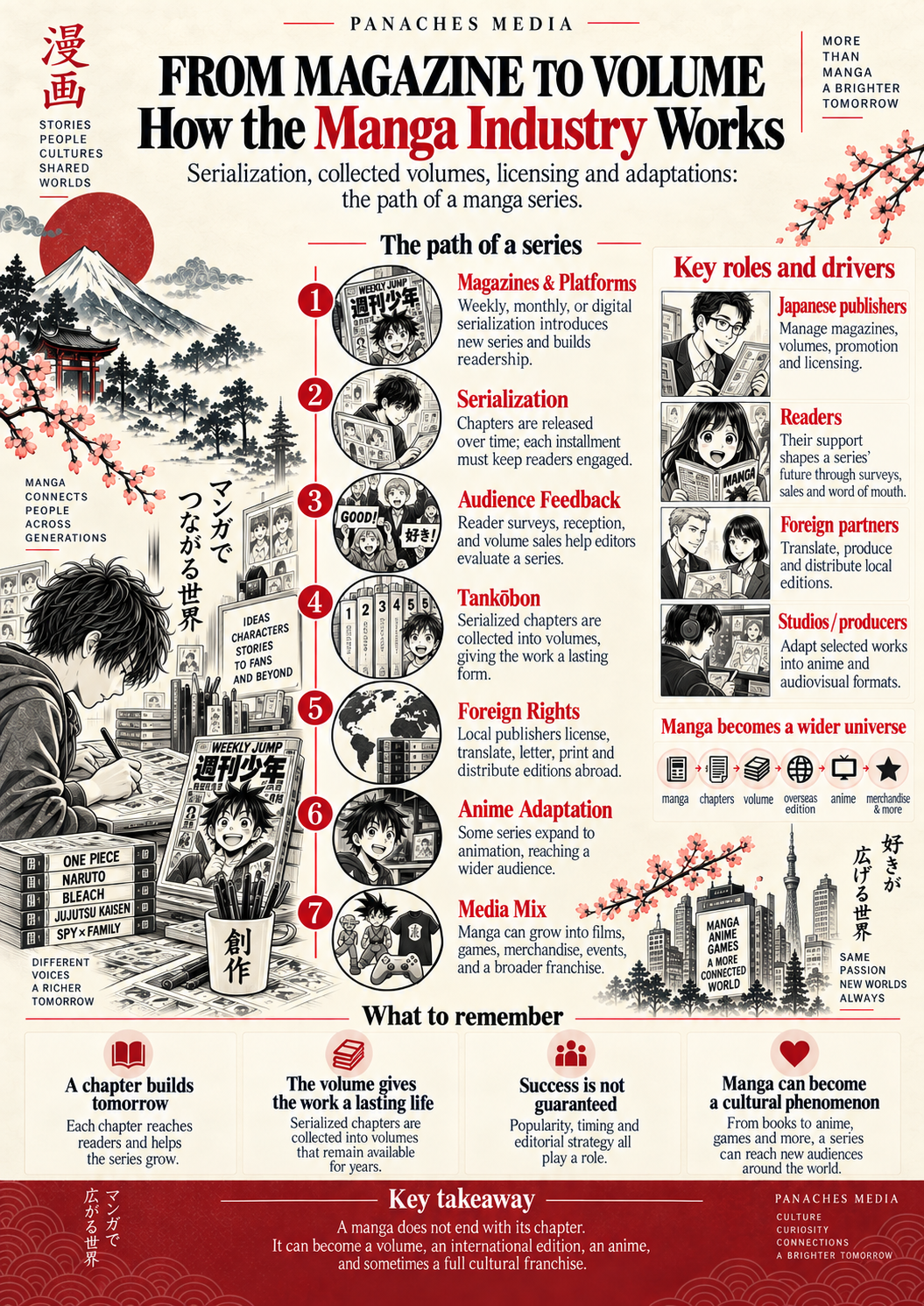
A series can therefore begin in a magazine, be discovered week after week by its first readers, become a collection of volumes, travel to other countries and eventually turn into an anime, film or video game.
Of course, not every work follows this path all the way through.
That is precisely what makes the industry so interesting.
The magazine: long at the heart of the system
For much of modern manga history, magazines have been the main meeting point between creators, publishers and readers.
Publications such as Weekly Shōnen Jump, Weekly Shōnen Magazine, Weekly Shōnen Sunday, Young Jump, Morning, Nakayoshi or Bessatsu Margaret do not publish a single manga. They bring several series together inside the same issue.
The reader therefore does not necessarily buy one isolated work.
They buy an editorial package.
This structure offers a major advantage: a new series can appear alongside already established titles and immediately benefit from their readership. Someone who buys a magazine to follow a favorite manga may discover several other creators, genres and opening chapters at the same time.
The magazine becomes both a product and a discovery platform.
Weekly or monthly: two very different rhythms
Publication frequency directly affects how a series lives.
A weekly magazine must provide new episodes at a very regular pace. Readers return quickly to the characters, but the production schedule can be extremely demanding. A monthly publication generally leaves more time between chapters and can offer longer episodes.
That does not mean one rhythm is necessarily better than the other.
They simply create different editorial conditions.
| Publication | Main consequence |
|---|---|
| Weekly | Frequent chapters, strong continuity with readers, intense production rhythm |
| Monthly | Longer gaps between releases, often longer chapters, different working organization |
| Digital | More varied schedules, immediate distribution and sometimes more flexible formats |
Apps and digital platforms have introduced even more possibilities. Some series still follow a very regular schedule, while others use more flexible release patterns.
Print magazines are therefore no longer the only gateway into manga.
But their legacy still structures a large part of the industry.
Serialization means having to convince readers again and again
Publishing a first chapter is not the same thing as building a series capable of lasting for several years.
Serialization turns a story into a recurring appointment.
Each episode has to move the plot forward while also giving readers a reason to return for the next one. A mystery may be opened, a conflict renewed, a new character introduced or a situation deliberately left unresolved.
That requirement obviously shapes the storytelling, but it also has an economic dimension: a series takes up pages, mobilizes an editorial team and contributes to the identity of a magazine or platform. Publishers therefore have to observe how the work is being received.
At Weekly Shōnen Jump, this relationship with readers has historically been especially visible. Shueisha openly emphasizes the importance of reader questionnaires: audience reactions contribute to the evaluation of series and can allow new creators to compete with much more established names.
This culture helped create the image of an extremely competitive magazine.
But one important distinction is necessary.
A ranking does not explain everything
The life of a series cannot be reduced to a formula such as:
poor ranking = immediate cancellation
Reader feedback can matter a great deal, particularly in some magazines, but editorial decisions also take into account the direction of the work, its potential, collected-volume sales, the overall balance of the magazine, future projects and the creator’s situation.
Even the order in which series appear in a table of contents should not be interpreted as a perfectly transparent public ranking of their future.
The industry uses indicators.
It does not operate through one magical number.
This distinction matters because the Japanese manga industry is sometimes reduced to the image of a brutal competition in which every series is automatically judged week after week by a ranking.
Reality is more complicated.
Editorial teams follow works over time, observe several forms of reception and make decisions that combine creativity, audience response and publishing strategy.
Why some series stop while others continue for twenty years
A serialized manga can follow several very different paths.
Some stories are designed to be relatively short and reach their natural conclusion. Others find a large enough audience to continue for many years. Some, finally, end much earlier because they fail to build the expected readership or because their editorial trajectory becomes difficult to sustain.
The word “cancellation” can make it sound as though a simple switch separates success from failure.
In practice, a series always exists under several constraints.
A work has to find its audience, but it also has to maintain a place in a catalogue where new projects are constantly arriving. An editorial team must support existing titles while launching future ones. A creator has to be able to maintain the work over time.
The extraordinary longevity of a title such as One Piece is therefore not the universal model for manga.
For every series that spans decades, dozens of others will tell much shorter stories.
And that variety is necessary.
Without endings, magazines could never renew their catalogues.
From chapter to tankōbon: when a series becomes a collection
International readers often encounter manga in a form very different from its original Japanese publication.
They buy a volume.
In Japan, several previously serialized chapters are usually collected into a book known as a tankōbon. This stage changes the way the work exists.
In a magazine, a chapter shares space with many other series. In a tankōbon, the manga finally has its own object: cover, spine, continuous pagination, possible bonus material and a visual identity of its own.
The move to collected volumes also allows some corrections. A drawing can be revised, an error removed or a small detail adjusted between prepublication and the final book edition.
More importantly, the tankōbon gives the series a different lifespan.
A magazine issue is tied to a particular date.
A volume can remain available for years, be reprinted, complete a collection and continue reaching new readers long after the original serialization.
Two products, two functions
The magazine and the volume therefore do not serve exactly the same purpose.
The magazine follows the present of the series. The volume builds its library.
This distinction explains why collected-volume publication is economically so important. A series that builds reader loyalty chapter after chapter can then turn that audience into buyers of books.
The number of volumes itself becomes a very visible sign of a work’s growth.
A two-volume series does not occupy the same industrial position as a collection of thirty, fifty or one hundred volumes.
Behind manga stand major publishing houses
Internationally, manga is largely associated with creators and series, but behind them are powerful publishing structures.
Shueisha, Kodansha and Shogakukan are among the best-known Japanese publishers in the field, alongside many others such as Kadokawa, Hakusensha, Square Enix, Akita Shoten and Futabasha.
Each operates its own magazines, brands, apps, collections and editorial lines.
A series therefore belongs to a much larger environment than its title alone.
A publisher may manage serialization, produce collected volumes, coordinate promotion, develop digital editions, support adaptations and organize international exploitation.
At Shueisha, the work of a manga editor officially extends beyond manuscript supervision. It can also include volume editions, reader events, merchandise supervision and work around animated or audiovisual adaptations.
The manga gradually becomes a complete publishing project.
Digital publishing has shifted the boundaries of serialization
For a long time, a reader outside Japan had to wait for a local publisher to acquire a license, translate the series, produce the volumes and distribute them in their country.
That process sometimes created a considerable delay between Japanese publication and international discovery.
Digital publishing has begun to reduce that distance.
Services such as MANGA Plus by SHUEISHA can now release selected chapters officially in several languages at the same time as their Japanese publication. This significantly changes the relationship between serialization and international distribution: a foreign reader can follow the current life of a series almost at the same moment as readers in Japan.
Manga therefore no longer travels only after becoming successful domestically.
It can begin building a worldwide readership while it is still being serialized.
This development does not replace foreign publishers or translated print volumes.
It adds another layer to the system: Japanese publication, international digital reading and local editions can now coexist.
How does a manga reach a foreign publisher?
When a manga is published in France, Spain, the United States or elsewhere, it is obviously not enough to translate a few files and send them to a printer.
The publisher needs publishing rights.
The Japanese publisher or rights holder authorizes a foreign partner to exploit the work within a defined territory, language and contractual framework.
The local publisher then has to produce its own edition: translation, graphic adaptation, lettering, manufacturing, printing or digital publication, distribution and promotion.
That is why the same work can follow different release schedules and appear in different editions depending on the country.
Titles themselves may sometimes be adapted.
Covers may receive market-specific elements.
Volume size, paper or bonus material can vary.
Even when the manga is already fully complete in Japan, its international publication remains a new editorial project.
Shueisha states that its manga are now published in more than eighty countries and territories through various partners, VIZ Media and its own international services.
The worldwide circulation of manga therefore depends on a broad network of licensing agreements and collaborations.
Anime: an adaptation, but also a change of scale
For some series, a new stage radically changes their visibility: anime adaptation.
Not every manga becomes an anime.
And an anime is not an automatic reward triggered by reaching a certain sales figure.
An adaptation requires partners, funding, a production team, an animation studio, a broadcaster or platform and a schedule capable of bringing all of these elements together.
When it succeeds, however, it can expose the work to an audience far larger than that of the original manga.
Some viewers discover the anime first, then buy the volumes to continue the story or return to its original form. An adaptation can also lead to new print runs, more translations and greater visibility in bookstores.
The manga and anime can then begin reinforcing one another.
Adapting does not mean simply copying the panels
Moving into animation also requires genuine interpretation.
The rhythm of a page has to become screen time. Movement, voices, music, sound effects and audiovisual staging must be added. Some sequences may be condensed, expanded or reorganized.
The manga publisher may also take part in this process by communicating the creator’s intentions and supervising certain aspects of the adaptation.
At this point, the industrial role of the publishing house extends far beyond simply producing a book.
From manga to franchise: the logic of the media mix
When a work becomes popular enough, it can begin to exist across several media at the same time.
Manga.
Anime.
Film.
Video game.
Merchandise.
Events.
Commercial collaborations.
This logic is often described in Japan through the idea of the media mix: the same fictional universe circulates across several media, with each one potentially directing new audiences toward the others.
It is not necessarily a plan that exists from the very first chapter.
Many series simply begin as manga and only develop this dimension after finding an audience.
But once a title becomes a particularly strong intellectual property, its value no longer depends only on the number of volumes sold.
A character may appear on clothing.
An exhibition can travel between cities.
A film can reignite interest in a completed series.
A video game can reach people who have never opened the manga.
The book remains the origin of the work, but the universe itself begins to become a cultural brand.
Success still never follows a guaranteed formula
From the outside, the path can look almost mechanical:
magazine → success → volumes → anime → merchandise → worldwide phenomenon
But that model only describes the most visible trajectories.
Some manga build excellent audiences without ever receiving an animated adaptation. Some anime are produced from series whose sales remain modest. A work can experience a revival years after ending. Another can be extremely popular in Japan and much less visible abroad.
The manga industry therefore has no recipe capable of automatically manufacturing a phenomenon.
Instead, it has several layers capable of amplifying a work when the circumstances align.
The magazine or platform creates discovery.
Serialization builds loyalty.
The tankōbon establishes the collection.
Translation opens new territories.
Adaptation changes the audience.
The media mix extends the universe further.
A work can stop at any one of these stages and still remain perfectly viable.
From a Japanese page to readers around the world
One of the most important changes of recent decades concerns the speed at which these different stages can now overlap.
In the past, a series could exist in Japan for several years before European or American readers became seriously aware of it.
Today, a new chapter can be available almost simultaneously in several languages, discussed online around the world and followed by an international audience while the Japanese serialization is still ongoing.
Shueisha uses MANGA Plus precisely to publish selected titles at the same time as their Japanese release, while local editions continue their own work on collected volumes.
The boundary between Japanese market and international market is therefore becoming increasingly porous.
This accelerated circulation now plays a major role in contemporary manga culture.
A global community can develop chapter after chapter instead of waiting several years to discover the work.
From magazine to volume, and then far beyond
The manga industry ultimately gives the same story several different lives.
In a magazine or on a platform, the series exists in the present. It has to find an audience, maintain its place and give readers a reason to return for the next chapter.
In the tankōbon, it becomes a lasting collection.
Abroad, it becomes a translated work adapted to a new market.
In anime, it changes language.
And when it develops into a franchise, its universe begins circulating far beyond the bookstore.
The progression can be summarized like this:
| Stage | Main function |
|---|---|
| Serialization | Introduce the work and keep readers following it over time |
| Audience response | Measure interest and support the series’ development |
| Tankōbon | Turn serialized chapters into a lasting collection |
| Foreign license | Adapt and publish the work in new markets |
| Anime / audiovisual | Reach another audience and give the story a new form |
| Media mix | Develop the universe across several media and products |
Manga then appears less like a simple book and more like the possible starting point of an entire cultural ecosystem.
But that ecosystem does not take the same form everywhere.
The arrival of manga in France offers an excellent example. Before becoming one of the largest markets outside Japan, it had to overcome cultural resistance, find its publishers, establish the original right-to-left reading direction and benefit from an entire generation raised on Japanese animation.
After examining the Japanese publishing machine, we can therefore follow its journey into another territory: how manga conquered France.
Main sources
To explore how this industry works in greater depth: Shueisha for the history of its magazines, editorial organization, the importance given to reader feedback and the development of works beyond print; MANGA Plus by SHUEISHA for simultaneous international publication and digital distribution; and institutional resources from Kodansha and Shogakukan for publishing, licensing and the international exploitation of manga.