Music often begins with listening.
Before a melody, a rhythm or a sound texture, there is sometimes an atmosphere we are trying to find again: a color, a tension, a memory, an energy, a voice, a silence.
Creating with sound is not only about producing a track.
It is learning to recognize what resonates.
Sound references as points of support
References play an essential role.
A track, a soundtrack, a loop, a street noise, an archive, a recorded voice or a simple atmosphere can become points of support.
We do not keep them in order to copy them.
We keep them in order to understand.
Why does this progression work? Why does this timbre move us? Why does this rhythm make us want to move forward? Why does this texture immediately set a scene?
Listening then becomes a way of analyzing.
Not only with the mind.
With the body, memory, attention and imagination.
When sound ideas scatter
In a musical or sound-based project, ideas scatter quickly.
An audio file in a folder. A note in a notebook. A reference in a browser tab. An image that gives an atmosphere. A sentence that could become a title. A structure sketched too quickly.
A project moves forward with all of this at once: sounds, words, images, intentions, attempts.
Sound does not always live alone.
It often dialogues with other forms.
An atmosphere can come from an image. A rhythm can be born from a scene. A texture can respond to a memory. A voice can change the entire meaning of a project.
Keeping fragments close
Panaches can serve as a workshop for keeping these elements together.
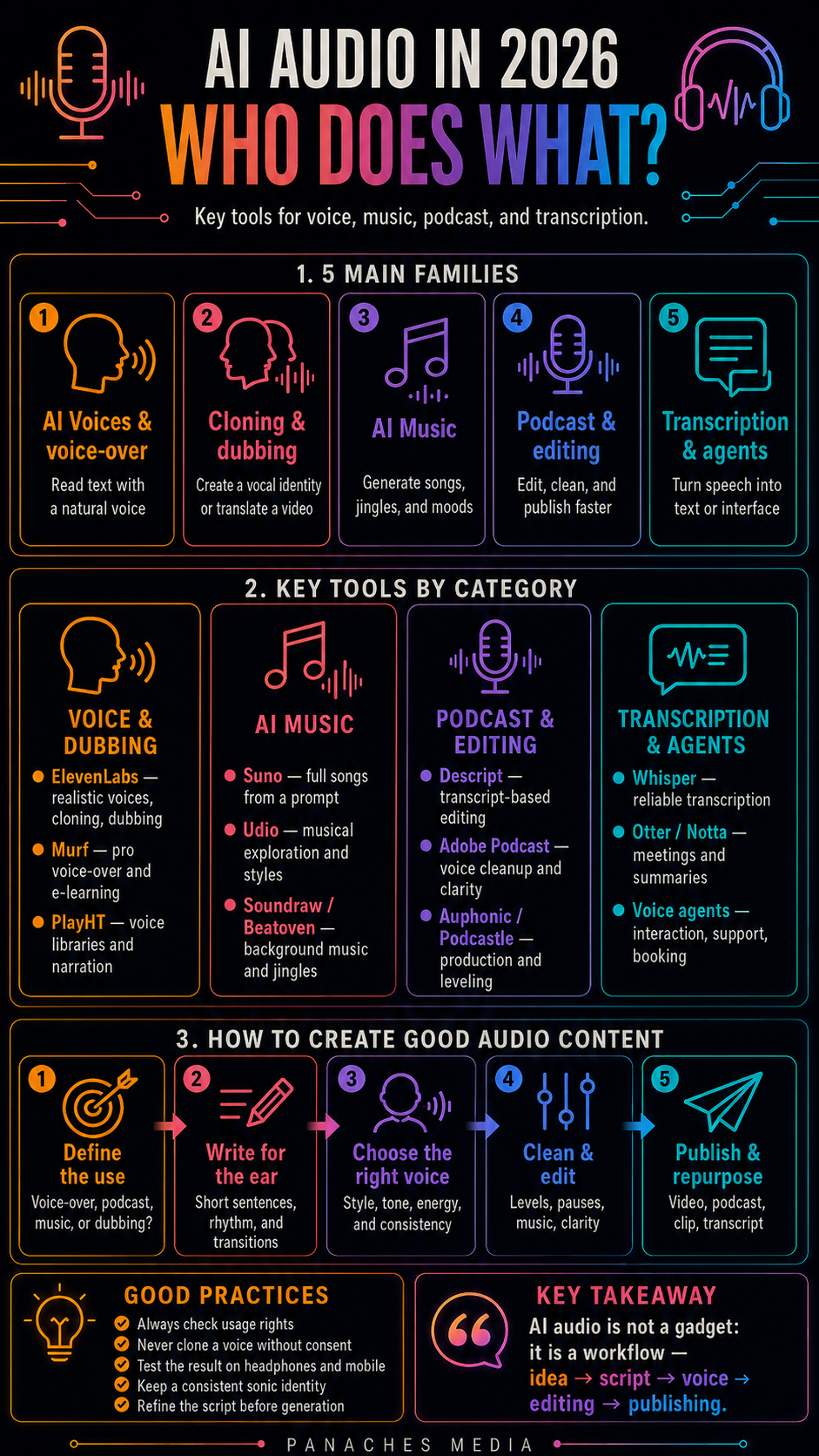
You can gather references, organize notes, prepare a visual atmosphere, open audio files, document an intention, build a library of fragments or connect a sound project to writing, video, image or narrative.
The goal is not to classify everything perfectly.
The goal is to keep enough continuity not to lose what feeds the listening.
A sound can become a lead. A note can clarify an intention. An image can set an emotional color. A reference can serve as a landmark for a texture, a dynamic or a structure.
Creating with several languages
This is especially true for hybrid creators.
A musician can think in images. A writer can build a scene from a sound atmosphere. A filmmaker can search for an emotional color before searching for a track. A developer can create an interactive world where sound guides the experience.
Music is not always isolated inside a single practice.
It crosses narrative, image, video games, installation, performance, editing and memory.
Creating with sound also means creating with what sound triggers.
Listening, choosing, transforming
Creating with music is not only about stacking tracks.
It is learning to listen, choose, organize, feel, associate and transform.
A good tool does not compose in your place.
It helps you keep close what feeds your listening.
A reference only becomes useful when it remains available at the right moment.
A sound idea only becomes a project when it can meet other elements: a text, an image, an intention, a structure, a space.
Key takeaways
Creating with sound often begins with listening: an atmosphere, a texture, a voice, a rhythm, a tension or a memory.
Sound references are not meant for copying, but for understanding what resonates and why.
A musical or sound-based project often brings together audio files, notes, images, ideas, structures and intentions.
Panaches can help keep these elements together to build a clearer sound workshop connected to other forms of creation.