A conquest that was never inevitable
Today, manga occupies such a visible place in French bookstores that it can seem almost natural within the country’s cultural landscape. Dedicated shelves can be found everywhere, new releases receive major promotion, and Japanese series have become as familiar to several generations as many Franco-Belgian classics. This can create the impression that France was always ready to embrace manga.
It was not.
Manga’s establishment in France was gradual, sometimes hesitant, often misunderstood and long accompanied by suspicion. Readers had to learn to read differently, publishers had to invent new commercial reference points, and cultural attitudes toward these works took time to evolve. Before becoming a pillar of the book market, manga was first treated as a foreign curiosity, then as a passing trend, before eventually being recognized as a fully legitimate part of comics and popular culture.
Its French history is especially fascinating because it does not rely on books alone. It also developed through television, schoolyards, video stores, the first specialized bookstores and later the major cultural retail chains. Manga was not simply imported: it was adapted, debated, sometimes distorted, and then gradually understood.
Manga did not conquer France all at once. It first entered the collective imagination before establishing itself on bookstore shelves.
Before manga shelves became common, television prepared the ground
If printed manga took time to establish itself, Japanese popular imagery had already found a more direct route toward French audiences: animation.
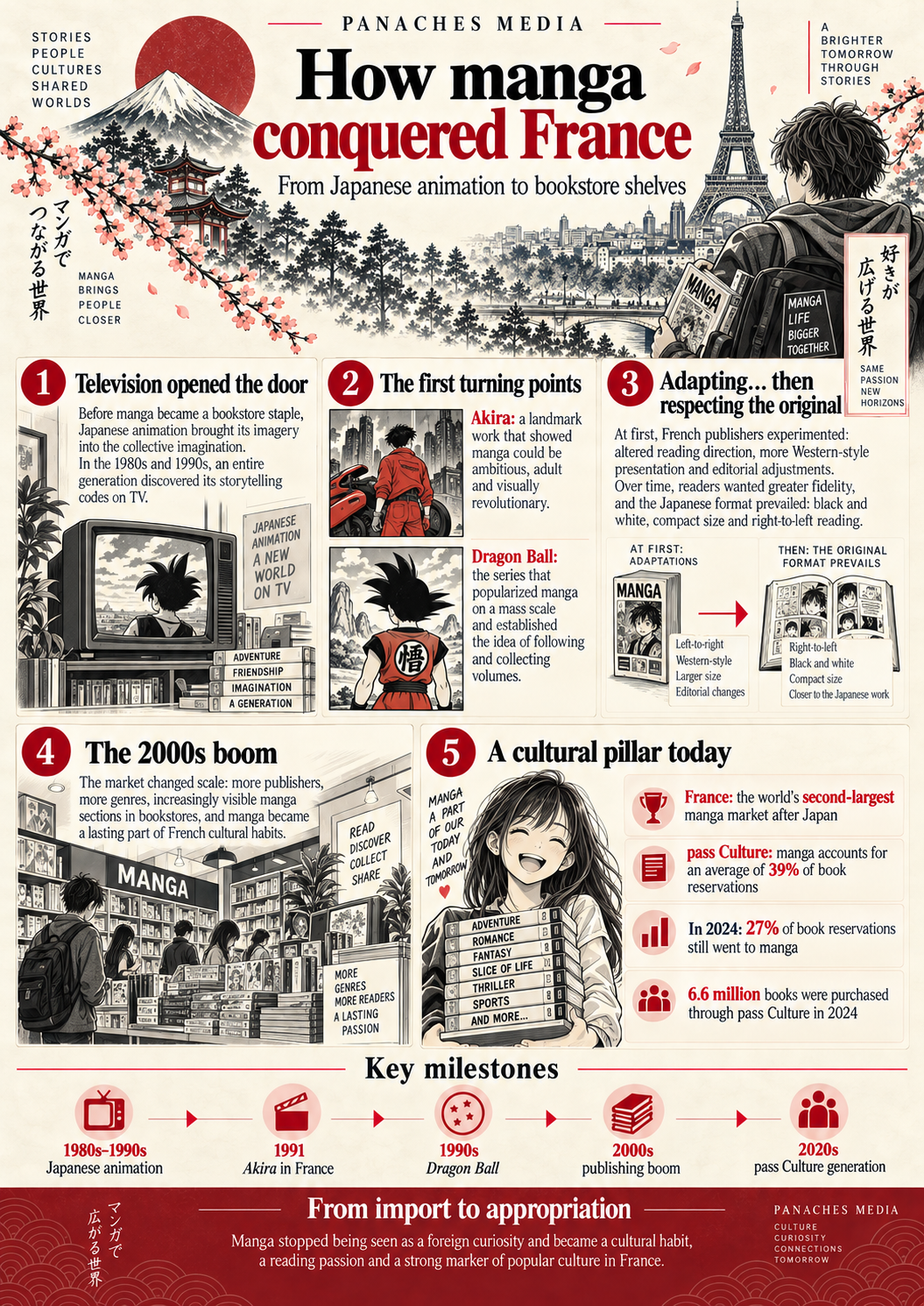
From the 1980s onward, and especially around the turn of the 1990s, many children and teenagers grew up watching Japanese animated series on television. For a large part of the public, the first encounter with this world therefore came not through books, but through cartoons. Names, faces, emotional codes, extended battles, transformations, coming-of-age stories and memorable theme songs left a lasting mark on an entire generation.
This point is essential because it explains why printed manga did not arrive in an empty cultural landscape. When publishers began offering volumes in bookstores, part of the public was already familiar with certain characters, certain universes and, more broadly, a Japanese way of telling stories.
This created one of the great French paradoxes: the country sometimes resisted manga as a book while already having partly embraced its culture through animation.
That familiarity did not remove all suspicion. Japanese animation was long described by some commentators as strange, excessive or violent. This critical atmosphere partly explains why the first steps of printed manga in France did not immediately resemble a triumph.
Akira and Dragon Ball: when manga became visible
One of the major turning points in France revolves around two names that have almost become symbols: Akira and Dragon Ball.
On the publishing side, Glénat played a decisive role. The company itself recalls that Jacques Glénat returned from Japan in 1989 with manga in his luggage, before the publisher began releasing manga in France from 1991 onward, first through newsstands and then bookstores. In its own history, Glénat cites Akira and later Dragon Ball as major landmarks in this opening. The case of Akira is particularly revealing: Glénat explains that an initial newsstand publication was only a partial success, but that the later collected editions truly helped launch the “manga revolution” in France.
Akira acted as a pioneer. Its visual power, ambitious science-fiction setting and more adult aura gave it an almost manifesto-like value: it demonstrated that manga could be something other than simple entertainment for children. The film, released in France in 1991, also helped establish this image of an aesthetic and cultural shock.
Dragon Ball worked differently. Where Akira impressed, Dragon Ball popularized. The series reached a much broader young audience already familiar with Japanese animation. Its success established the idea that manga could not only be read, but also collected, anticipated, shared and passed on.
To simplify slightly, we could say that one opened a cultural door, while the other proved that a genuine mass market was possible.
The early French years: manga adapted to local tastes
Manga published in France during the early 1990s did not always arrive in the form closest to its original Japanese edition.
Publishers experimented. They wondered whether readers would accept black-and-white artwork, long serialized formats, Japanese narrative pacing, frequent sound effects and, above all, the right-to-left reading direction, so different from French habits.
This led to various forms of adaptation: mirrored pages, partial rearrangement, graphic modifications, presentation closer to Western comics, or editorial choices intended to make the object seem less unfamiliar to an inexperienced readership.
These changes should not only be interpreted as cultural misunderstandings. They also reflect a transitional moment. Publishers were searching for a compromise between fidelity to the original work and commercial accessibility. They were operating in an environment where manga was not yet firmly established, and where there was no guarantee that a large audience would accept Japanese codes as they were.
This phase matters because it reminds us that manga’s French expansion did not happen in one clean movement. It passed through a period in which manga had, in a sense, to negotiate its own difference.
From adapted editions to respect for the original
One of the most decisive changes in the history of manga in France came when adaptation gradually stopped being the norm.
As the readership grew, series multiplied and manga culture became more established, readers became more demanding. They no longer simply wanted access to Japanese stories: they increasingly wanted them in a form considered closer to the original. Black-and-white artwork stopped being seen as a limitation and became understood as part of the medium. The smaller book format became familiar. Most importantly, the Japanese reading direction, once treated as an obstacle, gradually became a sign of respect for the original work.
The publication history of Akira at Glénat illustrates this evolution particularly well. The publisher recalls that in 1999, to celebrate the company’s thirtieth anniversary and ten years after this “new kind of comic” arrived in France, Akira was released again in its original black-and-white format. The gesture had strong symbolic value: what once had to be adjusted for the French market could now be promoted precisely because of its Japanese form.
In other words, France did not merely accept manga; it eventually learned to read it according to its own codes.
The 2000s: manga changes scale
Once the door had opened, expansion accelerated.
The 2000s marked a major change in scale. Manga no longer depended on only a handful of flagship titles: it became a structured publishing sector. New publishers and imprints gained visibility, catalogues diversified, genres multiplied, and booksellers increasingly treated manga as an essential part of the market rather than a niche product.
Several forces reinforced one another.
First, the generations that had grown up with Japanese animation reached the age at which they could buy books for themselves. Then, the growing number of series made it possible to reach much more varied audiences: adventure, sports, romantic comedy, fantasy, slice of life, thrillers, historical stories or more adult works. Finally, manga fitted particularly well with the logic of collecting: volume 1, volume 2, volume 3… Readers were not simply consuming a story; they were entering an ongoing continuity.
A few landmarks in this expansion
| Period | What changed |
|---|---|
| Late 1980s – early 1990s | First structured imports, Glénat’s pioneering role, still-fragile visibility |
| 1990s | Akira, Dragon Ball and the influence of Japanese animation create an initial foundation |
| 2000s | More publishers, broader genres and increasingly prominent manga sections |
| 2010s | Manga is no longer a passing fashion but a central part of youth publishing and pop culture |
| 2020s | Mass market, intergenerational readership, digital acceleration and the effect of the pass Culture |
Little by little, manga stopped being viewed as a “product from elsewhere” and became part of everyday French cultural habits.
France becomes a major manga market
This progression eventually produced a striking situation: France became one of the most important manga markets outside Japan.
The INA now notes that France has become the world’s second-largest manga market after Japan. This position does not rely solely on a handful of bestsellers, but on manga’s deep integration into the publishing landscape. Major book groups, general bookstores, specialist shops, retail chains, festivals, conventions and cultural media all contribute to its visibility.
France’s particular position can also be explained by its existing relationship with comics. The country already had a strong culture of the ninth art, with festivals, specialist bookstores, collecting habits and critical legitimacy. Manga therefore arrived in a country where comics were not regarded as a minor medium, even if its aesthetics and conventions challenged established habits.
The encounter was not immediate, but once it took hold, it became extremely fertile.
Manga benefited from two forms of support:
- an already strong comics culture, able to provide established distribution networks;
- a vibrant Japanese pop-culture ecosystem, carried by animation, video games and later the internet.
This combination helps explain why France became such fertile ground.
The pass Culture and today’s generation
Recent years show that manga is no longer simply a niche passion or a generational legacy. It is now fully embedded in the cultural practices of young readers.
Data published by the pass Culture is particularly revealing. In its analysis of the programme’s effects, the platform states that since its nationwide expansion, manga has represented an average of 39% of book reservations, although this share fell to 27% in 2024, suggesting a gradual diversification of reading habits. The pass Culture also notes that books remain the leading category reserved by 15- to 21-year-olds, with 6.6 million books purchased in 2024 and more than 28 million since the programme began.
These figures are interesting for several reasons.
First, they show that manga has acted as a gateway into reading for a significant part of the younger generation. They also show that this practice is not limited to a few famous titles: it forms part of a broader landscape in which young people build personal libraries, develop their tastes and sometimes establish their first regular relationships with bookstores. Finally, the recent relative decline in manga’s share of reservations does not necessarily indicate collapse, but rather normalization: manga remains important, while becoming part of a more diversified cultural ecosystem.
In other words, the current generation does not merely inherit manga culture: it experiences manga as an ordinary part of everyday culture.
A cultural conquest deeper than commercial success
Reducing the French history of manga to a bookstore success story would be insufficient.
Of course, the market matters. Sales figures, shelf space, publisher investment and the visibility of series all tell us something real. But manga’s conquest of France is also the story of much deeper cultural transformations.
It tells how an object once considered exotic or marginal gradually became familiar. It tells how readers learned to accept another reading direction, another narrative rhythm and different visual conventions. It also tells how television, publishing, fan communities, the internet, conventions and bookstores gradually built a shared culture.
This evolution explains why manga now occupies such a distinctive place in France. It is no longer merely a successful publishing category. It has become a shared language, a generational memory and, for many readers, one of their first major experiences of long-form reading.
Manga conquered France because it stopped being perceived as something strange and became first a cultural habit, then a lasting passion.
From importation to appropriation
If we summarize this history, manga’s French trajectory can be understood as a sequence of stages:
television discovery → first editorial imports → adaptation to the local market → learning Japanese codes → publishing boom → lasting integration into youth culture
This progression shows that the story is about more than commercial importation. France did not simply buy Japanese manga: it gradually made manga its own, to the point of becoming one of the main centres of its circulation outside Japan.
The next step deserves closer attention: once manga becomes part of readers’ everyday lives, how does that culture take shape in practice? Which genres dominate, which demographics structure the market, and how do French readers navigate this diversity?
After examining the history of this conquest, it therefore makes sense to look at how the manga landscape is structured today for French readers.
Main sources
For this article: Éditions Glénat for the history of manga’s arrival in France and the pioneering role of Akira and Dragon Ball; INA for contemporary perspectives on the early reception of manga in France and France’s position as the world’s second-largest manga market; the Cité internationale de la bande dessinée et de l’image for the cultural impact of the French release of the Akira film; and the pass Culture for current reading practices among young people and manga’s place within book reservations.