Why the question of the “best AI model” is misleading
Every month, new rankings appear.
The best model for coding. The best model for image generation. The best model for writing. The best model for web search. The best model for document analysis. The best model for reasoning. The best model for working fast. The best model for saving credits.
After a while, we end up asking a simple question:
What is the best AI?
The question seems logical.
But it is often badly framed.
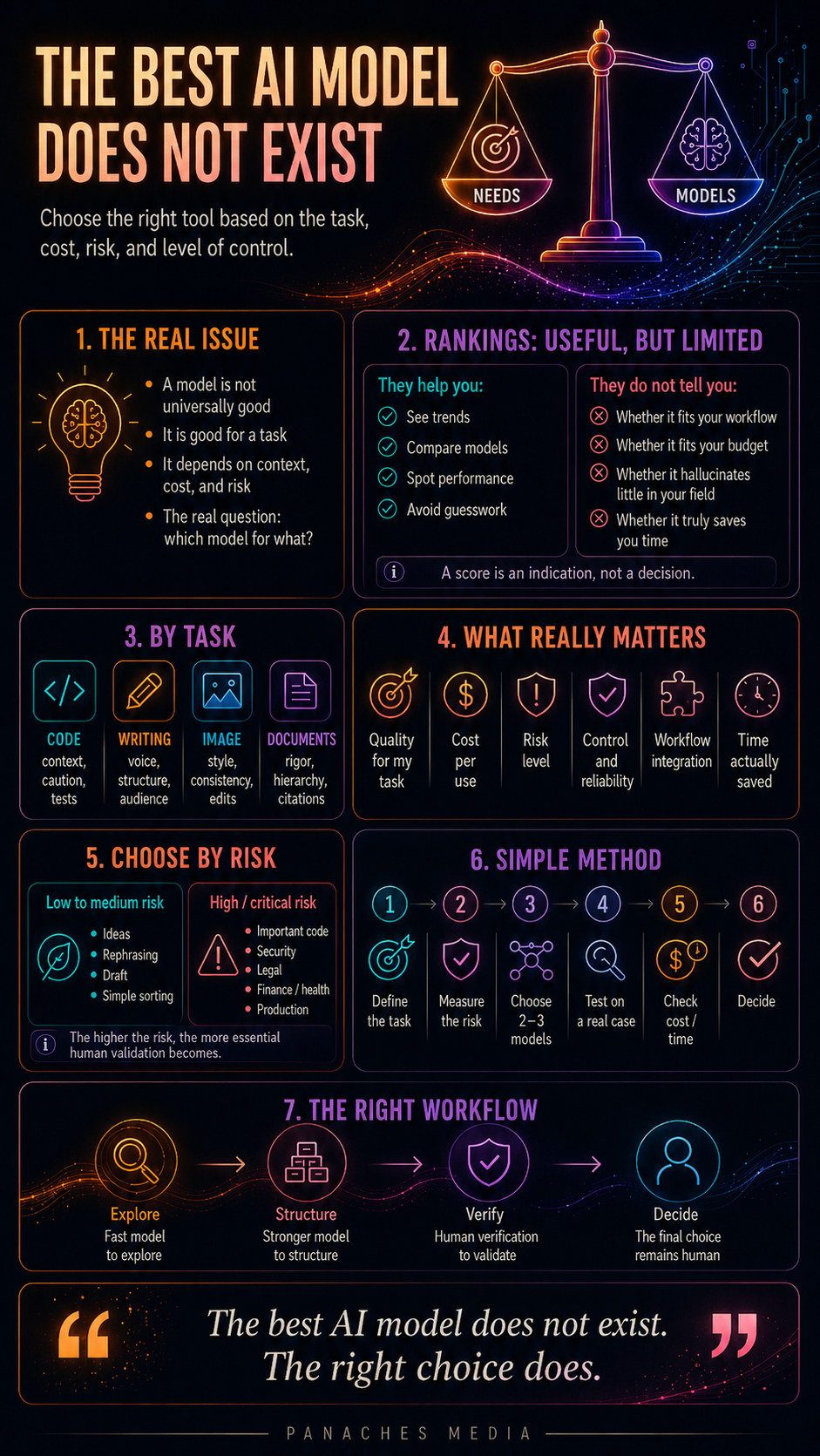
Because an artificial intelligence model is not “good” in absolute terms. It is good for a task, in a context, with constraints, a cost, a level of risk, and a way of working.
A model can be brilliant at fixing code, but excessive for rewriting three sentences.
Another can be excellent at generating images, but useless for analyzing software architecture.
A fast model may be enough to sort ideas, but risky if an important decision is involved.
A very powerful model can produce an impressive answer, but cost too much if used for everything.
So the real question is not:
What is the best model?
It is:
Which model is the right choice for what I need to do now?
And that nuance changes everything.
Rankings are useful, but they are not a complete compass
AI rankings have real value.
They show current trends. They reveal which players are progressing. They give a sense of relative performance. They help compare models on certain tasks. They prevent us from choosing completely at random.
But a ranking is still a snapshot.
Not an eternal truth.
The AI market evolves very quickly. A model can dominate a category for a few weeks, then be overtaken by a competing version, an update, a new reasoning mode, or a specialized tool.
Above all, a ranking does not measure everything.
It may say that a model responds well to public prompts.
It does not necessarily say:
- whether it respects your style;
- whether it understands your project;
- whether it is profitable for your budget;
- whether it produces maintainable code;
- whether it can stay within a strict scope;
- whether it hallucinates less in your domain;
- whether it integrates well into your workflow;
- whether it actually saves you time;
- whether it requires a lot of checking afterwards.
A score is an indication.
Not a decision.
It is a weather map.
Not the whole route.
An AI can be excellent in one area and average in another
One of the most common mistakes is believing that a very strong model in one field will automatically be the best everywhere.
That is not how it works.
Use cases are different.
Coding, writing, summarizing, searching, translating, generating an image, analyzing a screenshot, structuring an article, reading a legal document, or helping debug an application do not require exactly the same qualities.
For code, we expect:
- a good understanding of context;
- the ability to respect constraints;
- careful reading of errors;
- caution with modifications;
- good handling of tests;
- the ability not to touch the rest.
For writing, we expect:
- rhythm;
- voice;
- structure;
- sensitivity;
- the ability to avoid generic text;
- adaptation to the audience.
For images, we expect:
- strong composition;
- visual coherence;
- style control;
- good handling of text when needed;
- fidelity to the request;
- the ability to produce a coherent series.
For document analysis, we expect:
- rigor;
- good information hierarchy;
- the ability to cite or retrieve important passages;
- a low tendency to invent.
No model is perfect everywhere.
And even when a model is very good, it does not remove the need to choose the use case properly.
Power is not enough
It is tempting to always use the most powerful model.
After all, if we are paying for AI, we might as well use the best one, right?
Not necessarily.
A very powerful model can be useful for a complex task. But it can also be excessive for a simple task.
Using a premium model for everything is sometimes like taking a construction truck to buy a baguette.
It works.
But it is not necessarily smart.
Power should be reserved for tasks that justify it:
- complex architecture;
- deep correction;
- critical bug analysis;
- important technical decisions;
- risky generation or refactoring;
- security audits;
- pre-production validation;
- synthesis of long documents;
- multi-constraint reasoning.
For the rest, a simpler model may be enough:
- reformulating a paragraph;
- translating a short text;
- generating title variants;
- sorting ideas;
- preparing a list;
- cleaning up notes;
- writing a simple draft;
- making a first synthesis.
The right choice is not always the most powerful one.
The right choice is the best balance between quality, cost, risk, and saved time.
Cost is part of the decision
In conversations about AI, we talk a lot about performance.
We talk less about cost.
Yet cost changes everything.
A model can be excellent, but too expensive for daily use. Another can be slightly less brilliant, but much more profitable. A third can be perfect for exploration, but not reliable enough for validation.
Choosing a model is not only a technical decision.
It is also a strategic one.
We need to ask:
- how much does the task cost?
- how often will I repeat it?
- does the result need to be perfect?
- can I correct it manually?
- is the risk of error serious?
- does the model save me real time?
- or does it mostly give me more things to check?
This is a very practical question.
AI can be profitable if it accelerates a painful, repetitive, or difficult task.
It becomes less profitable if it creates so many corrections, doubts, and checks that it merely moves the work instead of reducing it.
AI should not only produce.
It should help.
And if it costs a lot without clarifying the work, it becomes one more problem in the stack.
The trap of the “magic” model
When a model is highly ranked, it can create a dangerous illusion.
We think:
This model is excellent, so it will understand.
But a model does not automatically understand your intention.
It does not necessarily know your history. It does not know what you refuse. It does not always guess your level of quality. It does not know your invisible constraints. It can produce a brilliant answer that is off target.
The more powerful the model, the more seductive the mistake can be.
That is the trap.
A poor answer produced by a small model is often easy to spot.
A poor answer produced by a very good model can be elegant, structured, convincing.
It can make us want to trust it.
When we should be checking it.
Apparent quality does not replace relevance.
A good model remains a tool.
Not an autopilot.
For code: generating is not validating
Software development is one of the areas where AI models are progressing fastest.
They can write functions, fix errors, generate components, explain a bug, suggest architecture, produce tests, and read logs.
It is impressive.
But one sentence must stay in mind:
Generated code is not validated code.
A model can produce code that looks clean.
But that does not guarantee:
- that it respects the existing architecture;
- that it does not break a neighboring module;
- that it handles edge cases;
- that it is maintainable;
- that it is secure;
- that it works in the final artifact;
- that it truly matches the need.
With coding AI, human skill does not disappear.
It moves.
Sometimes less typing.
But more framing. More reviewing. More testing. More validation. More responsibility.
The right model can help enormously.
But it does not replace a strict method.
For code, the real question is not only:
Which model writes the best code?
It is also:
Which model best respects the scope, constraints, tests, and reality of the project?
For images: the most beautiful result is not always the right choice
AI image generators are also progressing very quickly.
They produce visuals that are sharper, more detailed, more realistic, more stylized, sometimes spectacular.
But once again, the best model in a ranking does not necessarily answer every creative need.
A beautiful isolated image is not an art direction.
For a creator, we also need to look at:
- the coherence of a series;
- respect for a style;
- readability of composition;
- the ability to edit an image;
- text quality inside the image;
- control over details;
- usage rights;
- production cost;
- workflow integration.
A model can produce an impressive image, but be difficult to reproduce consistently in a series.
Another can be less spectacular, but more stable for a visual identity.
A third may handle editing better.
AI image generation is not only about immediate beauty.
It is about control, coherence, and intention.
Creating with AI is not asking for a beautiful image.
It is building a direction.
For writing: beware of text that is too clean
AI models are very good at writing clean text.
That is useful.
But it is also a trap.
They can produce fluent, structured, pleasant, error-free sentences with apparent logic.
And yet the text can lack voice.
Too neutral. Too general. Too smooth. Too predictable. Too much like “AI content”.
For writing, the best model is not only the one that writes well.
It is the one that helps reveal an intention.
A good writing model should be able to:
- suggest angles;
- improve structure;
- reformulate without flattening;
- respect a voice;
- accept nuance;
- help cut;
- strengthen an idea;
- criticize a passage;
- avoid generic tone.
But the final voice must remain human.
AI can help write.
It should not replace the eye of the person who signs.
Choose according to risk level
A simple way to choose a model is to start from risk.
Not all tasks are equal.
Some can be corrected easily.
Others can have serious consequences.
For a light task, we can accept a fast, economical, imperfect model.
For a critical task, we need a more reliable, more powerful, better-framed model, with human verification.
We can think like this:
| Risk level | Type of task | Logical choice |
|---|---|---|
| Low | Reformulation, ideas, titles, simple sorting | Lightweight or economical model |
| Medium | Article, synthesis, content analysis | Solid model + review |
| High | Important code, security, legal, finance, health | Strong model + sources + human validation |
| Critical | Production, release, strategic decision | Premium model + procedure + proof |
This table is not an absolute rule.
But it helps avoid a classic mistake: using the same model for everything.
A personal note, a public article, a bug fix, a financial decision, and a production validation do not require the same level of rigor.
AI should adapt to the risk.
Not the other way around.
Choose according to control level
The second important criterion is control.
Some tasks tolerate approximation.
Others do not.
If we ask for ideas for an article, an imperfect answer can be useful. It opens a path.
If we ask for a correction in a system already in production, approximation becomes dangerous.
So the right model is the one that accepts the frame.
It must understand:
- what needs to be modified;
- what must not be touched;
- what result is expected;
- how to prove the work is complete;
- which tests to run;
- which limits to respect.
For high-control tasks, the prompt becomes as important as the model.
A very good model badly framed can do anything very cleanly.
A less powerful but well-framed model can sometimes produce a better result on a simple task.
Quality comes from the combination:
right model + right frame + right validation.
Not from the model alone.
A simple method for choosing an AI model
Before choosing an AI, we can ask seven questions.
What is the task?
Writing? Coding? Summarizing? Searching? Translating? Analyzing? Creating an image? Fixing? Deciding?
The nature of the task already eliminates many bad choices.
What is the risk level?
Is this a private draft or public content? An idea or a decision? A local test or production?
The higher the risk, the more reliable the model must be and the stricter the control.
What cost is acceptable?
Some tasks deserve an expensive model.
Others do not.
A good workflow reserves premium models for moments where their power truly changes the result.
How much context is needed?
Some work requires a lot of context: project, history, constraints, files, documents, style.
If context matters, the model must be able to use it properly.
How much creativity is needed?
A creative task does not need the same model as a verification task.
Exploration requires openness.
Validation requires rigor.
What proof is needed?
For an important task, ask for proof: sources, tests, screenshots, modified files, limits, commands run.
Without proof, an answer remains a promise.
Who decides at the end?
The answer should always be clear:
The human.
The model suggests.
The human chooses.
The right model is often a combination of models
In practice, it is not always necessary to choose one model for everything.
Several models can be used depending on the step.
A fast model for exploration. A stronger model for structuring. A specialized model for coding. A visual model for generating an image. A critical model for review. A search tool for verification.
This is often smarter than trying to do everything with a single tool.
A good AI workflow looks less like a magic wand and more like a workshop.
In a workshop, we do not use the same tool to cut, sand, measure, draw, assemble, and verify.
With AI, it is the same.
The right use is not finding “the ultimate tool”.
It is building a coherent work chain.
The real criterion: does AI improve the work?
In the end, the best model is the one that truly improves the work.
Not the one that impresses the most.
Not the one that answers fastest.
Not the one that ranks first.
The one that helps us move forward.
A good model should help to:
- clarify an idea;
- reduce friction;
- produce a useful base;
- detect a problem;
- accelerate a task;
- improve a decision;
- strengthen a creation;
- secure a result;
- save real time.
If a model produces a lot but forces us to redo everything, it has not necessarily helped.
If it creates trust too quickly, it can even become dangerous.
If it costs a lot for a simple task, it damages the workflow.
If it helps us think, create, code, or verify better, then it becomes useful.
Performance is not only in the answer.
It is in the real effect on the work.
Getting out of the ranking noise
Rankings will continue to exist.
And that is fine.
They are useful for observing the market, discovering models, spotting trends, and understanding power dynamics.
But they should not turn us into hypnotized spectators.
Every new model should not become an emergency.
Every podium should not force a tool change.
Every score should not erase real experience.
The healthier posture is calmer.
Look at rankings. Understand trends. Test on real use cases. Measure cost. Check reliability. Keep a method. Choose according to need.
The best AI model does not exist.
There is a good model for a given task, at a given moment, with a given budget, a given risk, and a given requirement.
And perhaps that is good news.
Because it forces us to stay active.
To choose.
To compare.
To decide.
To avoid confusing performance with relevance.
AI only becomes truly useful when it stops being a fascination and becomes again what it should always be:
a tool serving an intention.