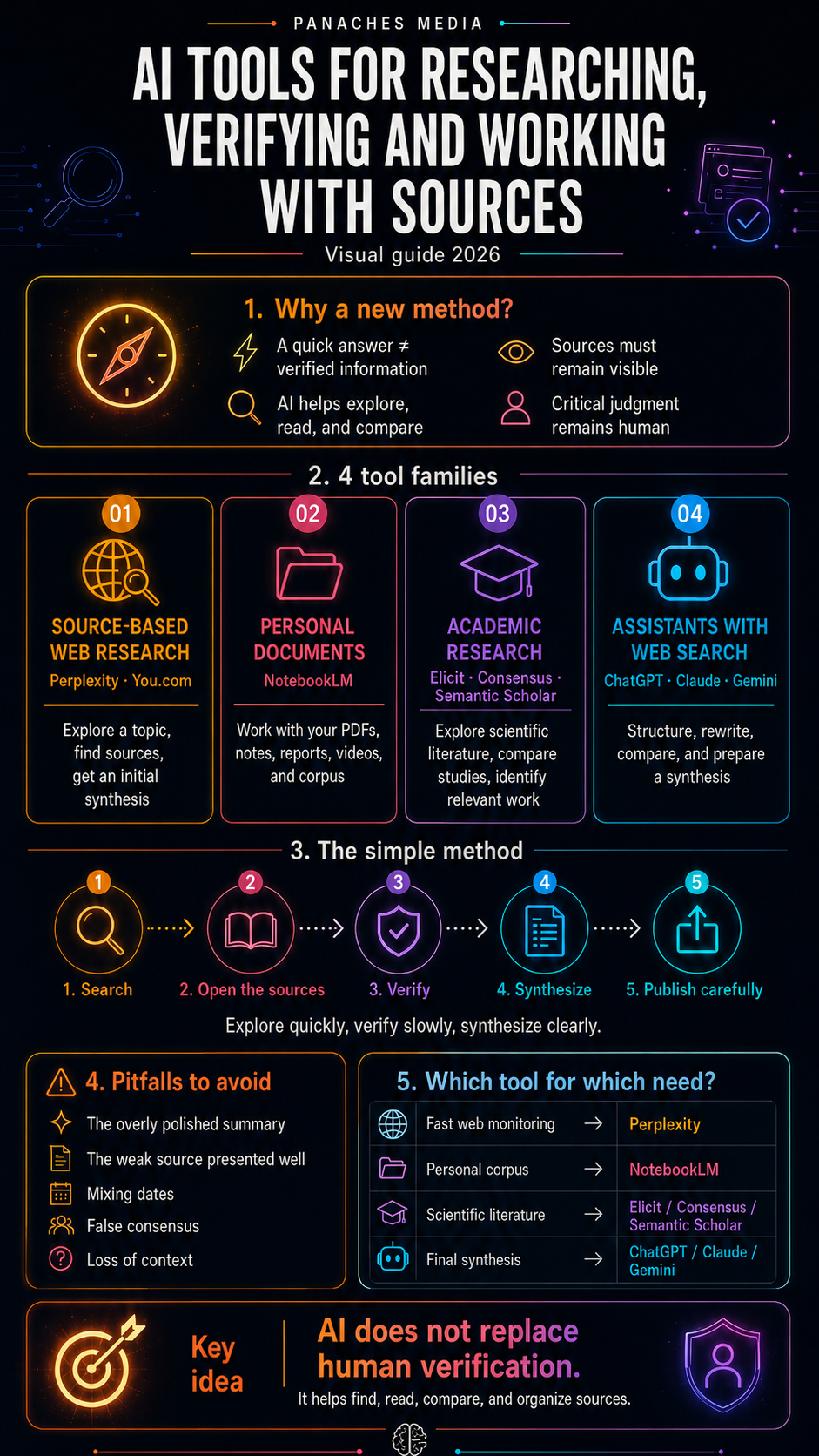
Why AI-powered research needs a new method
In 2026, searching for information no longer looks quite like it did a few years ago.
Before, you typed a query into a search engine, opened several links, compared pages, and then built your own synthesis.
Today, AI tools can search, summarize, compare, cite, organize, rewrite, extract data, query documents, and turn a corpus into a clear explanation.
That is extremely powerful.
But it is also dangerous if we confuse fast answers with verified information.
An AI research tool can save a great deal of time. It can help explore a topic, identify sources, read long documents, spot trends, or structure monitoring work. But it can also summarize too quickly, misinterpret a source, mix different levels of reliability, or create a feeling of certainty where verification is still needed.
The right reflex is not to replace human research with AI.
The right reflex is to build a method:
- search faster;
- verify more clearly;
- keep sources visible;
- distinguish web research, personal documents, and scientific literature;
- use each tool for the right role.
AI should not be a machine to believe. It should become a way to read, compare, and understand better.
Not all AI research tools do the same thing
The first mistake is putting all AI research tools in the same category.
Perplexity, NotebookLM, Elicit, Consensus, Semantic Scholar, and You.com do not serve exactly the same purpose.
Some tools are designed to search the web. Others are built to work with your own documents. Others target academic research. Others help explore a citation graph or a scientific field.
Several families should therefore be distinguished.
Source-based answer engines are used to query the web and obtain an answer accompanied by links.
Document reading tools are used to work with a corpus you provide yourself: PDFs, notes, reports, videos, transcripts, internal documents.
Academic research tools are used to explore scientific publications, papers, abstracts, methodologies, and sometimes study results.
Scientific mapping tools are used to understand relationships between papers, authors, references, and concepts.
General-purpose assistants with web search can also help, but their use must remain framed by source verification.
This distinction is essential.
Searching for recent news is not the same as analyzing a PDF. Analyzing a PDF is not the same as doing a literature review. Doing a literature review is not the same as preparing a popular science article.
Each use case needs its own tool and method.
Perplexity: searching quickly with visible sources
Perplexity has become one of the best-known tools for AI-assisted web research.
Its role is simple: answer a question based on sources, with visible links to the pages used.
It is very useful for:
- quickly exploring a topic;
- comparing several sources;
- getting an initial synthesis;
- following current events;
- finding figures or definitions to verify;
- preparing an article outline;
- identifying actors, tools, trends, or documents.
Perplexity should not be used as a final authority. It should rather be seen as an exploration accelerator.
Its strength is that it quickly surfaces sources and provides a structured answer. Its limitation is that it may select some sources over others, summarize too strongly, or create more coherence than actually exists.
The right use is therefore to open the links, read the important sources, and verify key information.
Perplexity is especially useful at the beginning of a research process, when the goal is to understand the landscape.
It answers the question well:
What are the main sources and ideas around this topic?
But before publishing, you should always go back to the original documents.
NotebookLM: working with your own documents
NotebookLM answers a different need.
Where Perplexity mainly helps with web research, NotebookLM is very strong when working on a corpus you provide yourself.
You can import documents, notes, PDFs, web pages, videos, or other sources, then query that corpus. The tool becomes a kind of reading assistant centered on your own sources.
It is valuable for:
- reading a file quickly;
- comparing several documents;
- generating a synthesis;
- retrieving information from a corpus;
- preparing a note;
- turning sources into an outline;
- creating educational material;
- understanding long reports;
- extracting key ideas.
Its great strength is that it remains attached to the provided sources.
For a writer, student, trainer, researcher, consultant, or content creator, it becomes very interesting as soon as a subject relies on multiple documents.
But here again, method matters.
NotebookLM can help summarize, but it does not replace careful reading of important passages. It can surface connections, but those connections still need to be checked for relevance. It can produce a clear overview, but it should not be used as the only proof.
Its best use is documentation work:
Here are my sources. Help me understand, compare, and organize them.
Elicit: speeding up scientific research
Elicit is more oriented toward scientific research and literature reviews.
It is useful when looking to explore academic papers, extract information, compare results, or structure research work.
Its value is strongest in repetitive and methodical tasks:
- finding relevant papers;
- filtering results;
- extracting data;
- comparing studies;
- preparing a systematic review;
- organizing information from several publications.
Elicit can save time, especially when the volume of literature is large.
But caution is necessary.
Scientific research requires rigor: inclusion criteria, methodology, study quality, bias, levels of evidence, disciplinary context. An AI tool can help sort information, but it should not decide alone whether a result is scientifically valid.
Elicit is therefore a method assistant, not a final judge.
It answers the question well:
Which papers seem relevant, and what data can I extract from them to move faster?
But critical judgment remains human.
Consensus: querying scientific literature
Consensus is another tool oriented toward academic research.
Its positioning is clear: help find answers in scientific literature, especially by relying on publications and research summaries.
It can be useful for:
- checking whether a subject has been studied;
- identifying consensus or recurring results;
- exploring a scientific question;
- finding reading leads;
- preparing serious popularization;
- avoiding reliance only on blog posts or opinions.
Consensus is especially interesting when you want to know what scientific work says about a question.
But once again, the word “consensus” requires caution.
Science is not always unanimous. Some questions are debated. Some studies are weak. Some results depend on methodology, sample size, field, or publication date.
A tool like Consensus can help reveal a trend, but important papers still need to be read, methodologies checked, and overly quick conclusions avoided.
Its proper use is:
Help me identify what the scientific literature seems to say about this question.
Not:
Give me a definitive truth.
Semantic Scholar: exploring scientific literature
Semantic Scholar is a very useful tool for exploring scientific literature.
It does not play exactly the same role as a conversational assistant. It is more about discovering papers, following references, identifying authors, understanding links between publications, and exploring a field.
It is a very good tool for:
- finding scientific articles;
- identifying important papers;
- spotting citations;
- discovering related work;
- following an author or field;
- building a bibliography;
- beginning serious academic exploration.
For Panaches Media content, Semantic Scholar can be useful when an article needs stronger sources, especially on AI, education, psychology, professional uses, creativity, or productivity.
It does not replace a synthesis tool, but it helps find reliable materials.
It answers the question well:
What papers exist on this subject, and how are they connected?
You.com and hybrid search engines
Alongside Perplexity, there are also hybrid engines such as You.com and other tools that combine web search, AI chat, and access to several response modes.
Their interest lies in offering an experience between the classic search engine and the conversational assistant.
They can be useful for:
- getting a quick answer;
- finding sources;
- comparing results;
- exploring different angles;
- moving between search, chat, and productivity.
But as with all generative search engines, the central point remains the same: sources must be opened, read, and compared.
A hybrid engine can accelerate the exploration phase, but it should not replace verification.
ChatGPT, Claude, and Gemini with web search: useful, but not enough on their own
General-purpose assistants can also perform research when they have a web feature or access to sources.
They are very useful for:
- formulating better queries;
- turning research into an outline;
- comparing arguments;
- summarizing sources;
- preparing a synthesis;
- spotting inconsistencies;
- explaining a difficult topic.
But their versatility can create an illusion.
Because a general-purpose assistant writes well, it can feel as though it has verified everything perfectly. That is not always the case.
When accuracy matters, you must require sources, ask for links, open the documents, and cross-check important points.
A general-purpose assistant is excellent for organizing thought.
But for research, it should be used as a work partner, not as a primary source.
The simple method: search, open, verify, synthesize
To use AI research tools properly, a simple method is often enough.
1. Search
Start by exploring the topic.
Use Perplexity, a search engine, a web assistant, or an academic tool to understand the landscape.
At this stage, the goal is not to conclude yet. The goal is to identify keywords, actors, sources, contradictions, and possible angles.
2. Open
Do not stop at the generated answer.
Open the important sources. Look at who published them, when, in what context, with what methodology, and with what level of reliability.
A cited link is not automatically proof. It is a lead to examine.
3. Verify
Cross-check important information.
A date, number, quote, price, feature, law, scientific result, or product announcement should be verified from the most reliable source possible.
When possible, prefer:
- the official source;
- the scientific paper;
- the documentation;
- the press release;
- the pricing page;
- the original report;
- several independent sources.
4. Synthesize
Once the sources have been verified, use AI to structure the work.
It can help produce an outline, a summary, a comparison table, a FAQ, an infographic, or a video script.
But synthesis must come after verification, not before.
The order matters:
Explore quickly, verify slowly, synthesize clearly.
Questions to ask an AI research tool
Good use often depends on the quality of the prompt.
Instead of asking:
Summarize this topic.
It is better to ask:
List the main sources, distinguish official sources from analysis articles, then indicate which points need verification.
Instead of asking:
What is the best tool?
It is better to ask:
Compare these tools according to their use case, limitations, official sources, and risks of confusion.
Instead of asking:
Is this claim true?
It is better to ask:
Verify this claim using primary or reliable sources, then indicate what remains uncertain.
Instead of asking:
Write me an article.
It is better to ask:
Based on these sources, propose an outline, the solid points, the points to nuance, and the information that needs further verification.
AI becomes much more reliable when you ask it to show the path, not just the result.
Pitfalls to avoid
AI research tools can create an impression of seriousness because they cite sources.
But a citation is not enough.
Several pitfalls appear often.
The overly polished summary
AI can turn a complicated subject into a very smooth answer. It is pleasant to read, but it can hide uncertainty, debates, or limitations.
The weak source presented well
A page can be cited without being the best source. A blog, a commercial page, or automatically generated content is not always worth the same as official documentation or an original report.
Mixing dates
In fast-moving fields, information from 2024 can already be outdated in 2026. You should always check the publication date and the date of the event.
False consensus
If several sources repeat the same information, it does not necessarily mean it is solid. They may all be repeating the same initial source without verifying it.
Loss of context
An AI tool can extract a correct sentence while forgetting the context that changes its meaning.
Confusing source and interpretation
Raw data, analysis, opinion, advertising, and scientific conclusions do not have the same value.
The user’s role is to keep that hierarchy clear.
Which tool should you choose depending on the need?
For fast web monitoring, Perplexity or a hybrid search engine can be very useful.
For working with personal documents, NotebookLM is often more suitable.
For scientific research, Elicit, Consensus, and Semantic Scholar provide better academic orientation.
For broad exploration, a general-purpose assistant with web search can help structure angles.
For precise verification, you need to return to primary sources: official documentation, reports, studies, product pages, press releases, legal texts, scientific articles.
For a final synthesis, an assistant such as ChatGPT, Claude, or Gemini can help turn verified sources into clear content.
A good research stack is therefore not one single tool.
It is a small chain:
search → read → verify → organize → synthesize → publish.
Inside Panaches
Panaches naturally fits into this source-based work logic.
Serious research is not limited to an AI answer. It involves documents, notes, files, excerpts, ideas, tables, visuals, sometimes code, sometimes web sources, sometimes PDFs.
The problem is often fragmentation.
One piece of information is in a browser. One note is in a text file. One PDF is in a folder. One screenshot is in a moodboard. One outline is in a mind map. One synthesis is in a separate document.
The value of a workspace like Panaches is precisely to bring these elements together into a more coherent environment.
An article can start with web monitoring, continue with PDFs, move through a notepad, be structured in a mind map, illustrated with a moodboard, then prepared for the CMS or social media.
AI then becomes a documentation work assistant: reading, comparing, rewriting, organizing, summarizing, preparing.
But sources remain at the center.
In a good workflow, AI does not erase documents. It helps make better use of them.
Conclusion: researching faster does not mean verifying less
AI research tools have become essential in 2026.
They save time, broaden exploration, speed up reading, and help structure information more clearly.
But their power does not remove the need for method.
A good AI research tool should help find sources, not ignore them. It should help compare, not believe too quickly. It should make verification more accessible, not make it disappear.
Perplexity, NotebookLM, Elicit, Consensus, Semantic Scholar, and assistants with web search can become very useful if they are given a clear role.
The right approach is simple:
Search with AI. Read the sources. Verify sensitive points. Synthesize with method. Publish with caution.
That is where AI becomes truly interesting: not as a shortcut to automatic truth, but as an accelerator of documentary intelligence.
FAQ
What is the best AI tool for web research?
Perplexity is one of the most practical tools for quickly getting source-based answers on the web. But the cited sources should always be opened and checked.
What is the difference between Perplexity and NotebookLM?
Perplexity is mainly used to search the web. NotebookLM is better suited for working with your own sources: PDFs, notes, documents, videos, or reports.
Can AI tools replace scientific research?
No. Tools such as Elicit, Consensus, or Semantic Scholar can accelerate literature exploration and organization, but they do not replace critical analysis, scientific method, and reading important studies.
Can AI-generated citations be trusted?
They should be treated as leads, not automatic proof. A cited source must be opened, read, and evaluated.
What simple workflow should be used to verify information?
The safest method is: search, open the sources, verify important points, cross-check with reliable sources, and only then synthesize.
What role can Panaches play in this type of workflow?
Panaches can serve as a workspace for bringing together notes, documents, PDFs, moodboards, outlines, syntheses, and AI assistance in a more coherent environment, helping reduce fragmentation during research.