

Overview
Walt Disney Animation Studios is an American animation studio whose history dates back to 1923, when Walt Disney and Roy O. Disney founded the Disney Brothers Cartoon Studio in Hollywood.
The company began modestly with the Alice Comedies, combining animation and live action.
A few years later, Walt Disney and his collaborator Ub Iwerks created Mickey Mouse. The success of Steamboat Willie in 1928, with its landmark use of synchronized sound, profoundly changed the studio’s future.
Disney then developed the Silly Symphonies, experimented with color, improved storytelling methods and contributed to the development of new camera techniques.
In 1937, Snow White and the Seven Dwarfs brought the studio into feature filmmaking and transformed the animation industry.
It was followed by Pinocchio, Fantasia, Dumbo, Bambi, Cinderella, Alice in Wonderland, Peter Pan, Sleeping Beauty, One Hundred and One Dalmatians, The Jungle Book and many other classics.
After Walt Disney’s death in 1966, the studio went through several decades of transition, successes and periods of uncertainty.
Beginning with The Little Mermaid in 1989, a new generation of films launched the era commonly known as the Disney Renaissance, with Beauty and the Beast, Aladdin, The Lion King, Pocahontas, The Hunchback of Notre Dame, Mulan and Tarzan among its major works.
The studio later moved toward computer animation while continuing to revisit hand-drawn animation on occasion.
Films such as Tangled, Wreck-It Ralph, Frozen, Big Hero 6, Zootopia, Moana, Encanto and their sequels renewed its catalog for new generations.
Technological innovation has remained central to this history: synchronized sound, Technicolor, the multiplane camera, Fantasound, xerography, CAPS, 3D animation, digital simulation and new rendering tools have repeatedly accompanied the studio’s artistic evolution.
More than a century after its creation, Walt Disney Animation Studios remains a structure distinct from Pixar within The Walt Disney Company.
Based primarily in Burbank, with an additional presence in Vancouver, the studio continues to develop original creations, historic franchises and new artistic and technological approaches.
History
1923 — Walt and Roy Disney found their studio
At the beginning of 1923, Walt Disney was in a difficult position.
His previous Kansas City studio, Laugh-O-gram Films, had failed financially.
Walt left Missouri for California, where his brother Roy O. Disney was already living.
He brought with him a project combining animation and live action: Alice’s Wonderland.
Distributor Margaret Winkler agreed to finance a series based on the concept.
On October 16, 1923, Walt signed the contract that officially launched production of the Alice Comedies.
Walt and Roy entered business together under the name Disney Brothers Cartoon Studio.
That date became the historical starting point for the Disney company and its animation operations.
The Alice Comedies
The studio’s first productions featured a real young actress moving through a primarily animated world.
This reversal of the usual formula — placing a live performer among drawn characters — helped the young studio stand out.
Resources remained extremely limited.
Walt drew, directed, organized production and constantly tried to improve working methods.
Revenue from the Alice Comedies gradually allowed the Disney brothers to develop their company and move into more suitable facilities.
Oswald the Lucky Rabbit
In the late 1920s, the studio developed Oswald the Lucky Rabbit for Universal.
The character became moderately successful.
But in 1928, Walt Disney discovered that he did not personally own the rights to Oswald.
The experience became one of the most important lessons of his career.
Walt understood the importance of controlling the characters and properties created by his studio.
Losing Oswald also forced the team to create a new character quickly.
1928 — Mickey Mouse
With crucial help from Ub Iwerks, Walt Disney developed Mickey Mouse.
The first shorts produced around the character were Plane Crazy and The Gallopin’ Gaucho.
But cinema was undergoing a revolution: sound.
Walt decided to make use of this new technology.
Mickey’s third film, Steamboat Willie, was designed around precise synchronization between animation, music and sound effects.
Steamboat Willie
Steamboat Willie premiered at the Colony Theatre in New York on November 18, 1928.
Its use of synchronized sound made a strong impression on audiences.
The film turned Mickey Mouse into a star almost immediately.
Its release date later became the date used to celebrate Mickey’s official birthday.
The success gave the studio new stability.
Mickey was soon joined by Minnie, Pluto, Goofy, Donald Duck and several other characters who became iconic.
The Silly Symphonies
Disney also developed the Silly Symphonies.
Unlike films centered on Mickey, these shorts allowed greater freedom to experiment with music, animation, characters and visual techniques.
The series became a true laboratory.
Artists could test new approaches without needing to respect the characteristics of a main franchise.
Many innovations later used in feature films were first tested in these shorts.
1932 — Flowers and Trees and color
In 1932, Disney released Flowers and Trees.
The short became one of the first major demonstrations of the three-strip Technicolor process in animation.
Walt Disney had secured a period of exclusivity for using the technology in cartoons.
The result quickly convinced the studio to progressively abandon black and white for its Silly Symphonies.
Flowers and Trees also won the Academy Award for Best Animated Short Film.
Color became a new creative tool for Disney.
Animation centered on personality
During the 1930s, Walt pushed his artists to go beyond simple comic movement.
Characters had to appear to think before acting.
This approach can notably be seen in Three Little Pigs in 1933.
The three pigs have distinct personalities despite relatively similar designs.
The song Who’s Afraid of the Big Bad Wolf? became extremely popular.
For Disney, the ability to create convincing personality gradually became more important than technical virtuosity alone.
Training the animators
Walt also invested in training his teams.
Artists studied drawing, anatomy, human and animal movement, acting and staging.
Classes were organized to improve their understanding of volume and behavior.
This desire to professionalize animation helped transform an industry still largely centered on comedic shorts.
The studio was gradually preparing for a project many considered impossible.
The multiplane camera
Disney wanted to give greater depth to painted backgrounds.
The multiplane camera allowed different visual elements to be placed on separate levels and moved independently in front of the camera.
The technique created a much more convincing impression of depth.
The 1937 short The Old Mill notably served as a showcase for the technology.
The multiplane camera would later be widely used in the studio’s feature films.
1937 — Snow White and the Seven Dwarfs
On December 21, 1937, Disney premiered Snow White and the Seven Dwarfs.
The project had generated considerable skepticism within the industry.
Producing an animated story more than an hour long seemed risky, expensive and technically extremely complex.
Its success was nevertheless enormous.
Audiences fully accepted following drawn characters through a dramatic, musical and emotional feature-length story.
The result permanently changed the scale of the studio’s ambitions.
The move into feature films
The success of Snow White allowed Disney to build a new studio in Burbank.
Feature films now became the core of the animation business.
The teams developed several extremely ambitious projects at the same time.
This period produced some of the most important films in the studio’s history, even if their costs and the international situation sometimes made profitability difficult.
1940 — Pinocchio
Pinocchio was released in 1940.
Adapted from Carlo Collodi’s story, the film follows a puppet who dreams of becoming a real boy.
The artists developed complex effects involving water, lighting and camera movement.
Jiminy Cricket became one of the film’s defining characters.
Although the international situation initially limited its box-office performance in several markets, Pinocchio gradually became one of the studio’s major classics.
1940 — Fantasia
That same year, Disney released Fantasia.
The film combines multiple animated sequences with works of classical music.
Walt wanted to create an audiovisual experience of exceptional ambition.
The studio notably developed Fantasound, a multichannel sound system that anticipated later stereophonic cinema.
Mickey Mouse appears in the famous The Sorcerer’s Apprentice segment.
Fantasia had a complicated commercial history, but gradually became one of Disney’s most ambitious projects.
1941 — Dumbo
The very high costs of Pinocchio and Fantasia forced the studio to produce more efficiently.
Dumbo, released in 1941, used a more economical production approach.
The film follows a young elephant with exceptionally large ears.
Its narrative and emotional simplicity contrasts with the technical sophistication of several earlier productions.
The result became one of the most beloved films of this early period.
1942 — Bambi
Bambi was released in 1942.
The film relied on detailed observation of animals and nature.
Animators studied the movement of deer and other species in order to create more convincing animation.
The story follows Bambi from birth into adulthood.
The film combines wonder, learning and confrontation with death in a way that was especially unusual for its time.
World War II
The war profoundly disrupted the studio’s activity.
International markets became difficult to access and several earlier productions struggled to recover their costs.
Disney also contributed to the American war effort by producing educational films, propaganda and material for the armed forces.
The studio could no longer immediately maintain the pace and ambition of its major feature productions of the previous years.
The package films
During the 1940s, Disney produced several films made up of shorter segments.
Saludos Amigos, The Three Caballeros, Make Mine Music, Fun and Fancy Free, Melody Time and The Adventures of Ichabod and Mr. Toad belong to this period.
This format allowed the studio to continue producing despite limited resources.
It also provided opportunities to experiment with different musical and visual forms.
1950 — Cinderella revives the studio
In 1950, Disney returned fully to the fairy tale with Cinderella.
The film represented a significant investment for a company still financially fragile.
Its success was therefore especially important.
Cinderella helped stabilize the studio and opened a new period of ambitious feature productions.
The character quickly joined Snow White among Disney’s defining heroines.
Alice in Wonderland and Peter Pan
Alice in Wonderland was released in 1951, followed by Peter Pan in 1953.
Both adapted famous British literary works.
They developed fantastic worlds where animators could play with transformations, changes of scale and eccentric characters.
Peter Pan notably introduced Disney’s version of Tinker Bell, who would become one of the most recognizable characters in the broader Disney universe.
1955 — Lady and the Tramp
Lady and the Tramp was released in 1955.
The film follows the relationship between Lady, a dog living in a comfortable home, and Tramp, a stray.
It became Disney’s first animated feature designed for the widescreen CinemaScope format.
The famous spaghetti dinner scene between the two dogs became one of the studio’s most iconic images.
1959 — Sleeping Beauty
Sleeping Beauty was released in 1959.
The film stands out for the highly stylized art direction of Eyvind Earle.
Its backgrounds, inspired notably by medieval art and illustration, give the production a radically different identity from earlier Disney fairy tales.
The film also makes extensive use of the multiplane camera and widescreen presentation.
Its especially high cost nevertheless pushed the studio to seek new production methods.
1961 — One Hundred and One Dalmatians and xerography
With One Hundred and One Dalmatians in 1961, Disney broadly adopted xerography to transfer animators’ drawings directly onto cels.
The technique greatly reduced the need for manual inking.
It also made the animators’ original linework much more visible on screen.
The film’s visual style therefore differs strongly from that of Sleeping Beauty.
This technological shift helped Disney keep hand-drawn feature production economically viable.
1967 — The Jungle Book
The Jungle Book was released in 1967, a few months after Walt Disney’s death in December 1966.
It was the last animated feature whose development Walt personally supervised to a significant degree.
The film relies heavily on character personality and music.
Baloo, Bagheera, King Louie and Shere Khan quickly became iconic.
Its success provided an important transition for the studio at the moment its founder was gone.
After Walt Disney
Walt’s death raised a fundamental question: could the studio continue without the person who had guided its development since 1923?
The remaining artists and executives continued production.
Several of the famous Nine Old Men, the generation of animators who had worked on the great classics, still played central roles.
But the studio also had to prepare a new generation.
1970 — The Aristocats
The Aristocats was released in 1970.
The film follows a family of Parisian cats threatened by a butler who wants to inherit their fortune.
It became the first Disney animated feature produced entirely after Walt’s death.
Its success demonstrated that the animation department could continue operating.
Robin Hood and The Rescuers
Robin Hood arrived in 1973 with an animal-based reinterpretation of the famous hero.
Then The Rescuers, released in 1977, followed two mice from the Rescue Aid Society trying to save a kidnapped little girl.
The success of The Rescuers was particularly important.
It showed that a new generation could begin taking over from the studio’s historic veterans.
A new generation of animators
During the 1970s and early 1980s, young artists joined Disney.
Several would later play important roles in American animation, at Disney or elsewhere.
The production of The Fox and the Hound became one notable point of transition between older and younger generations.
The handover was sometimes difficult, but increasingly necessary.
1981 — The Fox and the Hound
The Fox and the Hound was released in 1981.
The film follows the friendship between Tod, a fox, and Copper, a hunting dog whose natural and social roles are expected to make them enemies.
The production went through several team changes.
It strongly symbolizes the transition between artists trained directly under Walt Disney and those who would shape the studio’s future.
1985 — The Black Cauldron
The Black Cauldron was released in 1985.
The film embraced darker fantasy inspired by Lloyd Alexander’s Chronicles of Prydain.
Its production was long and difficult.
Its disappointing commercial reception deepened questions surrounding the future of animation at Disney.
The studio was then far from the dominant position it had held several decades earlier.
1986 — The Great Mouse Detective
The Great Mouse Detective was released in 1986.
The film reimagines the Victorian detective story within a society of mice living beneath London.
The climactic sequence inside Big Ben notably uses computer-generated elements to create the clock’s gears.
The film’s relative success restored some confidence to the teams.
Around the same period, the animation operation adopted the name Walt Disney Feature Animation, notably to distinguish it from television animation.
1988 — Oliver & Company
In 1988, Oliver & Company loosely transplanted Oliver Twist to contemporary New York.
The film became an encouraging commercial success.
But the next project would transform the studio’s future much more profoundly.
Disney returned to the musical fairy tale, a format that had defined part of its historic reputation.
1989 — The Little Mermaid
The Little Mermaid was released in 1989.
Directed by John Musker and Ron Clements, with songs by Howard Ashman and Alan Menken, the film follows Ariel, a young mermaid fascinated by the human world.
Its combination of fairy tale, humor, memorable supporting characters and songs integrated into the story became a major success.
The film is generally considered the beginning of the Disney Renaissance.
CAPS and the move toward digital production
At the same time, Disney began transforming its production methods.
The CAPS system, developed with Pixar, digitized coloring and compositing in traditional animation.
It gradually replaced techniques based on photographing physical cels.
The final sequence of The Little Mermaid already made use of the technology.
The Rescuers Down Under, released in 1990, then became the first Disney feature completed entirely through CAPS.
1991 — Beauty and the Beast
Beauty and the Beast was released in 1991.
Belle and the Beast became the center of an animated musical inspired by the French fairy tale.
The film was a major critical and commercial success.
It became the first animated feature nominated for the Academy Award for Best Picture.
The recognition demonstrated that Disney animation had returned to a central place in film culture.
1992 — Aladdin
Aladdin was released in 1992.
The film takes audiences to Agrabah and introduces the Genie, voiced in the original version by Robin Williams.
Williams’ performance profoundly influenced how the character was developed.
The film became a huge success.
Disney showed that the revival begun with The Little Mermaid was not temporary.
1994 — The Lion King
In 1994, The Lion King became one of the greatest phenomena in the studio’s history.
The story of Simba, a young lion who must reclaim his place after the death of his father Mufasa, combines family drama, comedy and music.
Songs by Elton John and Tim Rice, together with Hans Zimmer’s score, contribute strongly to its identity.
The success far exceeded expectations.
The film became one of Disney’s most important properties.
An especially productive Renaissance
The period continued with Pocahontas in 1995, The Hunchback of Notre Dame in 1996, Hercules in 1997, Mulan in 1998 and Tarzan in 1999.
The films explored very different visual and cultural settings.
Music often remained essential.
The studio also opened several production units around the world during this era to support its increased output.
1999 — Tarzan
Tarzan symbolically closes the decade of the Disney Renaissance.
The film notably developed the Deep Canvas technique, allowing greater depth in environments while preserving the appearance of painted artwork.
Tarzan’s movements through the trees make extensive use of the technology.
Phil Collins’ songs also contribute strongly to the film’s identity.
The 2000s — An industry in transition
At the beginning of the 2000s, animation underwent a radical transformation.
The success of Pixar, DreamWorks Animation and other studios accelerated the move toward computer-generated imagery.
Disney nevertheless continued for several years to produce mainly hand-drawn animation.
The Emperor’s New Groove, Atlantis: The Lost Empire, Lilo & Stitch, Treasure Planet and Brother Bear reflect very different creative approaches.
2002 — Lilo & Stitch
Lilo & Stitch was released in 2002.
The film follows the meeting between Lilo, a lonely Hawaiian girl, and Stitch, an alien creature designed to cause destruction.
Its visual style notably uses watercolor backgrounds.
The concept of ohana, the family one chooses and protects, becomes central.
The film’s success turned Stitch into one of the most popular Disney characters of his generation.
Treasure Planet and visual experimentation
Also released in 2002, Treasure Planet reimagines Treasure Island in a space setting.
The film combines hand-drawn characters, digital environments and 3D animation.
It became a showcase for the hybrid techniques Disney was exploring at the time.
Its commercial disappointment did not prevent the film from later developing a strong reputation among part of the audience.
2004 — Home on the Range
Home on the Range was released in 2004.
At the time, Disney presented it as one of the final major traditionally animated features in its primary production slate.
The industry was rapidly moving toward 3D.
The technological shift would profoundly change the studio’s organization.
2005 — Chicken Little
Chicken Little, released in 2005, became the first Walt Disney Feature Animation movie produced entirely with computer-generated imagery.
The film marked an important technical break.
Disney had to develop production methods comparable to those of the new digital studios while searching for its own identity.
The transition occurred during a broader transformation within the company.
2006 — Disney acquires Pixar
In 2006, The Walt Disney Company acquired Pixar Animation Studios.
The transaction had major consequences for the organization of Disney animation.
Ed Catmull and John Lasseter then assumed shared leadership responsibilities across Pixar and Walt Disney Feature Animation.
The goal, however, was not to merge the two studios.
Disney Animation and Pixar continued producing separately with their own teams and identities.
2007 — Walt Disney Animation Studios
In 2007, Walt Disney Feature Animation officially adopted the name Walt Disney Animation Studios.
The change emphasized both continuity with the studio’s heritage and a desire to avoid defining its work solely around a specific technique or format.
Hand-drawn animation, computer-generated imagery and hybrid technologies could all exist under the same identity.
2008 — Bolt
Bolt was released in 2008.
The film follows a dog actor who believes he genuinely possesses the superpowers portrayed in his television series.
Its production accompanied an important creative reorganization within the studio.
The film is generally regarded as a step toward the new generation of Disney productions that would emerge during the following decade.
2009 — The Princess and the Frog
In 2009, Disney returned to hand-drawn animation with The Princess and the Frog.
The film stars Tiana, a young New Orleans woman who dreams of opening her own restaurant.
John Musker and Ron Clements returned as directors.
The film combines fairy tale, music inspired by New Orleans and 2D animation.
Tiana became the first Black princess in Disney’s animated canon.
2010 — Tangled
Tangled was released in 2010 and became the studio’s 50th animated feature.
Inspired by Rapunzel, the film sought to combine the visual sensitivity of traditional Disney drawing with the possibilities of computer animation.
Rapunzel’s extremely long hair presented a major technical challenge.
The film’s success marked another important step in the studio’s renewed strength.
2011 — Winnie the Pooh
Winnie the Pooh, released in 2011, marked another return to traditional animation.
The film brought back Winnie, Piglet, Tigger, Eeyore and the other residents of the Hundred Acre Wood.
After this production, Disney Animation’s feature films focused mainly on computer-generated imagery, although drawing remained essential to visual development and short films.
2012 — Wreck-It Ralph
Wreck-It Ralph was released in 2012.
The film imagines the living world behind arcade machines.
Ralph, traditionally the villain of his game, wants to prove that he can become a hero.
The production combines different visual worlds inspired by several generations of video games.
Its success later led to Ralph Breaks the Internet in 2018.
2013 — Frozen
In 2013, Frozen once again transformed the scale of Disney Animation’s success.
Loosely inspired by Hans Christian Andersen’s The Snow Queen, the film focuses mainly on the relationship between sisters Anna and Elsa.
The song Let It Go became a worldwide phenomenon.
The film surpassed one billion dollars at the box office and won the Academy Award for Best Animated Feature.
Frozen quickly became one of Disney’s most important franchises.
2014 — Big Hero 6
Big Hero 6 was released in 2014.
Inspired by a Marvel property, the film follows Hiro Hamada, a young robotics prodigy, and the healthcare robot Baymax.
The city of San Fransokyo blends influences from San Francisco and Tokyo.
The film won the Academy Award for Best Animated Feature.
Baymax also became one of the defining characters of the studio’s modern era.
2016 — Zootopia
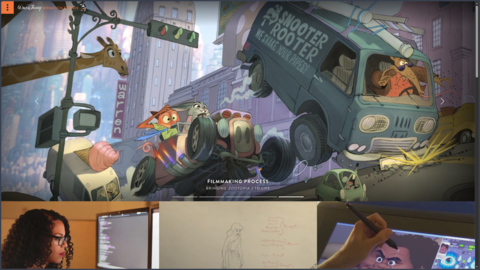
In 2016, Zootopia imagined a vast metropolis designed for different animal species.
Rabbit Judy Hopps dreams of becoming a police officer and must work with fox Nick Wilde to solve a case.
Beneath its police-comedy surface, the film notably explores prejudice and the ways a society can create or reinforce divisions.
Zootopia surpassed one billion dollars and won the Academy Award for Best Animated Feature.
2016 — Moana
That same year saw the release of Moana.
The film follows a young Polynesian woman chosen by the ocean to restore balance to her world.
She travels alongside demigod Maui.
The teams conducted extensive research into Pacific cultures.
The film combines adventure, music and exploration of an identity connected to the sea and cultural transmission.
Moana gradually became one of the studio’s most popular properties.
2018 — Ralph Breaks the Internet
Ralph Breaks the Internet continued the story of Ralph and Vanellope in 2018.
The characters leave the enclosed world of the arcade and discover a vast, chaotic representation of the internet.
The film plays with platforms, online culture, digital habits and several Disney properties.
Above all, it develops the friendship between Ralph and Vanellope as their desires begin to diverge.
2019 — Frozen II
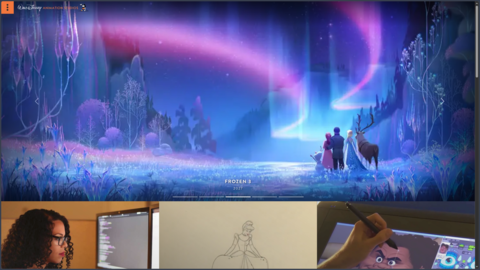
Frozen II was released in 2019.
The film explores the origins of Elsa’s powers and the history of the kingdom of Arendelle.
Anna, Elsa, Kristoff, Olaf and Sven travel toward an enchanted forest.
The sequel comfortably surpassed one billion dollars worldwide.
It confirmed Frozen as one of Walt Disney Animation Studios’ central contemporary franchises.
2021 — Raya and the Last Dragon
In 2021, Raya and the Last Dragon introduced the fantasy world of Kumandra.
Raya searches for the last dragon in hopes of reuniting a divided land.
The production draws on various Southeast Asian cultural influences.
Its release was heavily shaped by the Covid-19 pandemic, with simultaneous availability in some theaters and through Disney+ Premier Access.
2021 — Encanto
That same year, Encanto told the story of the Madrigal family in Colombia.
Every member possesses a magical gift except Mirabel.
The story gradually explores family expectations, the pressure to be exceptional and wounds passed across generations.
Songs by Lin-Manuel Miranda play a central role.
The film’s music became hugely successful and Encanto won the Academy Award for Best Animated Feature.
2022 — Strange World
Strange World was released in 2022.
The film follows several generations of the Clade family through a subterranean world filled with unusual creatures and environments.
Its visual style draws inspiration from pulp adventure and science-fiction stories.
Its commercial performance, however, remained below that of the studio’s recent major successes.
2023 — Wish and the 100th anniversary
In 2023, Disney celebrated the centennial of the company and its animation legacy.
Wish was developed within that context.
The film follows Asha, a young woman living in the kingdom of Rosas who discovers the true nature of King Magnifico’s control over his people’s wishes.
Visually, Disney sought to combine the volume of computer animation with an aesthetic inspired by illustration and watercolor.
The film also functions as a tribute to several historic motifs from the studio’s past.
2024 — Moana 2
In 2024, Moana 2 returned to Moana, Maui and the oceanic world of the first film.
The project, initially developed in another form, was eventually transformed into a theatrical feature film.
Its commercial success was enormous.
The film surpassed one billion dollars worldwide.
It confirmed Moana’s place among Disney Animation’s most powerful franchises.
New creative leadership
In September 2024, Jared Bush became Chief Creative Officer of Walt Disney Animation Studios.
A writer and director closely connected to Zootopia, Encanto and their worlds, he succeeded Jennifer Lee.
Lee, who had held the role since 2018, returned to a stronger focus on filmmaking, notably on the Frozen franchise.
Clark Spencer remained president of the studio.
This leadership structure guides the next phase of Disney Animation.
2025 — Zootopia 2
In November 2025, Disney Animation returned to Zootopia with Zootopia 2.
Judy Hopps and Nick Wilde investigate the mysterious arrival of a reptile, Gary De’Snake, whose presence disrupts the balance of the metropolis.
The film is directed by Jared Bush and Byron Howard, with Yvett Merino producing.
Its worldwide launch immediately set multiple records.
A historic success
Zootopia 2 surpassed one billion dollars only weeks after release.
By early 2026, it had also overtaken Inside Out 2 to become the highest-grossing animated film from a Motion Picture Association member studio worldwide.
By spring 2026, its box office was approaching $1.9 billion.
The film therefore became the biggest commercial success in Walt Disney Animation Studios history.
The Zootopia franchise also reached a new level internationally.
2026 — Hexed
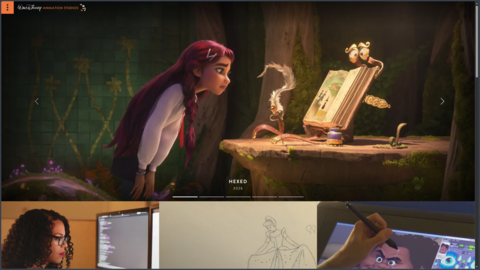
In 2026, Walt Disney Animation Studios is preparing Hexed, scheduled for theatrical release on November 25, 2026.
The film follows Billie, an impulsive teenager who discovers that she possesses magical powers.
The revelation takes her and her mother Alice beyond their everyday life into a vast realm of witches known as Hexe.
The project represents a new original creation after several years strongly marked by the return of major franchises.
As of October 2026, the film has not yet been released.
A studio more than a century old
In 2026, Walt Disney Animation Studios has more than a century of history.
The studio has survived multiple technological shifts, the deaths of its founders, economic crises, internal reorganizations and the arrival of numerous competitors.
Its current activity remains built around the same broad principle developed during its earliest decades: allowing storytelling, art and technology to evolve together.
It continues this work from Burbank and Vancouver, with teams of directors, artists, engineers and researchers developing the next generations of films.
What sets it apart
More than a century of continuity
Very few animation studios possess a history reaching back to the earliest decades of American commercial animation.
From 1923 to the present, Disney Animation has crossed silent cinema, sound cinema, color, traditional animation, photographic processes, computing and 3D.
This continuity creates an exceptional heritage.
Each new generation of artists works with a century of films, techniques and characters behind it.
Innovation as a tradition
The studio has never been defined by a single technology.
Steamboat Willie advanced the use of synchronized sound.
Flowers and Trees helped establish Technicolor in animation.
The multiplane camera created greater depth in painted backgrounds.
Fantasia experimented with multichannel sound through Fantasound.
Xerography transformed cel production.
CAPS digitized ink, paint and compositing.
Modern 3D tools continue the same tradition.
The technology changes, but its purpose remains to give artists more possibilities.
The fairy tale as a universal language
A large part of Disney’s identity is built around adapting or reinterpreting fairy tales, myths and literary stories.
Snow White, Cinderella, Sleeping Beauty, The Little Mermaid, Beauty and the Beast, Aladdin, The Princess and the Frog, Tangled and Frozen belong to this tradition.
The studio is no longer limited, however, to European fairy tales.
Its modern films also explore worlds inspired by the Pacific, Colombia and Southeast Asia, as well as entirely original settings.
Characters that became cultural icons
Mickey Mouse has long surpassed his status as a simple short-film character.
Other Disney creations have followed similar paths at different scales.
Snow White, Donald, Goofy, Tinker Bell, Ariel, Belle, Simba, Stitch, Elsa, Olaf, Baymax, Judy Hopps and Mirabel now belong to multiple generations of popular culture.
This ability to create enduring characters is one of the studio’s greatest historical strengths.
Music integrated into storytelling
Music holds a fundamental place in Disney animation.
Beginning with the Silly Symphonies, the studio explored the relationship between rhythm, imagery and narrative.
Its major features later developed a tradition of songs capable of advancing the story and revealing character.
This approach reached several peaks during the Disney Renaissance and returned strongly with productions such as Frozen, Moana and Encanto.
Traditional and digital animation
The studio’s recent history does not erase its hand-drawn heritage.
Even when films are produced through computer animation, drawing remains fundamental to visual development, character exploration, storyboarding and environment design.
Productions such as Tangled and Wish explicitly seek to bring 3D imagery closer to sensibilities inherited from traditional illustration.
Disney Animation therefore treats techniques as tools rather than incompatible identities.
A distinct identity from Pixar
Walt Disney Animation Studios and Pixar Animation Studios both belong to The Walt Disney Company.
They remain, however, two distinct studios.
Disney Animation has its own leadership, teams, history and projects.
Pixar likewise maintains its identity and Emeryville campus.
This separation allows both organizations to develop different cultures and creative approaches within the same corporate group.
Good to know
- Walt Disney Animation Studios traces its history back to 1923.
- The Disney Brothers Cartoon Studio was founded by Walt Disney and Roy O. Disney.
- The contract launching the Alice Comedies was signed on October 16, 1923.
- The studio’s earliest productions combined animation and live action.
- Oswald the Lucky Rabbit predates Mickey Mouse in the studio’s history.
- Walt lost control of the rights to Oswald in 1928, an experience that deeply influenced his later management of characters and intellectual property.
- Mickey Mouse was created in 1928, notably with essential contributions from Ub Iwerks.
- Steamboat Willie was released on November 18, 1928 with a landmark use of synchronized sound.
- The Silly Symphonies served as an artistic and technical laboratory.
- Flowers and Trees used three-strip Technicolor in 1932 and won an Academy Award.
- The Old Mill showcased the multiplane camera in 1937.
- Snow White and the Seven Dwarfs premiered on December 21, 1937.
- Its success notably enabled development of Disney’s major Burbank studio.
- Pinocchio and Fantasia were released in 1940.
- Fantasia was associated with development of the Fantasound system.
- Dumbo was released in 1941.
- Bambi was released in 1942.
- During World War II, the studio produced numerous educational and war-related films.
- Cinderella strongly revived the studio’s feature-film production in 1950.
- Alice in Wonderland was released in 1951 and Peter Pan in 1953.
- Lady and the Tramp was released in 1955.
- Sleeping Beauty was released in 1959.
- One Hundred and One Dalmatians broadly introduced xerography into production in 1961.
- Walt Disney died in 1966.
- The Jungle Book, released in 1967, was the last animated feature whose development Walt personally supervised to a major degree.
- The Aristocats was released in 1970.
- The Rescuers was released in 1977.
- The Fox and the Hound was released in 1981 and accompanied the transition between generations of animators.
- The Black Cauldron was released in 1985.
- The Great Mouse Detective was released in 1986.
- During the 1980s, the animation operation took the name Walt Disney Feature Animation.
- The Little Mermaid, released in 1989, opened the era generally known as the Disney Renaissance.
- The digital CAPS system was developed with Pixar.
- The Rescuers Down Under became the first Disney feature completed entirely through CAPS in 1990.
- Beauty and the Beast became the first animated film nominated for the Academy Award for Best Picture in 1991.
- Aladdin was released in 1992.
- The Lion King was released in 1994 and became one of the studio’s greatest successes.
- Pocahontas, The Hunchback of Notre Dame, Hercules, Mulan and Tarzan continued the Disney Renaissance.
- Lilo & Stitch was released in 2002.
- Chicken Little became the first Disney Animation feature produced entirely with computer-generated imagery in 2005.
- The Walt Disney Company acquired Pixar Animation Studios in 2006, but the two studios remained distinct.
- Walt Disney Feature Animation became Walt Disney Animation Studios in 2007.
- The Princess and the Frog marked an important return to hand-drawn animation in 2009.
- Tangled, released in 2010, was the studio’s 50th animated feature.
- Wreck-It Ralph was released in 2012.
- Frozen was released in 2013, surpassed one billion dollars and became a major franchise.
- Big Hero 6 was released in 2014.
- Zootopia and Moana were released in 2016.
- Frozen II was released in 2019 and surpassed one billion dollars worldwide.
- Raya and the Last Dragon and Encanto were released in 2021.
- Encanto won the Academy Award for Best Animated Feature.
- Strange World was released in 2022.
- Wish accompanied Disney’s centennial celebrations in 2023.
- Moana 2 was released in 2024 and surpassed one billion dollars worldwide.
- Jared Bush became Chief Creative Officer in September 2024.
- Clark Spencer remains president of Walt Disney Animation Studios.
- Zootopia 2 was released on November 26, 2025.
- The film surpassed $1.7 billion by January 2026 and approached $1.9 billion in spring.
- Zootopia 2 became the biggest commercial success in Walt Disney Animation Studios history.
- Hexed is scheduled for November 25, 2026.
- As of October 2026, Hexed has therefore not yet been released.
- Walt Disney Animation Studios currently operates in Burbank and Vancouver.
- The studio remains part of The Walt Disney Company, distinct from Pixar Animation Studios.