
Overview

Some studios are immediately associated with a character, a series, or a highly recognizable way of making games.

Valkyrie Entertainment tells a different part of the industry’s story.

Active in Seattle since 2002, the studio has specialized in game development, content production, and above all co-development. For more than twenty years, its work has involved joining productions already led by other teams, quickly understanding their technology, constraints, and creative direction, then contributing deeply enough to help the project reach its goals without making it lose its identity.

This position explains why the Valkyrie name is less familiar to the wider public than those of many studios whose games it has nevertheless helped build. When announcing its acquisition in 2021, Sony Interactive Entertainment stated that the team had already contributed to more than one hundred titles, citing franchises such as God of War, inFAMOUS, and Twisted Metal. Its founder and president, Joakim Wejdemar, described this ability to work with many different teams as central to the studio’s history.

Valkyrie is therefore not simply a subcontractor brought in to complete a few isolated tasks once most of a game has already been finished. Sony describes it as a studio providing content and co-development services, capable of working on both console and PC and across productions ranging from action games to live-service experiences. That flexibility is important enough that PlayStation Studios now directly presents Valkyrie as one of its co-development teams.

Since 2021, Valkyrie has been part of PlayStation Studios. This integration changes its position without really changing the logic of its work: the team continues contributing to productions led by other studios, but now primarily within the same first-party network.

The current PlayStation Studios page highlights its expertise on several major franchises and productions, including ASTRO BOT, Helldivers 2, and God of War.

That is precisely what makes Valkyrie interesting within a cultural map of video games.

Not every work is built by a single team working alone behind closed doors. Modern productions sometimes bring together several studios, external specialists, and teams responsible for integrating their work into one coherent creative vision. Valkyrie belongs to this less visible history of video games: the history of studios that help create major works without necessarily becoming the main name displayed on the cover.

History

2002: building a studio around collaboration

Valkyrie Entertainment began operating in 2002 in Seattle, Washington.

The studio was founded by Joakim Wejdemar with an orientation that would remain remarkably stable: provide other developers and publishers with production expertise capable of solving concrete problems during game development.

Sony Interactive Entertainment would later summarize this origin by explaining that Valkyrie had been providing art production and co-development services since 2002, with a philosophy centered on solving its partners’ problems while maintaining a high level of quality.

This approach may seem less spectacular than immediately creating a major original franchise.

Yet it requires a particular kind of expertise.

When a studio spends several years developing its own universe, it can gradually build its methods, tools, and vocabulary around that project. A co-development team often has to make the opposite journey: enter an existing production, quickly understand how it works, and become familiar enough with it to produce work that does not feel external.

Valkyrie gradually turns that adaptability into a specialty.

Growing without depending on a single franchise

Over the following years, Valkyrie contributes to a growing number of productions.

The studio is not built around a single genre or platform. Sony instead emphasizes that it has worked across console and PC, as well as on projects with very different styles, ranging from action games to experiences designed to operate over the long term.

That diversity matters because it prevents the studio from treating its internal methods as a formula that can simply be reproduced everywhere.

A large-scale cinematic action game does not have the same needs as a persistent multiplayer title. A production with a heavily stylized art direction does not require the same work as a project pursuing a much more realistic visual approach.

Valkyrie’s role is therefore less about applying a house aesthetic than about understanding the aesthetic of the project it joins.

Across its collaborations, the absence of a single defining franchise paradoxically becomes one of its strongest signatures.

Co-development becomes a specialty in its own right

On a major production, the term co-development can cover very different realities.

A partner team may contribute to art creation, design, engineering, content integration, or other needs directly connected to production. The larger the project, the more this collaboration needs to be integrated early and cleanly: an external studio unable to work with the tools, standards, and methods of the lead developer can quickly become an additional difficulty rather than a source of help.

Valkyrie builds its reputation precisely around this ability to integrate.

When Sony announces its acquisition, the company does not present the studio as a new creator intended to replace or compete with its existing teams. Instead, it emphasizes Valkyrie’s experience in content and co-development and the way its expertise can be used across PlayStation Studios.

This distinction also explains why a traditional list of games tells its story poorly.

Simply naming a title does not necessarily explain which part of its production involved Valkyrie, or how that contribution interacted with the work of the lead studio.

Its legacy therefore rests as much on collaboration as on the works to which its name is attached.

More than one hundred productions before PlayStation Studios

In December 2021, Joakim Wejdemar stated that Valkyrie had contributed to well over one hundred titles since its creation.

That number gives a sense of the experience accumulated by a team whose public visibility nevertheless remains relatively discreet. Officially mentioned examples include several PlayStation franchises, notably God of War, inFAMOUS, and Twisted Metal.

These collaborations are especially important for understanding what comes next.

When Sony decides to acquire Valkyrie, the two organizations are not suddenly discovering how to work together.

A relationship already exists through several productions.

The acquisition therefore transforms a recurring collaboration into direct membership within the same studio network.

2021: PlayStation turns a partner into an internal studio

On December 10, 2021, Sony Interactive Entertainment announces that it has entered into an agreement to acquire Valkyrie Entertainment.

Valkyrie is then set to become the 17th studio in PlayStation Studios and contribute to the development of major franchises within the organization. Sony directly emphasizes its adaptability and its ability to deliver high-quality work across different genres and platforms.

The operation takes place during a period when PlayStation is significantly expanding its studio network while also strengthening shared production capabilities.

In Valkyrie’s case, the appeal is quite different from an acquisition such as Insomniac Games or Housemarque.

Sony is not primarily buying a franchise associated with the studio.

It is integrating a production capability.

Valkyrie can now work with several PlayStation teams while being part of the same organization itself.

The announcement also states that day-to-day operations will continue to be led by the existing management team.

From external partner to internal specialist within the PlayStation network

This integration subtly changes Valkyrie’s role.

Before 2021, its adaptability allowed it to work with many different developers and publishers.

Within PlayStation Studios, that expertise can be used as a resource directly available to the other teams in the group.

This position brings Valkyrie somewhat closer to another profile already present in the organization: Nixxes Software.

The two studios do not perform exactly the same role. Nixxes is particularly known for engineering expertise, PC conversions, and artistic or design contributions, while PlayStation primarily presents Valkyrie through its co-development expertise. But their presence reveals a similar evolution: a modern first-party network no longer consists only of studios each creating their own game in isolation. It also includes specialist teams capable of moving between several productions.

This organization makes game development far more collaborative than the simple logo of the lead developer sometimes suggests.

God of War: a relationship that predates the acquisition

Among the collaborations highlighted during the acquisition, God of War holds a particular place.

Valkyrie was already working on the franchise before joining PlayStation Studios. Sony explicitly cites God of War among the major PlayStation series to which the studio had contributed during its years of independence.

That continuity illustrates the logic of the acquisition well.

Valkyrie already understood the demands of major PlayStation productions.

The teams involved already knew Valkyrie.

Bringing the studio into PlayStation Studios therefore reduces the administrative boundary between partners who had already learned how to produce together.

Even today, PlayStation’s official page directly associates Valkyrie with God of War when presenting its role within the organization.

ASTRO BOT, Helldivers 2, and the diversification of internal support

PlayStation’s current presentation of Valkyrie also cites ASTRO BOT and Helldivers 2 among the productions that have benefited from its co-development expertise.

Placing those three names together is revealing.

God of War is built around a large-scale, strongly narrative action adventure.

ASTRO BOT relies on extremely precise, colorful, playful platforming.

Helldivers 2 revolves around cooperative multiplayer and a live model designed to evolve with its community.

It would be difficult to derive an immediately visible “Valkyrie formula” from these productions.

And that is exactly the point.

The studio needs to be capable of contributing to projects that do not pursue the same emotions, rhythm, or structure.

Its consistency comes from the method of collaboration rather than from an aesthetic result.

A studio that remains deliberately difficult to isolate

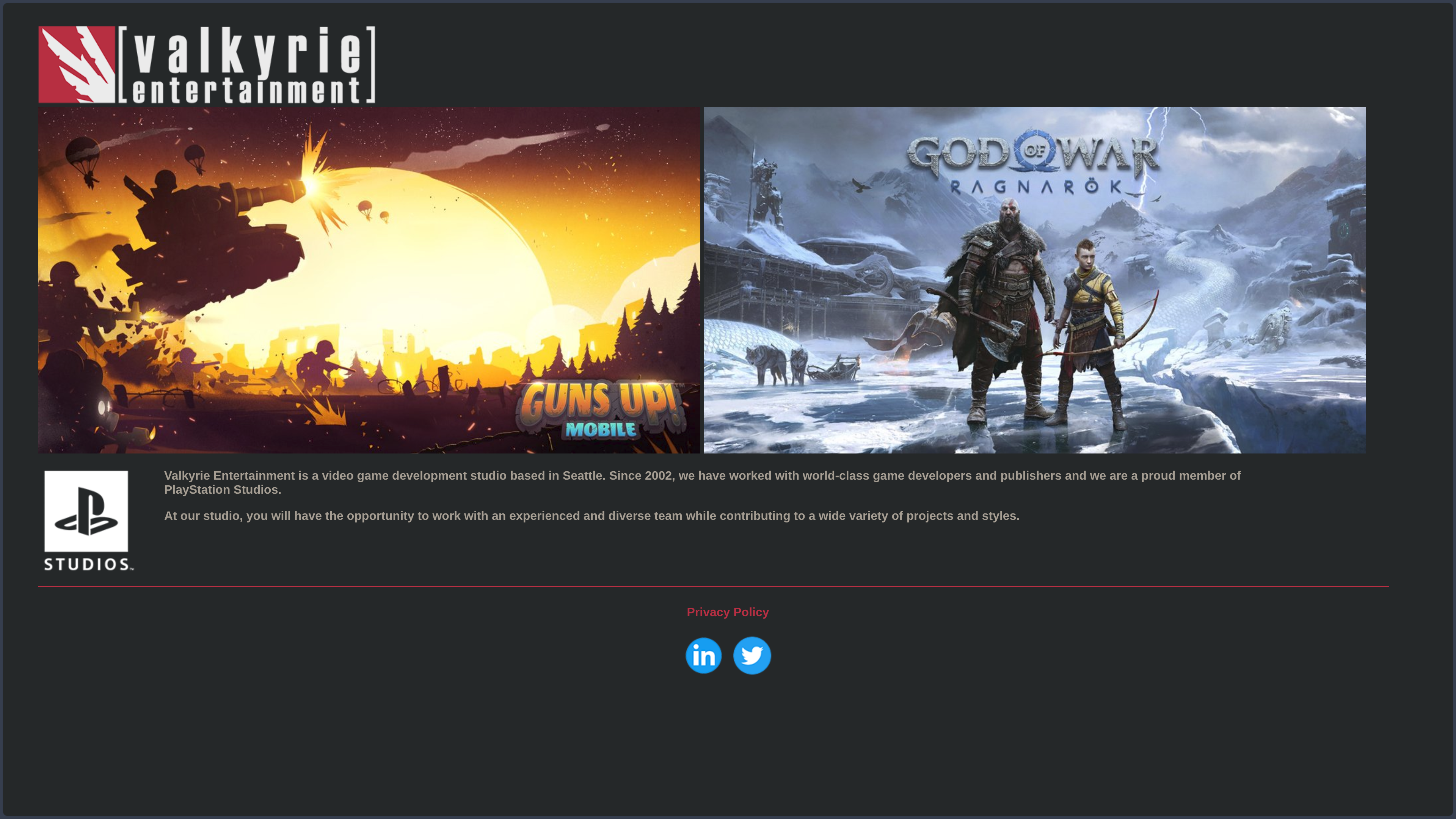
Valkyrie’s official website is remarkably restrained today.

It presents the studio as a development team based in Seattle, active since 2002, part of PlayStation Studios, and accustomed to contributing to a wide variety of projects and styles.

That description almost perfectly matches its history.

Valkyrie does not need to turn every collaboration into a demonstration of its own brand.

Its role succeeds when the final work remains coherent with the vision of the team leading it.

That gives the studio a fairly unusual position in a cultural catalog.

It matters precisely because it reminds us that the visible author of a game is not always the entirety of those who made it.

What sets it apart

Co-development is not a secondary role

The first thing to understand about Valkyrie is that co-development should not be confused with an incidental contribution.

When a team works on a major production for several years, it may entrust a partner with responsibilities that are directly integrated into the development of the game.

That requires more than occasionally providing resources.

The partner must understand the tools, respect technical and artistic standards, communicate with internal teams, and deliver content coherent enough to genuinely belong to the same project.

Sony specifically describes Valkyrie as a team bringing high-level co-development expertise to PlayStation Studios franchises.

That wording helps explain its role: Valkyrie is not positioned next to production.

It works inside production.

Adapting without erasing

An auteur studio can gradually build its own language.

A studio like Valkyrie has to learn the language of others.

That is a particular creative challenge.

Contributing to God of War means respecting what defines the world, characters, art direction, and systems developed around Santa Monica Studio.

Participating in ASTRO BOT requires a completely different sensitivity.

Working around a game like Helldivers 2 involves yet another production context.

The expertise, then, is not about forcing all of these projects into the same Valkyrie method.

It is about fitting Valkyrie into their respective methods.

That adaptability explains why Sony was already emphasizing it during the 2021 acquisition.

Being a specialist without being trapped in one specialty

Some support teams build their reputation around one very specific field: porting, animation, cinematics, visual effects, network infrastructure, or another clearly defined discipline.

Valkyrie has a broader profile.

Sony refers to both content production and co-development, while the studio presents itself as capable of contributing to many different projects and styles.

This generalist profile does not mean a lack of expertise.

It means that the studio’s core expertise may lie precisely in joining very different productions and quickly understanding what each one needs.

A signature that sometimes needs to become invisible

There is an interesting paradox in Valkyrie’s work.

For an auteur studio, being recognizable is often a quality.

For a co-development team, being too recognizable can become a problem.

If part of a game suddenly feels as though it was made by a different team, the collaboration becomes visible for the wrong reasons.

The best work is therefore sometimes the work the player never notices as an outside contribution.

That discretion does not mean the contribution is minor.

It means the teams succeeded in making something that belongs to the same whole.

Valkyrie therefore builds part of its reputation on a fairly unusual form of success: helping a work preserve someone else’s voice.

Modern AAA production is far less solitary than it appears

Valkyrie’s presence within PlayStation Studios also reveals something broader about the current industry.

Large productions now involve major teams, complex technologies, and volumes of content that make collaboration between studios increasingly common.

A work can be primarily developed by one identifiable team while still incorporating the contributions of many partners.

This reality is especially visible in the current PlayStation Studios organization, where teams such as Valkyrie and Nixxes contribute expertise across several productions rather than operating only around a franchise of their own.

The concept of the studio therefore remains relevant.

But it is no longer always enough to explain how a game is actually made.

More than one hundred titles without a central franchise

By the time it was acquired, Valkyrie had already contributed to more than one hundred titles.

That number is remarkable because it is not accompanied by a central franchise known to the wider public such as The Last of Us, Gran Turismo, or God of War.

Valkyrie’s legacy is scattered across the works of others.

That makes its history harder to tell through a simple succession of releases, but far more interesting when looking at the production networks behind games.

The studio represents another way of leaving a mark on the medium.

Not necessarily by creating a universe that everyone will immediately associate with its name.

By becoming one of the teams other creators can trust to help build theirs.

The PlayStation acquisition validates a method more than a catalog

When Sony acquires a studio, the franchises it owns can naturally form an important part of the deal.

In Valkyrie’s case, the 2021 announcement focuses primarily on its capabilities, adaptability, and experience in collaboration.

That is an important difference.

Sony is not mainly looking to acquire “the next Valkyrie game.”

It is integrating the studio itself as an additional capability within the PlayStation Studios network.

That logic is now clearly visible in the way PlayStation presents it: Valkyrie brings its co-development expertise to several major franchises across the organization.

Its main product is therefore almost never a single work.

It is its ability to help several different works come into existence.

Credits become part of cultural history

Finally, Valkyrie reminds us why game credits matter.

A cover, trailer, or marketing campaign naturally highlights a limited number of names.

The credits tell a much larger story.

They reveal partner teams, specialist studios, and collaborations that allowed the project to reach its final form.

For PANACHES CULTURE, a studio like Valkyrie makes it possible to document precisely that dimension.

A work can be linked to its lead developer without forgetting the other organizations that genuinely participated in its creation.

Understanding Valkyrie therefore also means understanding that video game culture is not built only around the most visible studios.

It is also built through the connections between them.

Good to know

  • Valkyrie Entertainment is a development studio based in Seattle, Washington, United States.
  • The studio has been active since 2002.
  • Joakim Wejdemar is its founder and was also its president when Sony announced the acquisition in 2021.
  • Valkyrie specializes in content production and co-development for other studios and publishers.
  • Sony stated in December 2021 that Valkyrie had already contributed to more than one hundred titles since its creation.
  • PlayStation franchises Valkyrie had contributed to before its acquisition included God of War, inFAMOUS, and Twisted Metal.
  • Sony Interactive Entertainment announced an agreement to acquire Valkyrie Entertainment on December 10, 2021.
  • Valkyrie then joined PlayStation Studios as the organization’s announced 17th studio.
  • The studio remains part of PlayStation Studios, and its own official website presents it as such.
  • PlayStation currently describes Valkyrie as a team specializing in co-development for major franchises across its network.
  • The official PlayStation Studios page currently cites ASTRO BOT, Helldivers 2, and God of War among the productions to which Valkyrie has contributed its expertise.
  • Valkyrie is not defined by a single franchise or genre: Sony highlights its experience across console and PC as well as different types of games.
  • Its integration into PlayStation Studios preserves the logic on which its reputation was built: collaborating with several teams rather than operating only around a proprietary production.