
Overview
There is a particular difficulty involved in developing a game based on a world that millions of people already know.
The player arrives before you do.
They know what Hogwarts looks like.
They already have an idea of what a lightsaber should feel like.
They know Buzz Lightyear.
Spider-Man.
Jack Sparrow.
Lightning McQueen.
Sometimes they have spent twenty years with these characters before the first line of code for the game has even been written.
So the problem is not simply:
“How do we make a good game?”
Another question also needs an answer:
“How do we let players enter a world they already know without making them feel as though they are visiting an imitation of it?”
That is probably the best way into Avalanche Software.
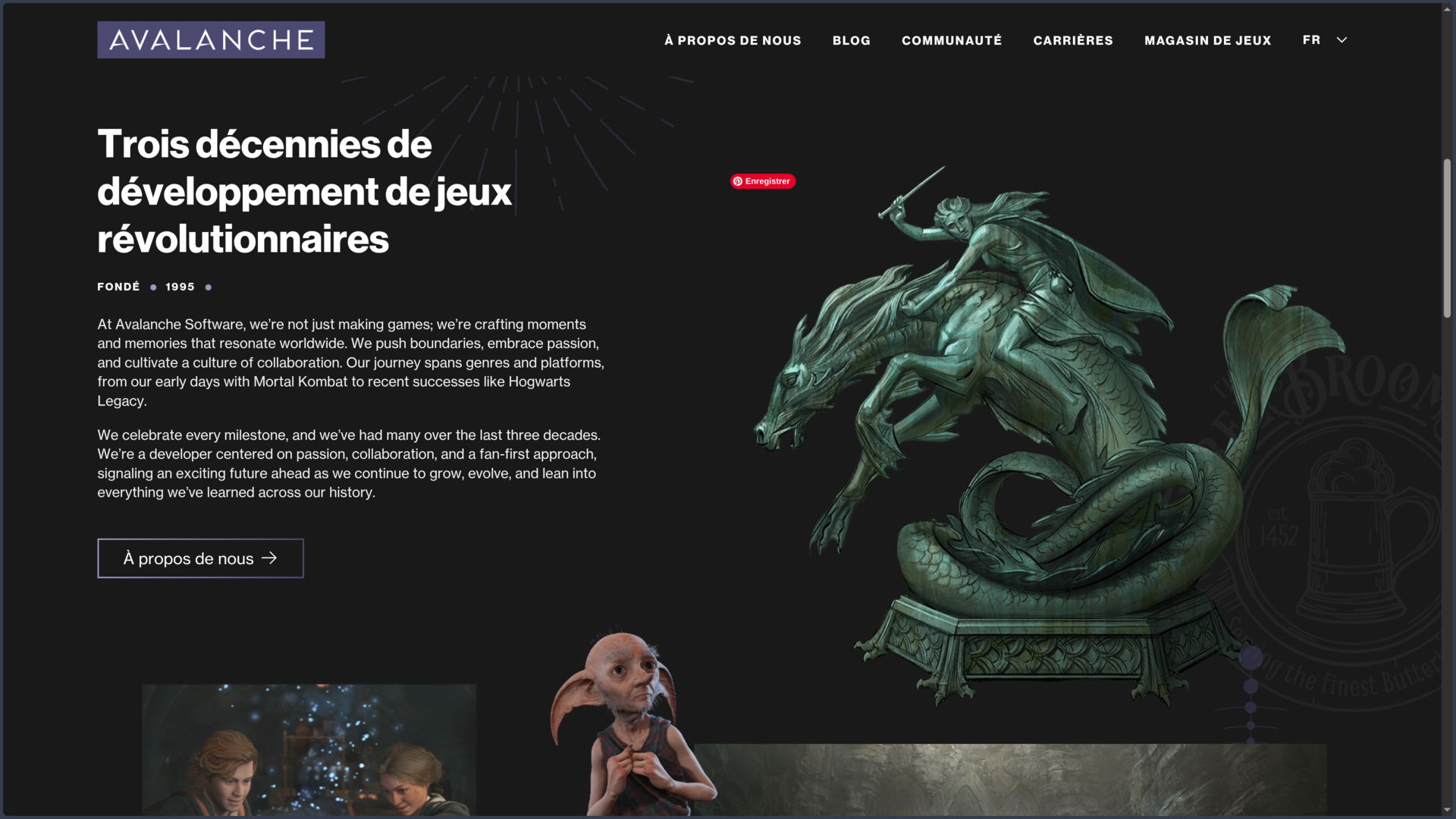
Founded in 1995 in Salt Lake City, Utah, the American studio has crossed more than three decades of video game history and over fifteen platforms.
Its catalogue touches extremely different worlds.
Mortal Kombat.
Tak and the Power of Juju.
Toy Story.
Cars.
Disney.
Pixar.
Marvel.
Star Wars.
And eventually:
Harry Potter and the Wizarding World.
Yet Avalanche did not simply become a workshop tasked with turning popular licenses into video games.
Its history reveals something more interesting.
The studio gradually learned to search for the particular fantasy players associate with each world.
In Disney Infinity, that means being able to mix toys and invent your own worlds.
In Hogwarts Legacy, it means something else.
Not replaying Harry Potter’s story.
Not looking at Hogwarts from the outside.
But entering the castle.
Choosing a house.
Learning spells.
Exploring the corridors.
Traveling to Hogsmeade.
Riding a broom.
And, for a few dozen hours, feeling as though this school exists for us too.
Avalanche itself now uses a revealing expression to describe its approach:
“by fans, for fans.”
Obviously, every studio working on a major license claims to care about its subject.
The difference is therefore not measured by the slogan.
It is measured by what the game chooses to make interactive.
Adapting a world is not only about reproducing what fans recognize. It means understanding what they have always dreamed of being able to do there.
That may be Avalanche Software’s most enduring specialty.
History
1995: a group of friends in Salt Lake City
Avalanche Software was founded in 1995 in Salt Lake City, Utah.
The studio now describes its founders as a small group of friends who made games together.
At the time, obviously, Avalanche was not yet associated with Disney or Warner Bros.
It first had to build experience.
The studio notably worked around the Mortal Kombat series and quickly accumulated productions for different machines.
That beginning already explains an important characteristic of its history.
Avalanche learned to work with:
different technologies;
different platforms;
different constraints;
and worlds it did not necessarily own.
That ability to adapt would become essential.
Because for much of its existence, the studio would not build its identity around one proprietary franchise.
Instead, it would learn to change worlds without completely losing its way of working.
Tak: creating its own playground too
Avalanche did not work only on existing licenses.
The studio also developed Tak and the Power of Juju, an adventure that became one of the creations directly associated with its early years.
Tak evolves in a colorful world mixing platforming, action and humor.
This period is interesting because it shows an Avalanche still quite different from the one the wider public would later know.
The studio did not yet have the scale of Disney Infinity.
Even less that of Hogwarts Legacy.
But it was already accumulating a valuable skill:
building spaces clear and playful enough that players want to move through them rather than merely look at them.
The environment is not only a reference.
It has to become a playground.
2005: entering Disney
In 2005, Avalanche joined Disney Interactive.
This began a period of more than ten years that would deeply shape the studio.
From 2005 to 2016, Avalanche worked on several Disney properties.
For a team specializing in adaptation, the situation was almost an ideal laboratory.
Disney does not own one world.
It owns a huge number of them.
Animation.
Pixar.
Superheroes.
Science fiction.
Historic characters from the brand.
Every franchise has its own visual, narrative and emotional rules.
The studio therefore had to learn how to move from one to another.
And above all:
to quickly understand what gives each one its identity.
Adapting is not copying
The classic trap of the licensed game is fairly simple.
Take a film.
Reproduce its main scenes.
Add a few fights.
A few collectibles.
Then hope that recognizing the characters will be enough.
Avalanche gradually looks for another path.
The important example arrives with Toy Story 3 in 2010.
The game includes a campaign tied to the film.
But it also develops something much freer:
the Toy Box Mode.
The idea almost seems obvious when you think about Toy Story.
Toys exist to be manipulated.
Mixed together.
Moved around.
Placed inside stories their manufacturer did not necessarily imagine.
So why should a Toy Story game only ask the player to follow a predefined scenario?
The Toy Box turns that intuition into a system.
Build.
Modify.
Experiment.
Mix elements.
Invent your own situations.
The player is no longer simply invited to visit the licensed universe.
They can begin to play with it like a real toy box.
That idea would become much more important three years later.
Disney Infinity: what if all the toy boxes could communicate?
In 2013, Avalanche launched Disney Infinity.
This time, the Toy Box concept changed scale.
The game used physical figurines that allowed characters to appear inside the digital experience.
But the most interesting idea was not only technological.
It was cultural.
Disney owns dozens of worlds traditionally separated by rules.
A character belongs to their film.
Their franchise.
Their era.
Their logic.
In a child’s bedroom, that separation does not really exist.
Woody can perfectly well meet a car.
A pirate.
A superhero.
A science-fiction character.
Because a child has no reason to respect the legal organization of a multimedia conglomerate while playing on the living-room carpet.
Disney Infinity turns precisely that childhood logic into a game system.
The Play Sets retain more structured adventures.
The Toy Box opens the borders.
And the concept becomes even more spectacular as the series grows.
Marvel, then Star Wars
Disney Infinity does not remain limited to Disney and Pixar characters.
Disney Infinity 2.0 opens the door widely to Marvel.
Then Disney Infinity 3.0 welcomes Star Wars alongside Disney, Disney-Pixar and Marvel worlds.
Avalanche suddenly has to solve an extremely particular problem.
How do you place in the same ecosystem:
Mickey;
Buzz Lightyear;
Iron Man;
Darth Vader;
Jack Sparrow;
and dozens of other characters,
without the result becoming nothing more than an interactive catalogue of intellectual property?
Once again, the answer comes through play.
The Toy Box provides a space where borders are intentionally flexible.
The crossover stops being an anomaly.
It becomes the rule.
This is probably one of the moments when Avalanche pushes its expertise as a licensed-game studio the furthest.
It no longer has to understand a single world.
It has to build a system capable of welcoming several of them at the same time.
2016: Disney Infinity stops
Then, suddenly:
everything stops.
In May 2016, Disney announces the end of its self-publishing activity on consoles.
Disney Infinity is discontinued.
And Avalanche Software closes.
Around 300 jobs are affected.
The reason goes beyond the studio’s own work.
The toys-to-life market becomes more difficult.
Costs rise.
Disney chooses to change strategy and return to a model based more heavily on licensing its properties to external partners.
For Avalanche, the consequence is much more concrete.
After more than twenty years of existence:
the studio no longer exists.
Its story could perfectly well have ended there.
The video game industry unfortunately has many studios whose final line looks exactly like this.
Closed.
Team scattered.
Logo archived.
End.
For Avalanche, that ending lasts less than a year.
2017: coming back from the dead
In January 2017, Warner Bros. Interactive Entertainment takes over Avalanche Software.
The studio is revived.
It is a fairly rare passage in the history of a creative company.
Avalanche is not simply sold while continuing business as usual.
It closes.
Then reopens.
A studio can lose its offices.
Its teams can begin to scatter.
Its projects can stop.
And yet the name, part of the expertise and enough people can still allow a reconstruction.
Avalanche then joins the Warner Bros. Games family.
The context changes.
The studio’s specialty, however, remains surprisingly relevant.
Warner also owns something Avalanche knows very well:
extremely powerful cultural universes.
Cars 3: an almost perfect transition
The first project of this new period remains, ironically, connected to Disney.
Avalanche develops Cars 3: Driven to Win, tied to the Pixar film.
The situation almost summarizes the transition by itself.
The studio no longer belongs to Disney.
It now belongs to Warner.
But it is still working on a Disney-Pixar universe.
Moving from one home to another therefore does not instantly erase the experience accumulated during the previous decade.
Then comes a project on a completely different scale.
Rebuilding Hogwarts
After joining Warner Bros. Games, Avalanche begins working on what will become Hogwarts Legacy.
The challenge is almost the opposite of Disney Infinity.
Disney Infinity had to bring enormous numbers of worlds together inside one shared system.
Hogwarts Legacy has to take one extremely famous world and give it enough depth for players to genuinely inhabit it.
The studio does not directly adapt the plot of the Harry Potter novels.
The story takes place in the 1800s, long before Harry’s adventures.
That choice creates significant freedom.
Hogwarts must remain Hogwarts.
The Wizarding World must remain recognizable.
But Avalanche can tell a new story.
The player takes the role of a student entering directly into their fifth year and explores the castle, Hogsmeade, the Forbidden Forest and the surrounding regions.
The design question therefore becomes particularly clear:
what has a fan always imagined doing when dreaming about going to Hogwarts?
Choose a house.
Walk through the castle.
Learn spells.
Brew potions.
Discover passages.
Fly on a broom.
Explore.
Meet creatures.
Find what lies behind a door the film never had any reason to open.
Avalanche is therefore no longer merely trying to reproduce familiar images.
The studio has to build the spaces between those images.
The castle as the main character
In Hogwarts Legacy, the real challenge is probably not modeling a large school.
It is making the castle feel as though it had a history before the player arrived and will continue to have one after they leave.
Staircases.
Corridors.
Classrooms.
Portraits.
Animated objects.
Passages.
Courtyards.
Towers.
Libraries.
Small animations the player can completely miss.
The game has to support two perspectives at the same time.
That of the player trying to complete a quest.
And that of the fan slowly walking down a corridor simply because they have waited fifteen years to be able to do it.
That is a fundamental difference.
In many games, the environment serves the objective.
Here, the environment is sometimes the objective.
The player may want to reach a place not because a mission promises a reward, but simply because they recognize its name.
2023: changing scale completely
Hogwarts Legacy is released in 2023.
The result transforms Avalanche’s position within the industry.
The studio, long known mainly for adaptations and Disney Infinity, becomes responsible for one of the year’s biggest commercial successes.
Avalanche now presents Hogwarts Legacy as the best-selling game of 2023 worldwide, based on full-game sales across console and PC.
The success matters on several levels.
Commercially, obviously.
But also for the studio’s image.
Avalanche demonstrates that a team historically associated with family-friendly adaptations and Disney games can carry a large-scale open-world action RPG.
The jump from Disney Infinity to Hogwarts Legacy seems enormous.
And yet there is a fairly clear continuity.
In both cases, Avalanche works to turn a player’s affection for an existing universe into opportunities for interaction.
The language changes.
The scale changes.
The audience changes.
But the fundamental question remains surprisingly similar.
The fan is not only a spectator
Avalanche’s current website repeatedly emphasizes a fan-first approach.
Naturally, that is also corporate language.
But Hogwarts Legacy offers a concrete way to observe what it means.
The game does not ask the player to be Harry Potter.
That is almost the most important decision.
Because the fan’s deeper fantasy is not necessarily:
“I want to reproduce Harry’s story exactly.”
It may be:
“I want to know what would happen to me if that door really existed.”
Create your character.
Choose.
Explore.
Have your own common room.
Develop your skills.
The player does not simply enter a story.
They are given enough space to project their own presence inside the license.
Avalanche had already experimented with this logic in Disney Infinity.
With Hogwarts Legacy, it turns it into a world.
Continuing after launch
Work on Hogwarts Legacy does not stop in 2023.
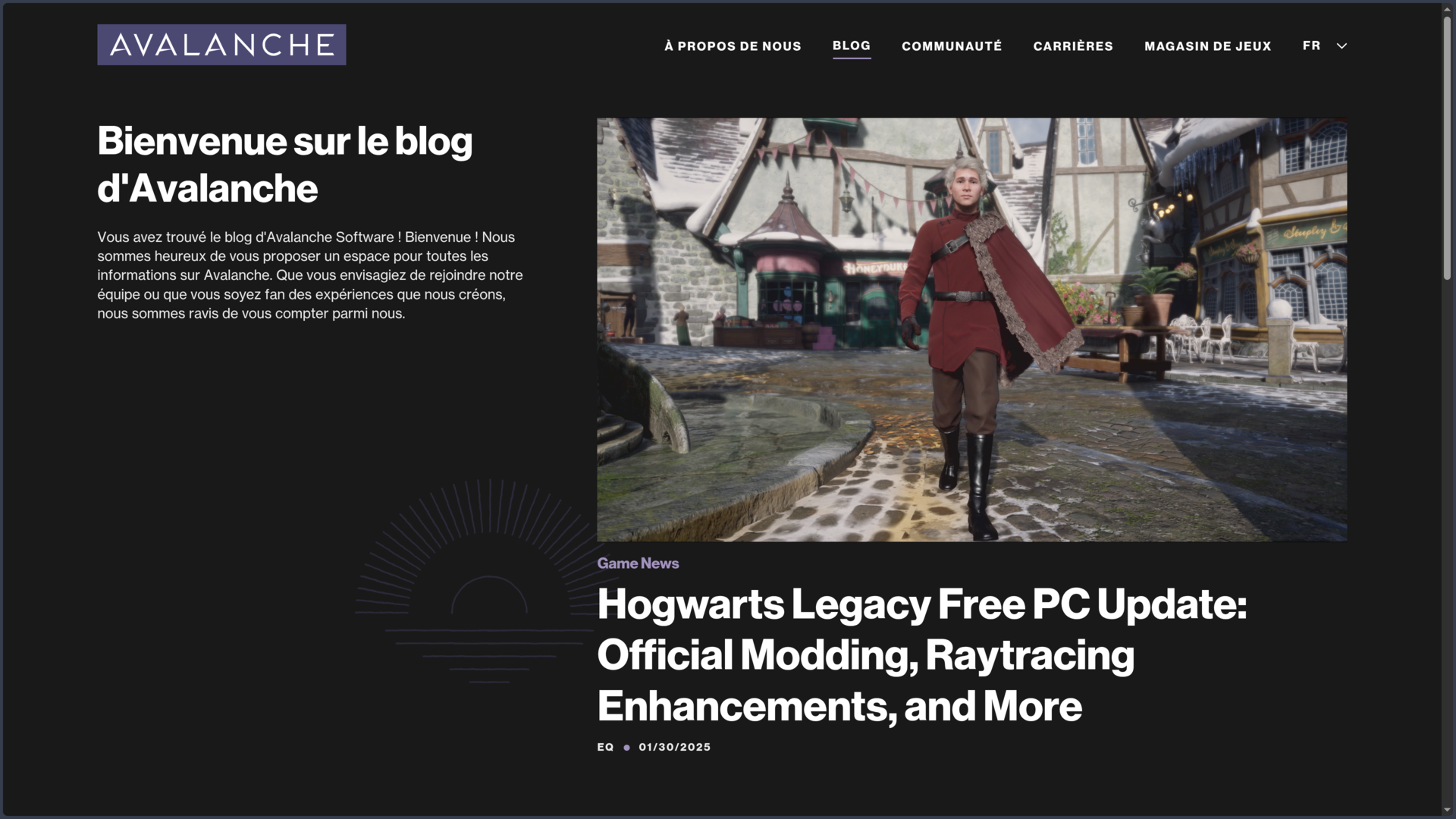
In January 2025, Avalanche notably introduces an official modding system on PC, accompanied by tools allowing players to work on several aspects of the game.
Character customization.
Quest creation.
Dungeon creation.
The change is interesting.
The studio that once built Disney Infinity’s Toy Box now gives players tools to alter its open world more directly.
The technologies and contexts have nothing in common.
But the idea feels related.
Give players a world, then gradually allow them to make something from it that the developer itself did not build.
2025: rebuilding yet another version
In June 2025, Hogwarts Legacy also arrives on Nintendo Switch 2.
Avalanche explains that it chose not to simply reuse the version made for the original Switch.
The team starts again from the assets of the current-generation versions in order to take greater advantage of the new hardware.
Resolution.
Textures.
Lighting.
Crowd density.
Performance.
Loading.
Controls.
The studio tries to bring this version closer to the project’s original vision.
Once again, the detail says something about Avalanche.
A licensed game does not stop being a translation problem after release.
Sometimes the exact same world has to be translated onto a new machine.
And the team has to determine what can be simplified without losing the intended feeling.
2026: thirty years later
In 2026, Avalanche Software is still based in Salt Lake City and remains part of the Warner Bros. Games ecosystem.
The studio continues recruiting across several development disciplines.
Its official website still mainly highlights Hogwarts Legacy and the improvements made to the game.
Avalanche does not publicly specify, on its current website, the nature of its next major project.
That is an important point.
After a success of this scale, rumors are inevitable.
But a PANACHES CULTURE fiche has no reason to turn a rumor into official history several years too early.
What can be said is much simpler.
Thirty years after its creation and ten years after being closed by Disney, Avalanche Software still exists.
That sentence alone is already fairly improbable.
What sets it apart
Inhabiting other people’s worlds
Many studios are immediately associated with worlds of their own.
FromSoftware.
Larian.
Naughty Dog.
Avalanche has a different history.
A huge part of its work consists of entering worlds already loaded with identity.
Disney.
Pixar.
Marvel.
Star Wars.
Wizarding World.
The studio therefore arrives after:
the authors;
the films;
the animators;
the artists;
the fans’ memories.
It does not begin with a blank page.
It begins with a page so full that finding somewhere to write becomes difficult.
Its expertise lies in discovering the interactive space still available inside an existing universe.
That is much more difficult than faithful reproduction.
A license is a translation problem
Adapting a universe from one medium into video games means changing language.
In cinema:
the camera decides where to look.
In a game:
the player can turn right while everyone wanted them to look left.
In a film:
a door can simply remain closed.
In a game:
someone is definitely going to try to open it.
In a novel:
it is enough to write that a city contains hundreds of houses.
In an open world:
some of those houses will actually have to exist.
Video games constantly ask questions the original work had no reason to answer.
What is behind it?
Can we go there?
Can we use that object?
What happens if I refuse?
Avalanche works precisely within that space.
Adaptation is no longer only about respecting what exists.
It has to imagine what exists around it.
Find the fantasy before finding the mechanic
A successful adaptation has to understand what the audience is actually fantasizing about.
For Toy Story, the natural pleasure is playing with toys.
So the Toy Box becomes central.
For Disney Infinity, the fantasy becomes:
what if all my toys could play together?
For Hogwarts Legacy:
what if I were a Hogwarts student myself?
This way of thinking changes the design process.
You do not necessarily begin with:
“We need to make an open world.”
You begin with:
“What does the player dream of doing in this universe?”
Then the genre, systems and structure have to try to make that dream playable.
It is an especially relevant method for licensed games.
Because a fan already carries an emotional expectation before they even know exactly how the combat works.
From Toy Box to open world
There is an interesting continuity between two productions that seem to have almost nothing in common.
Disney Infinity.
Hogwarts Legacy.
The first resembles a deliberately artificial digital toy box.
The second seeks immersion in a coherent world.
But both give a central place to personal exploration.
Disney Infinity says:
“Here are the pieces. Build something.”
Hogwarts Legacy says more:
“Here is the world. Find your place inside it.”
In both cases, the player stops being merely a spectator of a license.
They need to be able to leave a small personal trace inside a universe that existed before them.
The environment has to survive the fan who already knows everything
Working on a famous franchise creates a paradoxical difficulty.
The more the player loves the universe, the more closely they look.
A misplaced window.
Inconsistent architecture.
A creature behaving incorrectly.
A feeling that does not match their memories.
The team therefore cannot rely only on the power of the brand.
The brand also raises the level of expectation.
Avalanche explains that it tries to become expert in whatever subject it is working on.
The statement may seem obvious.
But it describes a considerable amount of work.
Archives.
References.
Architecture.
Objects.
Costumes.
Creatures.
Terminology.
The world’s internal rules.
And sometimes:
spaces nobody had ever represented precisely before.
The more famous a universe is, the less room the developer has to be approximate — and the more it still has to invent.
That is exactly the paradox of adaptation.
A studio capable of changing scale
Avalanche’s industrial evolution is remarkable as well.
Its early productions in the 1990s.
Tak.
Disney games.
Toy Story 3.
Disney Infinity.
Hogwarts Legacy.
These are not only different games.
They are different scales of production.
Different technological generations.
Different audiences.
Different business models.
The studio therefore had to learn how to transform itself several times.
That is often less spectacular than a change in art direction.
But it is essential.
A studio capable of making a good platform game is not automatically capable of managing a modern open world.
Pipelines.
Production.
Animation.
Content.
World streaming.
Narrative.
Performance.
Collaboration with external teams.
Everything changes scale.
Avalanche had to grow with its projects.
Dying does not necessarily mean disappearing
There is finally something very particular about the studio’s history.
Avalanche Software really did close.
In 2016, that is not a metaphor.
Disney ends Disney Infinity and abandons its console self-publishing business.
The studio is closed.
Then Warner Bros. takes it over in 2017 and revives it.
That rupture distinguishes its history from that of a company simply being acquired.
A studio is not only:
a name;
a building;
a legal entity.
It is also an accumulation of skills, relationships, tools, methods and collective memory.
When it closes, that memory immediately begins to scatter.
Avalanche’s reopening shows that part of this identity can sometimes be recovered.
Then rebuilt.
And six years after its revival, the studio releases the most important game in its entire history.
There are story arcs even screenwriters sometimes consider a little too neat.
This one is real.
“By fans, for fans” only matters if it changes the game
Avalanche strongly emphasizes its fan-first culture.
Taken alone, the phrase does not mean much.
A studio is obviously not going to announce:
“We work on licenses nobody here particularly likes.”
What matters is the consequence.
In Hogwarts Legacy, the most effective fan service is not necessarily a reference or a familiar name.
Sometimes it is much simpler.
Being able to walk where you wanted to walk.
Enter a room.
Climb a staircase.
Watch a portrait move.
Find a passage.
Stop for no particular reason and look at the castle.
Faithfulness is no longer only visual.
It becomes spatial and interactive.
The player recognizes the world because they can finally behave inside it the way they had imagined they could.
That is where the motto becomes genuinely interesting.
Good to know
- Avalanche Software was founded in 1995 in Salt Lake City, Utah. The studio describes its founders as a small group of friends who made games together.
- Avalanche Software should not be confused with Avalanche Studios Group, the Swedish company notably associated with Just Cause. The two companies have different histories.
- Avalanche Software states that it has created more than 30 games across more than 15 platforms during its three decades of activity.
- Its early years notably included work around Mortal Kombat, before developing productions and properties such as Tak and the Power of Juju.
- Avalanche was part of Disney Interactive from 2005 to 2016. During this period, the studio adapted several Disney properties and notably developed Toy Story 3 and the Disney Infinity series.
- Toy Story 3’s Toy Box represented an important step toward the philosophy of Disney Infinity, already giving players an open space centered on creation and mixing elements.
- Disney Infinity launched in 2013 and combined physical figurines, Play Sets and a digital Toy Box.
- Disney Infinity 3.0 notably brought together Disney, Disney-Pixar, Marvel and Star Wars universes within the same ecosystem.
- Disney announced the end of Disney Infinity and the closure of Avalanche Software in May 2016, as part of its withdrawal from console game self-publishing.
- The closure affected around 300 jobs.
- Warner Bros. Interactive Entertainment acquired and revived Avalanche Software in January 2017. The studio has since been part of the Warner Bros. Games family.
- Cars 3: Driven to Win was among the first projects completed after this revival, despite belonging to a Disney-Pixar property.
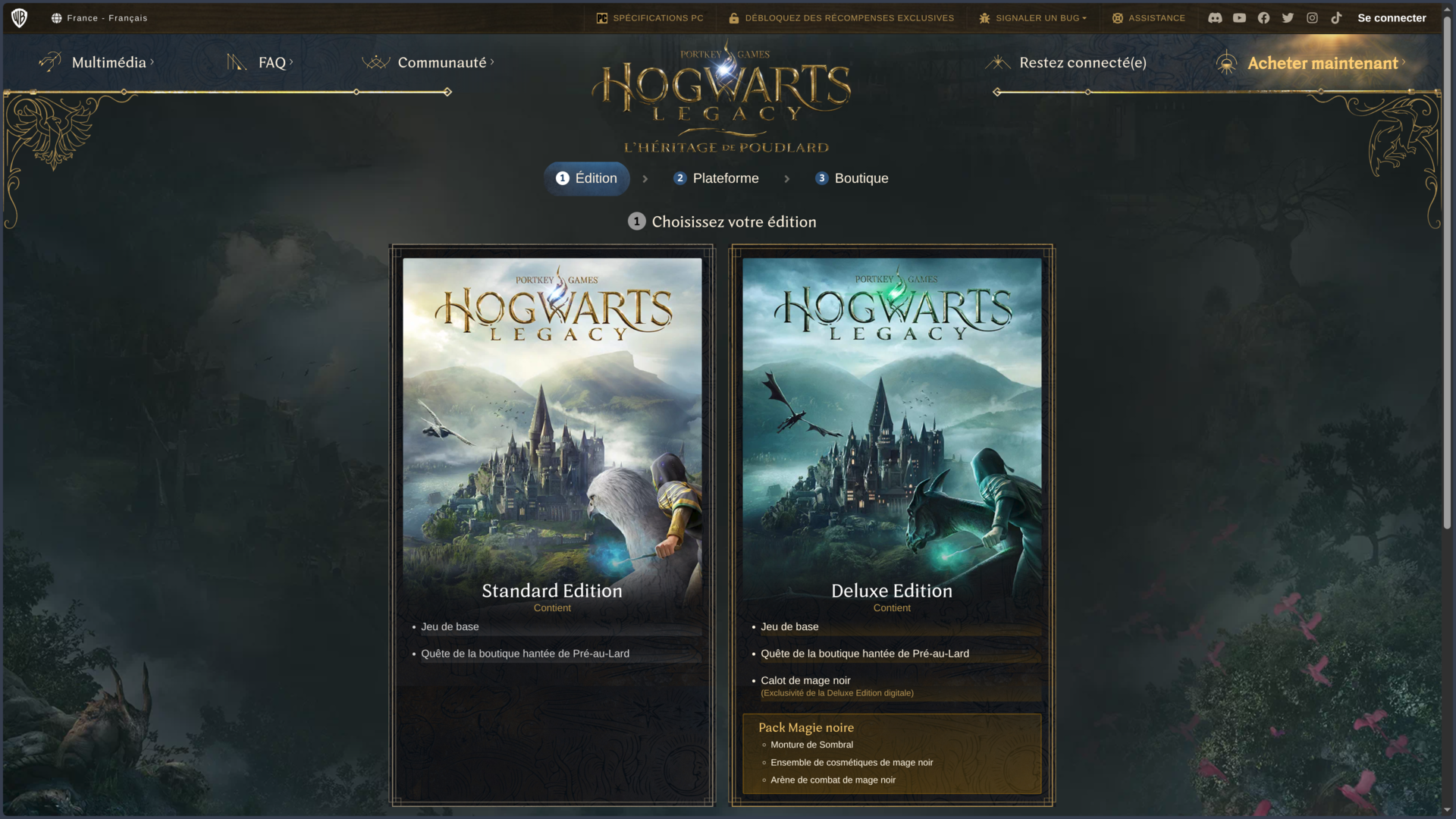
- Hogwarts Legacy was developed by Avalanche Software and published by Warner Bros. Games under the Portkey Games label.
- The game takes place in the Wizarding World of the 1800s, before the main Harry Potter story, and builds an original adventure around a Hogwarts student.
- Hogwarts Legacy was released in 2023 and became the best-selling game of the year worldwide in full-game sales across console and PC, according to Avalanche Software.
- Avalanche describes Hogwarts Legacy as its most ambitious project at the time it joined Warner Bros. Games.
- A January 2025 PC update introduced official modding, including tools for character customization, quest creation and dungeon creation.
- Hogwarts Legacy arrived on Nintendo Switch 2 on June 5, 2025. Avalanche explains that it used assets from the current-generation versions rather than simply adapting the original Nintendo Switch version.
- As of August 2026, Avalanche Software remains active in Salt Lake City and is recruiting across several development disciplines.
- The studio’s current official website does not yet publicly present its next major game. It is therefore preferable not to list an unannounced project based on rumors.