In Principles of Philosophy, first published in Latin in 1644 under the title Principia philosophiae, René Descartes brings together the foundations of his philosophical and scientific system. Building on the reflections developed in Discourse on the Method and Meditations on First Philosophy, he presents the principles of human knowledge before examining the nature of matter, the laws of motion, and the organization of the physical world. The work thus connects metaphysics with the natural sciences through a unified rational investigation. In the preface-letter accompanying the French translation by Abbé Picot, Descartes compares philosophy to a tree whose roots are metaphysics, its trunk physics, and its principal branches medicine, mechanics, and morality. This image expresses his ambition to construct a coherent body of knowledge in which different disciplines progressively contribute to wisdom and the conduct of human life.
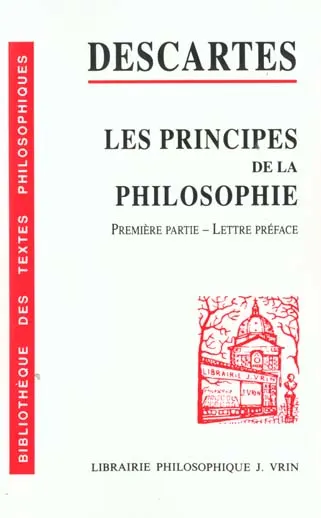
Descartes: Principles of Philosophy
Principles of Philosophy
- Librairie philosophique J. Vrin Publisher
- Hachette Livre Publisher
- F. Alcan Publisher
- René Descartes Author
From the foundations of thought to the laws of the universe, philosophy conceived as a tree of knowledge.
Details
- Type
- Book
- Release
- January 1, 1950
- Original title
- Principles of Philosophy
- Genres
- Philosophy
- ISBN
- 9782711601875
Synopsis
Descartes: Principles of Philosophy
Glossary terms: Certainty, Clear and distinct idea, Condition, Condition, Continuity, Discourse, Existence, Knowledge, Main / main branch, Metaphor, Metaphysics, Methodical doubt, Movement, Part, Particular, Philosophical problem, Philosophy, Publication, Representation, Science, Scientific theory, Story, Subject matter, Title, Treatise, Verse line, Work
Overview
Overview
In Principles of Philosophy, René Descartes sets out to present the foundations of his thought and his conception of the natural world in an organized form. First published in Latin in 1644 under the title Principia philosophiae, the work extends the investigations developed in Discourse on the Method and Meditations on First Philosophy. Descartes seeks to move beyond the presentation of individual philosophical problems and establish a coherent set of principles capable of explaining both the conditions of knowledge and physical phenomena. This ambition accounts for the systematic structure of the treatise, organized into four major parts progressing from metaphysics to the study of nature.
The first part, devoted to the principles of human knowledge, revisits the foundations of Cartesian philosophy. Descartes examines the need to doubt uncertain opinions in order to discover indisputable truths. He returns to the certainty of the thinking subject, the distinction between mind and body, the existence of God, and the criteria for recognizing genuine knowledge. Clear and distinct ideas occupy a central place in this approach: they are intended to provide the understanding with principles sufficiently secure to guide reasoning correctly. Metaphysics thus appears as the indispensable foundation of every science.
The second part establishes the principles of material things. Descartes defines the nature of bodies through extension, meaning their spatial dimensions, and seeks to explain their properties through matter and motion. He examines the general laws governing the movement of bodies, their interactions, and the conditions under which motion is preserved or transferred. His physics rests on a mechanistic conception of nature: phenomena must be understood through the shape, size, arrangement, and motion of the parts of matter. This approach leads Descartes to reject the existence of a true vacuum and to conceive of a universe entirely filled with matter.
The third and fourth parts apply these principles to the explanation of the visible world and the Earth. Descartes proposes a representation of the universe in which the movements of celestial bodies are explained by vast vortices of matter. He examines the formation and behavior of stars, planets, and comets before turning to terrestrial phenomena: the structure of the globe, light, heat, gravity, and the properties of magnets. These explanations rely on the physical hypotheses of his time and differ in several respects from current scientific knowledge. Nevertheless, they demonstrate his determination to apply a limited number of principles to a wide variety of natural phenomena.
The broader significance of the work becomes particularly clear in the preface-letter addressed to his French translator, Abbé Claude Picot. Descartes compares philosophy to a tree whose roots are metaphysics, its trunk physics, and its principal branches medicine, mechanics, and morality. This representation emphasizes both the dependence of the various sciences on fundamental principles and their complementary roles. For Descartes, the purpose of philosophy is not merely to understand the causes of things, but also to develop knowledge useful to human existence. The most complete morality therefore represents the highest degree of wisdom, since it presupposes a thorough understanding of the other disciplines.
Key Takeaways
Philosophy forms a system of interconnected knowledge. Descartes seeks to demonstrate that metaphysics, physics, and applied sciences are not isolated fields. The principles of knowledge must make it possible to establish the general laws of nature, which can then be used to explain particular phenomena and develop practical applications.
Metaphysics provides the foundations of knowledge. The search for certainty rests on methodical doubt, recognition of the thinking subject, and examination of clear and distinct ideas. These principles, already developed in Descartes' earlier works, are presented here as necessary conditions for constructing a systematic philosophy.
Material nature obeys mechanical laws. Descartes defines bodies through extension and explains their transformations through motion and interactions between the parts of matter. This conception rejects explanations based on mysterious qualities and seeks to make natural phenomena intelligible through general physical principles.
Knowledge should lead to practical wisdom. The image of the tree of philosophy expresses a progression from foundational knowledge toward its applications. Medicine, mechanics, and morality represent fields in which fundamental understanding can contribute to improving human life. The most perfect morality constitutes, from this perspective, the culmination of the sciences.
Conclusion
With Principles of Philosophy, René Descartes brings together the essential elements of his intellectual system and establishes continuity between the foundations of knowledge and the study of the physical world. The treatise presents a unified conception of knowledge in which metaphysics determines the general principles and physics seeks to explain natural phenomena through the laws of matter and motion.
The work occupies a central place in the history of modern philosophy and the development of mechanistic conceptions of nature. Although several of its scientific theories have been abandoned, its ambition to connect different disciplines through rational principles remains characteristic of the Cartesian project. The metaphor of the tree expresses this conception of philosophy as an undertaking whose ultimate purpose extends beyond theoretical knowledge toward wisdom and the conduct of life.
Good to Know
- Principles of Philosophy was first published in 1644, in Latin, under the title Principia philosophiae. The French translation by Abbé Claude Picot, published in 1647, was accompanied by a preface-letter written by Descartes.
- The treatise consists of four parts: The Principles of Human Knowledge, The Principles of Material Things, The Visible World, and The Earth. This organization reflects the progression from metaphysical foundations to physical explanations.
- The famous image of the tree of philosophy appears in the preface-letter to the French edition. Its roots represent metaphysics, its trunk physics, and its principal branches medicine, mechanics, and morality.
- Descartes develops a vortex theory to explain the movements of celestial bodies. This historical representation of the universe was progressively replaced by other physical models, notably those derived from Newtonian mechanics.
- The work is dedicated to Elisabeth of Bohemia, with whom Descartes maintained a philosophical correspondence concerning knowledge, freedom, morality, and the relationship between mind and body.
- Different editions do not necessarily reproduce all four parts of the treatise. Certain publications by Librairie philosophique J. Vrin primarily contain the first part, accompanied by the preface-letter or a selection of articles devoted to physics.
Link graph
Open in the full graphLoading the graph…
Only the strongest links are shown.