How does the human body function, and to what extent can its activities be explained through the laws of nature alone? In Treatise on Man, René Descartes develops a mechanistic conception of living organisms by imagining an artificial machine whose organization reproduces that of the human body. Through this thought experiment, he examines digestion, blood circulation, respiration, muscular movement, and the functioning of the senses. He also seeks to understand how mechanisms within the brain contribute to perception, memory, and imagination. By distinguishing bodily functions from those involving thought, Descartes proposes a physiological explanation of living organisms that challenges several traditional conceptions. This unfinished treatise represents an important stage in his investigation into the relationship between body and mind.
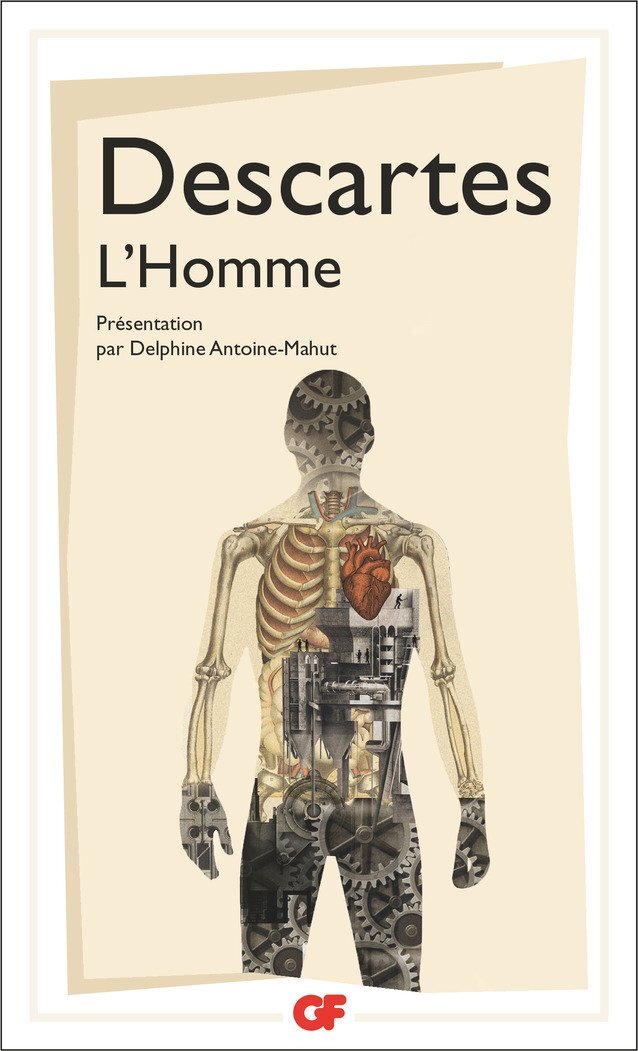
Descartes: Treatise on Man
- Readex Microprint Publisher
- Flammarion Publisher
- René Descartes Author
What if the human body could be understood as a machine governed by the laws of nature?
Details
- Type
- Book
- Original language
- French
- Genres
- Philosophy
- Information verified on
- October 14, 2026
Synopsis
Descartes: Treatise on Man
Glossary terms: Circulation, Ensemble, Function, Function, Hypothesis, Imagination, Mechanical rights, Movement, Part, Particle, Perception, Process, Process, Publication, Publisher, Reflection, Sanguine, Sensation, Set, Set, Simile, Story, Substance, Text, Thought experiment, Title, Tracking (type), Transformation, Treatise, Work
Overview
Overview
In Treatise on Man, René Descartes sets out to explain the functioning of the human body through the laws of mechanics and the properties of matter. Written as an extension of his investigations into nature, the treatise was intended to form part of the larger project known as The World, or Treatise on Light. Descartes seeks to understand the functions of living organisms without systematically relying on traditional explanations based on faculties of the soul or distinct vital principles. His ambition is to demonstrate that bodily phenomena can be studied as natural processes governed by physical causes.
To develop this approach, Descartes imagines a machine made of earth and created by God, resembling the human body in both structure and function. This fictional construction allows him to examine a living organism as an arrangement of parts and mechanisms whose movements can be explained through their material organization. He compares the body to automata, clocks, and artificial fountains, whose effects result from the arrangement of their components. This comparison does not mean that human beings are entirely reducible to machines: its primary purpose is to determine which bodily functions can be explained independently of the intervention of a rational soul.
The treatise examines the principal physiological functions. Descartes describes digestion, the transformation of food, blood circulation, respiration, and nutrition. He pays particular attention to the heart, whose activity he attributes to a mechanism involving heat and the expansion of blood. This explanation belongs to the scientific debates of his time, notably those influenced by William Harvey's research on blood circulation. Although some of his anatomical hypotheses proved incorrect, Descartes attempts to account for organic functions through material processes rather than mysterious forces or purposes inherent in nature.
Another essential aspect of the work concerns the brain, nerves, and bodily movements. Descartes introduces animal spirits, which he conceives as extremely fine material particles circulating through the nervous system. Their movement supposedly explains muscular contraction, responses to certain stimuli, and various involuntary movements. He extends this analysis to the mechanisms of sensory perception, imagination, memory, and sleep. The pineal gland occupies an important place in his model, particularly in coordinating sensory information and movement.
This investigation ultimately raises the question of the relationship between body and mind. Descartes distinguishes the mechanical operations of the organism from activities that require a thinking soul, such as reasoning and willing. By showing that many vital functions can occur without conscious intervention, he contributes to a new understanding of living organisms and automatic behavior. Left unfinished and published after the philosopher's death, Treatise on Man provides an important account of his mechanistic conception of physiology and his ambition to develop a rational science of the human body.
Key Takeaways
The human body can be studied as a natural machine. Descartes maintains that many organic functions result from the arrangement of bodily organs and their material interactions. This mechanistic conception seeks to explain vital phenomena through physical causes without invoking a separate vital principle for each function.
Physiological functions depend on bodily mechanisms. Digestion, respiration, blood circulation, and nutrition are analyzed as processes connected to the organization of living matter. Descartes thus attempts to apply the principles of physics to the study of the body, even though several of his explanations differ from current scientific knowledge.
The nerves and brain play a central role in movement and sensation. Descartes uses the concept of animal spirits to explain the transmission of movement through the nervous system. His model also addresses automatic responses, perception, memory, and imagination, contributing to the history of mechanistic explanations of behavior.
The distinction between bodily functions and thought remains essential. The treatise seeks to demonstrate what the body can accomplish through its material organization alone, without reducing reason and will to mere mechanical movements. This approach belongs to Descartes' broader investigation into the distinction between corporeal substance and thinking substance.
Conclusion
With Treatise on Man, René Descartes develops a mechanistic explanation of the functions of the human body, combining philosophical reflection, anatomical observations, and physiological hypotheses. His analysis of movement, circulation, sensation, and cerebral mechanisms contributes to a transformation in the study of living organisms, which are increasingly approached as systems whose operations can be explained through natural causes.
The treatise occupies a distinctive place in the history of philosophy and the sciences of the body. Despite its unfinished nature and the limitations of its physiological models, it reveals the importance of anatomical research in Cartesian thought and clarifies the relationships between Descartes' conception of matter, his theory of mind, and his project of a unified science of nature.
Good to Know
- Treatise on Man was written in the early 1630s as part of the project known as The World, or Treatise on Light. Descartes originally intended it to contribute to his general explanation of natural phenomena.
- The treatise remained unfinished and was published posthumously. A Latin translation, entitled De homine, appeared in 1662, followed by the French text in 1664, prepared by Claude Clerselier.
- The bodily machine imagined by Descartes is a thought experiment. It allows him to explain certain functions of living organisms without assuming that a soul must constantly intervene to produce organic movements.
- Animal spirits are, in Cartesian physiology, extremely fine material particles believed to circulate through the nerves. This historical hypothesis does not correspond to the functioning of the nervous system as understood by modern neuroscience.
- The pineal gland plays an important role in Descartes' explanations of perception and movement. He would also develop its significance in The Passions of the Soul, which addresses emotions and their regulation more directly.
- The edition published by Flammarion, in the GF collection, was prepared by Delphine Antoine-Mahut. It reproduces historical illustrations, contributions from the earliest editors, and the Treatise on the Formation of the Fetus, which addresses related questions concerning the development of the human body.
Link graph
Open in the full graphLoading the graph…
Only the strongest links are shown.