What does it mean to be human, and how can we give meaning to our existence? In Pensées, Blaise Pascal explores the contradictions of the human condition, divided between greatness and wretchedness, reason and passion, the desire for happiness and the awareness of death. He examines the illusions governing human behavior, the need for diversion, the limits of knowledge, and the difficulties involved in seeking truth. This investigation forms part of a project defending the Christian religion, through which Pascal seeks to demonstrate that faith offers an answer to the contradictions of human existence. Through fragments combining arguments, observations, and meditations, he questions the relationship between reason and the heart, the freedom to believe, and humanity's place in the face of infinity.
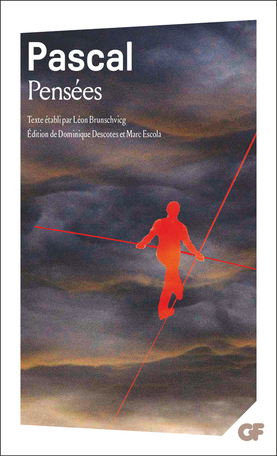
Blaise Pascal: Thoughts
Pensées
- Média Diffusion Publisher
- Gallimard Publisher
- Seuil Publisher
- Le Livre de Poche Publisher
- Pocket Publisher
- Blaise Pascal Author
Between greatness and wretchedness, reason and faith, Pascal explores the contradictions of the human condition.
Details
- Type
- Book
- Release
- 1670
- Original title
- Pensées
- Genres
- Philosophy
- ISBN
- 9782021287721
Synopsis
Blaise Pascal: Thoughts
Overview
Overview
In Pensées, Blaise Pascal develops an extensive investigation into the human condition, knowledge, and religion. The work brings together fragments from an unfinished project of Christian apologetics, intended to show how faith can respond to the fundamental questions of existence. Unlike a philosophical treatise arranged in a definitive progression, the Pensées consist of notes, arguments, meditations, and preliminary reflections. This fragmentary composition reveals the different directions of a thinker seeking to understand human nature before addressing religious questions.
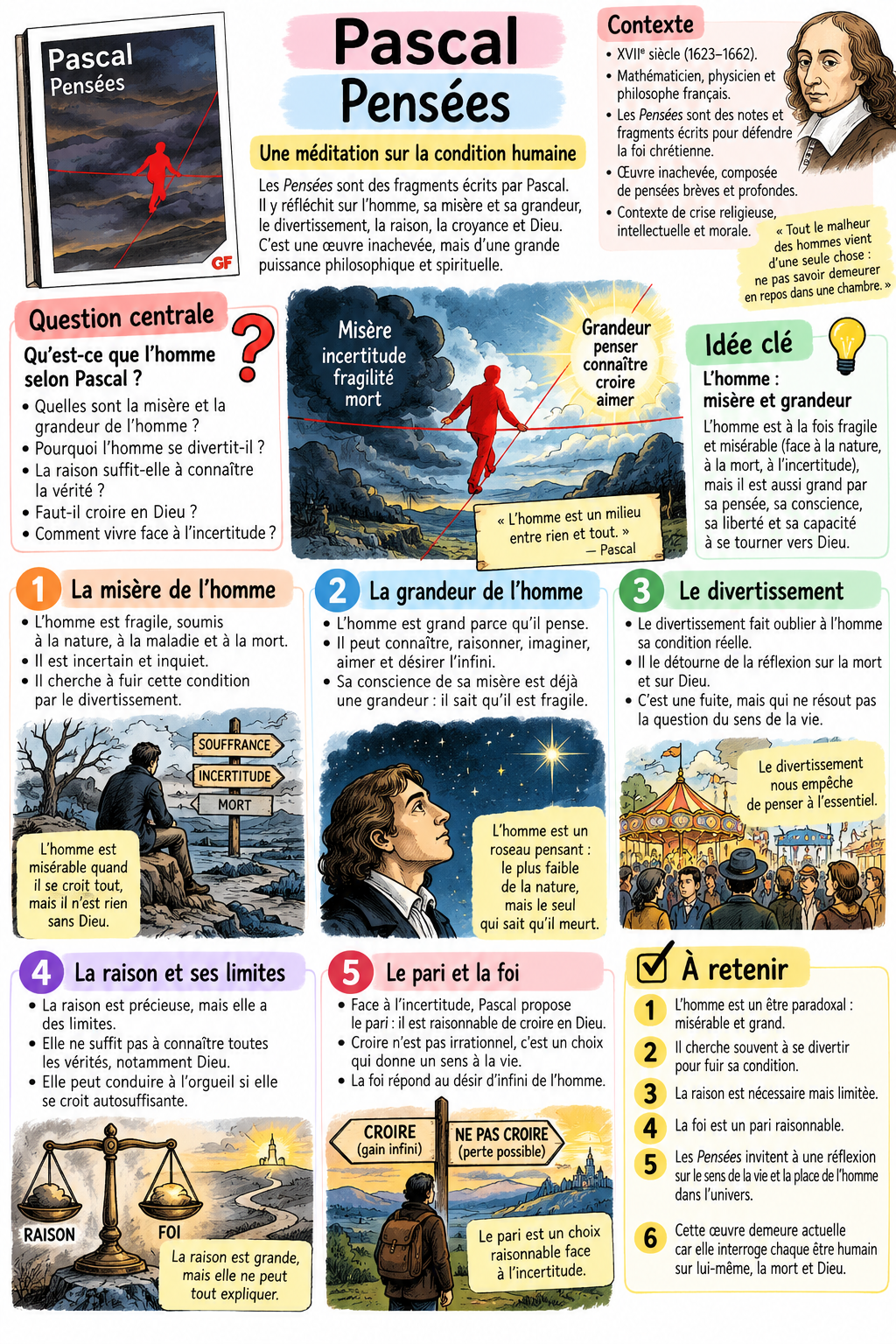
One of the central themes is the contradiction between human greatness and wretchedness. Pascal emphasizes that human beings possess remarkable intellectual capacities: they can reason, observe the world, seek truth, and become aware of their own existence. Yet they remain fragile, subject to passion, error, suffering, and death. This opposition finds expression in the image of the "thinking reed": human beings are physically vulnerable, but their ability to understand their own condition grants them a distinctive dignity.
Pascal also examines the pursuit of happiness and the illusions shaping human behavior. He observes that individuals seek wealth, honors, recognition, or distractions without necessarily achieving lasting satisfaction. This restlessness is explained through the concept of diversion (divertissement), which refers to anything that distracts the mind from confronting its own condition. Human activities thus become ways of escaping boredom, solitude, and awareness of mortality rather than answering the fundamental questions of existence.
This analysis leads to an investigation into the powers and limits of reason. As a mathematician and philosopher, Pascal recognizes the value of demonstration and rigorous reasoning. However, he maintains that reason alone cannot establish every truth or resolve the contradictions of human existence. He therefore gives particular importance to the heart, which notably designates a form of immediate knowledge of first principles and also plays a role in his understanding of faith. This distinction does not reject reason but seeks to clarify its proper domain and limitations.
Finally, the work develops an argument in defense of Christianity. Pascal confronts different philosophical doctrines with the question of happiness and seeks to show that Christianity provides an explanation for both human greatness and wretchedness. He examines historical and religious evidence, the significance of prophecies, and the figure of Jesus Christ. Among his most famous arguments is Pascal's Wager, which approaches religious belief through uncertainty, human choice, and their possible consequences. The overall project places philosophical inquiry within a broader investigation into religious truth and human destiny.
Key Takeaways
One of the fundamental ideas of Pensées lies in the paradox of human greatness and wretchedness. Human beings are capable of thought and knowledge, yet remain limited in both their power and their understanding of the world. Pascal shows that these two dimensions are inseparable: awareness of our weakness itself demonstrates a capacity that distinguishes us from other natural beings.
Diversion constitutes another major concept. Pascal does not refer only to leisure or pleasurable distractions, but to the entire range of activities that allow people to avoid thinking about the fragility of existence. The relentless pursuit of occupations, success, or recognition thus reveals a fundamental difficulty in remaining alone with oneself. This analysis belongs to a broader reflection on the inability of external goods to guarantee lasting happiness.
The distinction between reason and the heart also occupies an essential place. Pascal considers that certain truths rest on immediately recognized principles and cannot be demonstrated through prior propositions. Reason retains its full value within its proper domain, but it cannot claim to encompass all human knowledge. This investigation contributes to his criticism of philosophical systems that grant reason unlimited authority.
Pascal's Wager illustrates another dimension of his thought. Faced with the impossibility of establishing God's existence through a decisive demonstration, Pascal examines the situation of human beings confronted with a choice whose consequences might be infinite. His argument involves uncertainty, self-interest, and decision-making without itself constituting a proof of God's existence.
Finally, the Pensées must be understood in relation to their apologetic purpose. The analyses of vanity, happiness, reason, and the passions are not independent of religious questions. They prepare an investigation in which Pascal presents Christianity as an answer to the fundamental contradictions of the human condition.
Conclusion
With Pensées, Blaise Pascal develops a major investigation into human fragility, the limits of knowledge, and the pursuit of happiness. By confronting human aspirations with the realities of existence, he highlights the tensions between reason and passion, the desire for the absolute and human finitude, intellectual greatness and vulnerability.
The work occupies an essential place in the history of French philosophy and literature. Its fragmentary writing, psychological observations, and questions concerning faith have profoundly influenced reflections on human existence. The Pensées also remain a central testimony to the relationships between philosophy, science, and religion in Pascal's thought.
Good to Know
- The Pensées were first published posthumously in 1670, under the title Pensées de M. Pascal sur la religion et sur quelques autres sujets. This first publication, known as the Port-Royal edition, presented a selection of fragments that had been rearranged and sometimes revised.
- The work originated in an unfinished project of Christian apologetics. Pascal therefore left no definitive version of the complete text, which explains the differences in structure between editions.
- Several systems for arranging the fragments have been established, particularly by Léon Brunschvicg, Louis Lafuma, and Philippe Sellier. Their ordering and numbering differ, making it necessary to specify the edition used when citing a particular passage.
- The famous Pascal's Wager forms part of the Pensées. It employs reasoning about decision-making under uncertainty and occupies a distinctive place in the history of the philosophy of religion.
- The expression "thinking reed" comes from the Pensées. It also inspired the title Man Is a Thinking Reed (L'Homme est un roseau pensant), a separately published selection of fragments that should not be confused with the complete work.