How can words persuade, and what mechanisms make a speech convincing? In Rhetoric, Aristotle examines the means by which a speaker can defend an idea, develop an argument, and influence an audience's judgment. He distinguishes logical reasoning, the credibility of the speaker, and the emotions of listeners, while studying the different forms of discourse used in political and judicial life. His investigation gives particular importance to opinion, probability, and the methods used to construct coherent arguments. By exploring the relationships between language, reason, and persuasion, Aristotle establishes the foundations of a theory of communication and argumentative discourse.
Book
Philosophy
Aristotle: Rhetoric
Rhetoric
- Flammarion Publisher
- Les Belles Lettres Publisher
- RIVAGES Publisher
- Classiques Garnier Publisher
- Gallimard Publisher
- Aristote Author
How can words persuade, stir emotions, and influence human judgment?
Details
- Type
- Book
- Original title
- Rhetoric
- Genres
- Philosophy
- ISBN
- 9782081234451
Synopsis
Aristotle: Rhetoric
Overview
Overview
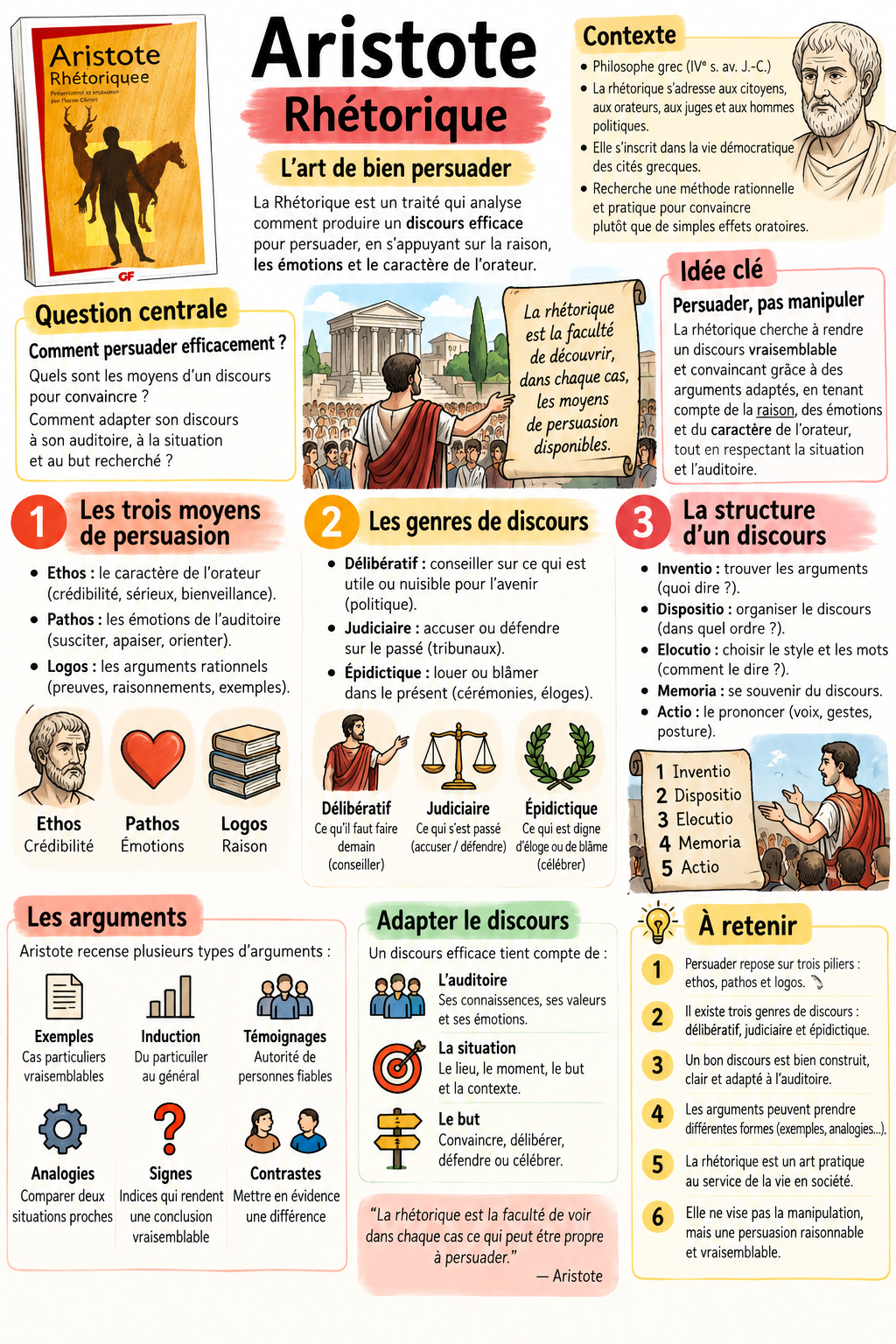
In Rhetoric, Aristotle undertakes an analysis of the mechanisms of persuasion and the role of speech in human relationships. His investigation belongs to the context of the ancient Greek city-state, where political debates, legal proceedings, and public speaking played an important role. Rather than reducing rhetoric to the art of captivating an audience through linguistic effects, he seeks to understand what makes a speech convincing and which principles allow its techniques to be examined.
Aristotle defines rhetoric as the faculty of identifying the available means of persuasion in any given situation. He connects it with dialectic, since both rely on reasoning and apply to questions that do not necessarily belong to a specialized science. Rhetoric operates particularly in areas where decisions depend on opinions, plausible arguments, and specific circumstances rather than absolutely certain demonstrations.
The work distinguishes three major forms of discourse. Deliberative rhetoric concerns future decisions and collective choices, particularly in political life. Judicial rhetoric deals with past actions and aims to accuse or defend. Epideictic rhetoric, finally, centers on praise or blame, emphasizing particular qualities, behaviors, or actions. This classification illustrates how the purposes of a speech vary according to its context and audience.
At the heart of the treatise are the three modes of persuasion: ethos, based on the character and credibility conveyed by the speaker through the discourse; pathos, concerning the emotional dispositions of the audience; and logos, grounded in argumentation. Aristotle examines the enthymeme, a form of reasoning particularly suited to persuasion, as well as the use of examples. He also investigates emotions, their causes, and their influence on judgment.
Composed of three books, Rhetoric also explores questions of style and speech organization. Aristotle considers clarity of expression, word choice, metaphors, and the arrangement of arguments. Persuasion thus emerges as a practice combining reflection, an understanding of the audience, and mastery of language.
Key Takeaways
One of the essential contributions of Rhetoric lies in the distinction between ethos, pathos, and logos. A speech may persuade through the trust inspired by the speaker, the emotions it evokes, or the strength of its arguments. These three dimensions do not necessarily operate independently: they can reinforce one another within the same discourse.
Aristotle also places considerable importance on the enthymeme, which he regards as a major instrument of rhetorical demonstration. Closely related to the syllogism, this form of reasoning often relies on accepted or probable premises. It makes it possible to construct arguments suited to situations in which scientific certainty is not directly available.
The analysis of emotions and opinion constitutes another important aspect of the treatise. Aristotle shows that human judgments do not depend exclusively on rational arguments: anger, fear, compassion, or confidence can alter how an audience receives a speech. Understanding these mechanisms is therefore essential to studying persuasion without reducing it to purely logical demonstration.
Finally, the work emphasizes the importance of how a speech is presented. Clarity, adaptation to the audience, and the organization of arguments all contribute to its effectiveness. This investigation establishes a lasting connection between logic, the psychology of emotion, and the study of language.
Conclusion
With Rhetoric, Aristotle offers a systematic analysis of persuasion as a practice combining reasoning, emotion, and expression. By examining different forms of discourse and the conditions of their effectiveness, he gives rhetoric an important place in philosophical reflection on the relationships between language, opinion, and collective life.
The treatise profoundly influenced the history of oratory, philosophy of language, and argumentation theory. Its fundamental distinctions remain influential in the study of political communication, legal discourse, literature, and the mechanisms of persuasion.
Good to Know
- Rhetoric, also known by its Greek title Technê rhêtorikê, consists of three books devoted to the means of persuasion, emotions, argumentation, and the organization of discourse.
- The concepts of ethos, pathos, and logos refer to three modes of persuasion, not three categories of speech. They are distinct from the deliberative, judicial, and epideictic genres.
- The concept of doxa, generally translated as "opinion," plays an important role in Aristotelian thought concerning reasoning based on commonly accepted beliefs.
- Rhetoric is closely connected to Topics, which examines dialectical reasoning, and Poetics, which explores the principles of representation and literary creation.
- Aristotle distinguishes the study of persuasive techniques from their moral application: the same argumentative resources can serve different intentions.