Presentation
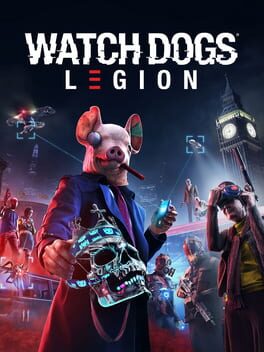
Developed primarily by Ubisoft Toronto and published by Ubisoft, Watch Dogs: Legion was released in 2020 under the creative direction of Clint Hocking, with Kent Hudson serving as Game Director and Sean Crooks as Lead Producer. The third main installment in the franchise abandons the single-protagonist structure used for Aiden Pearce and Marcus Holloway in favor of a system allowing players to recruit and control much of the population.
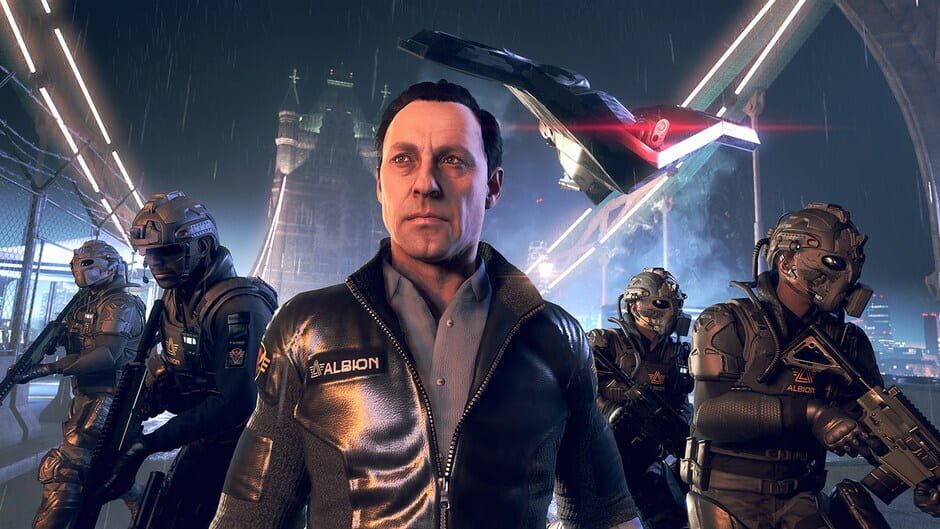
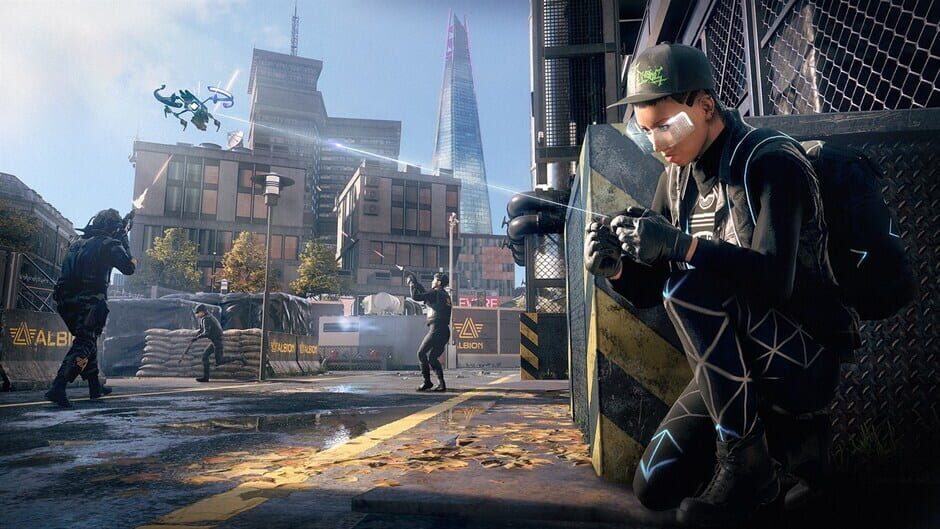
The game takes place in a near-future London profoundly transformed by political, social and technological crises. Following a series of bombings blamed on DedSec, private military company Albion takes a central role in maintaining order, filling the streets with automated controls, drones, checkpoints and surveillance systems.
The open world recreates several recognizable areas and landmarks of the British capital while adapting them to this authoritarian situation. Camden, Westminster, the City of London, Lambeth, Southwark, Tower Hamlets, Islington & Hackney and Nine Elms form the major explorable boroughs, each of which can gradually become more supportive of DedSec.
The central mechanic is the Play as Anyone system. Players do not control a predefined hero but can analyze almost any citizen they encounter, discover their occupation, relationships, abilities and disadvantages, and then attempt to convince them to join the resistance.
Every recruit has different characteristics. A construction worker may have access to a cargo drone, a spy can possess a specialized vehicle and weapons, an IT specialist may have advanced hacking abilities, while other characters can use uniforms to enter certain restricted areas more easily. Choosing an operative therefore directly changes how a mission can be approached.
Recruitment sometimes requires helping the potential operative or someone connected to them. Through the Deep Profiler, DedSec can examine a target's relationships and activities to discover different ways of earning their support. Citizens are therefore not simply interchangeable models: the game assigns them connections, schedules, professions and events that can interact with the player's activities.
Hacking remains at the center of the formula. Cameras, vehicles, security systems, turrets and numerous connected devices can be manipulated remotely. Legion places particular emphasis on drones, which are now widespread throughout Albion-controlled London and can be disabled, hijacked or turned against their owners.
The Spiderbot is one of the major new tools. This small robot can enter difficult spaces, interact with terminals and infiltrate certain facilities without directly exposing an operative. Cargo drones can meanwhile transport objects and even carry characters above the streets, opening access to rooftops and buildings that would otherwise be difficult to reach.
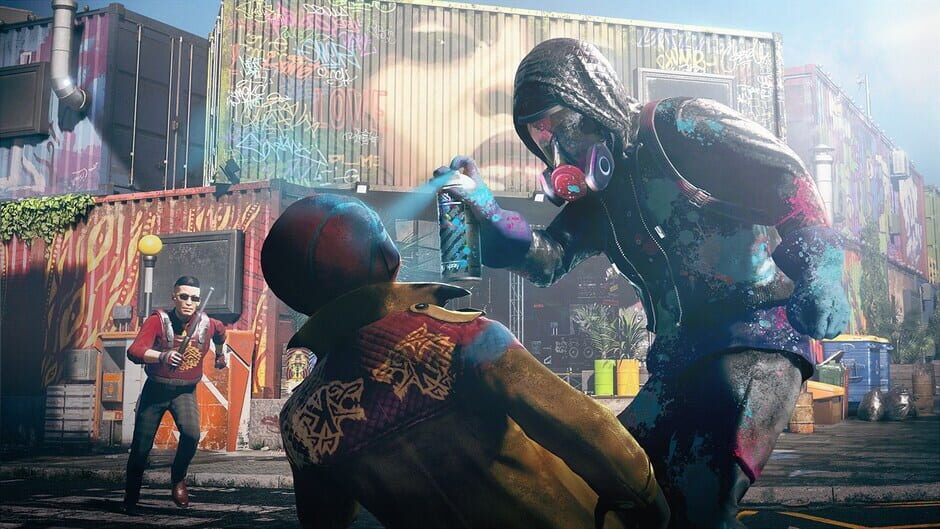
Stealth remains combined with third-person combat. Operatives can use firearms, non-lethal equipment, gadgets and melee attacks. Some possess particular abilities connected to their profession or background, encouraging players to build a team capable of answering different situations rather than developing a single universal character.
Progression relies in part on Tech Points found throughout London. They unlock or improve gadgets, hacking abilities and equipment that can be used by multiple operatives. DedSec's development therefore follows a collective progression system that complements the individual traits of each recruit.
The different boroughs also contain activities that reduce Albion's influence. Sabotage, evidence gathering and other operations increase a district's defiance until a special mission becomes available. Liberating a borough then makes certain activities easier and notably rewards the player with an additional specialized operative.
Watch Dogs: Legion ultimately returns to the technological themes of the series by applying them to artificial intelligence, automated surveillance, data exploitation and privatized security. These questions are directly connected to its recruitment system: the resistance is no longer represented by one exceptional hacker but by a collection of citizens using the same technological infrastructure to gradually reclaim their city.
What to remember
- A near-future London placed under surveillance after bombings blamed on DedSec, with Albion, Zero Day and Clan Kelley among the major forces in the story.
- The Play as Anyone system, allowing players to recruit and control almost any citizen encountered in the open world.
- Operatives with different occupations, abilities, equipment and disadvantages, directly affecting infiltration, combat and traversal options.
- Hacking focused heavily on drones, cameras, turrets, vehicles and security systems, with the Spiderbot serving as a major new tool.
- Collective progression built around recruitment, Tech Points and the gradual liberation of London's different boroughs.
- An evolution of the Watch Dogs formula that replaces a single hero with an entire resistance, assembled according to the profiles and abilities the player needs.
Conclusion
Watch Dogs: Legion changes the structure of the series by deliberately removing its central protagonist. Where Watch Dogs was built around Aiden Pearce and Watch Dogs 2 around Marcus Holloway, Legion makes DedSec itself the true main character and asks players to gradually assemble their own team.
The Play as Anyone system gives the population of the open world a practical purpose. Observing a passerby can reveal a specialist capable of making infiltration easier, a better-equipped fighter or a professional with privileged access to certain facilities. Recruitment therefore becomes directly connected to mission preparation.
This approach also strengthens the systemic nature of hacking. Drones, Spiderbots, cameras, vehicles and security systems allow many actions to be performed remotely, while each operative's particular skills add another layer of possibilities. The same situation can therefore be approached very differently depending on the team's composition.
London supports this design through its boroughs and Albion's constant presence. The city is more than a futuristic backdrop: checkpoints, drones and surveillance networks physically represent the themes of control driving the story while simultaneously providing tools that DedSec can turn against its opponents.
By making almost every citizen a potential recruit, Watch Dogs: Legion delivers the most experimental concept of the first three installments. The system produces a story less centered on one defined hero, but in return develops the idea of a resistance built directly from the city and its population.
Good to know
- Watch Dogs: Legion was developed primarily by Ubisoft Toronto and published by Ubisoft.
- Clint Hocking is credited as Creative Director, Kent Hudson as Game Director and Sean Crooks as Lead Producer.
- The game was released on October 29, 2020 for PlayStation 4, Xbox One, Windows and Stadia; Xbox Series X|S and PlayStation 5 versions followed in November.
- The story takes place in a near-future London where DedSec is blamed for a series of bombings carried out by an organization known as Zero Day.
- The Play as Anyone system allows players to recruit almost any citizen in the open world and use their individual abilities, equipment and characteristics.
- An online mode was added after launch, allowing players to form teams for various cooperative activities.
- The narrative expansion Bloodline, released in 2021, takes place before the main campaign and brings back Aiden Pearce and Wrench as playable characters.
```