Presentation
Breath of the Wild asked the player how far they could go. Tears of the Kingdom adds another question: what can they build to get there?
Hyrule remains immediately recognizable. The same mountains shape the horizon, villages often occupy familiar locations and the major regions retain their identity. Yet the territory is no longer the same.
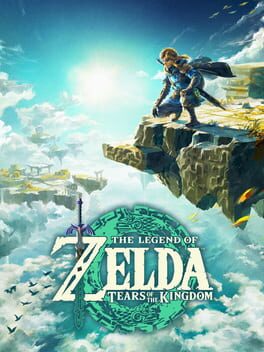
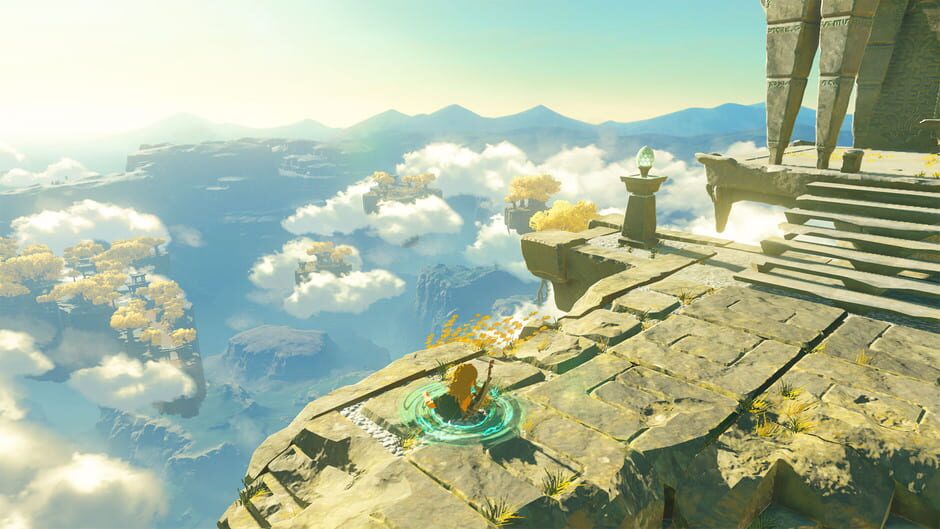
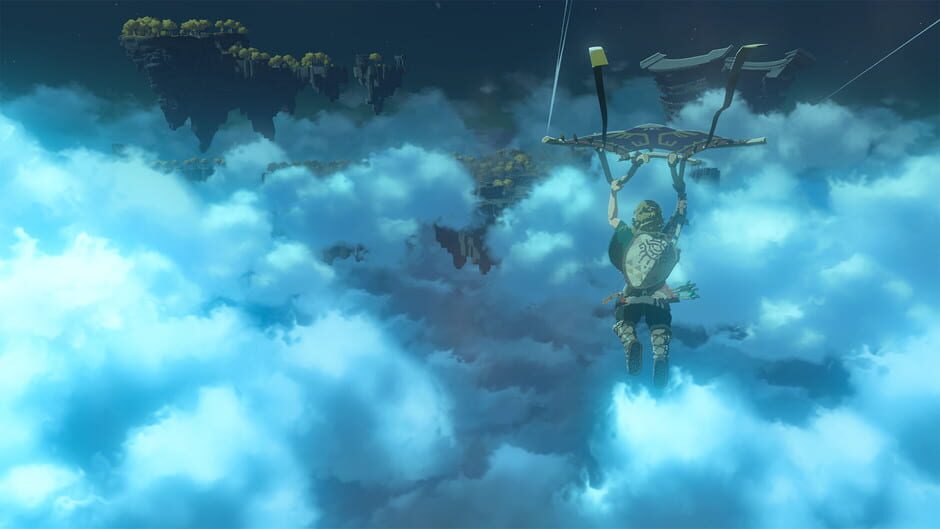
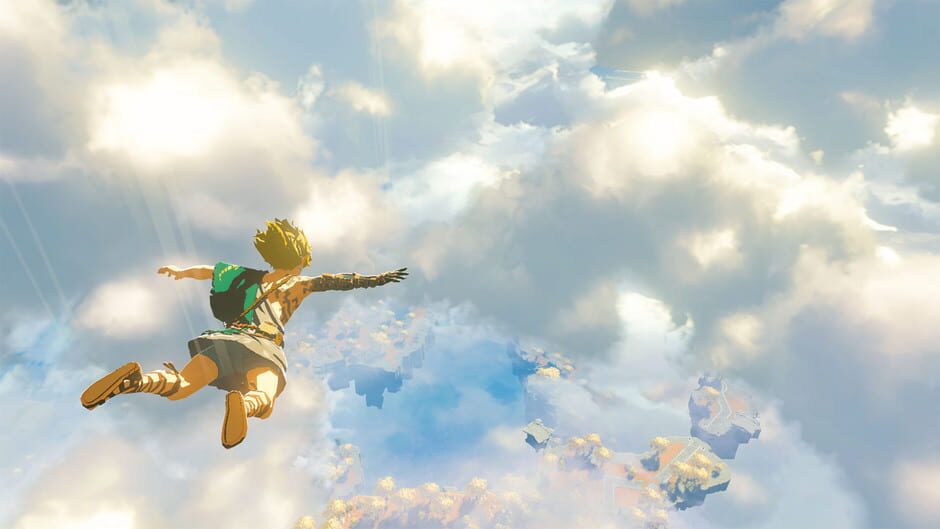
The Upheaval has opened caves, altered familiar locations and carved enormous chasms into the land. Above the kingdom now float entire sky archipelagos. Beneath the surface stretch the Depths, a territory almost completely submerged in darkness.
This structure transforms the map into a vertical space.
The sky contains islands of very different sizes, sometimes occupied by Shrines, mechanisms or ancient structures. Reaching one may require taking advantage of an object fallen from above, using a tower, building a machine or simply studying the geography until a possible route becomes clear.
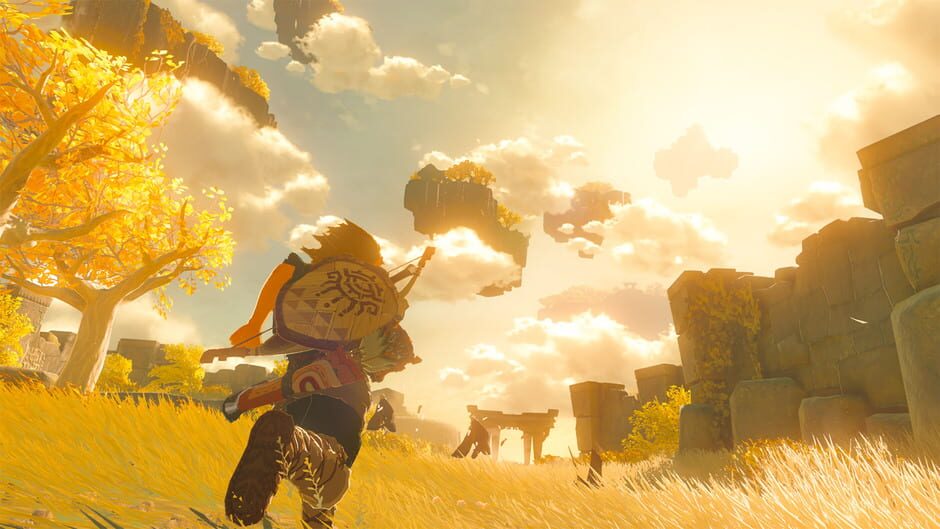
The surface reuses the open world of the previous game but gives familiar places new functions. Locations once known to the player may now serve as entrances to caves, chasms or routes toward the sky. Returning to Hyrule therefore does not simply mean revisiting an old map: the player learns to read it through new dimensions.
The Depths create the opposite effect of the sky.
This immense underground region is almost entirely dark. Brightbloom Seeds gradually illuminate the path, while Lightroots reveal parts of the map. The Gloom covering these areas can temporarily reduce Link’s maximum hearts, giving exploration a more hostile character than on the surface.
But the greatest transformation comes from Link’s new arm and the abilities it grants him.
Ultrahand allows many objects to be grabbed, moved and rotated. More importantly, it allows them to be attached together.
Two planks can become a bridge. A platform and a few wheels can become a vehicle. Fans can turn that construction into a boat or flying machine. The game does not necessarily ask the player to build something elegant: it mainly checks whether the creation performs its intended function.
Zonai Devices greatly expand these possibilities. Wheels, fans, steering sticks, rockets and other mechanisms can be combined with materials found throughout the world. Some constructions survive only a few seconds; others can cross an entire region.
Creation therefore becomes a genuine method of travel.
Fuse applies a similar idea to equipment. Link can combine different materials with weapons, shields or arrows.
A monster horn can strengthen a weapon. A rock attached to a sword creates a tool capable of breaking certain obstacles. A Bomb Flower attached to an arrow turns it into an explosive projectile. Materials found only moments earlier can therefore become immediately useful.
Weapon durability, already present in Breath of the Wild, remains important, but Fuse changes how it is experienced. A relatively ordinary weapon can become effective with the right material, giving greater value to loot obtained from enemies.
Ascend, meanwhile, transforms the relationship with enclosed spaces. When the right conditions are met, Link can pass through the material above him and emerge on an upper surface.
A cave can therefore become a shortcut to the top of a mountain. A room beneath a building can provide an unexpected exit. The player quickly begins looking at ceilings with as much attention as doors.
Recall reverses an object’s movement through time.
A rock that has fallen from a sky island can be sent back upward with Link standing on it. A projectile can return in the direction it came from. A mechanism can be forced to repeat its movement in reverse.
These four abilities share an essential characteristic: they are not limited to puzzles specifically designed around them. They remain available throughout most of the world and can interact with its physics.
Shrines continue this philosophy. Their challenges present more concentrated situations where the player must move, build, fuse or manipulate mechanisms. Many offer an obvious solution, but the systems are open enough for players to sometimes reach the same result in a far less conventional way.
Combat also benefits from this flexibility.
Link retains swords, spears, heavy weapons, bows and shields, along with dodging and parrying. But Fuse turns almost every material into an offensive possibility. Some items add elemental properties, others increase reach or completely change the original function of the equipment.
Ultrahand can also be used to create offensive devices. A construction equipped with certain Zonai Devices can become an improvised combat platform, turret or vehicle capable of attacking while moving.
The game therefore constantly blurs the line between solving a puzzle, moving through the world and fighting.
The main story revisits Hyrule’s major peoples, but their regions have evolved since the previous adventure. Tulin among the Rito, Sidon among the Zora, Yunobo among the Gorons and Riju among the Gerudo now occupy different places within their communities. Link does not return to a world frozen during his absence: its characters have continued to live.
This continuity gives more weight to revisiting familiar locations.
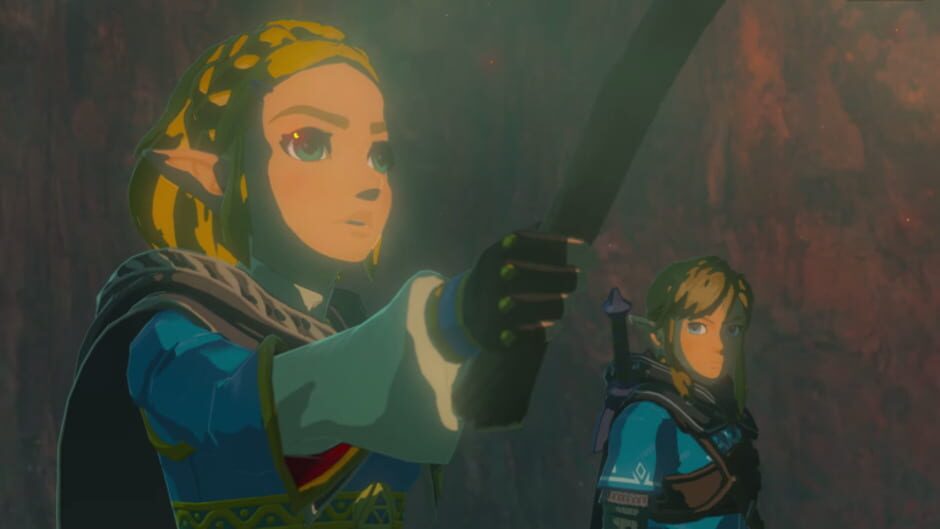
It also allows Tears of the Kingdom to tell the story of Hyrule across several eras. The investigation into Zelda and Ganondorf gradually leads Link toward ancient events, while the present-day kingdom must deal with the immediate consequences of the Upheaval.
The open world nevertheless keeps its central role. Nothing forces the player to constantly follow the story. An island seen in the sky, a chasm, a cave or simply the desire to test a strange construction can pull them away for hours.
The difference is that curiosity is no longer focused only on what the world contains.
It is also about what the player can do with it.
What to remember
- The direct sequel to The Legend of Zelda: Breath of the Wild, set in a Hyrule transformed by a new Upheaval and the return of Ganondorf.
- A world structured between the sky islands, the surface of Hyrule and the vast underground Depths.
- Four central abilities: Ultrahand for moving and attaching objects, Fuse for combining equipment and materials, Ascend for passing upward through surfaces and Recall for reversing the movement of objects.
- Zonai Devices that allow vehicles, machines and devices with highly varied functions to be built.
- Exploration that retains the freedom of Breath of the Wild while placing greater emphasis on verticality and creation.
- Combat where materials, fusions and constructions multiply the ways in which the environment can be used.
- A story that reunites several peoples and characters from the previous game while reaching back toward the origins of an ancient threat to Hyrule.
Conclusion
Tears of the Kingdom could have settled for making Breath of the Wild larger.
Nintendo chooses something more interesting: giving the player more ways to intervene in the world.
A river is no longer simply an obstacle to go around when a boat can be built. A difficult height can be reached with an improvised flying machine. A mediocre weapon can become useful after an unexpected fusion.
The game does not remove constraints. Batteries limit certain constructions, weapons remain fragile, Gloom makes the Depths dangerous and a poorly balanced machine can easily topple only a few seconds after being activated.
That is precisely what gives experimentation its value.
A failed construction is not necessarily wasted time. It shows why the idea did not work and often creates the urge to add a wheel, move a fan or try something completely different.
This freedom also has its drawbacks. The sheer number of possibilities can make some rewards feel less exceptional, and returning to much of the geography of Breath of the Wild cannot recreate the same feeling as discovering Hyrule for the first time. The abundance of activities and systems can also feel almost excessive.
But Tears of the Kingdom compensates by profoundly changing the relationship with this familiar space.
In Breath of the Wild, seeing a point on the horizon made you wonder what was there.
Here, the same point immediately creates a second thought: how am I going to get there?
A bridge, an improbable balloon, a rock moving backward through time or a machine whose design no reasonable person would have approved can all become valid answers.
Hyrule therefore remains a world to explore, but it also becomes an enormous workshop.
And in that workshop, the best solution is not necessarily the one Nintendo imagined first. It is often the one the player has just invented.
Good to know
- The Legend of Zelda: Tears of the Kingdom was developed and published by Nintendo.
- The game was released on May 12, 2023, for Nintendo Switch.
- It is the direct sequel to The Legend of Zelda: Breath of the Wild.
- Exploration now extends across the surface of Hyrule, islands in the sky and the Depths accessible through chasms opened by the Upheaval.
- Link’s four main new abilities are Ultrahand, Fuse, Ascend and Recall.
- Ultrahand notably allows objects and Zonai Devices to be assembled into bridges, vehicles and many other constructions.
- The game retains the open progression of its predecessor while placing much greater emphasis on creation and experimentation with physical systems.